NEET Exam  >  NEET Test  >  Physics Class 11  >  10-MinuteTest: Behaviour of Ideal Gases - NEET MCQ

Behaviour of Ideal Gases - Free MCQ Practice Test with solutions, NEET


MCQ Practice Test & Solutions: 10-MinuteTest: Behaviour of Ideal Gases (10 Questions)

You can prepare effectively for NEET Physics Class 11 with this dedicated MCQ Practice Test (available with solutions) on the important topic of "10-MinuteTest: Behaviour of Ideal Gases". These 10 questions have been designed by the experts with the latest curriculum of NEET 2026, to help you master the concept.

Test Highlights:

  • - Format: Multiple Choice Questions (MCQ)
  • - Duration: 10 minutes
  • - Number of Questions: 10

Sign up on EduRev for free to attempt this test and track your preparation progress.

10-MinuteTest: Behaviour of Ideal Gases - Question 1

In the case of real gases, the equation of state, PV = RT (where P, V and T are respectively the pressure, volume and absolute temperature), is strictly satisfied only if corrections are applied to the measured pressure P and the measured volume V. The corrections for P and V arise respectively due to

Detailed Solution: Question 1

According to kinetic theory of gases there is no intermolecular force of attraction between the molecule of gases but its not true as gases liquifise, at high pressure molecular interaction starts due to which pressure on the walls decreases as molecule dragged back so pressure exerted by real gas is less than ideal gas, due to repulsive forces molecule behave as small spheres and hence volume decreases

10-MinuteTest: Behaviour of Ideal Gases - Question 2

Which one of the following quantities can be zero on an average for the molecules of an ideal gas in equilibrium?

Detailed Solution: Question 2

In case of ideal gases the average velocity is always zero. Hence the average momentum is zero. 
Whereas average speed is non- zero so the kinetic energy is also non-zero,  as these two are scalar quantities.

10-MinuteTest: Behaviour of Ideal Gases - Question 3

Two specific heats of a perfect gas are related by:

Detailed Solution: Question 3

When cp & cv are given calorie & R in Joule then Cp – Cv = (R/J)

10-MinuteTest: Behaviour of Ideal Gases - Question 4

One mole of any substance at any temperature, pressure or volume always contains ________ molecules.

Detailed Solution: Question 4

1 mole = 6.02 x 10²³

10-MinuteTest: Behaviour of Ideal Gases - Question 5

Oxygen and nitrogen in two enclosures have the same mass, volume and pressure. The ratio of the temperature of oxygen to that of nitrogen is:

Detailed Solution: Question 5

For same mass the ratio of moles of oxygen to that of nitrogen is 14:16 = 7:8
And we know that PV = nRT
Hence as V and P are also same, ratio of temperature of oxygen to that of nitrogen is inverse of the ratio of moles that is 8:7

10-MinuteTest: Behaviour of Ideal Gases - Question 6

When the temperature goes up, the pressure inside a rigid container will _____.

Detailed Solution: Question 6

The pressure law states that for a constant volume of gas in a sealed container the temperature of the gas is directly proportional to its pressure. This can be easily understood by visualising the particles of gas in the container moving with a greater energy when the temperature is increased.

10-MinuteTest: Behaviour of Ideal Gases - Question 7

Four moles of an ideal diatomic gas is heated at constant volume from 20° C to 30° C. The molar specific heat of the gas at constant pressure (Cp) is 30.3 Jmol-1K-1 and the universal gas constant (R) is 8.3 Jmol-1K-1. The increase in internal energy of the gas is

Detailed Solution: Question 7

The value of Cp is 30.3
and as Cp-Cv = R(8.3)
hence Cv = 30.3-8.3
Cv is 22
change in internal energy = no of moles × Cv × change in temperature
hence
change in internal energy = 22 × 4 × 10
= 880j
Hence Option D is correct.
 

10-MinuteTest: Behaviour of Ideal Gases - Question 8

A region of the earth’s atmosphere contains n molecules (treated as ideal gas molecules) per unit volume. The temperature of air in the region is T. If k represents Boltzmann’s constant and R represents universal gas constant, the pressure of air in the region is

Detailed Solution: Question 8

PV = nRT
Where n = number of moles = m/NA
So, P = (m/V)(R/NA)T
Also, we know that R/NA = k
So, P = nkT

10-MinuteTest: Behaviour of Ideal Gases - Question 9

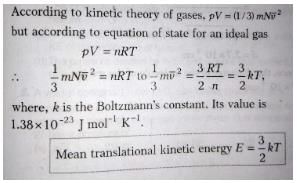
The average kinetic energy of translation of a molecule of an ideal gas at temperature T is:

Detailed Solution: Question 9
10-MinuteTest: Behaviour of Ideal Gases - Question 10

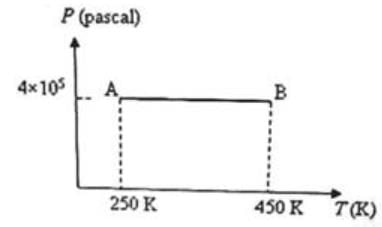
Three moles of an ideal monoatomic gas is initially in the state A shown in the adjoining pressure-temperature graph. It is taken to state B without changing its pressure. If R is the universal gas constant, the work done by the gas in this process is 
Detailed Solution: Question 10

The work done by the gas in taking it from state A to state B = PΔV where ΔW is the increase in volume at constant pressure P. 

We have PV = μRT where p is the number of moles in the sample of the gas and R is the universal gas constant. 

Therefore we have PΔV = μR ΔT = 3 xR(450 - 250) = 600R 

97 videos|376 docs|98 tests
Information about 10-MinuteTest: Behaviour of Ideal Gases Page
In this test you can find the Exam questions for 10-MinuteTest: Behaviour of Ideal Gases solved & explained in the simplest way possible. Besides giving Questions and answers for 10-MinuteTest: Behaviour of Ideal Gases, EduRev gives you an ample number of Online tests for practice
97 videos|376 docs|98 tests
Download as PDF