NEET Exam  >  NEET Test  >  Physics Class 11  >  25-MinuteTest: Projectile Motion - NEET MCQ

Projectile Motion - Free MCQ Practice Test with solutions, NEET Physics


MCQ Practice Test & Solutions: 25-MinuteTest: Projectile Motion (10 Questions)

You can prepare effectively for NEET Physics Class 11 with this dedicated MCQ Practice Test (available with solutions) on the important topic of "25-MinuteTest: Projectile Motion". These 10 questions have been designed by the experts with the latest curriculum of NEET 2026, to help you master the concept.

Test Highlights:

  • - Format: Multiple Choice Questions (MCQ)
  • - Duration: 25 minutes
  • - Number of Questions: 10

Sign up on EduRev for free to attempt this test and track your preparation progress.

25-MinuteTest: Projectile Motion - Question 1

Which one of the following is not an example of projectile?

Detailed Solution: Question 1

A projectile is any object thrown into space upon which the only acting force is gravity. A bullet fired from a gun, a kicked football, and a javelin thrown by an athlete are examples of projectiles once they are in motion and only gravity acts on them. Taking off of an aircraft is not a projectile because it involves continuous external force from the engines.

25-MinuteTest: Projectile Motion - Question 2

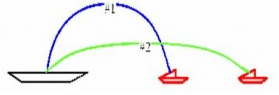
A battle ship simultaneously fires two shells at enemy ships. Both are fired with the same speed but with different directions as shown. If the shells follow the parabolic trajectories shown, which ship gets hit first?
Detailed Solution: Question 2

Ship 2 gets hit first. The time of flight only depends on the y-component of motion, not the x-component.  The higher you throw something up in the air, the more time it spends in the air.  It can also be shown from equation-

y=v0y t – ½ g t2=0  

    v0y for projectile μ1 is greater than for μ2.

25-MinuteTest: Projectile Motion - Question 3

 If an object is dropped through the window of a fast running train. Then

Detailed Solution: Question 3

When an object is still held it is the part of a system in which the train is moving, once it is left it still has the same velocity as the train for a person from ground. Thus as the velocity is horizontal and acceleration is vertical, it would follow a parabolic trajectory.

25-MinuteTest: Projectile Motion - Question 4

Which statement is true for a ball thrown at 20 degrees with the horizontal, when it is at the highest point in its trajectory?

Detailed Solution: Question 4
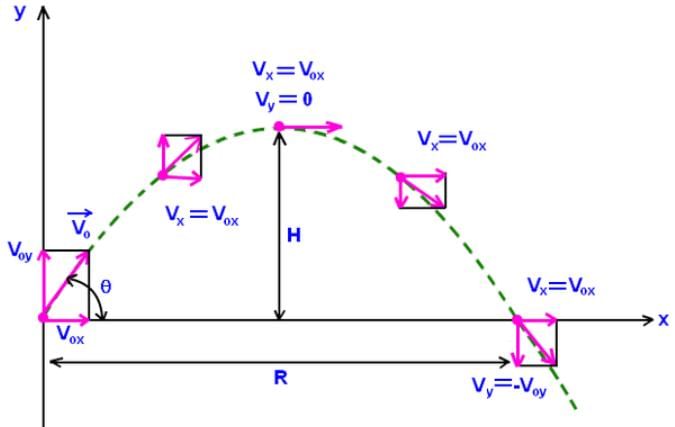

At the highest point in its trajectory, the acceleration (g) is acting in downward direction, whereas velocity of the projectile is only in the X (horizontal) direction.

25-MinuteTest: Projectile Motion - Question 5

 How many directions are possible for the same horizontal range?

Detailed Solution: Question 5

We know that the horizontal range for any projectile motion let say R = 2u2.sin 2a /g
Where u is initial speed, and a is the angle at which the particle is thrown, which is responsible for direction. So in between the possible range of a that is 0 - 90, there are maximum two equal values of sin 2a, thus the maximum number of directions for the same or equal range are 2.

25-MinuteTest: Projectile Motion - Question 6

A body is thrown with a velocity of 10m/s at an angle of 60 degrees with the horizontal. Its velocity at the highest point is: 

Detailed Solution: Question 6

At the highest point, its vertical velocity will become zero. Hence the only left velocity is horizontal which remains unchanged and is equal to 10 cos 60 = 5m/s

25-MinuteTest: Projectile Motion - Question 7

The quantity which remains unchanged during the flight of an oblique projectile is

Detailed Solution: Question 7

As there is no horizontal acceleration is present in oblique projection horizontal component of velocity is constant

25-MinuteTest: Projectile Motion - Question 8

At the point of maximum height, the acceleration is:

Detailed Solution: Question 8

At a point of maximum height, the derivative of displacement i.e. velocity is zero but as the gravitational acceleration is equal at all near points to the surface of earth, acceleration at maximum height is still equal to g.

25-MinuteTest: Projectile Motion - Question 9

At what angle should a projectile with initial velocity ‘v’ be thrown, so that it achieves its maximum range?

Detailed Solution: Question 9

Sine of an angle has maximum value 1 when the angle is 90 degree Rmaxis obtained when 2ø = 90 degreeorø= 45 degree

25-MinuteTest: Projectile Motion - Question 10

When a projectile is thrown up at an angle θ to the ground, the time taken by it to rise and to fall are related as

Detailed Solution: Question 10

Let the initial speed be u. The vertical component of initial velocity is u‑sinθ, and the acceleration is g downward.

Time of ascent (time to reach maximum height) is found from v = u‑sinθ - g t with final vertical velocity v = 0, giving t1 = (u‑sinθ)/g.

The maximum height is h = (u2 sin2θ)/(2g). Time to fall from this height to the launch level is t2 = √(2h/g) = (u‑sinθ)/g, so t2 = t1.

Therefore, when the projectile returns to the same vertical level from which it was projected, the times of rise and fall are equal. If the launch and landing heights are different, the rise and fall times are not generally equal.

97 videos|376 docs|98 tests
Information about 25-MinuteTest: Projectile Motion Page
In this test you can find the Exam questions for 25-MinuteTest: Projectile Motion solved & explained in the simplest way possible. Besides giving Questions and answers for 25-MinuteTest: Projectile Motion, EduRev gives you an ample number of Online tests for practice
97 videos|376 docs|98 tests
Download as PDF