AIBE Exam  >  AIBE Test  >   (All India Bar Exam) Mock Test Series  >  AIBE (All India Bar Exam) Mock Test- 1 - AIBE MCQ

AIBE (All India Bar Exam) Mock Test- 1 Free Online Test 2026


Full Mock Test & Solutions: AIBE (All India Bar Exam) Mock Test- 1 (100 Questions)

You can boost your AIBE 2026 exam preparation with this AIBE (All India Bar Exam) Mock Test- 1 (available with detailed solutions).. This mock test has been designed with the analysis of important topics, recent trends of the exam, and previous year questions of the last 3-years. All the questions have been designed to mirror the official pattern of AIBE 2026 exam, helping you build speed, accuracy as per the actual exam.

Mock Test Highlights:

  • - Format: Multiple Choice Questions (MCQ)
  • - Duration: 210 minutes
  • - Total Questions: 100
  • - Analysis: Detailed Solutions & Performance Insights

Sign up on EduRev for free and get access to these mock tests, get your All India Rank, and identify your weak areas to improve your marks & rank in the actual exam.

AIBE (All India Bar Exam) Mock Test- 1 - Question 1

What must be proven for a trademark to be considered inherently distinctive?

Detailed Solution: Question 1

For a trademark to be considered inherently distinctive, it must not require secondary meaning to be recognized as such. Inherently distinctive marks, like fanciful or arbitrary marks, are recognized immediately as identifiers of source without needing evidence of consumer recognition.

AIBE (All India Bar Exam) Mock Test- 1 - Question 2

What is the commencement date of the Land Acquisition Act, 1894?

Detailed Solution: Question 2

The Land Acquisition Act, 1894 received assent on 2 February 1894 and came into force on 1 March 1894 as per the commencement provision of the Act. This date marks when the law became operative across British India.

AIBE (All India Bar Exam) Mock Test- 1 - Question 3

According to Section 3, which of the following is NOT included in the definition of "land"?

Detailed Solution: Question 3

Section 3(a) defines "land" to include benefits arising from land, things attached to the earth, and things permanently fastened to things attached to the earth. Movable property is expressly excluded from this inclusive definition of land.

AIBE (All India Bar Exam) Mock Test- 1 - Question 4

What is the significance of public documents such as a company's Memorandum and Articles of Association being registered with the Registrar of Companies?

Detailed Solution: Question 4

The registration of a company's Memorandum and Articles of Association with the Registrar of Companies transforms them into public documents. This means that any member of the public has the right to view and inspect these documents, ensuring transparency and accountability within the corporate structure. This accessibility allows potential investors, creditors, and other stakeholders to verify a company's operations and governance.

AIBE (All India Bar Exam) Mock Test- 1 - Question 5

Which statement best describes the implications of the Doctrine of Indoor Management for organizations lending to a company?

Detailed Solution: Question 5

The Doctrine of Indoor Management implies that organizations lending to a company can rely on the validity of publicly recorded documents without needing to verify internal compliance with every detail of internal procedures. This principle simplifies commercial lending and promotes smoother transactions, as it allows lenders to engage with companies without the burden of exhaustive internal scrutiny.

AIBE (All India Bar Exam) Mock Test- 1 - Question 6

Which principle ensures that administrative decisions must avoid arbitrariness?

Detailed Solution: Question 6

The Wednesbury principle is the key concept that mandates administrative decisions to avoid arbitrariness, bias, or bad faith. It requires that decisions be reasonable and justifiable within the legal context, ensuring that actions taken by administrative authorities are fair and not capricious.

AIBE (All India Bar Exam) Mock Test- 1 - Question 7

Who first prominently used the phrase 'Public Law Litigation'?

Detailed Solution: Question 7

Abram Chayes, an American legal scholar, first prominently introduced and developed the concept of 'Public Law Litigation' in his 1976 Harvard Law Review article, describing a new model of litigation involving institutional reform and public policy issues. This framework significantly influenced the evolution of Public Interest Litigation in India during the 1980s.

AIBE (All India Bar Exam) Mock Test- 1 - Question 8

Public Interest Litigation in India can be broadly defined as:

Detailed Solution: Question 8

PIL in India refers to litigation initiated for the enforcement of public interest, particularly rights of disadvantaged sections who cannot approach courts themselves. It focuses on collective or diffuse rights rather than individual grievances, expanding access to justice beyond traditional private disputes.

AIBE (All India Bar Exam) Mock Test- 1 - Question 9

Which provision of the Code of Civil Procedure, 1908 deals with settlement through alternative dispute resolution including mediation?

Detailed Solution: Question 9

Section 89 of the CPC empowers courts to refer suitable civil disputes to ADR mechanisms such as mediation, conciliation, arbitration, or Lok Adalat if settlement appears possible. This provision supports out-of-court resolution and aligns with the spirit of expeditious justice, though it is distinct from PIL mechanisms.

AIBE (All India Bar Exam) Mock Test- 1 - Question 10

Which of the following activities is explicitly included under the definition of "Industry" as per the Industrial Disputes (Amendment) Act, 1982?

Detailed Solution: Question 10

The definition of "Industry" encompasses promotional activities related to sales or business by an establishment, highlighting the organized effort to meet human needs. In contrast, agricultural operations and educational institutions are explicitly excluded from this definition.

AIBE (All India Bar Exam) Mock Test- 1 - Question 11

What major change did the Constitution (101st Amendment) Act, 2016 introduce?

Detailed Solution: Question 11

The Constitution (101st Amendment) Act, 2016 was pivotal in integrating various indirect taxes into a single Goods and Services Tax (GST) system. This amendment aimed to simplify the tax structure in India, facilitating easier compliance for businesses and enhancing the overall efficiency of tax collection. An important outcome of this integration is the reduction of cascading taxes, which has benefitted consumers.

AIBE (All India Bar Exam) Mock Test- 1 - Question 12

What is the primary significance of the neighbor principle established in Donoghue v. Stevenson?

Detailed Solution: Question 12

The neighbor principle defined in Donoghue v. Stevenson broadens the scope of who can claim damages in negligence cases, indicating that individuals who are closely and directly affected by another's actions are owed a duty of care. This principle is foundational in tort law because it clarifies that the duty of care extends beyond contractual obligations, allowing consumers to seek compensation for injuries caused by defective products.

AIBE (All India Bar Exam) Mock Test- 1 - Question 13

Under Section 106 of the Indian Evidence Act, who has the burden of proof concerning facts especially within their knowledge?

Detailed Solution: Question 13

Section 106 states that when a fact is especially within the knowledge of one party, that party has the burden of proving that fact. This provision ensures fairness, as it requires the party with the best access to the relevant information to provide proof of it.

AIBE (All India Bar Exam) Mock Test- 1 - Question 14

What was the outcome of the judicial proceedings in the case of Pakala Narayana Swami v King Emperor at the Sessions Judge in Berhampur?

Detailed Solution: Question 14

The Sessions Judge in Berhampur convicted the accused of murder, resulting in a death sentence in the case of Pakala Narayana Swami v King Emperor. This verdict marked a significant moment in the legal battle surrounding the incident.

AIBE (All India Bar Exam) Mock Test- 1 - Question 15

According to the Allahabad High Court ruling, which scenario does not invoke the right of pre-emption?

Detailed Solution: Question 15

The Allahabad High Court ruled that when a husband transfers property to his wife in exchange for dower, it is classified as a sale. Consequently, this situation does not allow for the exercise of the pre-emptive right of Shufaa, highlighting the specific contexts in which this right applies and reinforcing its legal boundaries.

AIBE (All India Bar Exam) Mock Test- 1 - Question 16

Under which circumstance does a minor’s domicile not change with that of their parent?

Detailed Solution: Question 16

A minor's domicile remains unaffected by the parent's change of domicile if the minor is married. This reflects the legal principle that marriage grants a person a separate legal identity and residence, distinguishing their domicile from that of their parents.

AIBE (All India Bar Exam) Mock Test- 1 - Question 17

What is the primary purpose of a quasi-contract?

Detailed Solution: Question 17

A quasi-contract is designed to prevent unjust enrichment, ensuring that one party does not benefit unfairly at the expense of another, even in the absence of a formal contract. This legal obligation arises from the necessity to uphold fairness and justice in various situations.

AIBE (All India Bar Exam) Mock Test- 1 - Question 18

What is a notable case that illustrates the principle of implied indemnity?

Detailed Solution: Question 18

The case of Simpson v. Thomson illustrates the principle of implied indemnity, where the indemnifier may be entitled to the rights of the indemnity holder once they fulfill their obligations. This case highlights how indemnity can arise from the circumstances surrounding a contract, even if not explicitly stated.

AIBE (All India Bar Exam) Mock Test- 1 - Question 19

What must be provided to a civil servant before their dismissal, according to Article 311?

Detailed Solution: Question 19

Article 311 mandates that civil servants must be given a reasonable opportunity to respond to the charges against them before dismissal, ensuring that they can defend themselves against any allegations. This process aligns with the principles of natural justice.

AIBE (All India Bar Exam) Mock Test- 1 - Question 20

What are some grounds on which the Supreme Court may transfer a case?

Detailed Solution: Question 20

The Supreme Court can transfer cases based on several grounds, including recommendations from superior judicial officers and requests from trial courts. These measures ensure that the legal process is upheld and that cases are managed in a manner that promotes fairness and justice. The goal is to address situations where the integrity of the trial may be compromised, thus safeguarding the rights of all parties involved.

AIBE (All India Bar Exam) Mock Test- 1 - Question 21

In the Civil Procedure Code (CPC), under what circumstances are alterations to a judgment permissible?

Detailed Solution: Question 21

Alterations to a judgment in the Civil Procedure Code (CPC) are primarily allowed for arithmetical or clerical errors and errors resulting from accidental slips or omissions. These changes are intended to rectify mistakes such as numerical inaccuracies, basic mathematical errors, or essential details that may have been inadvertently overlooked. It is crucial to ensure the accuracy and integrity of legal documents and proceedings by addressing these specific types of errors.

AIBE (All India Bar Exam) Mock Test- 1 - Question 22

In legal proceedings, what does setting aside an ex-parte order typically involve?

Detailed Solution: Question 22

Setting aside an ex-parte order in legal proceedings often involves allowing the absent party to challenge the order under specific legal provisions. This process ensures fairness by providing an opportunity for the absent party to present reasons for their non-appearance and seek a reversal of the decision.

AIBE (All India Bar Exam) Mock Test- 1 - Question 23

In an interpleader suit, what does Order XXXV Rule 4 allow the court to do at the first hearing?

Detailed Solution: Question 23

Order XXXV Rule 4 grants the court the authority, during the initial hearing of an interpleader suit, to absolve the plaintiff from all liabilities and responsibilities. If the court determines that the plaintiff is not at fault or involved in the dispute, they can release the plaintiff from the case, award them their costs, and dismiss the lawsuit. This provision ensures that the plaintiff is not wrongfully burdened with ongoing legal proceedings when they are not implicated in the conflict.

AIBE (All India Bar Exam) Mock Test- 1 - Question 24

Which of the following statement(s) is/are incorrect?

(a) In Keshavananda Bharati case, the Supreme Court has said that the Preamble to the Constitution is a key to open the mind of the makers.

(b) "Socialist and Secular" words were added to the Preamble by 44th amendment of the Constitution.

(c) Preamble can only be amended if it violates the basic structure of the Constitution.

(d) Since Preamble is not Article so it is not part of the Constitution.

Detailed Solution: Question 24

The correct answer is '(b) and (d) are incorrect'

Explanation

  • In Keshavananda Bharati case:
    • The Supreme Court stated that the Preamble to the Constitution is a key to open the mind of the makers, reflecting the philosophy and fundamental values of the Constitution.
  • 44th Amendment:
    • The words "Socialist" and "Secular" were added to the Preamble by the 42nd Amendment of the Constitution, not the 44th Amendment.
  • Preamble and Basic Structure:
    • The Preamble can be amended, but it should not alter the basic structure of the Constitution, as established by the Supreme Court in the Keshavananda Bharati case.
  • Preamble as part of the Constitution:
    • The Preamble is an integral part of the Constitution, as affirmed by the Supreme Court in the Berubari case and later reiterated in the Keshavananda Bharati case.

Other Related Points

  • 42nd Amendment:
    • The 42nd Amendment of 1976 is known as the "Mini-Constitution" due to the extensive changes it made, including the addition of the terms "Socialist" and "Secular" to the Preamble.
  • Basic Structure Doctrine:
    • The basic structure doctrine ensures that certain fundamental features of the Constitution cannot be altered by amendments, safeguarding the core principles of the Constitution.
  • Preamble's Legal Status:
    • While the Preamble is not enforceable in a court of law, it provides a guiding light for interpreting the Constitution and understanding its objectives.

AIBE (All India Bar Exam) Mock Test- 1 - Question 25

Which of the following offence(s) is/are not punishable with death as one of the punishment?

A. Kidnapping for Ransom etc.

B. Sedition

C. Attempt to Murder by a person under sentence of imprisonment for life, if hurt is caused

D. Murder

E. Wagging war against the Government of India

Choose the correct answer from the options given below:

Detailed Solution: Question 25

The correct answer is Option 3.

Explanation

  • Offences and Death Penalty:

    • A. Kidnapping for Ransom etc.:

      • Under Section 364A of the Indian Penal Code (IPC), kidnapping for ransom is punishable with death or life imprisonment and fine.
    • B. Sedition:

      • Sedition, under Section 124A of the IPC, is not punishable with death. The maximum punishment for sedition is life imprisonment along with a fine.
    • C. Attempt to Murder by a person under sentence of imprisonment for life, if hurt is caused:

      • Under Section 307 of the IPC, attempt to murder by a person under sentence of imprisonment for life, if hurt is caused, is punishable with death or life imprisonment.
    • D. Murder:

      • Under Section 302 of the IPC, murder is punishable with death or life imprisonment and a fine.
    • E. Waging war against the Government of India:

      • Under Section 121 of the IPC, waging war against the Government of India is punishable with death or life imprisonment and a fine.

Other Related Points

  • Option 1 (A and B only):

    • Incorrect because sedition is not punishable with death, while kidnapping for ransom can be.
  • Option 2 (B and C only):

    • Incorrect because the attempt to murder by a person under a life sentence can be punishable with death.
  • Option 3 (B only):
  • Correct because sedition is not punishable with death
  • Option 4 (B and E only):

    • Incorrect because waging war against the Government of India is punishable with death.

AIBE (All India Bar Exam) Mock Test- 1 - Question 26

Arrange the following judgements on Torts in Chronological order:

(a) Ashby v/s White

(b) MC Mehta v/s Union of India

(c) Reyland Vs Fletcher

(d) Donoghue v/s Stevenson

Choose the correct option:

Detailed Solution: Question 26

The correct answer is Option 2

Explanation

Ashby v/s White

Year: 1703
Summary: This case established the principle that a violation of a legal right invited compensation, even if no actual damage was suffered. In this case, the plaintiff was wrongfully prevented from voting in a parliamentary election, which was deemed a violation of his legal right [1].
Reyland [Rylands] v Fletcher

Year: 1868
Summary: This landmark decision is known for establishing the rule in Rylands v Fletcher, which states that a person who brings onto his land and keeps there anything likely to do mischief if it escapes is liable for all the direct damage which results from its escape. It's a foundational case for the law concerning nuisance and negligence [2].
Donoghue v/s Stevenson

Year: 1932
Summary: Perhaps one of the most famous tort cases, this established the modern concept of negligence, laying down the principle that individuals owe a duty of care to others. In this case, Mrs. Donoghue found a decomposed snail in a bottle of ginger beer, leading to the establishment of the 'neighbour principle' [3].
MC Mehta v/s Union of India

Year: 1987
Summary: A significant case in Indian environmental law, part of the series of MC Mehta cases. It expanded the doctrine of “Absolute Liability” for harm caused by hazardous and inherently dangerous industries. This decision was pivotal for environmental jurisprudence in India [4].
Based on the years these judgments were rendered, the correct chronological order is:

  • Ashby v/s White (1703)
  • Reyland [Rylands] v Fletcher (1868)
  • Donoghue v/s Stevenson (1932)
  • MC Mehta v/s Union of India (1987)

This sequence reflects the development of tort law over the centuries, starting from the basic recognition of legal rights, through the establishment of negligence and duty of care, to the principle of absolute liability for inherently dangerous industries.

Therefore, option 2 is correct, which lists the cases in their chronological order as:

(a) Ashby v/s White
(c) Reyland [Rylands] v Fletcher
(d) Donoghue v/s Stevenson
(b) MC Mehta v/s Union of India
This selection clearly represents the evolution of tort law principles from the early 18th century through the late 20th century.

AIBE (All India Bar Exam) Mock Test- 1 - Question 27

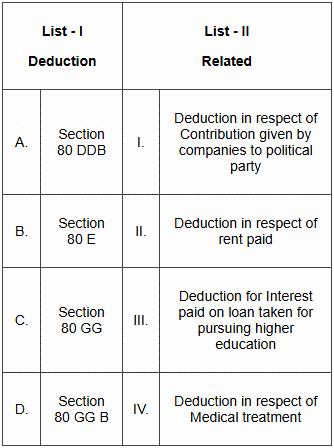
Match List - I with List - II.

Choose the correct answer from the options given below:

Detailed Solution: Question 27

The correct answer is 'A - IV, B - III, C - II, D - I'.

Explanation

  • Section 80 DDB (A) matches with Deduction in respect of Medical treatment (IV).
    • Section 80 DDB allows for a deduction on the expenses incurred for medical treatment of specified diseases.
    • The deduction is available to the taxpayer for themselves or their dependents.
    • This section is particularly beneficial for individuals facing high medical costs due to serious illnesses.
    • The amount of deduction is subject to certain limits specified under the Income Tax Act.
  • Section 80 E (B) matches with Deduction for Interest paid on loan taken for pursuing higher education (III).
    • Section 80 E provides a deduction for the interest paid on education loans taken for higher studies.
    • The deduction is available for a maximum of 8 years or until the interest is fully paid, whichever is earlier.
    • This benefit is applicable for loans taken for higher education of the taxpayer, spouse, children, or a student for whom the taxpayer is a legal guardian.
    • There is no upper limit on the amount of interest that can be claimed as a deduction under this section.
  • Section 80 GG (C) matches with Deduction in respect of rent paid (II).
    • Section 80 GG allows for a deduction on the rent paid by individuals who do not receive House Rent Allowance (HRA) from their employer.
    • The deduction is subject to certain conditions, including that the taxpayer or their spouse/child should not own residential accommodation at the place of employment.
    • The amount of deduction is calculated based on specific criteria, including rent paid and total income.
    • This deduction is beneficial for self-employed individuals or salaried employees who do not get HRA.
  • Section 80 GGB (D) matches with Deduction in respect of Contribution given by companies to political party (I).
    • Section 80 GGB allows companies to claim a deduction for contributions made to political parties or electoral trusts.
    • This deduction is available for any sum contributed by a company to a political party registered under section 29A of the Representation of the People Act, 1951.
    • The contribution must be made through a non-cash mode such as cheque, bank draft, or electronic transfer.
    • This provision encourages corporate donations to political parties and ensures transparency in political funding.

AIBE (All India Bar Exam) Mock Test- 1 - Question 28

Consider the following statements in reference to the President of India.

1. Article 53 of the Constitution of India mentions that the executive power of the Union shall be vested in the President.

2. The President shall hold office for a term of five years from the date on which he enters his office.

3. Article 60 of the Constitution of India mentions the procedure for the impeachment of the President.

Which of the statements given above is/are correct?

Detailed Solution: Question 28

The correct answer is 1 and 2 only.

Explanation

  • President of India.
    • Article 53 of the Constitution of India mentions that the executive power of the Union shall be vested in the President. Hence statement 1 is correct.
    • The President shall hold office for a term of five years from the date on which he enters upon his office. Hence statement 2 is correct.
    • Article 61 of the Constitution of India mentions the procedure for the impeachment of the President. Hence statement 3 is not correct.

Other Related Points

  • PRESIDENT
    • The President of India is elected by indirect election, As far as practicable, there shall be uniformity of representation of the different States at the election, according to the population and the total number of elected members of the Legislative Assembly of each State, and parity shall also be maintained between the States as a whole and the Union [Art. 55].
    • This second condition seeks to ensure that the votes of the States, in the aggregate, in the electoral college for the election of the President, shall be equal to that of the people of the country as a whole.
    • In this way, the President shall be a representative of the nation as wen as a representative of the people In the different States.
      • It also gives recognition to the status of the States in the federal system.
    • The system of indirect election was criticized by some as falling short of the democratic ideal underlying universal franchise, but indirect election was supported by the framers of the Constitution, on the following grounds.

AIBE (All India Bar Exam) Mock Test- 1 - Question 29

Part IV of the Indian constitution provides for ____________.

Detailed Solution: Question 29
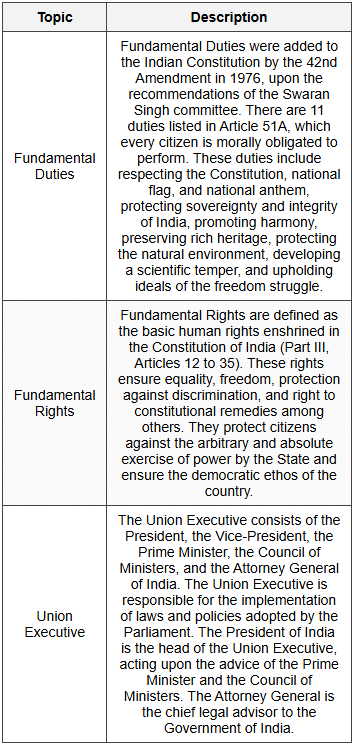
The correct answer is Directive Principles of State policy.

Explanation

  • Part IV (Article 36-51) of the Indian Constitution is related to Directive Principles of our State Policy.
  • It is not enforceable by any court but these are fundamental in the governance of the country.
  • It is the duty of the government to apply these principles in law-making.
  • These principles have been taken from the Constitution of Ireland.

Other Related Points

AIBE (All India Bar Exam) Mock Test- 1 - Question 30

Which of the following is correct as per the Motor Vehicles Act, 1988?
A. Section 140 of the Motor Vehicles Act, 1988 deals with the principle of No Fault Liability
B. United Indian Insurance Ltd v. Karamchand (2011) deals with third parties
C. Doctrine of pay and recover is covered under Section 149 of the Motor Vehicles Act, 1988
D. As per Section 173 of Motor Vehicles Act, 1988, an appeal to High Court from the award of Motor Accident Claim Tribunal to be preferred within 60 days from the date of the award.
Choose the correct answer from the options given below:

Detailed Solution: Question 30

The correct answer is 1) A, C and D only.

Explanation of Statements as per the Motor Vehicles Act, 1988

  • Section 140 of the Motor Vehicles Act, 1988
    • Deals with the principle of No Fault Liability. Hence statement A is correct.
  • United Indian Insurance Ltd v. Karamchand (2011)
    • This case deal with third parties in the context provided. Hence statement B is correct.
  • Section 149 of the Motor Vehicles Act, 1988
    • Covers the doctrine of pay and recover. Hence statement C is correct.
  • Section 173 of the Motor Vehicles Act, 1988
    • States that an appeal to the High Court from the award of the Motor Accident Claim Tribunal must be preferred within 90 days from the date of the award. Hence statement D is incorrect.

View more questions
5 tests
Information about AIBE (All India Bar Exam) Mock Test- 1 Page
In this test you can find the Exam questions for AIBE (All India Bar Exam) Mock Test- 1 solved & explained in the simplest way possible. Besides giving Questions and answers for AIBE (All India Bar Exam) Mock Test- 1, EduRev gives you an ample number of Online tests for practice
Download as PDF