AP TET Exam  >  AP TET Test  >  APSET Mock Test Series 2026  >  APSET Paper 2 Mock Test - 1 (Management) - AP TET MCQ

APSET Paper 2 Mock Test - 1 (Management) Free Online Test 2026


Full Mock Test & Solutions: APSET Paper 2 Mock Test - 1 (Management) (100 Questions)

You can boost your AP TET 2026 exam preparation with this APSET Paper 2 Mock Test - 1 (Management) (available with detailed solutions).. This mock test has been designed with the analysis of important topics, recent trends of the exam, and previous year questions of the last 3-years. All the questions have been designed to mirror the official pattern of AP TET 2026 exam, helping you build speed, accuracy as per the actual exam.

Mock Test Highlights:

  • - Format: Multiple Choice Questions (MCQ)
  • - Duration: 120 minutes
  • - Total Questions: 100
  • - Analysis: Detailed Solutions & Performance Insights

Sign up on EduRev for free and get access to these mock tests, get your All India Rank, and identify your weak areas to improve your marks & rank in the actual exam.

APSET Paper 2 Mock Test - 1 (Management) - Question 1

Which of the following is not a principle of 'Hot Stove Rule'?  

Detailed Solution: Question 1

The Hot Stove Rule is a principle used in management and employee discipline. It is based on the analogy of touching a hot stove and the immediate consequences that follow. The four principles of the Hot Stove Rule are:

  • Prior Warning: Just as a hot stove emits heat before burning, employees should be given prior warning about the consequences of their actions or behaviors.
  • Immediate Response: Just as touching a hot stove results in an immediate burn, disciplinary action should be prompt and immediate after an employee violates a rule or policy.
  • Consistent Action: Just as touching a hot stove will always result in a burn, disciplinary actions should be consistent and applied uniformly to all employees who engage in similar behaviors.
  • Personal Approach: This option is not part of the Hot Stove Rule. Instead, it is often associated with effective management and leadership styles, emphasizing a personalized approach to understanding and addressing individual employee needs and concerns.

So, option 4 (Personal Approach) is not a principle of the Hot Stove Rule.

APSET Paper 2 Mock Test - 1 (Management) - Question 2

Which of the following is/are to be considered by an investor while exercising the option?  

Detailed Solution: Question 2

In options trading, "to exercise" means to put into effect the right to buy or sell the underlying security that is specified in the options contract. If the holder of a put option exercises the contract, then he will sell the underlying security at a stated price within a specific timeframe. Exercise price and spot price are considered by an investor while exercising the option.

APSET Paper 2 Mock Test - 1 (Management) - Question 3

The appropriate method to derive the growth rate according to Dividend-Growth Model for equity valuation is:  

Detailed Solution: Question 3

The Gordon Growth Model (GGM) is used to determine the intrinsic value of a stock based on a future series of dividends that grow at a constant rate. It is a popular and straightforward variant of a dividend discount mode (DDM). According to this model, the appropriate method to derive the growth rate is plough-back ratio multiplied by return-on-equity. The plough-back ratio is a fundamental analysis ratio that measures how much earnings are retained after dividends are paid out.

APSET Paper 2 Mock Test - 1 (Management) - Question 4

Read the statement and choose the correct option:-

Statement (I) : A “Star” is the market leader in a high-growth market; and it has sufficient cash to support other businesses.
Statement (II) : “Dogs” have a weak market share in high – growth market

Detailed Solution: Question 4

Statement (I) states that a "Star" is the market leader in a high-growth market and has sufficient cash to support other businesses. However, this statement is incorrect. In the context of business strategy, a "Star" refers to a product or business unit that has a high market share in a high-growth market. It does not necessarily imply having sufficient cash to support other businesses. The statement incorrectly combines two different aspects of business analysis.

Statement (II) states that "Dogs" have a weak market share in high-growth markets. This statement is also incorrect. In business analysis, "Dogs" refer to products or business units that have a low market share in a low-growth market. They are not associated with high-growth markets.

Therefore, since both statements are incorrect, the correct answer is (D) Both the Statements (I) and (II) are incorrect.

APSET Paper 2 Mock Test - 1 (Management) - Question 5

Strategy of distribution in which seller limits its dealers to not to sell any competitors products is classified as

Detailed Solution: Question 5

Exclusive dealing refers to an arrangement whereby a retailer or wholesaler is ‘tied’ to purchase from a supplier on the understanding that no other distributor will be appointed or receive supplies in a given area.
Exclusive dealing arrangement occurs when a manufacturer or wholesaler restricts a retailer into carrying only its products and nothing from competing vendors.
Example: Safeway-Coca-Cola

APSET Paper 2 Mock Test - 1 (Management) - Question 6

 In most firms, a rating committee used for performance appraisals consists of ________members.

Detailed Solution: Question 6

A rating committee usually consists of the employee's immediate supervisor and three or four other supervisors.

APSET Paper 2 Mock Test - 1 (Management) - Question 7

Read the statements and choose the correct option:-

Statement (I): A low market – penetration index indicates substantial growth potential for all the firms.
Statement (II): Generally, price competition increases and margins fall when the market -penetration index is already high.

Detailed Solution: Question 7

A low market – penetration index indicates substantial growth potential for all the firms.
Generally, price competition increases and margins fall when the market -penetration index is already high. Hence, Both Statements are correct.

APSET Paper 2 Mock Test - 1 (Management) - Question 8

Attributes or benefits that consumers strongly associate with a brand, positively evaluate, and believe they could not find to the same extent with a competitive brand is known as:  

Detailed Solution: Question 8

Attributes or benefits that consumers strongly associate with a brand, positively evaluate, and believe they could not find to the same extent with a competitive brand is known as points-of-difference. Differentiation is the way in which the goods or services of a company differ from its competitors. Indicators of the point of difference's success would be increased with customer benefit and brand loyalty.

APSET Paper 2 Mock Test - 1 (Management) - Question 9

Small scale industries (SSIs) also known as MSMEs are defined and categorized by the Micro, Small & Medium Enterprises Development Act :

Detailed Solution: Question 9

The Micro, Small & Medium Enterprises Development Act, 2006 is an Indian legislation that aims to promote and facilitate the growth of micro, small, and medium enterprises (MSMEs) in the country. The act provides a legal framework for the classification, registration, and support of these enterprises.

Under the act, MSMEs are categorized based on their investment in plant and machinery or equipment for manufacturing enterprises, and investment in equipment for service enterprises. The act defines the criteria for micro, small, and medium enterprises based on their investment in these assets.

Micro enterprises are defined as enterprises where the investment in plant and machinery or equipment does not exceed 25 lakh Indian rupees. Small enterprises are those where the investment is more than 25 lakh rupees but does not exceed 5 crore rupees. Medium enterprises are defined as enterprises where the investment is more than 5 crore rupees but does not exceed 10 crore rupees.

The act also provides various benefits and support to MSMEs, such as financial assistance, credit facilities, tax incentives, and preferential treatment in government procurement. It aims to promote the competitiveness and growth of MSMEs and encourage entrepreneurship and job creation in the country.

Overall, the Micro, Small & Medium Enterprises Development Act, 2006 plays a crucial role in defining and categorizing MSMEs in India and providing them with necessary support and incentives to thrive and contribute to the economy.

APSET Paper 2 Mock Test - 1 (Management) - Question 10

Raj, Ramesh and Rajesh are all making decisions about how to approach the team project. They have only one week to write a 75-page analysis of the government's suit against Microsoft. In addition, they all work full-time. Which decision-making model will they probably rely on?

Detailed Solution: Question 10

Raj, Ramesh and Rajesh are all making decisions about how to approach the team project and they will probably rely on Bounded rationality, which is defined as a concept that suggests that the ability of managers to be perfectly rational in making decisions is limited by such factors as cognitive capacity and time constraints. (a) In rational decision-making, managers possess and understand all the information that is relevant to their decisions at the time they make them. (b) Break-even analysis is a measure by which the level of sales, which is necessary to cover all fixed costs, can be determined. (c) Intuition is "direct perception of truth, fact, etc., independent of any reasoning process; immediate apprehension." (e) Garbage-can model is a non-rational model of managerial decision-making stating that managers behave in virtually a random pattern in making nonprogrammed decisions.

APSET Paper 2 Mock Test - 1 (Management) - Question 11

Resource management is concerned mainly with the management of 

Detailed Solution: Question 11

Resources in education, thus, refer to all those assets such as contingency, equipment, instructional material, personnel, buildings, finance and ideas which have the potential to be used in the process of education for attaining certain goals. Management is mostly concerned with the comprehensive effort to direct, guide and integrate human efforts, which are focused on the accomplishment of educational goals. In short, resource management has to do with the maximum exploitation of all available resources for the attainment of educational goals. It provides and mobilizes all the required resources including those from the Ministry of Human Resource Development and other organizations and the community and ensures their full and effective utilization. 

Key Points

  • Resource management, as already noted, is concerned mainly with the management of both human and material resources.
  • The human resources include learners, parents, teachers and all other employees employed in the sphere of education at local, regional, state and central levels.
  • On the material side, there are factors like money, buildings, grounds, equipment, and instructional supplies.
  • All these that have a bearing on the educational process have to be integrated in such a manner as to bring about the attainment of educational goals. 

Thus from the above-mentioned points, it is clear that resource management is concerned mainly with the management of both human and material resources.

APSET Paper 2 Mock Test - 1 (Management) - Question 12

Budgetary control helps in implementation of:

Detailed Solution: Question 12

Budgetary Control:

  • Setting up a specific budget by management to track the variance between the company's actual performance and budgeted performance is referred to as budgetary control.
  • It aids managers in using these budgets to track and manage different costs throughout the course of a specific accounting cycle.
  • It compels management to think about the future, which is probably the most important feature of a budgetary planning and control system. Forces management to look ahead, to set out detailed plans for achieving the targets for each department, operation and (ideally) each manager, to anticipate and give the organisation purpose and direction.

Standard Costing:

  • Standard Costing is a cost accounting technique that aids in assessing how well materials, labour, and overhead are doing and reporting variations so that remedial action can be taken.
  • By contrasting the real costs with the standard cost for the actual production, the deviations are thoroughly examined, documented, and their causes are ascertained.
  • This method enables the company to utilise its resources to the fullest.
  • Furthermore, the management can monitor organisational operations by evaluating deviations, or the discrepancy between actual performance and expected performance.

Important Points

  • The methods of standard costing and budgetary control both offer a benchmark to assess performance and examine discrepancies between actual and estimated numbers.
  • Periodic budget adjustments are necessary due to the side-by-side comparisons done by budgetary control, which also eliminates the necessity for reporting deviations that are present in standard costing.
  • The common objective is of controlling business operations by establishing pre-determined targets.

APSET Paper 2 Mock Test - 1 (Management) - Question 13

The best way to curb the illegal activities in an organization is

Detailed Solution: Question 13

The correct answer is Formulating a mechanism for employees to report unethical activities. 

  • Unethical behaviors can plague a workplace, whether an executive steals money from the company or an associate falsifies documents.
  • Unethical behaviors can damage a company's credibility, causing the business to lose customers and ultimately shut down.
  • However, business owners and their management teams can work with employees to prevent unethical behaviors.

Key Points

Ways to Promote Ethical Behavior in the Workplace:

  • Establish straightforward guidelines: You should develop an easily understood yet comprehensive code of conduct that outlines company expectations for ethical behavior at work. Identify common missteps and how to avoid them while unambiguously relating the consequences of ethical failings.
  • Promote knowledge: Don’t just offer a code of conduct or ethics training to new hires as one of the ways to prevent unethical behavior in the workplace. Routinely provide refresher courses to your existing staff. Bring in guest speakers to help employees build problem-solving skills so that they can react appropriately to employee misconduct.
  • Provide tools: Consider implementing a reporting system that allows your employees to disclose conduct violations anonymously, and identify procedures for staff to request private meetings with supervisors responsible for ethics oversight.
  • Be proactive: Organizations that lacked anti-fraud controls suffered greater average losses—often twice as much—from ethics violations.
  • Employ data monitoring: Another effective way to prevent unethical behavior in the workplace is to establish management review boards to investigate possible violations to the code of conduct. Set up reporting hotlines or email accounts that are capable of capturing relevant details including corresponding documentation or the names of potential witnesses.
  • Foster ethical behavior: When evaluating candidates during the hiring process, you should consider their values and whether they fit into the company’s vision. Distribute responsibilities across employees and departments, creating a system of checks and balances that reduce the risk of unethical behavior.
  •  

Hence, the best way to curb illegal activities in an organization is formulating a mechanism for employees to report unethical activities. 

APSET Paper 2 Mock Test - 1 (Management) - Question 14

Which of the following is the purpose of Operations Research and Systems Analysis approach in policy formulation process?

Detailed Solution: Question 14

Various techniques are involved in reaching sound and rational policy decisions and in converting policy proposals into policy. A variety of techniques and tools are used for improving and enhancing the policy formulation process. Some of the techniques include:

Cost-benefit Analysis; l

Economic Forecasting; l

Operations Research and Systems Analysis; and l

PPBS Approach. i)

Cost-benefit Analysis:

  • Cost-benefit analysis is a very useful technique which is used in the fields of economics, mathematics, statistics, operations research, etc.
  • This technique is of great help to the policymakers while framing gender-specific policies and offers advice on the formulation and development of public policy.
  • The costs of a policy or programme are calculated and set against the benefits it can offer to women. Thus the potential benefit of the policy is calculated.
  • This technique helps the policymaker to opt for a policy or programme which offers the maximum net benefit to women.
  • Critics argue that everything cannot be quantified. While framing policies for promoting gender equity and equality, values are involved more than calculations. It would be difficult to make calculations for a subject of value.

Economic Forecasting:

  • Forecasting models were developed by the Organization for Economic Cooperation and Development (OECD) in the 1960s and 1970s in order to forecast trends.
  • Most governments have a model of the national economy which is used to show the impact of policy changes on the economy. Such models have a strategic role to play in formulating economic policies.
  • With the information and knowledge that is available, this model brings out various assumptions and suggests alternatives to try out. For example, if the government likes to know ‘what would be the effect if the income of women increases by 2 per cent?’ such a forecasting model would be helpful to the government in choosing the policy alternative.
  • The forecast might come up with various assumptions like it would contribute to economic welfare, growth of the individual or improved standard of living, etc.
  • Forecasting helps in justifying policy and expenditure plans and is also useful to explore various policy alternatives. However, it should also be noted that forecasting may not be accurate at all times.  

Operations Research and Systems Analysis:

  • Operations Research (OR), Systems Analysis and Decision Analysis are other important techniques in policy formulation.
  • These techniques according to Dror, share the following characteristics:
    • A bias for action and improvement;
    • The values of ‘rationality’ and ‘efficiency’;
    • Utilization of quantitative models; and
    • Holistic view and examination of all relevant variables. 
  • The purpose of the OR approach is to help policymakers to determine policy and actions in a scientific manner.
  • These techniques help a policymaker to choose a course of action by investigating the problem and selecting the alternatives in the light of their consequences.
  • They have a wide application in government, especially in health, social services, law enforcement, etc. iv)

PPBS Approach:

  • The Planning-Programming-Budgeting System (PPBS) was first adopted in the US in the 1960s both for increasing administrative performance and for improving the policymaking process in the military field.
  • The technique of PPBS was promoted as a means for improving policymaking and performance throughout the national government mechanisms. This was helpful in designing budgeting and policymaking.
  • The overall purpose of PPBS was to create rationality in the budgeting process, by requiring administrators to plan long-range organizational goals and establish programmes to attain the goals.
  • With the use of PPBS, the budgeting process is evaluated at every step.
  • PPBS enables a thorough examination of goals related to a policy or programme. Then, analysis of alternatives is made to find the most effective way of achieving programme/policy objectives at least cost.
  • PPBS tries to review the outcome of the policy/programme at every stage. For example, the stipulated objectives of the Mahatma Gandhi National Rural Employment Guarantee Scheme (MGNREGA) towards women and its contribution favouring women can be reviewed from time to time through PPBS.

APSET Paper 2 Mock Test - 1 (Management) - Question 15

Who proposed the Balance Theory of attitude change?

Detailed Solution: Question 15
Balance theory is a theory of attitude change, proposed by Fritz Heider. It conceptualises the cognitive consistency motive as a drive toward psychological balance. The consistency motive is the urge to maintain one's values and beliefs over time.

APSET Paper 2 Mock Test - 1 (Management) - Question 16

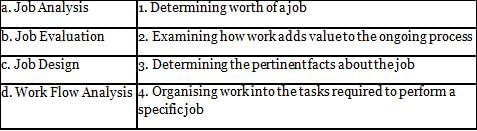
Match the following:

Detailed Solution: Question 16

  • Job Analysis is determining the pertinent facts about the job. It is the process of gathering and analysing information about the content and the human requirements of jobs, as well as, the context in which jobs are performed.
  • Job Evaluation is a systematic way of determining the value/worth of a job in relation to other jobs in an organisation. It tries to make a systematic comparison between jobs to assess their relative worth for the purpose of establishing a rational pay structure.
  • Job design is a core function of human resource management and it is related to the specification of contents, methods and relationship of jobs in order to satisfy technological and organisational requirements as well as the social and personal requirements of the job holder or the employee.
  • Workflow analysis is the process of examining an organisation's workflows, generally for the purpose of improving operational efficiency. It identifies areas of process improvement such as redundant tasks or processes, inefficient workplace layouts and bottlenecks in the workflow.

APSET Paper 2 Mock Test - 1 (Management) - Question 17

Which of the following is/are type(s) of direct marketing?

Detailed Solution: Question 17
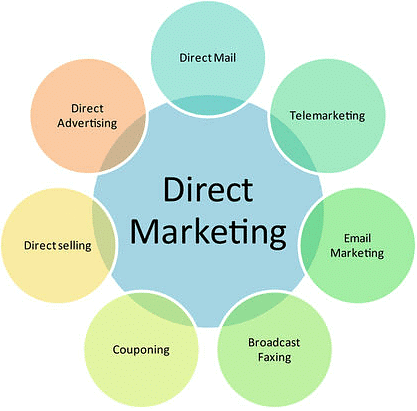
Direct marketing is a form of communicating an offer, where organisations communicate directly to a pre-selected customer and supply a method for a direct response. Among practitioners, it is also known as direct response marketing. Direct marketing has various types:

APSET Paper 2 Mock Test - 1 (Management) - Question 18

The car maker Ford has opted for

Detailed Solution: Question 18

In franchise organization, stages of production and distribution process are linked by a channel member called franchiser.
The franchise is further divided into the following three forms:
Manufacturer Sponsored Retailer Franchise System
Manufacturer Sponsored Wholesaler franchise System
Service Firm Sponsored Retailer Franchise System
Manufacturer Sponsored Retailer Franchise System: Automobile industry is composed of this form of the franchise system.
Manufacturer Sponsored Wholesaler franchise System: Soft drink industry adopts this form of the franchise system.
Service Firm Sponsored Retailer Franchise System: In this form of franchises, certain retailers are given license by the service firm to provide the services of that firm to the consumers.
So, the car maker Ford has opted for Manufacturer Sponsored Retailer Franchise System.

APSET Paper 2 Mock Test - 1 (Management) - Question 19

Under FEMA all ________ account transactions are free unless specifically restiricted.

Detailed Solution: Question 19

A current account transaction has been defined as a transaction other than capital account transaction.
This means that all transactions that do not alter assets or liabilities outside India of residents or assets or liabilities in India of non-residents are termed as current account transactions.
FEMA allows free selling/drawal of foreign exchange to/from authorised dealer (AD); however, it empowers the Union government to notify certain restrictions for current account remittances, in consultation with the Reserve Bank of India (RBI).
So, Under FEMA all current account transactions are free unless specifically restricted.

APSET Paper 2 Mock Test - 1 (Management) - Question 20

A business idea becomes a good business opportunity when it comes which four of the following?
Attractiveness
Foreign collaboration
Political Support
Timeliness
Durability
Value addition to end user

Detailed Solution: Question 20
A business idea can become business opportunity if it is attractive. People can get something different.
Customer will get satisfaction after using that product. It should be on reasonable price. There should be a time frame to work on idea.
There must be durability. There should be potential in business idea and product cost must be low and product should be durable.

APSET Paper 2 Mock Test - 1 (Management) - Question 21

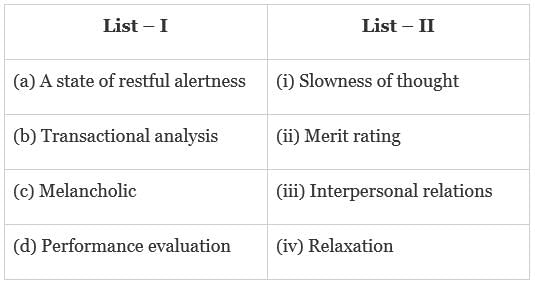
Match the following:

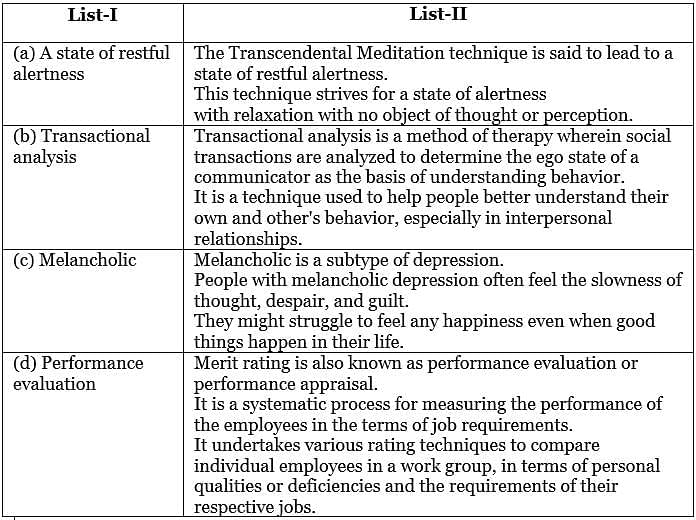
Detailed Solution: Question 21


Therefore, from the above explanation, it is clear that option b) is the correct answer.

APSET Paper 2 Mock Test - 1 (Management) - Question 22

Arrange the operations is production planning and control in the correct sequence:

(i) Routing
(ii) Dispatching
(iii) Follow up
(iv) Scheduling

Choose the correct answer from the code given below:

Detailed Solution: Question 22

The correct answer is (i), (iv), (ii), (iii)

  • Production Planning: It is the process of planning in advance and deals with specific concepts of what, how, when and how much to produce. The basic objective of Production Planning is to ensure right quality and quantity of material available at the time of production.
  • Production Control: It ensures that the production/ manufacturing team can achieve the targeted production, regulate inventory management, optimum utilization of resources and cost saving.

Important Points 

  •  Production Planning and Controlling works on the function that "First plan and then work on it".
  • Production Planning and Controlling ensures maintenance of inventory i.e. no under / over stocking.
  • Major functions of Production Planning and Controlling are: Planning, Routing, dispatching, Scheduling and follow up.​

​The correct sequence in Production planning and Controlling is: 

  1. Routing (process of deciding the correct path/ route of work)
  2. Scheduling (fixing the amount of work to do with specific starting and completion time).
  3. Dispatching (implementation stage of production and giving required authority to do the work)
  4. Follow up (controlling device which is concerned with evaluating the result).

Hence,​ the correct order is Routing, Scheduling, Dispatching and Follow up i.e. (i), (iv), (ii), (iii)

APSET Paper 2 Mock Test - 1 (Management) - Question 23

Other things being equal, an increase in income leads to a decrease in demand for

Detailed Solution: Question 23

An inferior good is an economic term that describes a good whose demand drops when people's incomes rise. This occurs when a good has more costly substitutes that see an increase in demand as incomes and the economy improve.
In economics, the demand for inferior goods decreases as income increases or the economy improves. When this happens, consumers are more willing to spend on costly substitutes. Some of the reasons behind this shift may include quality or a change to a consumer's socio-economic status.

APSET Paper 2 Mock Test - 1 (Management) - Question 24

F.W. Taylor has done which of the following studies for improving the production process?

Detailed Solution: Question 24

F.W. Taylor has done the following studies for improving the production process:

  • Time Study: Time study is the technique of observing and recording the time required by a workman of reasonable skills and ability to perform each element of the tasks in a job.
  • Motion Study: Motion study is a technique which involves close observations of the movement of body and limbs of an individual required to perform a job.
  • Fatigue Study: Fatigue study helps in maintaining the operational efficiency of the workers.

APSET Paper 2 Mock Test - 1 (Management) - Question 25

The Internal Rate of Return (IRR) is determined where the Net Present Value is

Detailed Solution: Question 25

The Internal Rate of Return (IRR) is a metric used in capital budgeting to estimate the profitability of potential investments. The internal rate of return is a discount rate that makes the net present value (NPV) of all cash flow from a particular project equal to zero.

APSET Paper 2 Mock Test - 1 (Management) - Question 26

Who defines advertising as ''any paid form of non-personal presentation and promotion of ideas, goods and services by an identified sponsor''?

Detailed Solution: Question 26

American Marketing Association (AMA) defines advertising as "any paid form of non-personal presentation and promotion of ideas, goods and services by an identified sponsor".
The AMA is the only organisation that provides direct benefits to marketing professionals in both business and education and assists in personal and professional career development among marketing professionals, and to advance the science and ethical practice of marketing disciplines.

APSET Paper 2 Mock Test - 1 (Management) - Question 27

Stage 1: System and software requirements
Stage 2: Design
Stage 3: Coding
Stage 4: Testing
Stage 5: Operations
The above stages expressed in which model of system

Detailed Solution: Question 27

The waterfall model is a linear sequential (non-iterative) design approach for software development, in which progress flows in one direction downwards (like a waterfall) through the phases of conception, initiation, analysis, design, construction, testing, deployment and maintenance.

  • System and software requirements: captured in a product requirements document
  • Analysis: resulting in models, schema, and business rules
  • Design: resulting in the software architecture
  • Coding: the development, proving, and integration of software
  • Testing: the systematic discovery and debugging of defects
  • Operations: the installation, migration, support, and maintenance of complete systems

APSET Paper 2 Mock Test - 1 (Management) - Question 28

When India adopted/enacted Consumer protection act?

Detailed Solution: Question 28

  • In the year 1986 the GOI enacted the consumer protection act.
  • It’s providing for a system for the protection of consumer rights and the redressal of consumer dispute.
  • Includes: Individual domestic customers, societies and non for profit organisations.
  • Excludes: Commercial Customers fully.

APSET Paper 2 Mock Test - 1 (Management) - Question 29

Car enters the drive-through of a fast food restaurant to place an order, and then it proceeds to pay for the food and pick up the order. This is an example of:

Detailed Solution: Question 29

  • A car enters the drive-through of a fast food restaurant to place an order, and then it proceeds to pay for the food and pick up the order. This is an example of a multiphase and multichannel system. This is the part of queuing theory, which was developed to avoid the queue in service Industry like banks, restaurants etc.
  • In this system there are many channels and many phases so that customer do not need to wait and he can utilize that time in a productive way.

APSET Paper 2 Mock Test - 1 (Management) - Question 30

Assertion (A): Demand forecasting reduces risk related to business activities.
Reason (R): Demand forecasting helps in production planning, capacity planning, layout planning and inventory management.

Detailed Solution: Question 30

The correct answer is Both (A) and (R) are correct and (R) is the correct explanation of (A).

Demand Forecasting: 

  • Demand forecasting is a technique for the estimation of probable demand for a product or service in the future.
  • It is based on the analysis of past demand for that product or service in the present market condition.
  • Demand forecasting should be done on a scientific basis and facts and events related to forecasting should be considered.

Key Points

  •  Demand plays a vital role in the decision-making of a business.
  • In competitive market conditions, there is a need to take the correct decisions and make planning for future events related to business like a sale, production, etc.
  • The effectiveness of a decision taken by business managers depends upon the accuracy of the decision taken by them.
  • Demand forecasting reduces risk related to business activities and helps it to take efficient decisions.
  • Thus Assertion (A) is correct. 
  • Good forecast helps in appropriate production planning, process selection, capacity planning, facility layout planning, inventory management, etc.
  • Thus Reason (R) is also correct and (R) is the correct explanation of (A).

Hence, the correct answer is Both (A) and (R) are correct and (R) is the correct explanation of (A).

View more questions
60 tests
Information about APSET Paper 2 Mock Test - 1 (Management) Page
In this test you can find the Exam questions for APSET Paper 2 Mock Test - 1 (Management) solved & explained in the simplest way possible. Besides giving Questions and answers for APSET Paper 2 Mock Test - 1 (Management), EduRev gives you an ample number of Online tests for practice
Download as PDF