AP TET Exam  >  AP TET Test  >  APSET Mock Test Series 2026  >  APSET Paper 2 Mock Test - 5 (Geography) - AP TET MCQ

APSET Paper 2 Mock Test - 5 (Geography) Free Online Test 2026


Full Mock Test & Solutions: APSET Paper 2 Mock Test - 5 (Geography) (100 Questions)

You can boost your AP TET 2026 exam preparation with this APSET Paper 2 Mock Test - 5 (Geography) (available with detailed solutions).. This mock test has been designed with the analysis of important topics, recent trends of the exam, and previous year questions of the last 3-years. All the questions have been designed to mirror the official pattern of AP TET 2026 exam, helping you build speed, accuracy as per the actual exam.

Mock Test Highlights:

  • - Format: Multiple Choice Questions (MCQ)
  • - Duration: 120 minutes
  • - Total Questions: 100
  • - Analysis: Detailed Solutions & Performance Insights

Sign up on EduRev for free and get access to these mock tests, get your All India Rank, and identify your weak areas to improve your marks & rank in the actual exam.

APSET Paper 2 Mock Test - 5 (Geography) - Question 1

Given below are two statements. One is labelled as Assertion (A) and the other is labelled as Reason (R).

Assertion (A): The River Ganga has a deep but narrow channel at Rishikesh.

Reason (R) : Lateral cutting occurs at the youthful stage in rivers.

Select the correct answer from options given below:

Detailed Solution: Question 1

 The River Ganga originates at Gangotri glacier in the Himalayas. It is in its youthful stage in the mountains of Himalayas. A river does downward cutting in its youthful stage while it does lateral cutting in later stages. At Rishikesh, the channel of Ganga is narrow and deep due to downward cutting done by river Ganga.

Thus, the correct answer is C.

APSET Paper 2 Mock Test - 5 (Geography) - Question 2

Who among the following is regarded as the founder of the humanistic approach in geography?

Detailed Solution: Question 2

The Correct Answer is Yi-Fu-Tuan.

Key Points

  • Humanistic School in Geography:
    • Chinese-American geographer Yi-Fu Tuan is the founder of the Humanistic School in Geography in 1976.
    • Human geography is distinguished by; - Human awareness - Human agency - Human consciousness - Human creativity.
    • The humanistic approach is a way of thinking in human geography; approach that seeks to put humans at the center of geography.
  • Well-known Humanist Geographers:
    • Anne Buttimer
    • Edward Relph
    • Yi-Fu Tuan
  • In 1976, it was Yi-Fu Tuan who argued for humanistic geography as concerned with people and their conditions.

Additional Information

  • Humanistic Geography (social & cultural geography) problems and Prospects: Edited by David Ley, Marawyn Samuels (1978).
  • Others included Humanistic geographers Edmunds Bunkse, Anne Buttimer, James Duncan, Jhon Western, etc
  • As a counter to the postulates of positivism, Leonard Guelke propounded the philosophy of idealism and urged human geographers, especially the historical geographers to probe into what humans, as decision-makers believed in and not why they believed.

APSET Paper 2 Mock Test - 5 (Geography) - Question 3

Consider the following statement of computation of composite index and state which of these are true-

i. The index has indicators like development vulnerabilities, exclusions etc.

ii. They compare country performances.

iii. They are not easy to interpret.

iv. It summarizes multi-dimensional realities.

Detailed Solution: Question 3
The computation of composite index is a composite phenomenon like development, vulnerabilities, exclusion etc. Composite indicators also compare country performances which are increasingly being recognized as useful in policy analysis and public communication. It is easy to interpret and can summarize multi-dimensional realities with a view to support decision making.

APSET Paper 2 Mock Test - 5 (Geography) - Question 4

Match List I with List II

Detailed Solution: Question 4

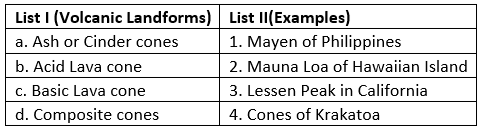
  • Ash or Cinder cones are formed when the volcanic material thrown out of the volcano cools and form small solid pieces known as cinders. The solid particles that are rained down create a circular cone around the crater and a cinder cone is formed. These are also termed as central type of volcanoes. The cones of Krakatoa, Mt. Pele, Mt. Fuji are certain examples.
  • The Acid Lava cone is formed by viscous lava and which has a presence of silica. This lava deposits itself near the neck of the crater just after an explosion and later forms a dome by solidification. Lessen Peak of California and Pary-de-dome of France are perfect examples.
  • Basic lava cone or shield volcanoes are different from the acid lava cones in terms of material compositions and shape formation. The basaltic lava having low silica content flows out quietly and gives rise to the formation of a shield. A shield shaped volcano forms with a wide base and low slope in course of time. Best example is the Mauna Loa od Hawaiian Island.
  • The composite are probably the largest and highest volcanic cones. They are formed by the deposition of lava and ash, layer after layer in a parallel format. Fujiyama, Mayen are the best examples of such cones.

APSET Paper 2 Mock Test - 5 (Geography) - Question 5

Consider the following pairs:

Which of the pairs given above are correctly matched?

Detailed Solution: Question 5
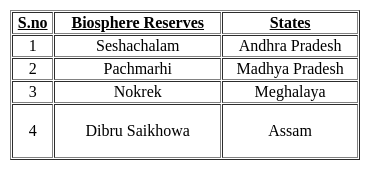
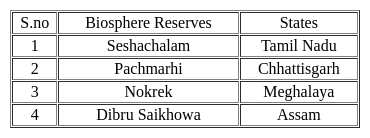
The correct answer is 3 and 4 only.

Key Points

Additional Information

  • The Seshachalam Hills are hilly ranges part of the Eastern Ghats in Andhra Pradesh.
    • In 2010 it was designated as a Biosphere Reserve.
    • It has large reserves of red sandalwood which is used in medicines, soaps, spiritual rituals.
  • The Pachmarhi Biosphere Reserve is a biosphere reserve in the Satpura Range in Madhya Pradesh.
    • The conservation area was created in 1999 by the Indian government.
    • UNESCO designated it a biosphere reserve in 2009.
  • Nokrek Biosphere Reserve is a national park located in the West Garo Hills district of Meghalaya.
    • UNESCO added this National park to its list of Biosphere Reserves in May 2009.
  • Dibru-Saikhowa is a national park in Assam, India.
    • It is located in Dibrugarh and Tinsukia districts and was designated a Biosphere Reserve in July 1997.

APSET Paper 2 Mock Test - 5 (Geography) - Question 6

Who emphasized the need for unbalanced growth in the field of development economics?

Detailed Solution: Question 6

There are two theories concerning the strategy of economic development:

  1. Theory of Balanced Growth: According to Rodan, Nurkse, and Lewis, these economies should make simultaneous investments in all sectors to achieve balanced growth.
  2. Theory of Unbalanced Growth: According to Hirschman, Singer, Fleming, these economies should create a situation of unbalance by making a large investment in any one sector.

Key Points

Hirschman’s View:

  • Albert Hirschman, an American Economic Professor, explained the economic growth process in terms strikingly similar to those of Myrdal.
  • Hirschman felt that “ Interregional inequality of growth is an inevitable concomitant and condition of growth itself”.
  • Hirschman explained his concept with the help of two terms i.e.,” Trickling-down effect” and Polarization effect”.
    • Trickling down effect (analogous to Myrdal’s Spread effect)
    • Polarization effect (analogous to backwash effect).
  • Some economists criticized Hirschman’s theory of “economic transmission” - for having created terminological confusion for the terms already accepted in the scientific language

Hence, A. Hirschman emphasized the need for unbalanced growth in the field of development economics.

APSET Paper 2 Mock Test - 5 (Geography) - Question 7

Which of the following is the correct sequence of the Core Periphery Model as given by Friedman ?

Detailed Solution: Question 7

Important Points

The conventional core-periphery model of development tries to represent the emergence of a regional urban system in four major stages which goes on par with the development of regional transport systems. From an initial process that favors the setting of spatial inequalities, these are eventually reduced and a functionally integrated urban system emerges.

Stage 1 (Pre-industrial): Localized Economics

  • The pre-industrial (agricultural) society, with localized economies and a small-scale settlement structure.
  • Each settlement is fairly isolated, activities are dispersed and mobility is low.
  • There are limited differences between spatial entities in terms of levels of economic development.

Stage 2 (Transitional): Core-periphery

  • The concentration of the economy in the core city begins as a result of innovation, capital accumulation, and industrial growth.
  • The specific reasons behind this concentration are often not too clear, location (better access) being a significant factor, but the fact remains that a dominant center emerges within an urban system to become its growth pole.
  • Trade and mobility increase, but within a pattern dominated by the core even if the overall mobility remained low.
  • Among the numerous examples of such a phase are the early industrialization of Great Britain in the late 18th century or the beginning of the colonial incorporation of Latin America, Africa, or Asia.

Stage 3 (Industrial): dispersion of economic activity

  • Through a process of economic growth and diffusion, other growth centers emerge.
  • The main reasons for deconcentration are increasing input costs (mainly labor and land) in the core area.
  • This diffusion is linked with increased interactions between elements of the urban system and the construction of transport infrastructures.

Stage 4 (Post-industrial): spatial integration

  • The urban system becomes fully integrated and spatial inequalities are reduced significantly.
  • The distribution of economic activities creates a specialization and a division of labor linked with intense flows along high-capacity transport corridors.
  • The factors that have favored spatial inequalities in the previous phases of development have structured dominant poles of the urban system and favored the setting of a large commercial gateway, usually a world city.

Hence, the correct sequence is Localized economies, core-periphery, dispersion of economic activity, spatial integration

APSET Paper 2 Mock Test - 5 (Geography) - Question 8

Consider the following statements:

1. India's first solar-wind hybrid plant is located in Maharashtra.

2. Diu is the first solar-powered island in India.

3. India's first village to be powered by solar all day is located in Gujarat.

Which of the statements given above are correct?

Detailed Solution: Question 8

The correct answer is 2 and 3.Key PointsSolar Power:

  • India ranks 3rd in the renewable energy country according to Attractiveness Index’ in 2021.
  • It is the 3rd largest energy-consuming country in the world.
  • India stands 4th globally in Renewable Energy Installed Capacity (including Large Hydro).
  • It ranks 4th in Wind Power capacity & 4th in Solar Power capacity (REN21 Renewables 2022 Global Status Report).
  • India's first wind and solar hybrid power generating plant is located in Jaisalmer, Rajasthan. Hence, statement 1 is incorrect.
  • The hybrid power plant unlocks the full potential of renewable energy.
  • It eliminates generation intermittency and provides a more stable alternative to meet rising power demand.
  • The union territory of "Diu" is India's first solar-powered island. Hence, statement 2 is correct.
  • Diu generates a total of 13 MW of electricity from solar power on a daily basis.
  • Modhera in Gujarat state is India's first village to run entirely on solar power. Hence, statement 3 is correct.
  • The solar project not only reduces the villages' energy bills, but it is also becoming a source of revenue.

APSET Paper 2 Mock Test - 5 (Geography) - Question 9

Consider the following statements: 

A. Relict Mountain are formed by differential erosion because of differing solubility and erodibility of rocks in the region.

B. Converging boundary volcanism produces island arch like the Japanese arc

C. Alps, Andes, Appalachian and Ural are the examples of Block mountains.

D. GK Gilbert gave the Thermal Contraction Theory in 1890.

Which of the following are Incorrect? 

Detailed Solution: Question 9

Answer: 3) Only C and D.

Key Points

  • Statement C is incorrect because Alps, Andes, Appalachian, and Ural are not examples of block mountains. They are examples of fold mountains.
  • Statement D is incorrect because G.K. Gilbert gave the Glacial rebound theory in 1890, not the Thermal Contraction Theory.
  • Thermal Contraction Theory was given by H. Jeffreys in his famous book, The Earth: Its origin history and physical constitution.

Additional Information 

Relict mountains are mountains that have been worn down by erosion over time. They are typically rounded and have gentle slopes.

Converging boundary volcanism occurs when two tectonic plates collide, causing one plate to be forced beneath the other. This process can create island arcs, which are chains of volcanic islands.

Block mountains are formed when large blocks of the Earth's crust are uplifted or tilted by tectonic forces.

Thermal Contraction Theory states that the Earth's crust has contracted as the Earth has cooled, causing mountains to form.

Glacial rebound theory states that the Earth's crust has rebounded after the weight of glaciers has been removed, causing mountains to form.

APSET Paper 2 Mock Test - 5 (Geography) - Question 10

"These mountains are formed by vertical movements of blocks next to faults". The given statement is correct for which of the following:

Detailed Solution: Question 10

Answer: 2) Block mountains.

Key Points

  •  Block mountains are formed by the vertical movement of blocks of the Earth's crust along faults.
  • These faults are typically caused by the collision of two tectonic plates. When two plates collide, one plate is often forced beneath the other in a process called subduction.
  • As the subducting plate descends into the mantle, it melts and rises to the surface as magma. This magma can erupt onto the surface, forming volcanoes, or it can solidify beneath the surface, forming plutons.
  • The collision of the plates also causes the crust to fold and fault, which can create block mountains.
  • Block mountains are typically characterized by steep slopes, sharp crests, and flat tops. They are often found in groups, or ranges, and can be hundreds of kilometers long.
  • Some of the most famous block mountains in the world include the Sierra Nevada mountains in California, the Rocky Mountains in North America, and the Andes Mountains in South America.

Additional Information

  • Fold mountains are formed when two tectonic plates collide, causing the Earth's crust to fold and buckle. This type of mountain is typically long and narrow, with steep sides and a sharp crest.
  • Relict mountains are mountains that have been worn down by erosion over time. They are typically rounded and have gentle slopes.
  • Upwarped mountains are formed when a large area of the Earth's crust is uplifted, but the rocks are not folded or faulted. This type of mountain is typically broad and has a gently sloping top.

APSET Paper 2 Mock Test - 5 (Geography) - Question 11

The oldest rocks tend to be found __________.

Detailed Solution: Question 11

Answer: Option 3) In the interior of continents

Key Points

  • The oldest rocks tend to be found In the interior of continents.
  • This is because the interiors of continents are generally more stable and have been less affected by tectonic activity than the margins of continents or the ocean basins.
  • The Earth's crust is divided into two main types: continental crust and oceanic crust. Continental crust is thicker and less dense than oceanic crust. It is also older, with some continental rocks dating back more than 4 billion years.
  • Oceanic crust, on the other hand, is younger, with most of it being less than 200 million years old.
  • The oldest rocks on Earth are found in the interiors of continents because these areas have been relatively stable and have not been subjected to the same amount of tectonic activity as the margins of continents or the ocean basins.
  • The margins of continents and the ocean basins are more likely to experience earthquakes, volcanic eruptions, and other geological events that can destroy or recycle rocks.

Additional Information

  • On the margins of ocean basins:

The margins of ocean basins are more likely to experience tectonic activity, which can destroy or recycle rocks.

  • In the interiors of ocean basins: 

The interiors of ocean basins are vast submarine regions that collectively cover nearly three-quarters of Earth's surface. The interiors of ocean basins are not typically associated with the oldest rocks as there a regular formation of new crust due to the convectional currents rising beneath the earth. 

  • Along the margins of continents:

The margins of continents are more likely to experience tectonic activity, which can destroy or recycle rocks.

Therefore, the correct answer is "In the interiors of continents".

APSET Paper 2 Mock Test - 5 (Geography) - Question 12

A potential downside of medical tourism can be:

Detailed Solution: Question 12

​Access to post-operative care and follow-up appointments after returning home

While medical tourism provides numerous advantages such as cost savings, access to specialized treatments, and reduced waiting times, it also comes with its set of challenges and potential downsides. These downsides can affect the quality of care and the overall patient experience, making it essential for individuals considering medical tourism to weigh these factors carefully.

Key Points

1. Access to post-operative care and follow-up appointments after returning home:

  • This option highlights a significant downside of medical tourism.
  • After undergoing medical procedures abroad, patients might face challenges in accessing necessary post-operative care and follow-up appointments upon returning to their home country.
  • Coordination between the healthcare provider abroad and local healthcare providers can be complex, leading to potential gaps in care.
  • Additionally, complications or questions that arise post-surgery might be harder to address without direct access to the medical team that performed the procedure.
  • This can impact the overall success of the treatment and patient recovery.

Additional Information

2. Lack of familiarity with cultural norms and language barriers at the destination:

  • While navigating cultural norms and language barriers can be challenging for medical tourists, this factor is not inherently a downside of medical tourism itself but rather a consideration that individuals must prepare for when choosing a destination.
  • Many medical tourism providers offer translation services and cultural orientation to minimize these issues.

3. Increased economic benefits for the hosting country:

  • This option describes a positive outcome of medical tourism rather than a downside.
  • Medical tourism can significantly contribute to the economy of the hosting country by generating revenue, creating jobs, and stimulating local development.
  • This aspect is beneficial for the destination country and does not represent a disadvantage for medical tourists.

4. Improved access to preventative healthcare in developing nations:

  • This option also outlines a positive impact of medical tourism, particularly for the hosting countries.
  • The influx of medical tourists can lead to improvements in healthcare infrastructure and services, including preventative care, benefiting both tourists and the local population.
  • This is not a downside for individuals seeking medical treatment abroad.

Important Points

  • Potential patients contemplating medical tourism should conduct thorough research and planning, including understanding the risks and challenges associated with post-operative care and follow-up.
  • Establishing a plan with healthcare providers both at home and abroad for ongoing care, and considering the purchase of medical tourism insurance, can help mitigate some of these downsides.

APSET Paper 2 Mock Test - 5 (Geography) - Question 13

Which of the following is NOT mentioned as a challenge for the tourism industry?

Detailed Solution: Question 13

Answer: 4) Growing preference for virtual experiences over physical travel.

The tourism industry faces numerous challenges that can impact its growth and sustainability. These challenges range from external geopolitical factors to internal shifts in consumer preferences. It's essential to identify the specific hurdles the industry must navigate to adapt effectively and continue thriving.
Key Points
Growing preference for virtual experiences over physical travel:
  • While there has been an increase in the availability and quality of virtual experiences, particularly accelerated by the COVID-19 pandemic, this trend is not commonly cited as a significant challenge to the traditional tourism industry.
  • Virtual experiences offer supplementary options for exploration and can even stimulate interest in physical travel by providing a taste of what real-world destinations have to offer.
  • They can also serve as an accessible means for those unable to travel due to financial, health, or other constraints.
  • Virtual tourism might complement rather than compete directly with physical travel experiences.
Additional Information
Competition from emerging travel destinations:
  • This is a real challenge as new and previously less-known destinations become more accessible and market themselves more effectively.
  • Competition requires established travel destinations to innovate and improve their offerings to retain and attract tourists.
  • It pushes the industry to focus on differentiation and enhancing visitor experiences to stay competitive.

Geopolitical conflicts impacting travel safety and accessibility:
  • Geopolitical conflicts and tensions can significantly impact the tourism industry by making certain destinations less safe or entirely inaccessible.
  • This challenge forces the industry to be adaptable and responsive to changing global dynamics, impacting everything from travel advisories to insurance costs and overall tourist preferences.
Increasing demand for responsible and sustainable travel practices:
  • The growing awareness and concern over environmental issues and local community impacts have led to a demand for more responsible and sustainable travel practices.
  • This challenge requires the industry to innovate and implement practices that minimize negative impacts while maximizing positive contributions to conservation efforts and local economies.
  • It signifies a shift in how travel experiences are designed, marketed, and delivered.
Important Points
  • While the tourism industry faces these and other challenges, addressing them effectively is crucial for long-term sustainability and success.
  • The ability to adapt and respond to changing consumer preferences, global situations, and calls for responsible practices will distinguish industry leaders.
  • Embracing innovation and sustainability can transform challenges into opportunities for growth and positive impact.

APSET Paper 2 Mock Test - 5 (Geography) - Question 14

What BEST describes the impact of technology on the tourism industry?

Detailed Solution: Question 14

Answer: 3) It offers both opportunities for personalized experiences and privacy concerns.

The profound impact of technology on the tourism industry cannot be overstated. It has revolutionized how services are delivered, enhanced the customer experience, and also introduced new challenges. Among these impacts, the ability to offer personalized travel experiences alongside emerging privacy concerns stands out as especially significant.
Key Points
It offers both opportunities for personalized experiences and privacy concerns:
  • Advanced data analytics and AI enable travel companies to tailor their offerings to individual preferences, improving customer satisfaction and engagement.
  • From personalized travel recommendations to targeted marketing, technology makes it possible to cater to the unique desires of each traveler.
  • However, this customization relies on collecting and analyzing vast amounts of personal data, raising legitimate concerns about privacy and data protection.
  • As companies navigate these opportunities, they must also address the ethical considerations and regulatory requirements associated with handling personal information.
Additional Information
INCOREECT OPTIONS:
It primarily leads to job losses in the travel industry:
  • While technology has automated certain functions that previously required manual effort, suggesting that it primarily leads to job losses oversimplifies its impact.
  • Technology also creates new opportunities and jobs within the industry, such as in digital marketing, data analysis, and IT support.
  • Furthermore, by improving efficiency and customer experiences, technology can drive growth and demand, potentially leading to job creation in other areas of the tourism sector.
It solely benefits large travel companies and booking platforms:
  • Although large travel companies and booking platforms have indeed benefited from technological advancements, they are not the sole beneficiaries.
  • Technology has also empowered smaller operators by leveling the playing field, enabling them to reach a global audience through social media, online marketplaces, and affordable travel technologies.
  • Startups and innovative enterprises can disrupt the market with new ideas and services, indicating that the benefits of technology in tourism are more widely distributed.
It has minimal impact on travel planning and booking processes:
  • This statement underestimates the dramatic transformation technology has brought to planning and booking travel.
  • Online booking platforms, mobile apps, virtual reality previews, and user-generated content on social media have all made researching and booking travel more accessible, convenient, and informative for consumers.
  • The shift towards online and mobile channels has fundamentally changed how travelers interact with the industry, making technology's impact far from minimal.
Important Points
  • The intersection of technology and tourism continues to evolve, offering immense potential to enhance the travel experience while posing new challenges.
  • As the industry adapts to these changes, the focus should remain on harnessing technology to improve services and operational efficiency, while also prioritizing ethical considerations and customer trust, particularly concerning privacy.

APSET Paper 2 Mock Test - 5 (Geography) - Question 15

Die Erdkunde was written by

Detailed Solution: Question 15

‘Die Erdkunde’ means Earth sciences. It is often used as translation of geography in German language. It is a collection of 19 volumes of books with over 20000 pages. It was written by Carl Ritter. It was intended to be complete geography of the world, but Ritter could complete only Asia and Africa in his lifetime.

Thus, the correct answer is C.

APSET Paper 2 Mock Test - 5 (Geography) - Question 16

Consider the following statements about Dualism:

i. Dualism means difference in views.

ii. Dualism lies in methodology.

iii. It includes content of study, approach of study and method of study.

Choose the correct option from below:

Detailed Solution: Question 16

Dualism means difference in views, in geography dualism lies in its methodology which includes content of study, approach of study and method of study. Content is the subject matter, approach is the point of view to look at a problem, method is the way to deal with the problem.

APSET Paper 2 Mock Test - 5 (Geography) - Question 17

Use the map below showing the main agricultural regions in China to answer the question that follows.
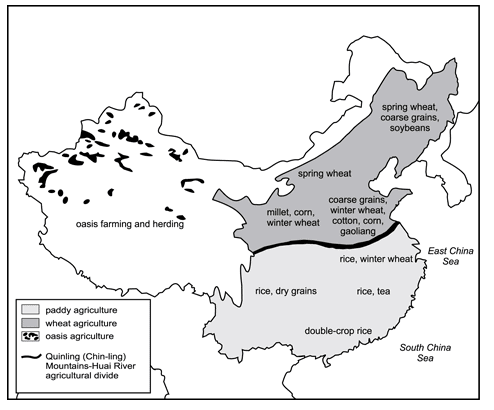
To explain the origins of the regional difference in Chinese agricultural production shown in the map, which of the following types of information would be most useful?

Detailed Solution: Question 17

This question requires the examinee to demonstrate knowledge of basic cartographic concepts and how to interpret information in maps, charts, diagrams, and other graphic formats. Physical geography and climate are the primary determinants of those forms of agricultural activity that are most appropriate in a given region. Whereas a sloping topography and scarce rainfall limit large parts of western China to oasis farming and herding, many eastern areas of the country possess physical attributes that make them well suited for extensive production of various types of grains.

APSET Paper 2 Mock Test - 5 (Geography) - Question 18

Which one of the following is a sedimentary type of biogeochemical cycle?

Detailed Solution: Question 18

Concept:

  • Organisms need a constant supply of nutrients for various metabolic activities.
  • The nutrient amount varies in different ecosystems and also due to seasonal variations.
  • The amount of nutrients present in the soil at any given point in time is known as the standing state.
  • Though variable, nutrients are never lost from the ecosystem.
  • This is due to the process of nutrient cycling, which refers to the movement of nutrient elements through the different components of the ecosystem.
  • They are also known as biogeochemical cycles.
  • The rate of release of nutrients into the atmosphere is controlled by environmental factors like soil, moisture, pH and temperature.

Important Points

Biogeochemical cycles are of 2 types:

  1. Gaseous -
    • These include the nitrogen and carbon cycles.
    • The main reservoir for these cycles is in the atmosphere.
  2. Sedimentary -
    • These include the sulphur and phosphorus cycles.
    • Their reservoir is in the Earth's crust.
  • The function of these reservoirs is to meet the deficit that might be caused due to imbalance in the rate of influx and efflux.

Thus, phosphorus and sulphur are sedimentary types of biogeochemical cycle

Additional Information Phosphorus Cycle:

  • Phosphates in the rocks are the main reservoir for this biogeochemical cycle.
  • Here the gaseous exchange of phosphorus between organisms and the environment is negligible.

Sulphur Cycle:
  • The sulphur reservoir is in the soil and sediments where it is locked in organic (coal, oil and peat) and inorganic deposits (pyrite rock and sulphur rock) in the form of sulphates, sulphides and organic sulphur.
  • It is released by weathering of rocks, erosional runoff and decomposition of organic matter and is carried to terrestrial and aquatic ecosystems in a salt solution.
  • The sulphur cycle is mostly sedimentary except two of its compounds hydrogen sulphide (H2S) and sulphur dioxide (SO2) add a gaseous component to its normal sedimentary cycle.
  • Sulphur enters the atmosphere from several sources like volcanic eruptions, combustion of fossil fuels, from the surface of the ocean and from gases released by decomposition. Atmospheric hydrogen sulphide also gets oxidised into sulphur dioxide.
  • Atmospheric sulphur dioxide is carried back to the earth after being dissolved in rainwater as weak sulphuric acid.

APSET Paper 2 Mock Test - 5 (Geography) - Question 19

“When a particular area starts developing, it attracts human as well as physical capital” these phenomena is called?

Detailed Solution: Question 19

Swedish economist Gunnar Myrdals propagated an economic development effect model namely backwash effect. Backwash effect basically means that if one particular area in a country starts growing or developing, it causes human capital as well as physical capital from other parts of the country to gravitate to this part of the country.

APSET Paper 2 Mock Test - 5 (Geography) - Question 20

Economic development refers to________

Detailed Solution: Question 20

Key Points

  • Economic Development is the creation of wealth from which community benefits are realized. It is more than a jobs program, it's an investment in growing your economy and enhancing the prosperity and quality of life for all residents. Economic development means different things to different people.
  • Economic development means the change in growth along with progressive changes in the socio-economic conditions of the country.
  • While Economic growth implies a change or an increase in the real output of the country. Growth must be accompanied by the progressive reduction in the inequalities and social vagaries for being called economic development. 

Economic development is not economic growth

  1. It’s easy to confuse development with growth, considering they have similar meanings and are often used interchangeably. Add the fact that economic growth is an important part of economic development. Economic growth is all about numbers. “Economic Growth is the positive change in the real output of the country in a particular span of time.”
  2. Economic growth is a straightforward measurement of actual economic output — things like gross domestic product (GDP) fall into this measurement. It’s a pure numbers game.
  3. But economic development is much broader in scope and includes elements that you might not normally associate with economics, like social welfare, early childhood education, and criminal justice reform.

Economic development refers to Economic growth plus changes in output distribution and economic structure. Therefore Option 2 is the correct answer.

APSET Paper 2 Mock Test - 5 (Geography) - Question 21

Which of the following statements relating to Ratzel's concept of Lebensraum, is not correct?

(a) It is the geographical area within which living organisms develop.

(b) It is the economic and cultural activity of the people outside their enclosed settled area.

(c). It deals with the relation between human society and a spatial organization and its physical setting.

(d). It is a geopolitical term that studies space from the viewpoint of the state.

Choose the correct option from below:

Detailed Solution: Question 21

The correct answer is (b) and (d).
Key Points

  • The German concept of Lebensraum comprises policies and practices of settler colonialism that proliferated in Germany from the 1890s to the 1940s.
  • For Ratzel, the Lebensraum was of fundamental significance when the scientist wants to understand the spatial characteristics of life, as life cannot be separated from its spatial requirements.
  • In Ratzel’s own words: “ new form of life needs space in order to come into existence, and yet more space to establish and pass on its characteristics”
  • For Ratzel the same laws that governed organic differentiation governed the differentiation of human societies and states.
  • The focus on overpopulation and its detrimental effects were common in nineteenth-century social science.
  • The key event influencing and to some degree shaping German geographical thought during the second half of the 19th century was the publication of Charles Darwin’s On the Origin of Species by Means of Natural Selection or the Preservation of Favoured Races in the Struggle for Life.

Hence, options (a) and (c) only are correct only to Ratzel's concept of Lebensraum.

APSET Paper 2 Mock Test - 5 (Geography) - Question 22

What has been the major cause of the population explosion?

Detailed Solution: Question 22
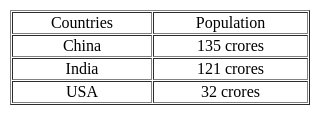
The correct answer is Improved medicare facility.

Important Points

  • Population Explosion is a sudden, large increase in the size of a population.
  • The major factors that are responsible for population explosion are illiteracy, reduced mortality, increased birth rate/fertility
  • Improved medicare facility is one the major cause for the population explosion.
  • The most simple method to control population explosion is to encourage small families about different control measures such as contraceptives. Periodic abstinence is the natural measure for control.

Additional Information

Most populated countries and their population:

APSET Paper 2 Mock Test - 5 (Geography) - Question 23

What does the volume of international trade of a country imply?

Detailed Solution: Question 23

Some countries only support self-sufficiency on food supplies, which means that there is little surplus for exports and hence can afford only a few imports. Whereas, on the other hand, countries which have a large international trade, can import a large amount of goods. This means that a wide range of products and manufactured goods are available as surplus. Thus, the volume of international trade is taken as a country's guide to economic well-being. As the economic well-being of a country increases, the number of employments, living standards, and others increase.

APSET Paper 2 Mock Test - 5 (Geography) - Question 24

The theory of rimland was published in which of the following book?

Detailed Solution: Question 24

Correct Answer: The Geography of Peace

Key Points

  • In 1944, Nichols Spykman created a theory that countered Mackinder's Heartland theory. Spykman stated that Eurasia's Rimland, the coastal areas, is the key to controlling the World Island .
  • In 1944, Spykman as the point of critic or antithetic to the Heartland Theory presented his work titled “The Rimland Theory” in his book – “The Geography of Peace”
  • The rimland contains the Heartland. Whoever would control the rimland, would eventually control the World Island. Whoever would control the World Island would soon control the world.
  • His theory has been based on the 2 basic postulates of Mackinder’s Geographical Causation of History and, The conflict between Land Power and Sea power
  • His theory was influential mainly during the Cold War. The Soviet Union desired to control the rimland around them. If accomplished, the Soviet Union would control the heartland, rimland, and the World Island.

Additional Information 

  • In 1904, Sir Halford Mackinder published the Heartland theory. The theory proposed that whoever controls Eastern Europe controls the Heartland. It also supported the concept of world dominance.
  • A more revised version explains that whoever controls the heartland, controls the world island. Whoever controls the World Island, will soon rule the world. In other words, the group or nation that dominates Hartland can then extend its domination over a far wider area. The heartland has primarily been Central Asia, the high seas, and Eurasia.
  • The Nazi party was in favor of the concept during World War II. The idea was very popular with the party, and they sought to achieve it. Also, the theory was accepted by the Soviet Union during the Cold War. Each nation made great territorial strides toward the heartland, but to no avail.

APSET Paper 2 Mock Test - 5 (Geography) - Question 25

Which one of the following is a result of rapid industrialisation and urbanization?

Detailed Solution: Question 25

The correct answer is Rural depopulation.

Key Points

  • Rural depopulation processes affect regions where the rural exodus surpasses natural growth, reducing the total number of inhabitants to a critical level and causing aging of demographic compositions.
  • Nevertheless, depopulation may also be caused by displacement because of large infrastructure investments.
  • Industrialization occurs when an industry is introduced on a large scale to a region or country — for example, when an economy goes from being based on agriculture to being based on production and other industries.
  • This period hence referred to the Industrial Revolution.
  • Urbanization relates to the increasing number of people that live in urban areas.
    • Urbanization is not solely a modern phenomenon, but a rapid and historic transformation of human social roots on a global scale, whereby predominantly rural culture is being quickly replaced by predominantly urban culture.

APSET Paper 2 Mock Test - 5 (Geography) - Question 26

Given below are two statements. One is labelled as Assertion (A) and the other is labelled as Reason (R).

Assertion (A): The double-humped camel found in cold desert of Ladakh is called as Bactrian camel.

Reason (R) : Greeks called the area of central Asia as Bactria.

Select the correct answer from options given below:

Detailed Solution: Question 26

The ancient Greeks believed that all area above the Caspian Sea is a cold desert. The ancient region of the parts of Central Asia was called as Bactria. The area extends from north of Hindu Kush mountains near Tibet to south of river Amo. The double-humped camel found in the Nubra valley is found in this region. Therefore, the camel is also called as Bactrian camel.

Thus, the correct answer is A.

APSET Paper 2 Mock Test - 5 (Geography) - Question 27

Identify the non Green-House Gas(GHG) from the following :

Detailed Solution: Question 27

Carbon Monoxide is an odorless, tasteless, poisonous gas, CO, that results from the incomplete combustion of carbon. Inhalation causes central nervous system damage and asphyxiation. Carbon monoxide is a one-carbon compound in which the carbon is joined only to a single oxygen.

APSET Paper 2 Mock Test - 5 (Geography) - Question 28

Which one of the following components is not taken into consideration by the Environmental Pollution Assessment (EPA) of US to calculate the Air Quality Index (AQI)?

Detailed Solution: Question 28

The air quality index (AQI) is an index for reporting air quality on a daily basis. It is a measure of how air pollution affects one's health within a short time period. The purpose of the AQI is to help people know how the local air quality impacts their health. The higher the AQI value, the greater the level of air pollution and the greater the health concerns. AQI quickly disseminates air quality information in real-time.​
The Environmental Protection Agency (EPA) calculates the AQI for five major air pollutants, for which national air quality standards have been established to safeguard public health.

1. Ground-level ozone
2. Particle pollution/particulate matter (PM2.5/pm 10)

3. Carbon Monoxide
4. Sulfur dioxide
5. Nitrogen dioxide

Additional Information

Air Quality Index Categories

  • Good (0–50) - Minimal Impact
  • Satisfactory (51–100) - May cause minor breathing difficulties in sensitive people.
  • Moderately polluted (101–200) - May cause breathing difficulties in people with lung disease like asthma, and discomfort to people with heart disease, children and older adults.
  • Poor (201–300) - May cause breathing difficulties in people on prolonged exposure, and discomfort to people with heart disease
  • Very Poor (301–400) - May cause respiratory illness in people on prolonged exposure. Effect may be more pronounced in people with lung and heart diseases.
  • Severe (401-500) - May cause respiratory issues in healthy people, and serious health issues in people with lung/heart disease. Difficulties may be experienced even during light physical activity.

APSET Paper 2 Mock Test - 5 (Geography) - Question 29

Read the following statements and select the correct answer using the code given below:

a) The closed folds are formed due to mild compressive action.

b) Joints are fractures, where a significant amount of rocks are displaced.

c) Asymmetrical folds have irregular and unequal limbs.

d) The Isoclinal folds are formed when a compressive force is strong on both sides leading to parallel limbs in a fold.

Detailed Solution: Question 29

The closed folds are formed due to intense compressive actions. Joints are fractures where no rock displacement takes place. The limbs of an asymmetrical fold are inclined at different angles and are irregular. The isoclinal folds have limbs parallel to each other, and they are formed when a compressive force is equally strong on both sides.

Thus, the Correct answer is D.

APSET Paper 2 Mock Test - 5 (Geography) - Question 30

The sum of deviations taken away from the mean is:

Detailed Solution: Question 30

The correct answer is option 1) always equal to 0.

Key Points

  • Deviation is the distance between each data point and the mean of the data set.
  • The sum of deviations taken away from the mean is calculated by adding up all the distances between each data point and the mean.
  • The sum of deviations taken away from the mean is always equal to 0, regardless of the data set.

Additional Information

  • This property of the sum of deviations from the mean is used to calculate variance and standard deviation, which are important statistical measures.
  • The formula for calculating the sum of deviations taken away from the mean is: ∑(Xi - X̄) = 0, where Xi represents each data point and X̄ represents the mean of the data set.
  • This property is a consequence of the fact that the mean is the balancing point of the data set, where the sum of deviations above the mean is equal to the sum of deviations below the mean.

Hence, the sum of deviations taken away from the mean is always equal to 0, regardless of the data set.

View more questions
60 tests
Information about APSET Paper 2 Mock Test - 5 (Geography) Page
In this test you can find the Exam questions for APSET Paper 2 Mock Test - 5 (Geography) solved & explained in the simplest way possible. Besides giving Questions and answers for APSET Paper 2 Mock Test - 5 (Geography), EduRev gives you an ample number of Online tests for practice
Download as PDF