JEE Exam  >  JEE Test  >  Chemistry Main & Advanced  >  Amines - 1 - JEE MCQ

Amines - 1 - Free MCQ Test with solutions for JEE Chemistry


MCQ Practice Test & Solutions: Amines - 1 (27 Questions)

You can prepare effectively for JEE Chemistry for JEE Main & Advanced with this dedicated MCQ Practice Test (available with solutions) on the important topic of "Amines - 1". These 27 questions have been designed by the experts with the latest curriculum of JEE 2026, to help you master the concept.

Test Highlights:

  • - Format: Multiple Choice Questions (MCQ)
  • - Duration: 60 minutes
  • - Number of Questions: 27

Sign up on EduRev for free to attempt this test and track your preparation progress.

Amines - 1 - Question 1

When methylamine reacts with HCl the product is

Detailed Solution: Question 1

Equation for the Reaction:

CH3NH2+HCl→CH3NH3+Cl

Explanation:

  • Methylamine (CH₃NH₂) is a weak base.
  • Hydrochloric acid (HCl) is a strong acid.
  • When methylamine reacts with HCl, the lone pair on nitrogen accepts a proton (H⁺) from HCl, forming methylammonium ion (CH₃NH₃⁺).
  • This results in the formation of methylammonium chloride (CH₃NH₃⁺ Cl⁻), which is a salt.

Final Answer:

Option A: Methylammonium chloride.

Amines - 1 - Question 2

Quaternary ammonium salt is formed

Detailed Solution: Question 2

A quaternary ammonium salt is formed by multiple methods:

  1. Serial nucleophilic substitution (Option A): A primary amine undergoes successive alkylation, forming a quaternary ammonium salt (R₄N⁺X⁻).
  2. Reaction with alkyl or benzyl halide (Option B): Ammonia or amines react with alkyl/benzyl halides, leading to quaternary ammonium salt formation.
  3. Nucleophilic substitution (Option C): Amines act as nucleophiles, replacing the halide group in alkyl halides, forming quaternary ammonium salts.

Since all these processes can lead to quaternary ammonium salt formation, the correct answer is: Option D: All of these

Amines - 1 - Question 3

Arrange the following in order of increasing basicity: aniline, p – nitroaniline, p – toluidine,and p – methoxyaniline

Detailed Solution: Question 3

  • The methoxy group (-OCH₃) at the para position significantly increases basicity compared to the -CH₃ group due to its strong +M (mesomeric) effect, which donates electron density to the benzene ring.
  • The presence of the nitro group (-NO₂) at the para position decreases basicity due to its strong -M (mesomeric) and -I (inductive) effects, which withdraw electron density from the benzene ring, reducing the availability of the lone pair on nitrogen.

  • The -OCH₃ group at the para position increases basicity more than the -CH₃ group at the para position, while the presence of the -NO₂ group at the para position significantly decreases basicity.

Hence, the correct answer is Option B.

Amines - 1 - Question 4

The action of nitrous acid on an aliphatic primary amine gives

Detailed Solution: Question 4

Amines - 1 - Question 5

Reduction by LiAlH₄ of hydrolyzed product of an ester gives

Detailed Solution: Question 5

(a): Reduction of hydrolysed product of ester by LiAlH₄ produces two alcohols. ​

Amines - 1 - Question 6

Which of the following will be the most stable diazonium salt RN₂⁺X⁻?

Detailed Solution: Question 6

Aromatic diazonium salts are more stable due to dispersal of the positive charge in the benzene ring.

Amines - 1 - Question 7

For carbylamine reaction, we need hot alcoholic KOH and

Detailed Solution: Question 7

In the carbylamine reaction, primary amines on heating with chloroform in the presence of alcoholic KOH form isocyanides (or carbylamines). It is used to distinguish 1° amines from 2° and 3° amines.

Amines - 1 - Question 8

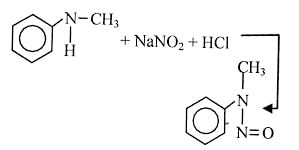
Predict the product.

Detailed Solution: Question 8

(d): 2° aliphatic and aromatic amines react with nitrous acid to form N-nitrosoamine.

Amines - 1 - Question 9

Which of the following represents the correct order of the acidity in the given compounds?

Detailed Solution: Question 9

(c): FCH₂COOH > ClCH₂COOH > BrCH₂COOH > CH₃COOH

Acidity decreases as the -I effect of the group decreases. Fluorine (F) is the most electronegative atom and hence has the highest -I effect among the halogens. ​

Amines - 1 - Question 10

An acyl halide is formed when PCl₅ reacts with an

Detailed Solution: Question 10

When PCl₅ reacts with a carboxylic acid, an acyl halide is formed. Here's how it works:

  • PCl₅ is a chemical reagent used to replace the -OH group of a carboxylic acid with a chlorine atom.
  • This results in the formation of an acyl chloride, a type of acyl halide.
  • Acyl halides are reactive and commonly used in organic synthesis.

Amines - 1 - Question 11

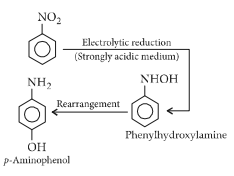
The electrolytic reduction of nitrobenzene in strongly acidic medium produces

Detailed Solution: Question 11
Amines - 1 - Question 12

Electrolytic reduction of nitrobenzene in weakly acidic medium gives

Detailed Solution: Question 12

(c): Electrolytic reduction of nitrobenzene in weakly acidic medium gives aniline, but in strongly acidic medium, it gives p-aminophenol through the acid-catalyzed rearrangement of the initially formed phenylhydroxylamine.

Amines - 1 - Question 13

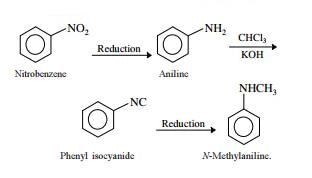
then A is :

Detailed Solution: Question 13

(b): ‘C’ must be an isocyanide and obtained from a 1° amine by the Carbylamine reaction (CHCl₃ + KOH). Further, the 1° amine must be obtained by reduction of nitrohydrocarbon. So, ‘A’ is nitrobenzene.

Amines - 1 - Question 14


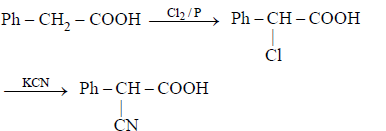
Detailed Solution: Question 14


Amines - 1 - Question 15

Sodium formate on heating yields

Detailed Solution: Question 15

(NaOH + I₂) / NaOI is the best suitable reagent for the above reaction.

Amines - 1 - Question 16

Which one of the following order is wrong, with respect to the property indicated?

Detailed Solution: Question 16

(b): Basic strength decreases as:
cyclohexylamine > aniline > benzamide.

Lesser basicity in aniline and benzamide is due to the participation of the lone pair of electrons of the –NH₂ group in resonance.

Amines - 1 - Question 17

A racemic acid CH3CHClCOOH is allowed to react with (S)-2-methylbutan-1-ol to form ester

           Nitrogen Compoinds 

and the reaction mixture is carefully distilled. The correct statement about the mixture distillate is:

Detailed Solution: Question 17

The reaction involves a racemic acid (CH₃CHClCOOH) reacting with (S)-2-methylbutan-1-ol. The mixture is then distilled, resulting in:

  • Formation of two different compounds: (R, S) and (S, S).
  • These compounds are diastereomers.
  • Diastereomers have different physical properties (such as boiling points) and can be separated by distillation.
  • Each fraction obtained is optically active.
  • The racemic mixture reacts separately with (S)-2-methylbutan-1-ol, forming (R, S) and (S, S) esters, which are diastereomers.

Final Answer: Option A: Two fractions, each optically active.

Amines - 1 - Question 18

Which of the following compounds is most basic?

Detailed Solution: Question 18

(b): In benzylamine, the electron pair present on the nitrogen is not delocalized with the benzene ring.

Amines - 1 - Question 19

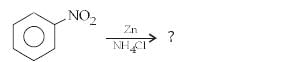
What is the product obtained in the following reaction?

Detailed Solution: Question 19

Amines - 1 - Question 20

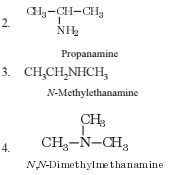
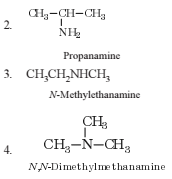
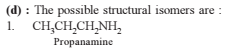
The number of structural isomers possible from the molecular formula C3H9N is  

Detailed Solution: Question 20
Amines - 1 - Question 21

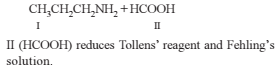
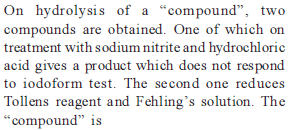
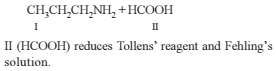
On hydrolysis of a “compound”, two compounds are obtained. One of which on treatment with sodium nitrite and hydrochloric acid gives a product which does not respond to the iodoform test. The second one reduces Tollens' reagent and Fehling’s solution. The “compound” is

Detailed Solution: Question 21

Amines - 1 - Question 22

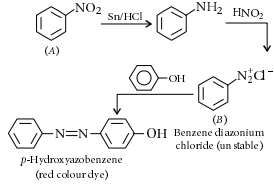
A given nitrogen-containing aromatic compound ‘A’ reacts with Sn/HCl, followed by HNO₂ to give an unstable compound ‘B’. ‘B’, on treatment with phenol, forms a beautiful coloured compound ‘C’ with the molecular formula C₁₂H₁₀N₂O. The structure of compound ‘A’ is

Detailed Solution: Question 22
Amines - 1 - Question 23

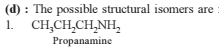
The number of structural ismers possible from the molecular formula C3H9N is  

Detailed Solution: Question 23
Amines - 1 - Question 24

Which of the following compound gives benzoic acid on hydrolysis ?

Detailed Solution: Question 24

Amines - 1 - Question 25

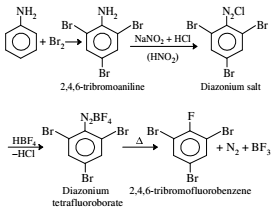
Aniline is reacted with bromine water and the resulting product is treated with an aqueous solution of sodium nitrite in the presence of dilute hydrochloric acid. The compound so formed is converted into a tetrafluoroborate which is subsequently heated dry. The final product is

Detailed Solution: Question 25
Amines - 1 - Question 26

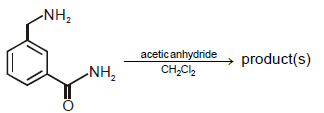
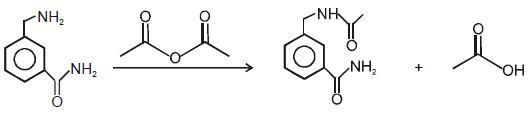
In the reaction shown below, the major product(s) formed is/are

Detailed Solution: Question 26

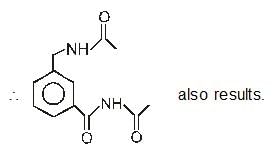
since –CH₂–NH₂ is more basic.
The resulting amide will fail to react further. Had it been possible, imide formation would have occurred at both the sites.

Amines - 1 - Question 27


Detailed Solution: Question 27

335 videos|699 docs|300 tests
Information about Amines - 1 Page
In this test you can find the Exam questions for Amines - 1 solved & explained in the simplest way possible. Besides giving Questions and answers for Amines - 1, EduRev gives you an ample number of Online tests for practice
Download as PDF