
Biomolecules - Free Assertion & Reason Questions with Solutions NEET NCERT
MCQ Practice Test & Solutions: Assertion & Reason Test: Biomolecules (10 Questions)
You can prepare effectively for NEET NCERT Based Tests for NEET with this dedicated MCQ Practice Test (available with solutions) on the important topic of "Assertion & Reason Test: Biomolecules". These 10 questions have been designed by the experts with the latest curriculum of NEET 2026, to help you master the concept.
Test Highlights:
- - Format: Multiple Choice Questions (MCQ)
- - Duration: 20 minutes
- - Number of Questions: 10
Sign up on EduRev for free to attempt this test and track your preparation progress.

Directions: This question consist of two statements, each printed as Assertion and Reason. While answering this question, you are required to choose any one of the following four responses.
Assertion : D(+)– Glucose is dextrorotatory in nature.
Reason : ‘D’ represents its dextrorotatory nature.
Assertion : D(+)– Glucose is dextrorotatory in nature.
Reason : ‘D’ represents its dextrorotatory nature.
Detailed Solution: Question 1
Directions: In this question, A statement of Assertion (A) is followed by a statement of Reason (R). Mark the correct choice as.
Assertion (A): Deoxyribose, C5H10O4 is not a carbohydrate.
Reason (R): Carbohydrates are optically active polyhydroxy aldehyde or polyhydroxy ketone or substances which give aldehyde or ketone on hydrolysis.
Assertion (A): Deoxyribose, C5H10O4 is not a carbohydrate.
Reason (R): Carbohydrates are optically active polyhydroxy aldehyde or polyhydroxy ketone or substances which give aldehyde or ketone on hydrolysis.
Detailed Solution: Question 2

Directions: This question consist of two statements, each printed as Assertion and Reason. While answering this question, you are required to choose any one of the following four responses.
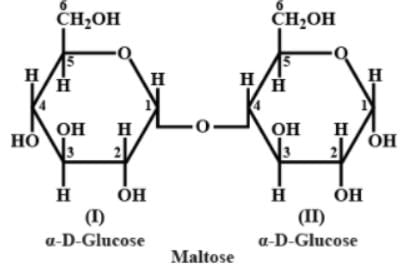
Assertion β-glycosidic linkage is present in maltose
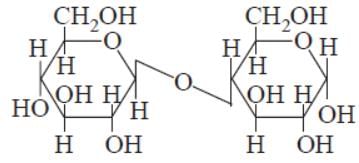
Reason : Maltose is composed of two glucose units in which C–1 of one glucose unit is linked to C–4 of another glucose unit.
Assertion β-glycosidic linkage is present in maltose
Detailed Solution: Question 3
Directions: In this question, A statement of Assertion (A) is followed by a statement of Reason (R). Mark the correct choice as.
Assertion (A): The two strands of DNA are complementary to each other.
Reason (R): The hydrogen bonds are formed between specific pairs of bases.
Assertion (A): The two strands of DNA are complementary to each other.
Reason (R): The hydrogen bonds are formed between specific pairs of bases.
Detailed Solution: Question 4
Directions: This question consist of two statements, each printed as Assertion and Reason. While answering this question, you are required to choose any one of the following four responses.
Assertion : Vitamin D cannot be stored in our body
Reason : Vitamin D is fat soluble vitamin and is excreted from the body in urine
Assertion : Vitamin D cannot be stored in our body
Reason : Vitamin D is fat soluble vitamin and is excreted from the body in urine
Detailed Solution: Question 5
Directions: In this question, A statement of Assertion (A) is followed by a statement of Reason (R). Mark the correct choice as.
Assertion (A): Glycine must be taken through diet.
Reason (R): It is non-essential amino acid.
Assertion (A): Glycine must be taken through diet.
Reason (R): It is non-essential amino acid.
Detailed Solution: Question 6
Directions: This question consist of two statements, each printed as Assertion and Reason. While answering this question, you are required to choose any one of the following four responses.
Assertion : Sucrose is called an invert sugar.
Reason : On hydrolysis, sucrose bring the change in the sign of rotation from dextro (+) to laevo(–).
Assertion : Sucrose is called an invert sugar.
Reason : On hydrolysis, sucrose bring the change in the sign of rotation from dextro (+) to laevo(–).
Detailed Solution: Question 7
Directions: In this question, A statement of Assertion (A) is followed by a statement of Reason (R). Mark the correct choice as.
Assertion (A): Glucose reacts with hydroxylamine to form an oxime and also adds a molecule of hydrogen cyanide to give cyanohydrin.
Reason (R): The carbonyl group is present in the openchain structure of glucose.
Assertion (A): Glucose reacts with hydroxylamine to form an oxime and also adds a molecule of hydrogen cyanide to give cyanohydrin.
Reason (R): The carbonyl group is present in the openchain structure of glucose.
Detailed Solution: Question 8
Directions: This question consist of two statements, each printed as Assertion and Reason. While answering this question, you are required to choose any one of the following four responses.
Assertion : At isoelectric point, the amino group does not migrate under the influence of electric field.
Reason : At isoelectric point, amino acid exists as a zwitterion.
Assertion : At isoelectric point, the amino group does not migrate under the influence of electric field.
Reason : At isoelectric point, amino acid exists as a zwitterion.
Directions: In this question, A statement of Assertion (A) is followed by a statement of Reason (R). Mark the correct choice as.
Assertion (A): All naturally occurring α amino acids except glycine are optically active.
Reason (R): Most naturally occurring α amino acids have L-configuration.
Assertion (A): All naturally occurring α amino acids except glycine are optically active.
Reason (R): Most naturally occurring α amino acids have L-configuration.
Detailed Solution: Question 10
