CBSE Class 10  >  Class 10 Test  >  Social Studies (SST)   >  Assertion & Reason Test: Federalism - Class 10 MCQ

Federalism - Free Assertion & Reason Questions with Solutions Class 10


MCQ Practice Test & Solutions: Assertion & Reason Test: Federalism (18 Questions)

You can prepare effectively for Class 10 Social Studies (SST) Class 10 with this dedicated MCQ Practice Test (available with solutions) on the important topic of "Assertion & Reason Test: Federalism". These 18 questions have been designed by the experts with the latest curriculum of Class 10 2026, to help you master the concept.

Test Highlights:

  • - Format: Multiple Choice Questions (MCQ)
  • - Duration: 36 minutes
  • - Number of Questions: 18

Sign up on EduRev for free to attempt this test and track your preparation progress.

Assertion & Reason Test: Federalism - Question 1

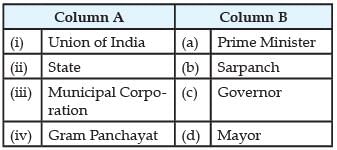
Match the following items given in Column A with those column B:
Detailed Solution: Question 1

(i) Union of India: The Union Cabinet headed by the prime minister is appointed by the President of India to assist the latter in the administration of the affairs of the executive.

(ii) State: Governors, all of whom are popularly elected, serve as the chief executive officers of the fifty states and five commonwealths and territories. As state managers, governors are responsible for implementing state laws and overseeing the operation of the state executive branch.

(iii) Municipal Corporation: The Mayor is the head of the municipal corporation, but in most states and territories of India the role is largely ceremonial as executive powers are vested in the Municipal Commissioner.

(iv) Gram Panchayat: A sarpanch or gram pradhan or mukya is a decision-maker, elected by the village-level constitutional body of local self-government called the Gram Sabha (village government) in India.

Assertion & Reason Test: Federalism - Question 2

Analyse the information given below, considering one of the following correct options:

It includes subjects of national importance such as defence of the country, foreign affairs, banking, communications and currency. They are included in this list because we need a uniform policy on these matters throughout the country.

Detailed Solution: Question 2

Union List includes subjects of national importance such as defence of the country, foreign affairs, banking, communications and currency. The Union Government alone can make laws relating to the subjects mentioned in the Union List.

Assertion & Reason Test: Federalism - Question 3

Assertion and Reason Type Questions:

In the questions given below, there are two statements marked as Assertion (A) and Reason (R). Read the statements and choose the correct option:

Assertion (A) : Federalism is a system of government in which the power is divided between a central authority and various constituent units of the country.

Reason (R) : Usually, a federation has one level of government.

Detailed Solution: Question 3

One is the government for the entire country that is usually responsible for a few subjects of common national interest. The others are governments at the level of provinces or states that look after much of the day-to-day administering of their state.

Assertion & Reason Test: Federalism - Question 4

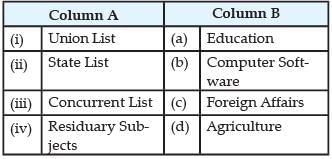
Match the following items given in Column A with those column B:
Detailed Solution: Question 4

(i) Union List: Union List includes subjects of national importance such as defence of the country, foreign affairs, banking, communications and currency. They are included in this list because we need a uniform policy on these matters throughout the country.

(ii) State List: In the Constitution, 'Agriculture' has been placed as Entry 14 in the State List along with several ancillary matters, while some agriculture-related items have been included in the Union List and the Concurrent List.

(iii) Concurrent list: The Indian constitution in its original enactment defined education as state subject. Under Article 42 of the constitution, an amendment was added in 1976 and education became a concurrent list subject which enables the central government to legislate it in the manner suited to it.

(iv) Residuary Subjects: Residuary Subjects are recognised as subjects that are not present in any of the lists stated in the constitution. The government of the Union has the powers to render law on Residuary Subjects. ,These subjects are e-commerce, Computer software and so on.

Assertion & Reason Test: Federalism - Question 5

Find the incorrect option:

Major steps towards decentralisation taken in 1992 were :

Detailed Solution: Question 5

The Incorrect option is (b): At least one-third of all positions are reserved for men.

Assertion & Reason Test: Federalism - Question 6

Analyse the information given below, considering one of the following correct options:

It includes subjects of common interest to both the Union Government as well as the State Governments, such as education, forest, trade unions, marriage, adoption and succession. Both the Union as well as the State Governments can make laws on the subjects mentioned in this list.

Detailed Solution: Question 6

Concurrent List includes subjects of common interest to both the Union Government as well as the State Governments, such as education, forest, trade unions, marriage, adoption and succession. Both the Union as well as the State Governments can make laws on the subjects mentioned in this list. If their laws conflict with each other, the law made by the Union Government will prevail.

Assertion & Reason Test: Federalism - Question 7

Assertion and Reason Type Questions:

In the questions given below, there are two statements marked as Assertion (A) and Reason (R). Read the statements and choose the correct option :

Assertion (A) : When power is taken away from Central and State governments and given to local government, it is called decentralization.

Reason (R) : The basic idea behind decentralization is that there are a large number of problems and issues which are best settled at the local level.

Detailed Solution: Question 7

  • When power is taken away from central and state governments and given to local government, it is called decentralisation. Decentralisation of powers is the sharing of powers among local self-governing bodies. It helps in proper functioning of government and through this, help by government can be reached to even remote parts of the country. On basis of decentralisation three tier Panchayat Raj system has been introduced.

  • The basic idea behind decentralisation is that there are a large number of problems and issues which are best settled at the local level. People have better knowledge of problems in their localities. They also have better ideas on where to spend money and how to manage things more efficiently. Besides, at the local level it is possible for the people to directly participate in decision making. This helps to inculcate a habit of democratic participation. Local government is the best way to realise one important principle of democracy, namely local self-government.

Assertion & Reason Test: Federalism - Question 8

Find the incorrect option:

Which of the following pair is incorrect?

Detailed Solution: Question 8

The Incorrect option is (d): Local government – Residuary powers

Correct answer is: Union government – Residuary powers.

Assertion & Reason Test: Federalism - Question 9

DIRECTION: Mark the option which is most suitable:

Assertion : India has a federal system.

Reason : Under a unitary system, either there is only one level of government or the sub-units are subordinate to central government.

Detailed Solution: Question 9

Both Assertion and Reason are correct, but Reason is not the correct explanation of the Assertion because the federal and unitary systems of government are two different systems.
India has adopted a federal structure of government wherein powers and governance are divided between the centre, state, and local levels. The federal system allows for a responsive government that addresses the issues of their respective jurisdictions so that every stratum of society gets an equal opportunity to voice its opinions. On the other hand, there is a unitary system of government wherein the central government is supreme, and there is no distribution of powers among different levels of government.

Assertion & Reason Test: Federalism - Question 10

DIRECTION: Mark the option which is most suitable:

Assertion : The subjects which are not included in Union List, State List and Concurrent List are considered as residuary subjects.

Reason : The subjects included that came after constitution was made and thus could not be classified.

Detailed Solution: Question 10

The subjects which are not included in Union List, State List and Concurrent List are considered as Residuary subjects. It includes the subjects such as computer software that came after constitution was made. Union Government has power to legislate on these ‘residuary’ subjects.

Assertion & Reason Test: Federalism - Question 11

DIRECTION: Mark the option which is most suitable:

Assertion : Zilla Parishad Chairperson is the political head of the zilla parishad.

Reason : Mayor is the head of municipal corporation.

Detailed Solution: Question 11

Panchayat samitis of a district together form the zilla parishad. Zilla Parishad chairperson is the political head of the zilla parishad. Municipalities are set up in towns. Mayor is the head of municipal corporation. The reason does not however explain the assertion.

Assertion & Reason Test: Federalism - Question 12

DIRECTION: Mark the option which is most suitable:

Assertion : Belgium and Spain has ‘holding together’ federation.

Reason : A big country divides power between constituent states and national government.

Detailed Solution: Question 12

(a) Both assertion and reason are true and reason is the correct explanation of assertion. The power of a large country is divided between constituent states and national government. The central government is more powerful than the states.

Assertion & Reason Test: Federalism - Question 13

DIRECTION: Mark the option which is most suitable:

Assertion : Third-tier of government is local government.

Reason : It made democracy weak.

Detailed Solution: Question 13

The third tier of government is done through decentralisation. It helped in making democracy stronger by Bringing it to grass root level. Thus, the reason is false but assertion stands true.

Assertion & Reason Test: Federalism - Question 14

DIRECTION: Mark the option which is most suitable:

Assertion : Hindi is identified as the only official language of India.

Reason : It helped in creating supremacy of Hindi speaking people over others.

Detailed Solution: Question 14

he statement in the assertion, "Hindi is identified as the only official language of India," is false. While Hindi in the Devanagari script is the official language of the Union Government, English is also used for official purposes, and several other languages are recognized as scheduled languages. The reason given, "It helped in creating supremacy of Hindi speaking people over others," is also false because Hindi is not the only official language and the Constitution protects the rights of speakers of other languages. Therefore, both the assertion and the reason are false.

Assertion & Reason Test: Federalism - Question 15

DIRECTION: Mark the option which is most suitable:

Assertion : A major step towards decentralization was taken in 1992 by amending the constitution.

Reason : Constitution was amended to make the third tier of democracy more powerful and effective.

Detailed Solution: Question 15

The constitution was amended in 1992 to make the third tier more powerful and effective. It includes steps like regular elections for local government bodies, reservation of seats for OBC, SC, ST and women and creation of State Election Commission. The reason thus justifies the assertion.

Assertion & Reason Test: Federalism - Question 16

DIRECTION: Mark the option which is most suitable:

Assertion : Coalition government is formed during dearth of coal in the country.

Reason : It helps in overcoming coal crisis.

Detailed Solution: Question 16

When no party is able to prove clear cut majority, several regional parties come together to form coalition government. It has no connection with scarcity of coal in the country.

Assertion & Reason Test: Federalism - Question 17

A system of government in which power is divided between a central authority and various constituent unit of the country is called

Detailed Solution: Question 17

Federalism is a system of government in which the power is divided between a central authority and various constituent units of the country. Usually, a federation has two levels of government.

Assertion & Reason Test: Federalism - Question 18

DIRECTION: Mark the option which is most suitable:

Assertion : It is very simple to make the changes in the basic structure of the constitution.

Reason : Both the houses have power to amend the constitution independently.

Detailed Solution: Question 18

It is difficult to make changes in the constitution in the federal system. Any change has to be first passed through both the houses of Parliament through atleast two-third majority. Then it has to be ratified by the legislatures of atleast half of the total states. Thus both reason and assertion are false.

79 videos|602 docs|67 tests
Information about Assertion & Reason Test: Federalism Page
In this test you can find the Exam questions for Assertion & Reason Test: Federalism solved & explained in the simplest way possible. Besides giving Questions and answers for Assertion & Reason Test: Federalism, EduRev gives you an ample number of Online tests for practice
79 videos|602 docs|67 tests
Download as PDF