
Units & Measurement - Free Assertion Reason Questions with Solutions NEET
MCQ Practice Test & Solutions: Assertion & Reason Test: Units & Measurement (15 Questions)
You can prepare effectively for NEET Physics and Measurement for NEET with this dedicated MCQ Practice Test (available with solutions) on the important topic of "Assertion & Reason Test: Units & Measurement". These 15 questions have been designed by the experts with the latest curriculum of NEET 2026, to help you master the concept.
Test Highlights:
- - Format: Multiple Choice Questions (MCQ)
- - Duration: 30 minutes
- - Number of Questions: 15
Sign up on EduRev for free to attempt this test and track your preparation progress.

Directions : Each of these questions contain two statements, Assertion and Reason. Each of these questions also has four alternative choices, only one of which is the correct answer. You have to select one of the codes (a), (b), (c) and (d) given below.
Assertion: Dimensional constants are the quantities whose values are constant.
Reason: Dimensional constants are dimensionless.
Detailed Solution: Question 1
Directions : Each of these questions contain two statements, Assertion and Reason. Each of these questions also has four alternative choices, only one of which is the correct answer. You have to select one of the codes (a), (b), (c) and (d) given below.
Assertion : Parallax method cannot be used for measuring distances of stars more than 100 light years away.
Reason : Because parallax angle reduces so much that it cannot be measured accurately.
Detailed Solution: Question 2

Directions : Each of these questions contain two statements, Assertion and Reason. Each of these questions also has four alternative choices, only one of which is the correct answer. You have to select one of the codes (a), (b), (c) and (d) given below.
Assertion : The cesium atomic clocks are very accurate
Reason : The vibration of cesium atom regulate the rate of cesium atomic clock.
Detailed Solution: Question 3
Directions : Each of these questions contain two statements, Assertion and Reason. Each of these questions also has four alternative choices, only one of which is the correct answer. You have to select one of the codes (a), (b), (c) and (d) given below.
Assertion : Now a days a standard metre is defined in terms of the wavelength of light.
Reason : Light has no relation with length.
Detailed Solution: Question 4
Directions : Each of these questions contain two statements, Assertion and Reason. Each of these questions also has four alternative choices, only one of which is the correct answer. You have to select one of the codes (a), (b), (c) and (d) given below.
Assertion : The number of significant figures depends on the least count of measuring instrument.
Reason : Significant figures define the accuracy of measuring instrument.
Detailed Solution: Question 5
Directions : Each of these questions contain two statements, Assertion and Reason. Each of these questions also has four alternative choices, only one of which is the correct answer. You have to select one of the codes (a), (b), (c) and (d) given below.
Assertion : Number of significant figures in 0.005 is one and that in 0.500 is three
Reason : This is because zeros are not significant.
Detailed Solution: Question 6
Directions : Each of these questions contain two statements, Assertion and Reason. Each of these questions also has four alternative choices, only one of which is the correct answer. You have to select one of the codes (a), (b), (c) and (d) given below.
Assertion : Energy cannot be divided by volume.
Reason : Dimensions for energy and volume are different.
Detailed Solution: Question 7
Directions : Each of these questions contain two statements, Assertion and Reason. Each of these questions also has four alternative choices, only one of which is the correct answer. You have to select one of the codes (a), (b), (c) and (d) given below.
Assertion : Avogadro’s number is the number of atoms in one gram mole.
Reason : Avogadro’s number is a dimensionless constant.
Detailed Solution: Question 8
Directions : Each of these questions contain two statements, Assertion and Reason. Each of these questions also has four alternative choices, only one of which is the correct answer. You have to select one of the codes (a), (b), (c) and (d) given below.
Assertion : When we change the unit of measurement of a quantity, its numerical value changes.
Reason : Smaller the unit of measurement smaller is its numerical value.
Detailed Solution: Question 9
Directions : Each of these questions contain two statements, Assertion and Reason. Each of these questions also has four alternative choices, only one of which is the correct answer. You have to select one of the codes (a), (b), (c) and (d) given below.
Assertion : A.U. is much bigger than Å.
Reason : A.U. stands for astronomical unit and A stands for Angstrom.
Detailed Solution: Question 10
Directions : Each of these questions contain two statements, Assertion and Reason. Each of these questions also has four alternative choices, only one of which is the correct answer. You have to select one of the codes (a), (b), (c) and (d) given below.
Assertion: In the measurement of physical quantities direct and indirect methods are used.
Reason : The accuracy and precision of measuring instruments along with errors in measurements should be taken into account, while expressing the result.
Detailed Solution: Question 11
Directions : Each of these questions contain two statements, Assertion and Reason. Each of these questions also has four alternative choices, only one of which is the correct answer. You have to select one of the codes (a), (b), (c) and (d) given below.
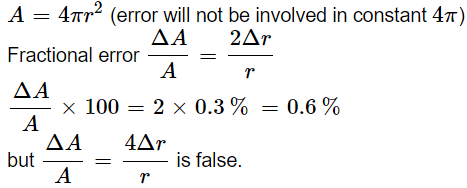
Assertion : The error in the measurement of radius of the sphere is 0.3%.The permissible error in its surface area is 0.6%.
Reason : The permissible error is calculated by the formula ΔA/A=4Δr/r
Detailed Solution: Question 12
Directions : Each of these questions contain two statements, Assertion and Reason. Each of these questions also has four alternative choices, only one of which is the correct answer. You have to select one of the codes (a), (b), (c) and (d) given below.
Assertion : Out of three measurements I = 0.7 m; I = 0.70 m and I = 0.700 m, the last one is most accurate.
Reason : In every measurement, only the last significant digit is not accurately known.
Detailed Solution: Question 13
Directions : Each of these questions contain two statements, Assertion and Reason. Each of these questions also has four alternative choices, only one of which is the correct answer. You have to select one of the codes (a), (b), (c) and (d) given below.
Assertion : Absolute error may be negative or positive.
Reason : Absolute error is the difference between the real value and the measured value of a physical quantity.
Detailed Solution: Question 14
Directions : Each of these questions contain two statements, Assertion and Reason. Each of these questions also has four alternative choices, only one of which is the correct answer. You have to select one of the codes (a), (b), (c) and (d) given below.
Assertion: ‘Light year’ and ‘Wavelength’ both measure distance.
Reason : Both have dimension of time.
Detailed Solution: Question 15
12 videos|27 docs|24 tests |
