JEE Exam  >  JEE Test  >  BITSAT Mock Tests Series & Past Year Papers 2026  >  BITSAT Chemistry Test - 4 - JEE MCQ

BITSAT Chemistry Test - 4 Free Online Test 2026


MCQ Practice Test & Solutions: BITSAT Chemistry Test - 4 (30 Questions)

You can prepare effectively for JEE BITSAT Mock Tests Series & Past Year Papers 2026 with this dedicated MCQ Practice Test (available with solutions) on the important topic of "BITSAT Chemistry Test - 4". These 30 questions have been designed by the experts with the latest curriculum of JEE 2026, to help you master the concept.

Test Highlights:

  • - Format: Multiple Choice Questions (MCQ)
  • - Duration: 40 minutes
  • - Number of Questions: 30

Sign up on EduRev for free to attempt this test and track your preparation progress.

BITSAT Chemistry Test - 4 - Question 1

Which of the following group is sharp ortho and para directive?

Detailed Solution: Question 1

All the groups are o- and p-directive.
In (–OH) group, lone pair of electron present at oxygen (O -atom) , increases electron density for electrophile at o−  and p− positions. Thus, it is sharp o− and p− directive.)

BITSAT Chemistry Test - 4 - Question 2

Nitrobenzene can be prepared from benzene by using a mixture of concentrated HNO3 and concentrated. H2SO4. In the mixture, nitric acid acts as a/an:

Detailed Solution: Question 2
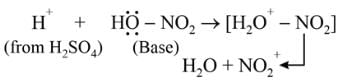
This is nitration of benzene with nitronium electrophile.
As we know sulphuric acid has more acidity then nitric acid, so sulphuric acid gives proton and nitric acid takes proton to remove water and to form nitronium ion.

BITSAT Chemistry Test - 4 - Question 3

Chloroprene is obtained by addition of HCI to

Detailed Solution: Question 3

Chloroprene is obtained by treating vinylacetylene with HCI.

2-chloro-1,3-butadiene
(chloroprene)

BITSAT Chemistry Test - 4 - Question 4

On vigorous oxidation by alkaline permanganate solution, (CH3)2C=CH−CH2CH3 gives:

Detailed Solution: Question 4

Generally, alkenes can easily be oxidized by potassium permanganate and other oxidizing agents. The products formed depend on the reaction conditions. 
At low temperatures, with low concentrations of oxidizing reagents, alkenes form diols.
When more concentrated solutions of potassium permanganate and higher temperatures are employed (vigorous conditions), the reaction would not stop at this point.
The product of the reaction depends on the arrangement of groups around the carbon−carbon double bond. The potassium permanganate (VII) solution oxidizes the alkene by breaking the carbon - carbon double bond and replacing it with two carbon - oxgyen double bonds forming carbonyl compounds. 

  • If there are two alkyl groups at one end of the bond, that part of the molecule will give a ketone.
  • If there is one alkyl group and one hydrogen at one end of the bond, that part of the molecule will give a carboxylic acid.
  • If there are two hydrogens at one end of the bond, that part of the molecule will give carbon dioxide and water.

In 2- methyl 2−pentene, one carbon contains two methyl groups on one side of the double bond and the other carbon has one alkyl chain and one hydrogen. Hence, the product will be one ketone and one carboxylic acid.

BITSAT Chemistry Test - 4 - Question 5

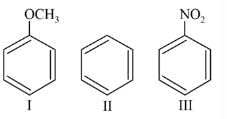
Among the following compounds (I-III) the correct order of reaction with electrophilic reagent is
Detailed Solution: Question 5
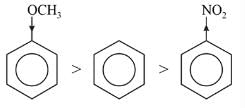
Methoxy group is electron releasing group it increases electron density of benzene nucleus - NO2 group is electron withdrawing group, it decreases the electron density of benzene nucleus. Thus, the order of reaction with electrophilic regent is

BITSAT Chemistry Test - 4 - Question 6

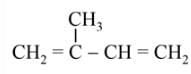
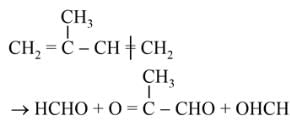
The products obtained on ozonolysis of the given alkene, followed by reaction with Zn/H2O are:
Detailed Solution: Question 6
BITSAT Chemistry Test - 4 - Question 7

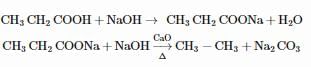
X on heating with soda lime gives ethane. X can be:

Detailed Solution: Question 7

The method of preparation of an alkane using soda lime (which is a mixture of  NaOH and CaO) is known as soda lime decarboxylation.
In soda lime decarboxylation, carboxylic acid is heated with soda lime, resulting into the formation of alkane having one carbon less than carboxylic acid.

BITSAT Chemistry Test - 4 - Question 8

The number of geometrical isomers of CH3CH=CH−CH=CH−CH=CHCl is

Detailed Solution: Question 8

Geometrical isomerism arises due to the restricted rotation in the molecule. In this molecule, a double bond causes restricted rotation and the geometrical isomers are formed. In the given compound, there are three double bonds and each carbon atom is substituted differently. So the number of geometrical isomers will be 2n = 23 = 8, where n is the number of double bonds whose each carbon atom is differently substituted.

BITSAT Chemistry Test - 4 - Question 9

Chlorination of benzene is not possible in the following reaction.

Detailed Solution: Question 9
Since iodine is less electronegative than chlorine, therefore, ZnCl2 react with ICl to form iodonium ion(I+) as electrophile which subsequently reacts with benzene to produce iodobenzene

BITSAT Chemistry Test - 4 - Question 10

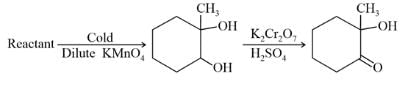
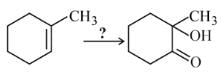
The missing reagents to complete the reaction are

Detailed Solution: Question 10


First reagent is cold alkaline KMnO4, which converts alkene into diol.
Second reagent is acidic K2 Cr2 O7, which oxidises secondary alcohol into ketone. Tertiary alcohol is not oxidised.

BITSAT Chemistry Test - 4 - Question 11

Toluene is nitrated and the resulting product is reduced with tin and hydrochloric acid. The product so obtained is mixed with NaNO2/HCl and CuBr and then heated, the product so formed contains.

Detailed Solution: Question 11
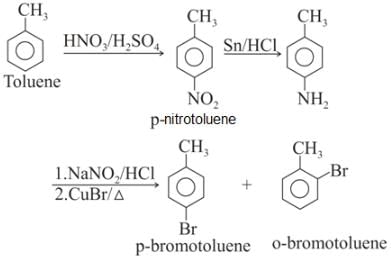
The reaction Sequence is as Follows :

When a diazonium salt is treated with copper (I) chloride (Cu2Cl2) or copper (I) bromide (Cu2Br2), the corresponding haloarene is formed. This reaction is known as Sandmeyer reaction. It is used for introducing a chloro or bromo group in the benzene ring.

BITSAT Chemistry Test - 4 - Question 12

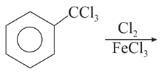
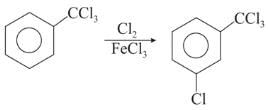
Find the major product in the following reaction,

Detailed Solution: Question 12

–CCl3 group is m–directing due to -I and -H effect.

BITSAT Chemistry Test - 4 - Question 13

What would be the product formed when 1-bromo-3-chlorocyclobutane reacts with two equivalents of metallic sodium in ether?

Detailed Solution: Question 13

The reaction is Wurtz's type reaction and follows free radical mechanism.

BITSAT Chemistry Test - 4 - Question 14

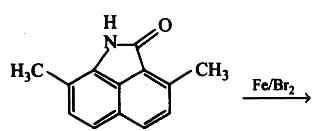
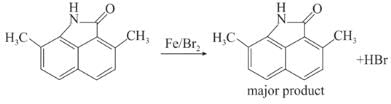
Product on monobromination of this compound is

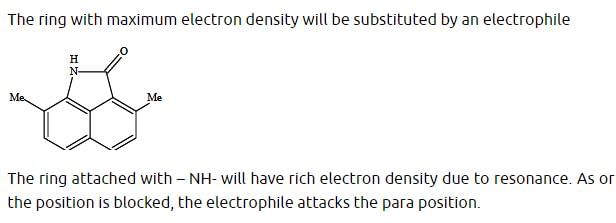
Detailed Solution: Question 14


BITSAT Chemistry Test - 4 - Question 15

Which of the following undergoes nucleophilic substitution exclusively by an SN1 mechanism

Detailed Solution: Question 15

Aliphatic SN1 reaction is carried out in two steps. In first step carbocation is formed and its formation is based on the stability of carbonation. 
In the second step, the nucleophile is attracted to carbocation to give final products. Hence, an order of SN1 is

The aryl halides e.g., chlorobenzene are less reactive as compared to alkyl halides towards nucleophilic reagents in either SN2 or SN1 reaction because carbon-halogen bond in the aryl halide is strong (due to its double bond character). 

BITSAT Chemistry Test - 4 - Question 16

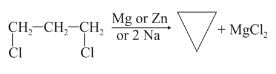
What is the product A in the following?

Detailed Solution: Question 16


It is Wurtz coupling reaction. In first step one chlorine is removed to generate nucleophile. After this intramolecular nucleophilic substitution takes place to form cyclic compound.
Hence, in given reaction cyclopropane is a final product.

BITSAT Chemistry Test - 4 - Question 17

Racemic tartaric acid is optically inactive due to

Detailed Solution: Question 17

Racemic tartaric acid is optically inactive due to external compensation.

Racemic tartaric acid is an equimolar mixture of optically active d- and l- forms. This form of tartaric acid is optically inactive due to external compensation.

BITSAT Chemistry Test - 4 - Question 18

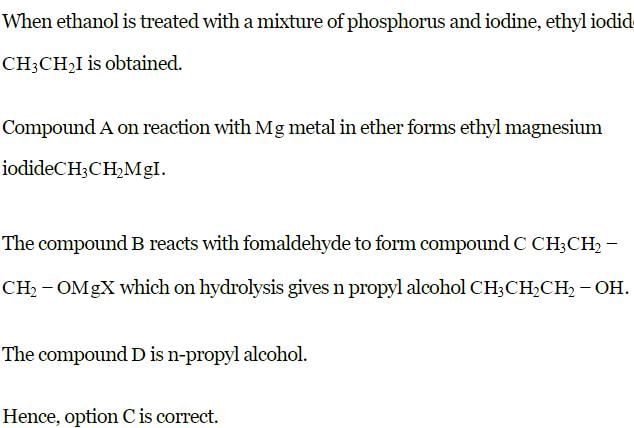
In the following sequence of reactions, 

, then compound D is:

Detailed Solution: Question 18
BITSAT Chemistry Test - 4 - Question 19

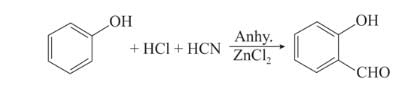
The following reaction is known as

Detailed Solution: Question 19

In the presence of anhydrous ZnCl2, phenol form salicyladehyde. It is Gattermann-aldehyde reaction.

BITSAT Chemistry Test - 4 - Question 20

 Which of the following compounds will form the precipitate with aq. AgNO3 solution most readily?

Detailed Solution: Question 20

It is an example of SN1SN1 reaction.
Rate of SN1 reaction α stability of carbocation SN1 reaction α stability of carbocation 
In option A carbocation formed after removing halogen is destabilized by −I-I effect.
In option B carbocation formed after removing halogen is stabilized by +M effect since lone pair is present at oxygen atom.
In option C carbocation formed after removing halogen is stabilized by +M effect of lone pair present on nitrogen atom but lone pair is also in conjugation with benzene ring therefore +M effect is less.
In option D carbocation formed after removing halogen is stabilized by +M effect of lone pair present on nitrogen atom and +M effect of nitrogen atom is more than that of oxygen atom. Hence, option D is most stable. 

BITSAT Chemistry Test - 4 - Question 21

Isotopes have

Detailed Solution: Question 21

Those substances which have same atomic number but different atomic weight are known as isotopes. The number of protons present in the nucleus of the atom is known as atomic number.

BITSAT Chemistry Test - 4 - Question 22

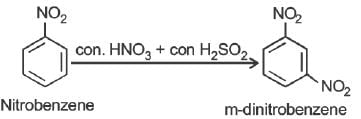
Nitrobenzene on nitration produce

Detailed Solution: Question 22


Therefore, on nitration it produce m-dinitrobenzene. 

BITSAT Chemistry Test - 4 - Question 23

The specific rate constant of a first order reaction depends on

Detailed Solution: Question 23

the specific rate constant of a first order reaction depends on the temperature of the reaction. The rate constant, k , is a measure of the relationship between the rate of a chemical equation and the concentration of the reacting substance.

BITSAT Chemistry Test - 4 - Question 24

The law which explains the law of conservation of mass is

Detailed Solution: Question 24

The law of conservation of mass can be best explained by Dalton’s law, because according to Dalton’s law atoms can neither be created nor destroyed.

BITSAT Chemistry Test - 4 - Question 25

The type of linkage present in protein molecule is

Detailed Solution: Question 25

The linkage present in protein molecules is known as peptide linkage.

BITSAT Chemistry Test - 4 - Question 26

Two molecules of an ideal gas expand spontaneously into a vacuum. The work done is

Detailed Solution: Question 26

We know that during expansions of an ideal gas in vacuum. The work done is zero as in vacuum there is no force of attraction or repulsion is taking place.

BITSAT Chemistry Test - 4 - Question 27

Toluene and chromyl chloride reacts to produce 

Detailed Solution: Question 27

Chromyl chloride oxidise toluene as below

BITSAT Chemistry Test - 4 - Question 28

Schiff’s reagent is

Detailed Solution: Question 28

Schiff's reagent is a solution of rosaniline hydrochloride used for the detection of aldehyde group.

BITSAT Chemistry Test - 4 - Question 29

At 25°C the pH value of a solution is 6, the solution is

Detailed Solution: Question 29

The pH of neutral solution is 7. The pH below 7 shows acidic and above 7 shows basic solution.

BITSAT Chemistry Test - 4 - Question 30

In an aqueous solution hydrogen will not reduce of

Detailed Solution: Question 30

In an aq. solution hydrogen will not reduce Zn2+ as its reduction potential is lower than hydrogen.

2 videos|18 docs|70 tests
Information about BITSAT Chemistry Test - 4 Page
In this test you can find the Exam questions for BITSAT Chemistry Test - 4 solved & explained in the simplest way possible. Besides giving Questions and answers for BITSAT Chemistry Test - 4, EduRev gives you an ample number of Online tests for practice
Download as PDF