CUET Exam  >  CUET Test  >   UG Mock Test Series 2026  >  Biology: CUET Mock Test - 2 - CUET MCQ

CUET UG Biology: Mock Test - 2 Free Online Test 2026


Full Mock Test & Solutions: Biology: CUET Mock Test - 2 (50 Questions)

You can boost your CUET 2026 exam preparation with this Biology: CUET Mock Test - 2 (available with detailed solutions).. This mock test has been designed with the analysis of important topics, recent trends of the exam, and previous year questions of the last 3-years. All the questions have been designed to mirror the official pattern of CUET 2026 exam, helping you build speed, accuracy as per the actual exam.

Mock Test Highlights:

  • - Format: Multiple Choice Questions (MCQ)
  • - Duration: 60 minutes
  • - Total Questions: 50
  • - Analysis: Detailed Solutions & Performance Insights

Sign up on EduRev for free and get access to these mock tests, get your All India Rank, and identify your weak areas to improve your marks & rank in the actual exam.

Biology: CUET Mock Test - 2 - Question 1

Arrange the following events of human embryo development in a correct sequence:

(A) Blastocyst formation

(B) Implantation

(C) Formation of morula

(D) Cleavage in zygote

Choose the correct answer from the options given below:

Detailed Solution: Question 1

Key Points

  • The correct sequence of human embryo development starts with (D) Cleavage in zygote, which is the first step following fertilization. This process involves the division of the zygote into smaller, multicellular stages without the zygote increasing in size.
  • Following cleavage, the zygote develops into (C) the morula, a solid ball of cells.
  • As development continues, the morula transforms into (A) the blastocyst, a hollow ball of cells with an inner cell mass that eventually forms the embryo.
  • The final step in the sequence is (B) implantation, where the blastocyst attaches itself to the wall of the uterus.

The correct answer is option 2: (D), (C), (A), (B).

Additional Information

  • Option 1: (C), (D), (B), (A) is incorrect because it suggests that the morula forms before cleavage, which is not the correct order of development.
  • Option 3: (D), (B), (C), (A) incorrectly places implantation before the formation of the morula and blastocyst, which is not possible as implantation is the final step in this sequence.
  • Option 4: (A), (C), (D), (B) is incorrect as it suggests the blastocyst forms before cleavage and morula formation, which contradicts the actual developmental sequence.

Biology: CUET Mock Test - 2 - Question 2

Amniocentesis is used to detect the:

Detailed Solution: Question 2

Amniocentesis is a medical procedure used for prenatal diagnosis of chromosomal abnormalities and fetal infections. It involves extracting a small amount of amniotic fluid, which contains fetal tissues, for analysis.

Key Points

  • Amniocentesis is primarily used to detect the presence of certain genetic disorders. This includes conditions such as Down syndrome, cystic fibrosis, and spina bifida.

Additional Information

  • Sexually transmitted diseases: Amniocentesis is not typically used to detect sexually transmitted diseases. Such conditions are usually diagnosed through blood tests, urine tests, or swabs of the affected area.
  • Causes of infertility: Amniocentesis cannot be used to determine the causes of infertility. Infertility assessments usually involve a different set of tests for both men and women.
  • Presence of pneumonia germs: Although amniocentesis can detect some infections, it is not specifically used for diagnosing pneumonia in the fetus. Pneumonia diagnosis would typically involve chest X-rays or sputum tests in the suspected individual.

Biology: CUET Mock Test - 2 - Question 3

What will be the number of genotypes and phenotypes obtained in F2 generation when male parent RRyy is crossed with female parent rrYY?

Detailed Solution: Question 3

Key Points

  • In a cross between RRyy (round, yellow seeds) and rrYY (wrinkled, green seeds), the F1 generation will all be RrYy, exhibiting the dominant traits (round and green seeds).
  • The F2 generation, obtained by self-pollinating the F1 generation, will show a variety of genotypes due to the independent assortment and segregation of alleles during gamete formation.
  • When considering two traits controlled by two genes, each with two alleles (Rr and Yy), the Punnett square method predicts that 16 different genotypes can be formed in the F2 generation.
  • However, these 16 genotypes will only result in 4 different phenotypes because the traits are independently inherited and express complete dominance (round yellow, round green, wrinkled yellow, wrinkled green).
  • Therefore, the number of genotypes is 9 and the number of phenotypes is 4, which aligns with option 3.

Additional Information

  • Option 1 (16 genotypes and 4 phenotypes) incorrectly suggests a reversal in the number of genotypes and phenotypes.
  • Option 2 (4 genotypes and 16 phenotypes) also incorrectly reverses the numbers, and it is not possible to have more phenotypes than genotypes in this scenario.
  • Options 4 and 5 are not applicable as they either present incorrect combinations or are left blank.
  • The correct understanding of Mendelian genetics and the principles of dominance, segregation, and independent assortment is crucial for predicting the outcomes of genetic crosses.

Biology: CUET Mock Test - 2 - Question 4

Which of the following genetic disorder is not a type of Mendelian disorder?

Detailed Solution: Question 4

Key Points

  • Down's syndrome is not a type of Mendelian disorder. It is caused by the presence of an extra copy of chromosome 21 (Trisomy 21), which is a type of chromosomal disorder.

Additional Information

  • Colour blindness is a Mendelian disorder linked to the X chromosome. It is commonly a result of the inability to perceive colors correctly, often red and green.
  • Haemophilia is another X-linked Mendelian disorder characterized by the inability of blood to clot properly, leading to excessive bleeding from even minor injuries.
  • Thalassaemia is a Mendelian genetic disorder affecting the blood, where the body makes an abnormal form of hemoglobin, resulting in excessive destruction of red blood cells and anemia.

Biology: CUET Mock Test - 2 - Question 5

Which one of the following will represent low stability and high resilience?

Detailed Solution: Question 5

The correct answer is An ecosystem which can be easily damaged but can recover after some time if damaging effect stops

  • Low Stability: Stability in an ecosystem refers to its ability to resist change or disturbance. In this case, the ecosystem described can be easily damaged, indicating low stability. This means that even minor disturbances or stresses can disrupt its structure and function.
  • High Resilience: Resilience is the ability of an ecosystem to recover and return to its original state after being disturbed. The ecosystem described in option 1 can recover after some time if the damaging effect stops. This demonstrates high resilience because despite being easily damaged, it has the capacity to bounce back and restore itself.

In summary, option 1 represents an ecosystem that is prone to damage (low stability) but has the ability to recover effectively (high resilience). This combination of characteristics is typical of ecosystems that are subject to frequent disturbances but can adapt and regenerate over time.

Biology: CUET Mock Test - 2 - Question 6

When environmental conditions are favorable, then the population growth curve will be

Detailed Solution: Question 6
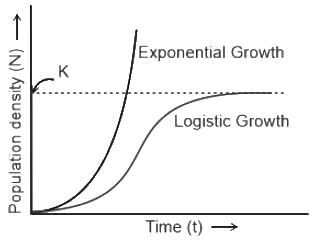
Concept:

  • Growth models help us understand if the growth of any population over time follows a particular pattern or not.
  • This also helps us to understand several other attributes of the population.
  • Growth models explain 2 types of growth curves:
    • Exponential - This takes place when the resources are unlimited and the population keeps growing.
    • Logistic - This is a growth model that takes the limitations of resources into account.

Key Points

  • A 'J-shaped' curve represents an exponential growth curve.
  • Such cases where the population keeps growing exponentially is known as exponential growth.
  • Exponential growth takes place when the environmental conditions are favorable and the resources available are unlimited.
  • Under such ideal conditions, the species are able to realize their full growth potential.
  • This results in an increased reproductive ability leading to exponential growth of the population.
  • When the population density (N) is plotted against time (t), it produces a J-shaped curve for exponential or geometric growth.

It can be denoted by the equation:

where, N = Population Density,

= Rate of change of population density.

Here, 'r' represents the intrinsic rate of natural increase, which is the difference between the per capita birth and death (b-d).

Biology: CUET Mock Test - 2 - Question 7

Where does fertilization occur in a flowering plant?

Detailed Solution: Question 7

Fertilization occurs inside the ovary, where the sperm cell from the pollen fertilizes the ovule, resulting in the formation of a zygote.

Biology: CUET Mock Test - 2 - Question 8

What structure aids in the transfer of sperm to the ovule in flowering plants?

Detailed Solution: Question 8

The pollen tube forms after pollination and grows down through the style, allowing the sperm cell to reach and fertilize the ovule in the ovary.

Biology: CUET Mock Test - 2 - Question 9

The fusion of male and female gametes results in the formation of ___________.

Detailed Solution: Question 9

The fusion of male (sperm) and female (egg) gametes forms the zygote, which later develops into the seed.

Biology: CUET Mock Test - 2 - Question 10

What is the function of exons in eukaryotic gene expression?

Detailed Solution: Question 10

Exons are the coding sequences in eukaryotic genes that contain the genetic information necessary for protein synthesis.

NCERT Topic: Exons in eukaryotes

NCERT Line: "In eukaryotes, the gene is split. The coding sequences, exons, are interrupted by non-coding sequences, introns."

Biology: CUET Mock Test - 2 - Question 11

What would happen, if in a gene encoding a polypeptide of 50 amino acids, 25th codon (UAU) is mutated to UAA?

Detailed Solution: Question 11

UAA is a nonsense codon. It signals for polypeptide chain termination. Hence, only 24 amino acids chain will be formed.

Biology: CUET Mock Test - 2 - Question 12

Match column I with column II and select the correct option from the given codes.
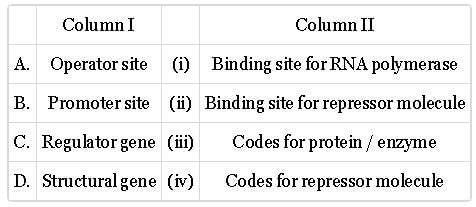
Detailed Solution: Question 12

The accessibility of promoter regions of prokaryotic DNA is regulated by interaction of proteins with sequences called as operators. Repressor molecules that repress gene expression bind to the operator sits and as a result the promoter cannot initiate gene transcription. Promoter is the site for the binding of the RNA polymerase to initiate the process of transcription. It refers to a conserved sequence that is specific for the binding of the RNA polymerase that can bring the expression genes for various functions. Regulator gene is the gene of an operon that codes for a repressor molecule that can bind to the operator sequence and stop gene expression. Structural gene codes for proteins or enzymes that are essential for the cell growth and survival 
So, the correct option is 'A - (ii), B - (i), C - (iv), D - (iii)'.

Biology: CUET Mock Test - 2 - Question 13

What is the role of the anticodon loop in tRNA?

Detailed Solution: Question 13

The anticodon loop is crucial for the accurate translation of mRNA into protein, as it ensures that the correct amino acid is added to the growing polypeptide chain.

Biology: CUET Mock Test - 2 - Question 14

According to the Hardy-Weinberg principle, what condition indicates that evolution is occurring in a population?

Detailed Solution: Question 14

The Hardy-Weinberg principle states that allele frequencies remain stable (genetic equilibrium) unless disturbed by factors like genetic drift, mutation, or natural selection. A change in allele frequencies, as in Option C, indicates evolution, disrupting the equilibrium.

Biology: CUET Mock Test - 2 - Question 15

On Galapagos island, Darwin observed variation in beaks of birds (Darwin's finches) and he concluded:

Detailed Solution: Question 15

  • All the varieties, he conjectured, evolved on the island itself.
  • From the original seed eating features, many other forms with altered beaks arose, enabling them to become insectivorous and vegetarian finches

Biology: CUET Mock Test - 2 - Question 16

Which of the following factors contribute to changes in gene and allele frequencies, leading to speciation?

1. Gene migration or gene flow
2. Genetic drift
3. Mutation
4. Genetic recombination
5. Natural selection

Detailed Solution: Question 16
Gene migration or gene flow (1) involves the movement of genes between populations, affecting gene frequencies.
Genetic drift (2) refers to random changes in gene frequencies due to chance events, especially in small populations.
Mutation (3) introduces new genetic variations that can alter gene frequencies.
Genetic recombination (4) during gametogenesis creates new combinations of alleles, influencing genetic diversity.
Natural selection (5) acts on heritable traits, enhancing reproductive success and influencing the frequency of advantageous alleles in future generations.
All these factors contribute to changes in allele frequencies and can lead to speciation over time.

Biology: CUET Mock Test - 2 - Question 17

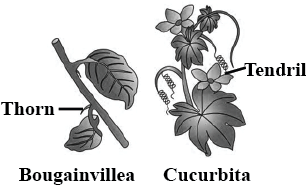
The given figure shows an example of 

Detailed Solution: Question 17

A thorn of Bougainvillea and a tendrill of Curcurbita, both are stem modifications and thus represent homologous structures. The modifications indicate the evolution of the organ to suit different functions which is also known as divergent evolution.

Biology: CUET Mock Test - 2 - Question 18

Which of the following statements regarding the disease typhoid is/are correct?

(i) Salmonella typhi are the pathogenic bacteria which enter human intestine through contaminated food and water and migrate to other organs through blood.
(ii) Sustained high fever (39C to 40C), weakness, stomach pain, constipation, headache and loss of appetite are some common symptoms of typhoid.
(iii) Typhoid vaccine is available as DPT vaccine.
(iv) Widal test is used for diagnosis of typhoid fever.
(v) The patient of this disease is not required to be treated with antibiotics.

Detailed Solution: Question 18

DPT vaccine is for diphtheria, pertussis and tetanus. The patient suffering from typhoid is required to be treated with antibiotics as it is a bacterial disease.

Biology: CUET Mock Test - 2 - Question 19

Which of the following statements about the treatment of HIV/AIDS is/are correct?

i. Anti-retroviral drugs can completely cure HIV/AIDS.

ii. Anti-retroviral drugs help control the replication of the virus and prolong the life of the patient.

iii. There is no vaccine available for HIV prevention, but safe sex practices can reduce transmission.

iv. HIV treatment is only effective during the early stages of infection.

Detailed Solution: Question 19

Statement i is incorrect because there is no complete cure for HIV/AIDS, but the disease can be managed with treatment.
Statement ii is correct as anti-retroviral drugs help control the replication of HIV and can prolong life.
Statement iii is correct because safe sex practices and other preventive measures can reduce the transmission of HIV, and there is no current vaccine.
Statement iv is incorrect as HIV treatment can be effective throughout the course of the disease, not just in the early stages.
Thus, the correct answer is Option B: ii and iii.

Topic in NCERT: Treatment of aids with anti-retroviral drugs

Line in NCERT: "treatment of aids with anti-retroviral drugs is only partially effective. they can only prolong the life of the patient but cannot prevent death, which is inevitable."

Biology: CUET Mock Test - 2 - Question 20

Match column I with column II and select the correct option from codes given below.

Detailed Solution: Question 20

A: A−(iv), B−(i), C−(v), D−(iii), E−(ii)

B: A−(ii), B−(i), C−(v), D−(iii), E−(iv)

C: A−(iv), B−(v), C−(iii), D−(ii), E−(i)

D: A−(ii), B−(v), C−(iii), D−(i), E−(iv)


    Allergy: Linked to IgE, which is responsible for allergic reactions.

    Helper T-cells: Linked to activation of B-cells, crucial for immune response.

    AIDS virus: HIV is a single-stranded RNA virus.

    X-rays: Known carcinogens that can cause cancer.

    Treatment of cancer: Often involves immunotherapy.

    The correct option is: A: A−(iv), B−(i), C−(v), D−(iii), E−(ii)

    Biology: CUET Mock Test - 2 - Question 21

    Which of the following reasons is mainly responsible for graft rejection in transplantation of organs?  (NEET 2022 Phase 2)

    Detailed Solution: Question 21

    • Option (1) is the correct answer as the body is able to differentiate between ‘self’ and ‘non-self’ and the cell-mediated immune response is responsible for the graft rejection.
    • Option (2) is incorrect as body of higher vertebrates have the ability to differentiate foreign organisms from self cells.
    • Option (4) is incorrect as the autoimmune response occur when the body’s immune system fails to recognize ‘self’ from ‘non-self’ and starts destroying the body’s own cells.

    Biology: CUET Mock Test - 2 - Question 22

    Match column I with column II and select the correct option from the codes given below.
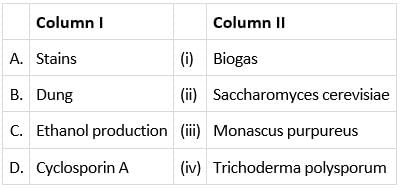
    Detailed Solution: Question 22

    Strains are produced by Monascus purpureus. Dung is used to producing Biogas. Saccharomyces cerevisiae is used in the production of ethanol.  Cyclosporin A is obtained from Trichoderma polysporum.

    Biology: CUET Mock Test - 2 - Question 23

    Which of the following statements regarding baculoviruses as biocontrol agents is/are correct?

    Detailed Solution: Question 23

    Baculoviruses are pathogens that attack insects and other arthropods. The majority of them used as a biological control agents are in the genus Nucleopolyhedrovirus.These viruses are excellent candidates for species-specific, narrow spectrum insecticidal applications. Infection with baculoviruses occurs when susceptible hosts eat virus particle present on foliage and dies. These are important in organic farming because of their specific action on harmful insects without causing any damage to beneficial insects as well as to the environment.

    Biology: CUET Mock Test - 2 - Question 24

    The restriction enzyme responsible for the cleavage of following sequence  is 
    5' - G - T - C - G - A - c - 3'
    3' - C - A - G - C - T - G - 5'

    Detailed Solution: Question 24

    HindII was the first discovered restriction endonuclease. It was isolated from Haemophilus influenzae. It produces blunt ends.

    Biology: CUET Mock Test - 2 - Question 25

    The different steps of recombinant DNA technology are given below randomly.
    (i) Isolation of the DNA fragments or genes to be cloned
    (ii) Introduction of the recombinant DNA into a suitable cell (usually E.coli) called host (transformation)
    (iii) Multiplication/expression of the introduced gene in the host
    (iv) Selection of the transformed host cells, and identification of the clone containing the desired gene/DNA fragment
    (v) Insertion of the isolated gene in a suitable plasmid vector

    Which of the following represents the correct sequence of steps?

    Detailed Solution: Question 25

    Recombinant DNA Technology Steps:
    The correct sequence of steps in recombinant DNA technology is as follows:
    (i) Isolation of the DNA fragments or genes to be cloned:
    - This step involves extracting the specific DNA fragments or genes from a source organism.
    (v) Insertion of the isolated gene in a suitable plasmid vector:
    - The isolated gene is inserted into a plasmid vector, which acts as a carrier for the gene.
    (ii) Introduction of the recombinant DNA into a suitable cell (usually E.coli) called host (transformation):
    - The recombinant DNA is introduced into a host cell, typically E.coli, through a process called transformation.
    (iv) Selection of the transformed host cells, and identification of the clone containing the desired gene/DNA fragment:
    - The transformed host cells are selected and screened to identify the clone that contains the desired gene or DNA fragment.
    (iii) Multiplication/expression of the introduced gene in the host:
    - The introduced gene in the host cell undergoes multiplication and expression, resulting in the production of the desired protein or molecule.
    Therefore, the correct sequence of steps in recombinant DNA technology is (i), (v), (ii), (iv), (iii), which corresponds to option C.

    Biology: CUET Mock Test - 2 - Question 26

    Enzyme' Taq polymerase' used in PCR, has been isolated from bacterium ________.

    Detailed Solution: Question 26

    The final step of PCR is extension, wherein TaqDNA polymerase (isolated from a thermophilic bacterium Thermus aquaticus) synthesies the DNA region between the primers, using DNTPs (denoxynucleoside triphosphates) and Mg2+. The primers are extened towards each other so that the DNA segment lying between the two primers is copied. The optimum temperature for this polymerisation step is 72C. Taq polymerase remains active during high temperature induced denaturation of double stranded DNA.

    Biology: CUET Mock Test - 2 - Question 27

    Which of the following genes were introduced in cotton to protect it from cotton bollworms?

    Detailed Solution: Question 27

    Two cry genes, crylAc and cryllAb have been incorporated in cotton. The genetically modified crop is called Bt cotton as it contains Bt toxin genes. The genes crylAc and cryllAb control cotton bollworms.

    Biology: CUET Mock Test - 2 - Question 28

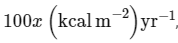
    In an ecosystem if the Net Primary Productivity (NPP) of first trophic level is  what would be the GPP (Gross Primary Productivity) of the third trophic level of the same ecosystem?  (2024)
    Detailed Solution: Question 28

    NPP at first trophic level would be the GPP for second trophic level. NPP at second trophic level would be GPP for third trophic level. Therefore, 100x(kcal/m2/yr) would be GPP at second trophic level and 100x * 10% (kcal/m2/yr) i.e 10x(kcal/m2/yr) energy would be GPP at third trophic level.

    Topic in NCERT: Productivity

    Line in NCERT: The rate of biomass production is called productivity. It is expressed in terms of gm–2 yr –1 or (kcal m–2 ) yr –1 to compare the productivity of different ecosystems. It can be divided into gross primary productivity (GPP) and net primary productivity (NPP)

    Biology: CUET Mock Test - 2 - Question 29

    Which of the following statements regarding the diversity of plants and animals in tropical regions is/are correct?

    i. Species diversity is generally higher in tropical regions compared to temperate and polar areas due to longer evolutionary timeframes.

    ii. Tropical environments, being less seasonal and more constant, promote niche specialization which contributes to greater species diversity.

    iii. The greater availability of solar energy in tropical regions leads to higher productivity, which indirectly supports greater biodiversity.

    iv. Polar regions have been less affected by glaciation events than tropical regions, resulting in higher species diversity in the poles.

    Detailed Solution: Question 29

    The correct statements are i, ii, and iii.

    1. Statement i is correct because the tropics have been relatively undisturbed for millions of years, allowing for more time for species diversification compared to temperate regions that have faced frequent glaciations.

    2. Statement ii is also correct since the less seasonal and more stable environments in the tropics allow for niche specialization, thus enhancing species diversity.

    3. Statement iii is correct as well; the greater solar energy availability in tropical regions contributes to higher productivity, which supports a wider range of species.

    4. Statement iv is incorrect because polar regions have been significantly affected by glaciation events, leading to lower species diversity compared to tropical regions.

    Therefore, the accurate answer is Option A: i, ii, and iii.

    Biology: CUET Mock Test - 2 - Question 30

    What is the primary cause of the extinction of marine species like the Steller's Sea Cow?

    Detailed Solution: Question 30

    The extinction of marine species like Steller's Sea Cow was primarily caused by over-exploitation by humans, including hunting and overharvesting.

    View more questions
    41 docs|160 tests
    Information about Biology: CUET Mock Test - 2 Page
    In this test you can find the Exam questions for Biology: CUET Mock Test - 2 solved & explained in the simplest way possible. Besides giving Questions and answers for Biology: CUET Mock Test - 2, EduRev gives you an ample number of Online tests for practice
    Download as PDF