CAT Exam  >  CAT Test  >  Quantitative Aptitude (Quant)  >  CAT Practice: Functions - 2 - CAT MCQ

CAT Practice: Functions - 2 - Free MCQ Test with solutions for Quant Aptitude


MCQ Practice Test & Solutions: CAT Practice: Functions - 2 (15 Questions)

You can prepare effectively for CAT Quantitative Aptitude (Quant) with this dedicated MCQ Practice Test (available with solutions) on the important topic of "CAT Practice: Functions - 2". These 15 questions have been designed by the experts with the latest curriculum of CAT 2026, to help you master the concept.

Test Highlights:

  • - Format: Multiple Choice Questions (MCQ)
  • - Duration: 25 minutes
  • - Number of Questions: 15

Sign up on EduRev for free to attempt this test and track your preparation progress.

*Answer can only contain numeric values
CAT Practice: Functions - 2 - Question 1

It is given that 

f(a,b) = logb​ α

g(x) = x3 - 2x2 + 7x + 11

h(x) = 2x + 1

Find the sum of values of x for which the following equality holds

f(g(x),h(x)) = 2


Detailed Solution: Question 1

f(g(x),h(x)) = 2

logh(x) g (x) = 2

log2x+1​ x3 − 2x2 + 7x + 11 = 2

(2x+1)2 = x3 − 2x2 + 7x + 11

4x2 + 4x + 1 = x− 2x2 + 7x + 11

x3 − 6x2 + 3x + 10 = 0

Also, x = -1 satisfies the above equation. Hence, (x+1) is a factor of the expression.

Using algebraic division and further factorization, we get

(x+1) (x-2) (x-5) = 0

Hence, the roots are -1, 2 and 5.

But if we consider -1, the base of the logarithm, 2x + 1 becomes -1, which is  not possible, hence the only possible values are 2 and 5.

Hence, sum = 7.

*Answer can only contain numeric values
CAT Practice: Functions - 2 - Question 2

f(x) and g(x) are 2 polynomial functions such that f(g(x)) = x2 + 12x + 33 and g(f(x)) = x2 + 4x + 5. it is given that f(26) = 46. What is maximum possible value of f(3)?


Detailed Solution: Question 2

We know that f(g(x)) =x2 + 12x +33
Thus f(g(f(x))) = f(x2) + 12f(x) + 33
Putting g(f(x)) = x2 + 4x + 5
Thus f(x2 + 4x + 5) = f(x)2 + 12f(x) + 33
Given f(26) = 46
putting x2 + 4x + 5 = 26
Or x2 + 4x - 21 = 0
Or (x+7)(x-3) =0.
Putting x = 3 in f(x2 + 4x + 5) = f(x)2 + 12f(x) + 33 
f(26) = 46 = f(3)2+12f(3)+33
Or f(3)2 + 12f(3) - 13 = 0
(f(3)+13)(f(3)-1) = 0 Thus f(3) = 1 or -13
1 > -13 so it is the answer

*Answer can only contain numeric values
CAT Practice: Functions - 2 - Question 3

A polynomial of four degree, f(x) exists such that the co-efficient of x4 is 1. It is given that f(-2)= -6, f(2)= 6, f(3)= 9 and f(4)= 12.

What is the value of f(5)?


Detailed Solution: Question 3

We see that the value of f(x) increases linearly w.r.t. the change in the value of x.
f(x) feels like 3x for values -2, 2, 3 and 4. But f(x) is actually a 4 degree polynomial.
So, f(x)= (x-a)(x-b)(x-c)(x-d) + g(x) can be the 4th degree polynomial. And for f(x) to be linear at given points, we see that -2, 2, 3 and 4 has to be the values of a,b,c and d such that the first term becomes 0 and g(x) drives the value of f(x).
g(x) has to be 3x as discussed before and hence f(x) is nothing but (x+2)(x-2)(x-3)(x-4)+ 3x.
f(x)=(x+2)(x-2)(x-3)(x-4)+ 3x satisfies all the given values of x and so we will find f(5) using this.
f(5)= (5+2)(5-2)(5-3)(5-4)+ 15= (7)(3)(2)(1)+15= 57.

CAT Practice: Functions - 2 - Question 4

The reduction in the speed of an engine is directly proportional to the square of the number of bogies attached to it. The speed of the train is 100km/hr when there are 4 bogies and 55kmph when there are 5 bogies. What is the maximum number of bogies that can be attached to the train so that it can move?


Detailed Solution: Question 4

Suppose Reduction in speed is R. Speed of the engine without any bogie =k

number of bogies attached = b, proportionality constant = c, Resultant speed = s

We have R = cb2 and s = k − R = k − cb2

100 = k − c(4)2 or, 100 = k − 16c(i)

and 55 = k − c(5)2 or 55 = k − 25c(ii)

Solving (i) and (ii) we get k = 180 and c = 5. Now we have S = 180 − 5b2. If we put b = 6, S = 0

Therefore, at most we can attach 5 bogies to the engine.

CAT Practice: Functions - 2 - Question 5

If f(x/y) = f(x) - f(y), and it is given that f(2) = 2.4, f(3) = 3.7, f(7) = 7, then find the value of f(4536)?


Detailed Solution: Question 5

If f(x/y) = f(x) - f(y),

We can see that f(x) is similar to the Log function.

i.e. Log(x/y) = Log(x) - Log(y)

So we need to break 4536 into its prime factors as follows,

4536 = 23.34.7

Log(4536) = 3Log 2 + 4 Log 3 + Log 7

Similarly f(4536) = 3f(2) + 4f(3) + f(7)

= 3 x 2.4 + 4 x 3.7 + 7

= 29

CAT Practice: Functions - 2 - Question 6

Let 0 ≤ a ≤ x ≤ 100 and f(x) = |x − a| + |x − 100| + |x − a − 50|.Then the maximum value of f(x) becomes 100 when a is equal to

Detailed Solution: Question 6
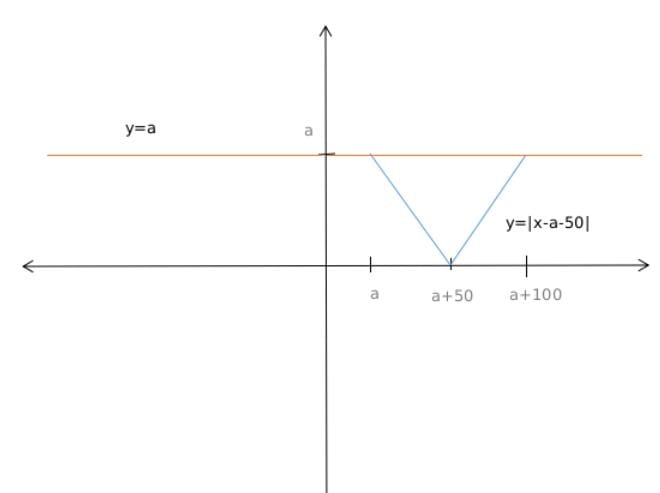
x>=a, so |x-a| = x-a

x<100, so |x-100| = 100-x

f(x) = (x-a) + (100-x) + |x-a-50| =100

or, |x-a-50| = a


From the graph we can can see that when x=a then

|x-a-50|=a

or, a= 50

Similarly when x=a+100

|x-a-50|=a

or, a= 50

So value of a is 50 when f(x) is 100.

CAT Practice: Functions - 2 - Question 7

The largest real value of a for which the equation |X + a| + |x − 1| = 2 has an infinite number of solutions for x is

Detailed Solution: Question 7

In the question, it is given that the equation ∣x + a∣ + ∣x − 1∣ = 2 has an infinite number of solutions for any value of x. This is possible when x in |x+a| and x in |x-1| cancels out.

Case 1:

x + a < 0, x - 1 ≥ ≥  0

- a - x + x - 1 = 2

a = -3

Case 2:

x + a ≥ ≥  0 and x - 1 < 0

x + a - x + 1 = 2

a = 1

Largest value of a is 1.

*Answer can only contain numeric values
CAT Practice: Functions - 2 - Question 8

Suppose for all integers x, there are two functions f and g such that f(x) + f(x – 1) – 1 = 0) and g(x) = x2. f(x2 – x) = 5, then the value of the sum f(g(5)) + g(f(5)) is

CAT Practice: Functions - 2 - Question 9

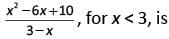
The minimum possible value of 

CAT Practice: Functions - 2 - Question 10

Consider two sets A = {2, 3, 5, 7, 11, 13} and B = {1, 8, 27}. Let f be a function from A to B such that for every element b in B, there is at least one element a in A such that f(a) = b. Then, the total number of such function f is

Detailed Solution: Question 10
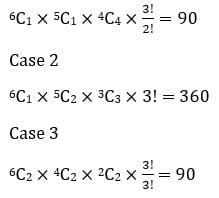
Concept: we have to distribute 6 distinct balls into three different boxes:
Case 1 (1, 1, 4)

Hence, the total number of such functions = 90 + 360 + 90<br>
= 540

*Answer can only contain numeric values
CAT Practice: Functions - 2 - Question 11

The number of distinct real values of x, satisfying the equation 
max{x, 2} - min{x, 2} = |x + 2| - |x - 2|, is


Detailed Solution: Question 11

We have,
max{x, 2} – min{x, 2} = |x + 2| – |x – 2|
Case1–> For x ≥ 2
x – 2 = x + 2 – (x – 2)
x – 2 = 4
x = 6
Thus for x ≥ 2, x = 6 is a solution.
Case 2–> For x < 2
2 – x = (x + 2) – (2 – x)
2 – x = 2x
x = 2/3
Hence, 2 distinct values of x exist.

CAT Practice: Functions - 2 - Question 12

Let 3 ≤ x ≤ 6 and  [x2] = [x]2, where [x] is the greatest integer not exceeding x. If set S represents all feasible values of x, then a possible subset of S is

Detailed Solution: Question 12
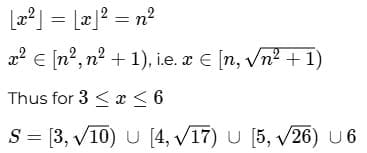
For n = 3,4,5 and x ∈ [n, n + 1) we have [x] = n, so the equation

Option B and C have √10 included, which is not part of the original set. And Option D has √18. So, it is not possible.
Option A is the answer.

CAT Practice: Functions - 2 - Question 13

Let   Then the domain of the function h(x) = f(g(x)) + g(f(x)) is all real numbers except

Detailed Solution: Question 13

We check where  or their compositions, become undefined.
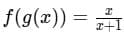
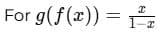
First, f(x) is undefined at x = 1/2 and g(x) is undefined at x=1.
Next, for 
Since, the denominator can't be zero, x = -1 must also be excluded.

⇒ x = 1 is not possible, which is already excluded.
So the values at which h(x) = f(g(x)) +g(f(x)) is undefined are 

CAT Practice: Functions - 2 - Question 14

If f(x) = (x+ 3x)(x+ 3x + 2) then the sum of all real roots of the equation  is

Detailed Solution: Question 14

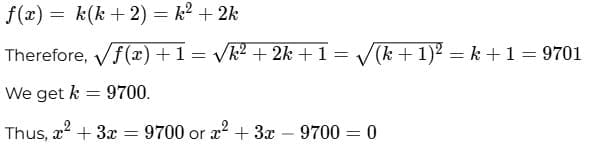
Let (x+ 3x) be equal to k. We have, 


Since x is real, the discriminant of the above quadratic has to be greater than or equal to zero.

We find that 3+ 4 ∗ 9700 ≥ 0 and therefore the quadratic has real roots.

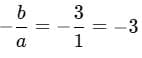
The sum of the roots will be 
Option D is the correct answer.

CAT Practice: Functions - 2 - Question 15

The number of real-valued solutions of the equation 2x+ 2-x = 2 - (x - 2)is:

Detailed Solution: Question 15

We notice that the minimum value of the term in the LHS will be greater than or equal to 2 {at x=0; LHS = 2}. However, the term in the RHS is less than or equal to 2 {at x=2; RHS = 2}. The values of x at which both the sides become 2 are distinct; hence, there are zero real-valued solutions to the above equation.

136 videos|255 docs|86 tests
Information about CAT Practice: Functions - 2 Page
In this test you can find the Exam questions for CAT Practice: Functions - 2 solved & explained in the simplest way possible. Besides giving Questions and answers for CAT Practice: Functions - 2, EduRev gives you an ample number of Online tests for practice
136 videos|255 docs|86 tests
Download as PDF