
CAT Practice: Profit & Loss - 1 - Free MCQ Test with solutions for UPSC
MCQ Practice Test & Solutions: CAT Practice: Profit & Loss - 1 (15 Questions)
You can prepare effectively for UPSC CSAT Preparation with this dedicated MCQ Practice Test (available with solutions) on the important topic of "CAT Practice: Profit & Loss - 1". These 15 questions have been designed by the experts with the latest curriculum of UPSC 2026, to help you master the concept.
Test Highlights:
- - Format: Multiple Choice Questions (MCQ)
- - Duration: 25 minutes
- - Number of Questions: 15
Sign up on EduRev for free to attempt this test and track your preparation progress.

Ram bought pens from a wholesaler at Rs. 200 per pen. For every additional pen sold by Ram after the first one, the selling price of the pen becomes Rs.5 less than the selling price of the previous pen. Using this strategy, Ram makes a 145% profit by selling 5 pens. What is the maximum number of pens a customer can buy in a single transaction such that Ram makes a profit on every pen sold?
Detailed Solution: Question 1
Sita bought mangoes from a whole-seller and transports the mangoes to her shop. The transporation incurred 20% of the cost she had spent to buy the mangoes. While transporting the mangoes to her shop one-eighth of her stock got squished and generally would not be sold at the same price as that of good quality mangoes. She sold the squished mangoes at 40% of her cost price. By approximately, how much must she markup the price of good quality mangoes such that she receives 10% profit on the overall transaction?
Detailed Solution: Question 2

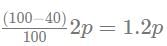
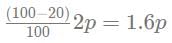
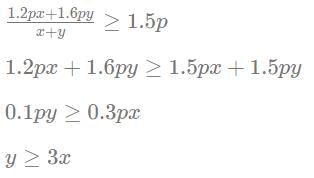
A shopkeeper marks up his goods by 100%. One day during the Dussehra Sale, he gave a discount of 40% to all customers who visited his shop in the morning slot and a discount of 20% to all the customers who visited his shop in the evening slot. All the goods in his shop were of the same type and had the same cost price. Let x be the number of goods sold during the morning slot and y be the number of goods sold during the evening slot, which of the following represents possible values of x and y, in order to have at least 50% profit?
Detailed Solution: Question 3
Sonali bought eggs at Rs 90 a dozen. She kept few eggs to herself and sold the remaining eggs such that the profit she made was 33 1/3 % of the money she spent to buy all the eggs. At what markup % did she sell the remaining eggs if she kept 1/3 of the eggs for herself?
Detailed Solution: Question 4
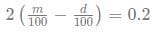
An absent-minded shopkeeper interchanged the markup of m% and discount d% of a product. So, instead of making a profit of 8%, he made a loss of 12% on the product. What is the value of d2 + m2?
Detailed Solution: Question 5


A company was purchasing 30 barrels of oil every month during lockdown from March 2020 till August 2020. The price per barrel paid by the company increased every month by a constant amount of $10. They purchased the barrels at $25 in March 2020. In September 2020, the company then sold half of the barrels at $45 each, half of the remaining at $50 each and all the remaining barrels at $70 each. What is the company's profit in percentage?
Detailed Solution: Question 6

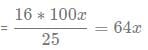
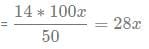
The selling price of 16 pens is the same the cost price of 25 pens. If the total discount offered on 50 pens is the same as the selling price of 14 pens then find out the markup percentage.
Detailed Solution: Question 7
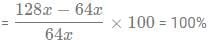
2 shopkeepers A and B sell similar articles. Both the shopkeepers buy the articles at the rate of 60 articles for Rs.40. A sells the articles at 60 for Rs.50, whereas B marks up the price of each article by 50% and then offers a 20% discount. What is the ratio of the number of articles A has to sell and the number of articles B has to sell to obtain the same profit?
Detailed Solution: Question 8

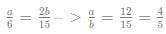
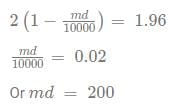
Mr. Yarn owns a fabric store. He sells his cloth 40% above the wholesale price he pays. One day he discovers that the meter stick has been using to measure the cloth he sells is not exactly a meter. Because of this error, he is only earning a 39% profit. Approximately how long is Mr. Yarn's faulty meter stick? (Note that he uses the meter stick only to sell cloth; the amount he buys is correct)
Detailed Solution: Question 9
Neeraj sells a LED TV to Siddarth for a profit of 10%. Siddarth sells it to Rahul for a loss of 15% and Rahul sells it to Akhil for Rs 33660. If Rahul earned a profit of 20% in the transaction, find the price at which Neeraj purchased the TV.
Detailed Solution: Question 10
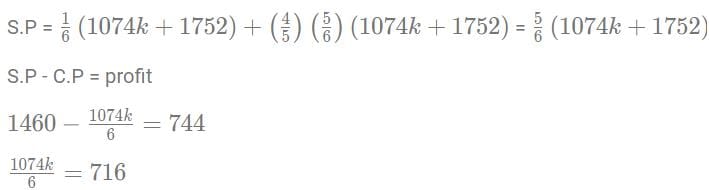
Ankita buys 4 kg cashews, 14 kg peanuts and 6 kg almonds when the cost of 7 kg cashews is the same as that of 30 kg peanuts or 9 kg almonds. She mixes all the three nuts and marks a price for the mixture in order to make a profit of ₹1752. She sells 4 kg of the mixture at this marked price and the remaining at a 20% discount on the marked price, thus making a total profit of ₹744. Then the amount, in rupees, that she had spent in buying almonds is
Detailed Solution: Question 11
Amal purchases some pens at ₹ 8 each. To sell these, he hires an employee at a fixed wage. He sells 100 of these pens at ₹ 12 each. If the remaining pens are sold at ₹ 11 each, then he makes a net profit of ₹ 300, while he makes a net loss of ₹ 300 if the remaining pens are sold at ₹ 9 each. The wage of the employee, in INR, is
Detailed Solution: Question 12
Gita sells two objects A and B at the same price such that she makes a profit of 20% on object A and a loss of 10% on object B. If she increases the selling price such that objects A and B are still sold at an equal price and a profit of 10% is made on object B, then the profit made on object A will be nearest to
Detailed Solution: Question 13


Jayant bought a certain number of white shirts at the rate of Rs 1000 per piece and a certain number of blue shirts at the rate of Rs 1125 per piece. For each shirt, he then set a fixed market price which was 25% higher than the average cost of all the shirts. He sold all the shirts at a discount of 10% and made a total profit of Rs 51000. If he bought both colors of shirts, then the maximum possible total number of shirts that he could have bought is
Detailed Solution: Question 14
Bina incurs 19% loss when she sells a product at Rs. 4860 to Shyam, who in turn sells this product to Hari. If Bina would have sold this product to Shyam at the purchase price of Hari, she would have obtained 17% profit. Then, the profit, in rupees, made by Shyam is
Detailed Solution: Question 15
145 videos|299 docs|126 tests |
