CAT Exam  >  CAT Test  >  Quantitative Aptitude (Quant)  >  CAT Practice: Profit & Loss - 2 - CAT MCQ

CAT Practice: Profit & Loss - 2 - Free MCQ Test with solutions for Quant


MCQ Practice Test & Solutions: CAT Practice: Profit & Loss - 2 (15 Questions)

You can prepare effectively for CAT Quantitative Aptitude (Quant) with this dedicated MCQ Practice Test (available with solutions) on the important topic of "CAT Practice: Profit & Loss - 2". These 15 questions have been designed by the experts with the latest curriculum of CAT 2026, to help you master the concept.

Test Highlights:

  • - Format: Multiple Choice Questions (MCQ)
  • - Duration: 25 minutes
  • - Number of Questions: 15

Sign up on EduRev for free to attempt this test and track your preparation progress.

CAT Practice: Profit & Loss - 2 - Question 1

A dishonest cloth merchant marks up the price of his cloth by 20%, and does not offer any discount unless asked for. Also, while selling, he uses a metre scale, whose actual length is 80cm. One fine day, an old woman visits his shop to buy some cloth. She is good at bargaining and consequently manages to buy the cloth at a price such that the merchant's net profit or loss is zero. What is the discount percentage she managed to get on the marked price while buying the cloth?

Detailed Solution: Question 1

Let the CP of 1 cm of cloth be Rs. 1.

Hence MP of 1 metre cloth = Rs. 100 x 1.2 = Rs 120

CP of the same amount of cloth = CP for 80cm cloth = Rs 80

Since there was no profit or no loss, SP = Rs 80.

Hence, discount = MP - SP = 120 - 80 = 40

Hence, discount % = 40​/120 × 100 = 33.33%

CAT Practice: Profit & Loss - 2 - Question 2

A dishonest shopkeeper adulterates the black pepper with papaya seeds. For each 1000 grams of real pepper, he adds 100 grams of papaya seeds. On top of that, he markups the price by 20% and then offers a discount of 15%. What is his profit % from the resulting sales?

Assume that the cost of papaya seeds is negligible.

Detailed Solution: Question 2

Let the actual cost price for the Pepper be Rsx / kg

He marks up the price by 20% and then give 15% discount. Thus the mentioned selling rate will be (1.2) (0.85) x = 1.02x

In reality, 1000 grams of pepper has 100 grams of papaya seeds.

Thus the 1100 grams of the mixture will have 1000 gram of real pepper

1kgbof the mixture will have 10/11​ kg of real pepper.

If the shopkeeper sells 1 kg of the mixture

Actual cost price for shopkeeper = 10/11​x

Actual selling price = 1.02x

CAT Practice: Profit & Loss - 2 - Question 3

A retailer buys a certain amount of tea at the rate of Rs. 100 per 500gm from a wholesaler. He then distributes the tea into small packets, each containing 20gm of tea, with negligible overhead costs. He marks each packet at Rs. 6. Later, he finds out that 90 packets had packaging issues and he had to reject them. He sells the remaining packets at their marked price and gets a profit of 39.20% in the entire process. What is the amount of tea he had bought initially?

Detailed Solution: Question 3

Let the amount of tea he bought be x kg.

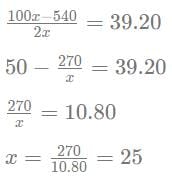
Therefore, cost price = x × 2 × 100 = 200x

Number of packets = x × 1000/20 ​= 50x

Number of packets he could sell = 50x − 90

Total selling price = 6 × (50x−90) = 300x − 540

Hence, profit = 300x − 540 − 200x = 100x − 540

Profit percent = × 100 = 39.20

Hence, amount he had bought initially = 25 kg.

CAT Practice: Profit & Loss - 2 - Question 4

A toothpaste manufacturer sells toothpaste to a wholesaler at a price such that the manufacturer has a profit of 10%. The wholesaler sells the toothpaste to a retailer such that the profit earned is 20% of the cost price of manufacturing it. The retailer sells the toothpaste to customers at mentioned MRP and gets 20% profit from the sales. If the customer had to pay Rs 312 for one tube of toothpaste, what will be the profit earned by the wholesaler by selling 5 toothpaste tubes to the retailer?

Detailed Solution: Question 4

Let the cost of manufacturing 1 unit of toothpaste is x

Thus the selling price for the manufacturer is 1.1x

Profit for the wholesaler = 0.2x thus the selling price for wholesaler = 1.3x

The selling price for the retailer = 1.2 × 1.3x = 1.56x

We are given that 1.56x = 312 or x = 200

Profit for wholesaler = 0.2x = Rs 40 per tube

Profit for 5 tubes = Rs200

*Answer can only contain numeric values
CAT Practice: Profit & Loss - 2 - Question 5

A cunning rice merchant uses a faulty weighing machine to cheat. While buying the rice from the whole seller he uses a faulty machine which shows the quantity 20% less than actually on the scale. While selling the rice, he uses another faulty scale which shows 10% extra weight than that on the scale. He marks up the price of rice by 20% on the rate he bought from the wholesaler. Sherlock found out about this scam and asked the rice seller to give approximately a d% discount on the current marked price so that the rice seller doesn't make a profit or a loss. What is the value of [d]?
[X] represents the largest integer less than or equal to X.


Detailed Solution: Question 5
Let the rate at which the whole seller sells the rice be Rs x per kg.
But the cunning merchant uses the faulty scale to trick the wholesaler. When the wholeseller puts in 1kg of rice, the machine will show 0.8kg of rice. Thus merchant will get 1 kg of rice for the price of 0.8x0.8x and thus Actual selling price for the wholeseller = Actual cost-price for the merchant = Rs0.8x = 4x/5 per kg.
The rate at which he sells the rice = Rs 1.2x per kg.
When the merchant puts 1 kg of rice on the weighing machine, the machine will show 1.1 kg.
As per the rate the customer has to pay 1.2x x 1.1 = 1.32x  for 1 kg of rice. 
Actual selling price for the merchant= Rs 1.32x per kg
Let Sherlock by y kgs of rice.
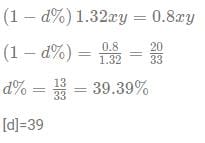
Cost price to the merchant = 0.8xy
Actual selling price for the merchant = 1.32 xy
Discount = d
In order to be no-profit no loss

*Answer can only contain numeric values
CAT Practice: Profit & Loss - 2 - Question 6

On the market of Covent Garden, Mrs. Smith and Mrs. Jones sell apples. Mrs. Jones sells her apples for two per rupee. The apples of Mrs. Smith are a bit smaller; she sells hers for three per rupee. At a certain moment, when both ladies have the same number of apples left, Mrs. Smith is being called away. She asks her neighbor to take care of her goods. To make everything not too complicated, Mrs. Jones simply puts all apples to one big pile, and starts selling them for two rupee per five apples. When Mrs. Smith returns the next day, all apples have been sold out. But when they start dividing the money, there appears to be a shortage of seven rupees. Supposing they divide the amount equally, how much in Rupees does Mrs. Jones lose in this deal?


Detailed Solution: Question 6

The big pile of apples contains the same amount of large apples of half a rupee each (from Mrs. Jones), as smaller apples of one-third rupee each (from Mrs. Smith). The average price is therefore (1/2 + 1/3)/2 = 5/12 rupee.
But the apples were sold for 2/5 rupees each (5 apples for 2 rupees). Or: 25/60 and 24/60 rupee respectively. This means that per sold apple, there is a shortage of 1/60 rupee. The total shortage is Rs.7. so the ladies together started out with 420 apples. These are worth 2/5x 420 = 168 rupees, or with equal division, 84 rupees for each. If Mrs. Jones would have sold her apples herself, she would have received 105 rupees. Conclusion: Mrs. Jones loses 21 rupees in this deal.

CAT Practice: Profit & Loss - 2 - Question 7

Ram sells only jeans of a particular make all of which he bought at the same price. During the Diwali festival, he started the "Buy 4 get 1 free " offer and on top of that, he gave 10% off on the bill. Despite such discounts, he made a profit of 5%. By, what percent was the cost of jeans marked up if all the customers availed both the offers?

Detailed Solution: Question 7

Let us  assume he bought each jeans at the price of P

Cost price for 4+1 =5 Jeans = 5P

He makes a profit of 5%, therefore the selling price of 5 Jeans = 1.05× 5 = 5.25P...(i)

Let the price after Markup be M.

Selling Price of 5 Jeans before discount = 44M

Selling price after discount = (0.9)4M = 3.6M .....(ii)

Equating (i) and (ii)

3.6M = 5.25 P

M = 1.4583 P

Therefore the markup percent is 45.83%

CAT Practice: Profit & Loss - 2 - Question 8

Ram buys rice from a whole sale dealer at Rs. 100 per Kg and sells it to his customers. While purchasing the rice, he noticed that the wholesaler was cheating him and was using a scale that showed 10% more weight than it was weighing. Instead of fighting with the wholesaler, he decided to markup his selling price in such a way that he earns a profit of 10%. What should the selling price (per Kg) be if Ram uses an accurate scale while selling to his customers?

Detailed Solution: Question 8

If he puts 1 kg of rice, the scale will show 1.1kg. Thus Ram has to pay Rs 110/kg
Now he intends to make a profit of 10% by selling this. 
Total amount he should get back = Rs 1.1 × 110 = Rs121121.
Thus by selling 1 kg rice he is getting Rs 121
The rate at which he sells = Rs121/kg

CAT Practice: Profit & Loss - 2 - Question 9

If the selling price of the article is reduced by 40% and the cost price remains the same, the profit reduces by 50%. Find the original profit % of the article?


Detailed Solution: Question 9

Let the SP be x and the CP be y.

(x-y) = 2(0.6x-y)

0.2x = y

x = 5y

Original profit% =

= 400

CAT Practice: Profit & Loss - 2 - Question 10

Minu purchases a pair of sunglasses at Rs.1000 and sells to Kanu at 20% profit. Then, Kanu sells it back to Minu at 20% loss. Finally, Minu sells the same pair of sunglasses to Tanu. If the total profit made by Minu from all her transactions is Rs.500, then the percentage of profit made by Minu when she sold the pair of sunglasses to Tanu is

Detailed Solution: Question 10

“Minu purchases a pair of sunglasses at Rs.1000 and sells to Kanu at 20% profit.”
This means, Minu purchased the glasses at Rs.1000 and sold them to Kanu at Rs.1200.
Minu made a profit of Rs. 200 so far.
“Then, Kanu sells it back to Minu at 20% loss.”
This means, Kanu sold the glasses back to Minu at 80% of 1200 = Rs. 960
“Finally, Minu sells the same pair of sunglasses to Tanu. … the total profit made by Minu from all her transactions is Rs.500”
This means, Minu has to make a further profit of Rs. 300. She achieves this by selling the glasses back to Tanu at 960 + 300 = Rs.1260
So the profit % in the transaction is 300/960 x 100 = 31.25%

*Answer can only contain numeric values
CAT Practice: Profit & Loss - 2 - Question 11

A shopkeeper offers a discount of 22% on the marked price of each chair, and gives 13 chairs to a customer for the discounted price of 12 chairs to earn a profit of 26% on the transaction. If the cost price of each chair is Rs 100, then the marked price, in rupees, of each chair is


Detailed Solution: Question 11

Cost price of each chair = 100
For 13 chairs, total cost = 13 × 100 = 1300
Profit = 26%, so total revenue
1.26 × 1300 = 1638
We were told that this amount is equal to the discounted price of 12 chairs. So the discounted selling price per chair

Discount offered = 22%, so:

CAT Practice: Profit & Loss - 2 - Question 12

The monthly sales of a product from January to April were 120, 135, 150 and 165 units, respectively. The cost price of the product was Rs. 240 per unit, and a fixed marked price was used for the product in all the four months. Discounts of 20%, 10% and 5% were given on the marked price per unit in January, February and March, respectively, while no discounts were given in April. If the total profit from January to April was Rs. 138825, then the marked price per unit, in rupees, was

Detailed Solution: Question 12
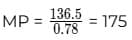
The total number of products is 120 + 135 + 150 + 165 = 570. Therefore, the total cost must have been 570 × 240 = 136800

Let the marked price for the products be X. The January, February, March, and April, selling prices would respectively be 0.8X, 0.9X, 0.95X, and X; based on the discounts given on each of the months.

The revenue earned from selling the products in each of the months would be: 120∗0.8X+135∗0.9X+150∗0.95X+165∗X = 525X

The profit earned would be: Revenue -  Cost, and therefore, 

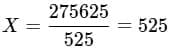
525X − 136800 = 138825

525X = 275625

The correct answer is option B, Rs. 525.

*Answer can only contain numeric values
CAT Practice: Profit & Loss - 2 - Question 13

Amal buys 110 kg of syrup and 120 kg of juice, syrup being 20% less costly than juice, per kg. He sells 10 kg of syrup at 10% profit and 20 kg of juice at 20% profit. Mixing the remaining juice and syrup, Amal sells the mixture at ₹ 308.32 per kg and makes an overall profit of 64%. Then, Amal’s cost price for syrup, in rupees per kg, is


Detailed Solution: Question 13

Total syrup - 110 kg

Total juice - 120 kg

It is given, cost price of syrup is 20% less than the cost price of juice.

Let the cost price of juice per kg be 10CP

Cost price of syrup per kg is 8CP

10kg syrup -> cost price = 80CP

It is given, 10kg syrup is sold at 10% profit. This implies selling price = 1.1*80CP = 88CP

20kg juice -> cost price = 200CP

It is given, 20kg juice is sold at 20% profit. This implies selling price = 1.2*200CP = 240CP

It is given, Mixing the remaining juice and syrup, Amal sells the mixture at ₹ 308.32 per kg

Selling price of the remaining mixture = 308.32*200 = Rs 61664

Total S.P = 61664 + 328CP

Total C.P = 880CP + 1200CP = 2080CP

Overall profit = 64%


Solving, we get CP = 20

Cost price for syrup per kg = 8CP = 8*20 = Rs 160

CAT Practice: Profit & Loss - 2 - Question 14

A wholeseller supplies few chips to a retailer every year. Each chip costs Rs 10,000 to the wholeseller. 5% of the chips are defective and they are to be replaced without charging anything extra. If the wholeseller still makes a profit of 20%, at what price is he selling it to retailer?

Detailed Solution: Question 14
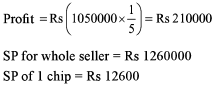
Let No. of chips supplied = 100

For whole seller, Net CP = (10000 x 100 + 5 x 10000) = Rs 1050000

CAT Practice: Profit & Loss - 2 - Question 15

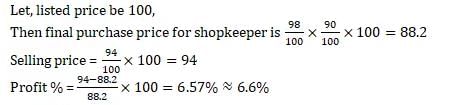
A shopkeeper purchases his goods at a discount of 10% on the list price. He normally gives a discount of 6% to his customers. If during a special scheme, he gets an additional discount of 2% on his purchase price, find his approximate profit percentage.

Detailed Solution: Question 15
136 videos|255 docs|86 tests
Information about CAT Practice: Profit & Loss - 2 Page
In this test you can find the Exam questions for CAT Practice: Profit & Loss - 2 solved & explained in the simplest way possible. Besides giving Questions and answers for CAT Practice: Profit & Loss - 2, EduRev gives you an ample number of Online tests for practice
136 videos|255 docs|86 tests
Download as PDF