CSIR NET Earth Science Exam  >  CSIR NET Earth Science Test  >   Mock Test Series  >  CSIR NET Earth Science Mock Test - 2 - CSIR NET Earth Science MCQ

CSIR NET Earth Science Mock Test - 2 Free Online Test 2026


Full Mock Test & Solutions: CSIR NET Earth Science Mock Test - 2 (150 Questions)

You can boost your CSIR NET Earth Science 2026 exam preparation with this CSIR NET Earth Science Mock Test - 2 (available with detailed solutions).. This mock test has been designed with the analysis of important topics, recent trends of the exam, and previous year questions of the last 3-years. All the questions have been designed to mirror the official pattern of CSIR NET Earth Science 2026 exam, helping you build speed, accuracy as per the actual exam.

Mock Test Highlights:

  • - Format: Multiple Choice Questions (MCQ)
  • - Duration: 180 minutes
  • - Total Questions: 150
  • - Analysis: Detailed Solutions & Performance Insights
  • - Sections covered: Part A, Part B, Part C

Sign up on EduRev for free and get access to these mock tests, get your All India Rank, and identify your weak areas to improve your marks & rank in the actual exam.

CSIR NET Earth Science Mock Test - 2 - Question 1

Which of the following represents the gradient of the continental slope?

Detailed Solution: Question 1

The continuously sloping portion of the continental margin, seaward of the continental shelf, extending down to the deep-sea floor of the abyssal plain, is known as continental slope.

It is characterised by gradients of 1:5 It extends between the depths of 180 - 3600 metres.

In some places, such as off the shore of Philippines, the continental slope extends to a great depth.

Along the base of the continental slope there is a deposit of sediments.

These sedimentary deposits form the continental rise.

In some regions the rise is very narrow but in others it may extend up to 600 km in width.

CSIR NET Earth Science Mock Test - 2 - Question 2

What is the shape of valley usually preferred for a reservoir?

Detailed Solution: Question 2

The valley could be a U-shaped glacial valley, or a V-shaped river valley or a broader synclinal valley. Flatlands and plains cannot make convenient places for reservoirs.

CSIR NET Earth Science Mock Test - 2 - Question 3

When a site is said to be sound, which of the following character is not desirable?

Detailed Solution: Question 3

Technically, the site should be as sound as possible: strong, impermeable and stable strong rocks at the site make the job of the designer much easy: he can evolve best designs.

CSIR NET Earth Science Mock Test - 2 - Question 4

Colour changing phenomenon which involves oxidation is

Detailed Solution: Question 4

Tarnish nay be described as a phenomenon of change of original colours of mineral to some secondary colours at its surface due its oxidation at the surface.

CSIR NET Earth Science Mock Test - 2 - Question 5

When the mineral occurs in flattened or square form, it is called

Detailed Solution: Question 5

The mineral occurs in the form of a flattened, square, rectangular or rhombohedral shape if it is said to be tabular. In other words, flattening is conspicuous compared to lengthwise elongation.

CSIR NET Earth Science Mock Test - 2 - Question 6

Rocks are inherently which type of materials?

Detailed Solution: Question 6

Rocks are inherently anisotropic materials, showing variation in properties in different directions.

CSIR NET Earth Science Mock Test - 2 - Question 7

A geophysicist travelling from the Bay of Bengal through the Ganga plain to the Himalaya, estimates the depth of Moho discontinuity. Which one of the following is the correct order of the Moho-depth estimates?

Detailed Solution: Question 7

Moho discontinuity is the boundary between the Earth’s crust and the mantle. From the Bay of Bengal through the Ganga plain to the Himalaya, the depth of Moho discontinuity is Himalaya > Ganga plain > Bay of Bengal because of the elevation and increasing width of the Earth’s crust.

CSIR NET Earth Science Mock Test - 2 - Question 8

Which of the following is not an example of ultrabasic igneous rocks?

Detailed Solution: Question 8

Ultramafic rocks are igneous and meta-igneous rocks with a very low silica content i. e. less than 45%, generally>18% MgO, high FeO, low potassium, and are composed of usually greater than 90 % mafic minerals which have dark coloured, high magnesium, and iron content.

The mantle of the earth is composed of ultramafic rocks. The ultramafic rocks are also known as ultrabasic rocks.

For example, peridotite, kimberlite, lamprophyre, lamproite, and komatiite.

Dolomite is an anhydrous carbonate mineral, which is composed of calcium magnesium carbonate.

CSIR NET Earth Science Mock Test - 2 - Question 9

The climatic conditions under which chemical weathering would be most rapid are:

Detailed Solution: Question 9

Chemical weathering is decomposition and disintegration of rocks due to chemical reactions. Water vapour and water mixes with the atmospheric gases within rocks, leads to chemical weathering. The rock’s chemical transformations are highly influenced by the interaction of water and oxygen through processes such as hydrolysis and oxidation.

Hot and humid conditions are favourable for this. Various chemical reactions are oxidation, carbonation, solution, hydration, chelation, hydrolysis, base exchange which lead to chemical weathering.

CSIR NET Earth Science Mock Test - 2 - Question 10

Who coined the term eutectic?

Detailed Solution: Question 10

The term eutectic was coined by British physicist and chemist Frederick Guthrie (1884).

The eutectic system refers to a homogeneous mixture of substances that melts or solidifies at a single temperature which is lower than the melting point of either of the constituents.

The eutectic temperature is the lowest possible melting temperature over all of the mixing ratios for the involved component species.

CSIR NET Earth Science Mock Test - 2 - Question 11

Find out the correct statement from the following.

Detailed Solution: Question 11

Insolation is the amount of solar radiation that reaches the earth’s surface through short waves. The earth also radiates heat energy like all other hot objects.

This is known as terrestrial radiation. The annual mean temperature on the earth’s surface is always constant. It has been possible because of the balance between insolation and terrestrial radiation.

This balance is termed the heat budget of the earth. The surplus heat energy from the tropics is re-distributed towards the poles as the tropics do not get progressively heated up and the high latitudes get permanently frozen.

CSIR NET Earth Science Mock Test - 2 - Question 12

Which of the following ecosystems has the greatest biomass?

Detailed Solution: Question 12
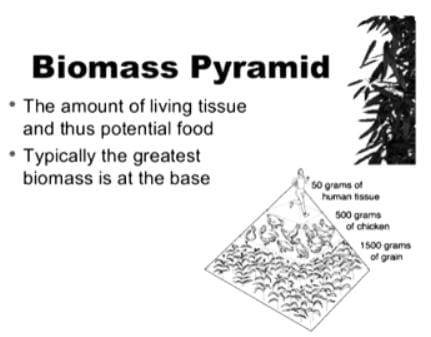
The ecosystem which is greatest in the biomass is the Forest Ecosystem because of the large amount of wood that trees accumulate through time.

The biomass of grasslands and croplands is much smaller in comparison. For fresh water bodies and the oceans, the biomass is even smaller.

CSIR NET Earth Science Mock Test - 2 - Question 13

Albedo of a surface is defined by the ratio of outgoing to incoming solar radiation. Keeping this in view, which of the following surface will have the highest albedo?

Detailed Solution: Question 13

Albedo has an effect on temperature. Substances with high albedo will have cooler temperatures. Substances with lower albedo absorb the rays of the sun and have higher temperatures. Asphalt has a very low albedo. This is why it can burn people’s feet when they walk on it in the summer.

Fresh snow has the Earth’s highest albedo at 0.95. Albedo is a measure of reflectivity. Fresh snow reflects approximately 95 percent of the sun’s rays.

CSIR NET Earth Science Mock Test - 2 - Question 14

Read the following statement and identify the corresponding soil forming processes

I. It is the process of removal of constituents in suspension or solution by percolating water from upper to lower layers.

II. It is the process of deposition of soil material in the lower layers

Detailed Solution: Question 14

Eluviation: It is the process of removal of constituents in suspension or solution by percolating water from upper to lower layers

Illuviation: The process of deposition of soil materials (removed from the eluvial horizon) in the lower layer

CSIR NET Earth Science Mock Test - 2 - Question 15

Typical composition of diatomite is

Detailed Solution: Question 15

Diatomite is a naturally occurring, soft, siliceous sedimentary rock. It is easily crumbled into a fine white to off-white powder. It has a particle size between 3 micrometre to more than 1 millimeter, but typically 10 to 200 micrometres.

Depending on the granularity, this powder can have an abrasive feel, similar to pumice powder, and is very light as a result of its high porosity. Typical composition of diatomite is 80 - 90 % silica, 2 to 4 % alumina, 0.5 to 2 % Iron oxide

CSIR NET Earth Science Mock Test - 2 - Question 16

Which one of the following minerals in the Moh’s scale of hardness is a silicate?

Detailed Solution: Question 16

The Mohs Scale is a relative scale because, instead of using an instrument to make a measurement, an unknown mineral’s hardness (or resistance to scratching) is compared to the hardness of the minerals that make up the scale. Since by definition every mineral has specific composition and physical properties, a mineral’s property of hardness will fall within a narrow range, and can thus be used to help differentiate it from other minerals.

Mohs choose minerals for his scale that are widespread and (except for diamond) readily available. From softest to hardest, the ten minerals are:

Talc – hydrated magnesium silicate –- Mg3Si4O10 (OH) 2

Gypsum – hydrated calcium sulfate -– CaSO4·2H2O

Calcite – calcium carbonate -– CaCO3

Fluorite – calcium fluorite –- CaF2

Apatite – hydrated calcium phosphate –- Ca5 (PO4) 3 (OH-, Cl, F-)

Orthoclase feldspar – potassium-aluminum silicate –- KalSi3O8

7: quartz – silicon dioxide -– SiO2 (the most abundant mineral on earth)

8: topaz – hydrated aluminum silicate -– AlSiO4 (OH-, F-) 2

9: corundum – aluminum oxide -– Al2O3

10: diamond – carbon – C

CSIR NET Earth Science Mock Test - 2 - Question 17

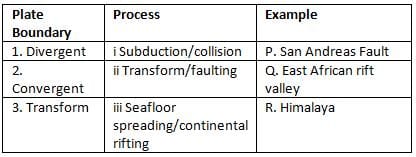
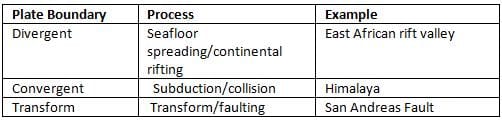
Match the following plate boundaries, tectonic processes and geographic examples
Detailed Solution: Question 17
CSIR NET Earth Science Mock Test - 2 - Question 18

Find the pair which does not match:

Detailed Solution: Question 18

The correct pairs of metamorphic facies and the corresponding mineral assemblages are:
If a set A has n elements, then its power set will contain 2n elements.
∴ Total number of elements in power set of A = 218.

CSIR NET Earth Science Mock Test - 2 - Question 19

What is the percentage of the total area of the ocean that overlies the continental shelf?

Detailed Solution: Question 19

The percentage of the total area of the ocean that overlies the continental shelf is approximately 7.50%.

So, the correct answer is:

a) 7.50%

CSIR NET Earth Science Mock Test - 2 - Question 20

Headword erosion is responsible for

Detailed Solution: Question 20

Headward erosion occurs at the origin of a stream channel. Headward erosion is a fluvial process of erosion, which causes the origin to move back away from the direction of the stream flow. So, Headward erosion causes in increasing in the stream length, hence enlarges its drainage basin and declining in stream gradient.

CSIR NET Earth Science Mock Test - 2 - Question 21

Which of the following minerals commonly occurs in prismatic or elongated crystal form?

Detailed Solution: Question 21

Beryl typically crystallizes in elongated forms. It often appears as long columnar crystals, characteristic of minerals in the beryl group (which includes emerald and aquamarine).
In contrast:

  • Calcite forms rhombohedral or scalenohedral crystals.

  • Orthoclase forms tabular or blocky crystals.

  • Barite generally forms tabular or plate-like crystals.

CSIR NET Earth Science Mock Test - 2 - Question 22

Arrange the correct sequence of the process of temperature decrease with increase in altitude.

i. The air parcel becomes lighter than the surrounding air and it starts to rise.

ii. Air parcel is subjected to differential heating compared to the surrounding air.

iii. Adiabatic Lapse Rate occurs.

iv. With the fall in ambient pressure, the temperature falls and the volume increases.

Detailed Solution: Question 22
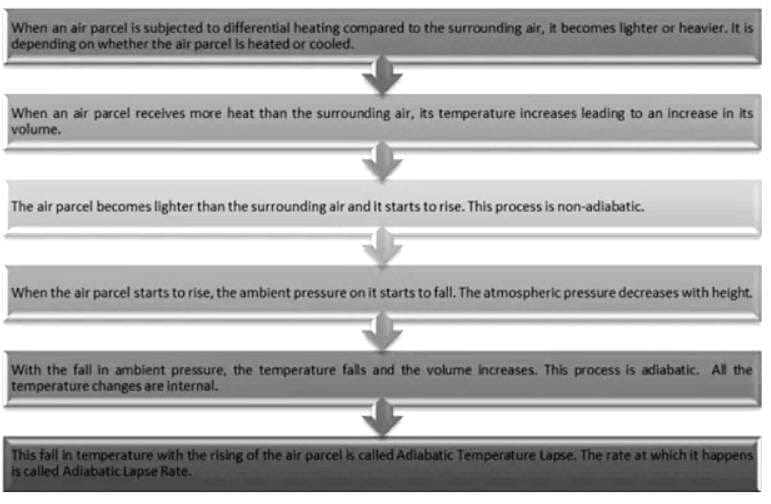
The process of temperature decrease with increase in altitude takes place as:

CSIR NET Earth Science Mock Test - 2 - Question 23

Which of the following causes the dissipating stage of a thunderstorm?

Detailed Solution: Question 23

The thunderstorm begins to dissipate when the downdrafts in the cloud begins to dominate over the updraft.

Since the warm moist air can no longer rise, the cloud droplets can no longer form.

The storm dies out with light rain as the cloud disappears from the bottom to the top.

The whole process takes about one hour for an ordinary thunderstorm to complete. The supercell thunderstorms are much larger, more powerful, and last for several hours.

CSIR NET Earth Science Mock Test - 2 - Question 24

Which of the following does occur during La-Nina?

Detailed Solution: Question 24

The condition of La Nina results into a weak monsoon characterised with deficient rainfall and drought conditions along Peru coast in December.

During the period of La Nina, the sea surface temperature across the equatorial Eastern Central Pacific Ocean will be lower than normal by 3oC to 5oC.

CSIR NET Earth Science Mock Test - 2 - Question 25

The air mass type most likely to form thunderstorms is

Detailed Solution: Question 25

Air mass is a large body of air having nearly uniform conditions of temperature and humidity at any given level of altitude.

Air mass has distinct boundaries and may extend hundreds or thousands of kilometres horizontally.

Air masses are generally classified into four types according to their basic source regions with respect to latitude.

CSIR NET Earth Science Mock Test - 2 - Question 26

A bar running perpendicular to the coastline that connects the coast with a neighbouring island is known as

Detailed Solution: Question 26

Tombolo is a deposition landform in which an island is attached to the main land by a narrow piece of land such as a spit or a bar.

As waves approach near an island, they are slowed by the shallow water surrounding it.

These waves then bend around the island to the opposite side. The wave pattern created by the water movement causes a convergence of longshore drift on the opposite side of the island.

The beach sediments that are moving by lateral transport on the lee side of the island will accumulate there conforming to the shape of the wave pattern.

The waves sweep the sediments together from both sides. Eventually when enough sediments have built up the beach shoreline known as spit will connect with an island to form a tombolo.

CSIR NET Earth Science Mock Test - 2 - Question 27

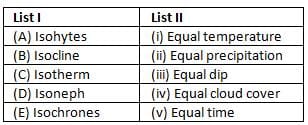
Match and select the correct answer form the codes given below:
Detailed Solution: Question 27

  • Isoneph represents the line connecting places at which the amount of cloud for a given period is the same.
  • Isotherm represents the line of equal temperature.
  • Isohyets are line connecting points of equal precipitation.
  • Isochrones represents the line on a map connecting points relating to the same time or equal times.
  • Isoclinic line or isocline refers to the line on a map connecting points of equal gradient or inclination.

CSIR NET Earth Science Mock Test - 2 - Question 28

Which of the following statement about river channel velocity is correct?

Detailed Solution: Question 28

Velocity is in all areas of a river channel. Velocity varies vertically and laterally across the river.

In a straight river channel, velocity is always greatest in the middle away from the banks and bed of the channel.

In deeper places, the flow is faster while in shallower places the flow is slower because there is more surface contact and friction in shallower places.

Average flow velocity at a cross section occurs at 0.6 depth. Velocity is higher over steeper gradients.

CSIR NET Earth Science Mock Test - 2 - Question 29

The temperature and pressure at which the three phases of water co-exist known as the triple point occurs at the temperature of

Detailed Solution: Question 29

Minerals may have different phases at different temperatures and pressures. Phase diagrams relate the phases to temperature and pressure. For example, water has three phases i. e. , solid, liquid, and gaseous. If water is placed in a closed vessel with the air removed and the temperature adjusted to 0.01, the three phases will co-exist.

There will be liquid water, some ice floating on the surface, and water vapour above. The pressure of the water vapour will be only 0.00603 atm or 4.57 mmHg.

The temperature and pressure at which the three phases co-exist is called the triple point.

Three lines radiate from the triple point, one separating ice from water vapour, the second one separating ice from liquid water, and a third separating liquid water from water vapour.

CSIR NET Earth Science Mock Test - 2 - Question 30

Overall, day to day variation in the sea surface temperature in the global oceans can have a maximum range of

Detailed Solution: Question 30
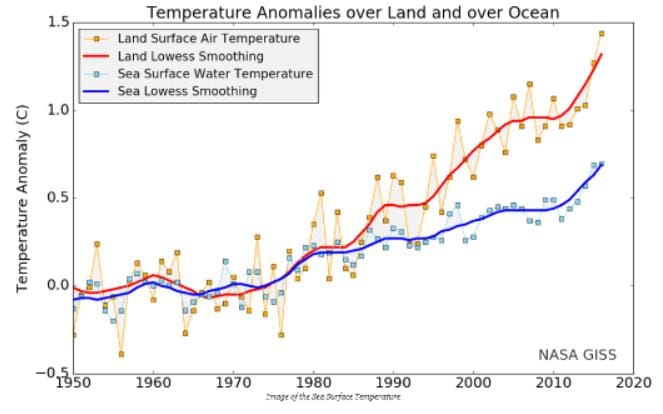
Sea surface temperature is the water temperature close to the ocean’s surface. On a calm day, there is local variation of SST by 6℃ . There is a warming or cooling of 0.5℃ at regional scale in the time of El Nino Southern Oscillation.

Overall, day to day variation in the sea surface temperature in the global oceans can have a maximum range of 2° C .

View more questions
6 tests
Information about CSIR NET Earth Science Mock Test - 2 Page
In this test you can find the Exam questions for CSIR NET Earth Science Mock Test - 2 solved & explained in the simplest way possible. Besides giving Questions and answers for CSIR NET Earth Science Mock Test - 2, EduRev gives you an ample number of Online tests for practice
Download as PDF