
CSIR NET Earth Science Mock Test - 6 Free Online Test 2026
Full Mock Test & Solutions: CSIR NET Earth Science Mock Test - 6 (150 Questions)
You can boost your CSIR NET Earth Science 2026 exam preparation with this CSIR NET Earth Science Mock Test - 6 (available with detailed solutions).. This mock test has been designed with the analysis of important topics, recent trends of the exam, and previous year questions of the last 3-years. All the questions have been designed to mirror the official pattern of CSIR NET Earth Science 2026 exam, helping you build speed, accuracy as per the actual exam.
Mock Test Highlights:
- - Format: Multiple Choice Questions (MCQ)
- - Duration: 180 minutes
- - Total Questions: 150
- - Analysis: Detailed Solutions & Performance Insights
- - Sections covered: Part A, Part B, Part C
Sign up on EduRev for free and get access to these mock tests, get your All India Rank, and identify your weak areas to improve your marks & rank in the actual exam.

The ratio of air's actual water vapour content to its water vapour capacity at a given temperature is called
Detailed Solution: Question 1
Direction: In the following question, select the related letters from the given alternatives.
SD : YJ :: HK :?
SD : YJ :: HK :?
Detailed Solution: Question 2

The depth at which the core layer starts and ends respectively is ____________
Detailed Solution: Question 3
At present Earth's perihelion occurs on 3rd January and aphelion occurs on 4th July. Roughly how many years will it take for the perihelion to occur on 4° July.
Detailed Solution: Question 4
With reference to stratospheric ozone depletion which of the following statements is FALSE?
Glacial-interglacial temperature contrast is the smallest in the equatorial region mainly because
Limestone pavements which are distinctive bare landforms, are usually the result of one of the following processes:
A high vertical wave caused by deep-sea earthquakes is known as:
Detailed Solution: Question 8
Which of the following countries is situated oma divergent plate boundary?
The rate of change of sea level was maximum during
During the process of evaporation, ocean experiences
The average June-September rainfall in India is more
Pyenocline indicates the vertical distribution of:
Detailed Solution: Question 13
What is the angle that can be made by fault plane with the horizontal?
Detailed Solution: Question 14
What is not considered about the shear zones?
Detailed Solution: Question 15
The type of joint which can be measured and mapped easily is
Detailed Solution: Question 16
Faults that are developed along bedding planes are
Detailed Solution: Question 17
How does the thickness of the layer affect flexural folding?
Detailed Solution: Question 18
Total field magnetic amomalies ΔF due to spherical are bodies satisfy the differential equation
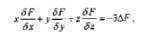
where z is the depth to the centre of the sphere. A sphere of very large magnetic susceptibility K is inductively magnetized in the earth's magnetic field at the magnetic latitude of sin-1 '1/√3) and generates a maximum anomaly of 300 gammas in the total field. where the total field decreases with elevation at a rate of i.0 gamma/meter, and the vertical component of the anomaly is zero.
The anomaly in the horizontal component, where the vertical component anomaly is zero, 18
where z is the depth to the centre of the sphere. A sphere of very large magnetic susceptibility K is inductively magnetized in the earth's magnetic field at the magnetic latitude of sin-1 '1/√3) and generates a maximum anomaly of 300 gammas in the total field. where the total field decreases with elevation at a rate of i.0 gamma/meter, and the vertical component of the anomaly is zero.
A vertical loop fixed transmitter electromagnetic survey was carried out to map a possible thin vertical conductor of resistivity I Ω m embedded in a host rock of resistivity-(10002m).
The frequency you recommend for this survey is
Consider an imaginary earth model of thick fluid core surrounded by a thick mantle and thin or no crist. The density in the mantle increases from 3.0 gm/cc at the surface to 5.0 gm/cc at the core -mantle boundary, and it abruptly increases to 10.0 gm/cc in the care. The velocity of the P wave, increase from 3.0 km/sec to 8.0 km/sec in the mantle, and is abruptly falls to 4.0 km/sec in the core. Direct P waves omanating from an earthquake at angles of incidence less than sin-3(3/16) cannot be received anywhere on the earth's surface. Further the time of arrival of the P wave increases at a rate of 250 sec/radian prior to the onset of shadow zone,
Which phase of the P-wave is not at all recorded on the earth's surface
What would be the expected geochemical trend with increasing rainfall as per the diagram above?
A vertical loop fixed transmitter electromagnetic survey was carried out to map a possible thin vertical conductor of resistivity I Ω m embedded in a host rock of resistivity-(1000 Ω m).
Consider the following situations in the above survey:
situation 1: The trammitter and receiver are on the same side of the conductor
Situation 2: The transmitter is an one side of the conductor and the receiver is just above the conductor
The coupling coefficients in these situations will be
Consider the following situations in the above survey:
situation 1: The trammitter and receiver are on the same side of the conductor
Situation 2: The transmitter is an one side of the conductor and the receiver is just above the conductor
The coupling coefficients in these situations will be
Oceanic lithosphere cools and thickens as a function of age away from mid occanic ridge and it is represented by cooling half-space model. If its thickness at 10 Ma is 10 km, what will be its thickness at 40 Ma?
As per Koppen's classification of climate, the following is correct:
With regard to Cenozoic deep sea sedimentary records, biostratigraphy is studied with the help of
You are required to solve for the root of the equation x3 -2x2 + 4x -1 = 0 in the limits (0 and 1) by the method of false position. The inference you obtain at the end of the 1st iteration is
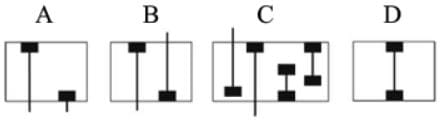
Diagrarms A, B, C and D illustrate principal kinds of biozones. The comect sequence is:
