
Physics CUET UG Case Based Questions Test: Electric Charges & Fields Free
MCQ Practice Test & Solutions: Case Based Questions Test: Electric Charges & Fields (10 Questions)
You can prepare effectively for JEE Physics CUET UG Mock Test Series 2026 with this dedicated MCQ Practice Test (available with solutions) on the important topic of "Case Based Questions Test: Electric Charges & Fields". These 10 questions have been designed by the experts with the latest curriculum of JEE 2026, to help you master the concept.
Test Highlights:
- - Format: Multiple Choice Questions (MCQ)
- - Duration: 20 minutes
- - Number of Questions: 10
Sign up on EduRev for free to attempt this test and track your preparation progress.

Read the following text and answer the following questions on the basis of the same:
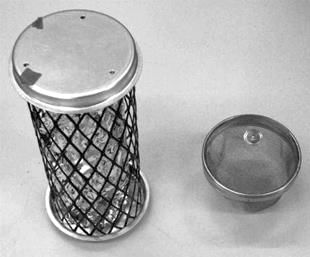
Faraday Cage: A Faraday cage or Faraday shield is an enclosure made of conducting material. The fields within a conductor cancel out with any external fields, so the electric field within the encloser is zero. These Faraday cages act as big hollow conductors you can put things in to shield them from electrical fields. Any electrical shocks the cage receives, pass harmlessly around the outside of the cage.
Which of the following materials can be used to make a Faraday cage?
Detailed Solution: Question 1
Read the following text and answer the following questions on the basis of the same:
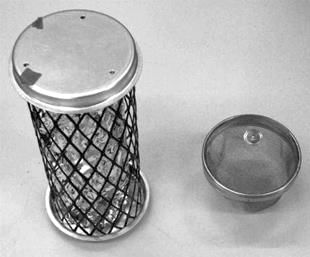
Faraday Cage: A Faraday cage or Faraday shield is an enclosure made of conducting material. The fields within a conductor cancel out with any external fields, so the electric field within the encloser is zero. These Faraday cages act as big hollow conductors you can put things in to shield them from electrical fields. Any electrical shocks the cage receives, pass harmlessly around the outside of the cage.
What is the electrical force inside a Faraday cage when it is struck by lightning ?
Detailed Solution: Question 2

Read the following text and answer the following questions on the basis of the same:
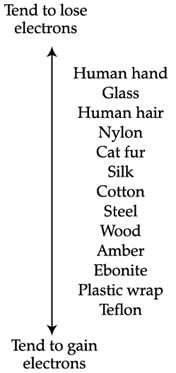
Tribo-electric series: The tribo-electric series is a list that ranks materials according to their tendency to gain or lose electrons. The process of electron transfer as a result of two objects coming into contact with one another and then separating is called tribo-electric charging. During such an interaction, one of the two objects will always gain electrons (becoming negatively charged) and the other object will lose electrons (becoming positively charged). The relative position of the two objects on the tribo-electric series will define which object gains electrons and which object loses electrons.
In tribo-electric series, materials are ranked from high to low in terms of the tendency for the material to lose electrons. If an object high up on this list (Glass, for example) is rubbed with an object low down on the list (Teflon, for example), the glass will lose electrons to the teflon. The glass will, in this case, become positively charged and the teflon will become negatively charged. Materials in the middle of the list (steel and wood, for example) are items those do not have a strong tendency to give up or accept electrons.
Materials in the upper position has _____ tendency to become positively charged.
Detailed Solution: Question 3
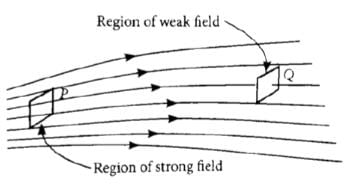
Electric field strength is proportional to the density of lines of force i.e., electric field strength at a point is proportional to the number of lines of force cutting a unit area element placed normal to the field at that point. As illustrated in given figure, the electric field at P is stronger than at Q.
Q. Electric lines of force about a positive point charge are
Q. Electric lines of force about a positive point charge are
Detailed Solution: Question 4
Read the following text and answer the following questions on the basis of the same:
Tribo-electric series: The tribo-electric series is a list that ranks materials according to their tendency to gain or lose electrons. The process of electron transfer as a result of two objects coming into contact with one another and then separating is called tribo-electric charging. During such an interaction, one of the two objects will always gain electrons (becoming negatively charged) and the other object will lose electrons (becoming positively charged). The relative position of the two objects on the tribo-electric series will define which object gains electrons and which object loses electrons. In tribo-electric series, materials are ranked from high to low in terms of the tendency for the material to lose electrons. If an object high up on this list (Glass, for example) is rubbed with an object low down on the list (Teflon, for example), the glass will lose electrons to the teflon. The glass will, in this case, become positively charged and the teflon will become negatively charged. Materials in the middle of the list (steel and wood, for example) are items those do not have a strong tendency to give up or accept electrons.
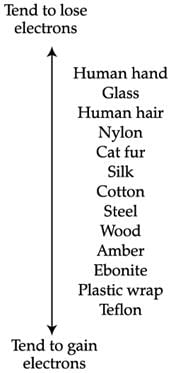
The object which loses electrons becomes _____ charged and the object gains electrons becomes ______ charged.
Detailed Solution: Question 5
Read the following text and answer the following questions on the basis of the same:
Faraday Cage: A Faraday cage or Faraday shield is an enclosure made of conducting material. The fields within a conductor cancel out with any external fields, so the electric field within the encloser is zero. These Faraday cages act as big hollow conductors you can put things in to shield them from electrical fields. Any electrical shocks the cage receives, pass harmlessly around the outside of the cage.
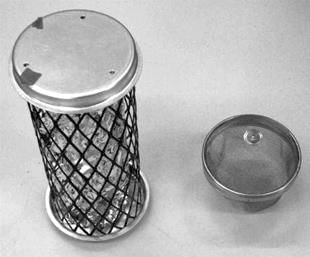
Example of a real-world Faraday cage is:
Detailed Solution: Question 6
Read the following text and answer the following questions on the basis of the same:
Tribo-electric series: The tribo-electric series is a list that ranks materials according to their tendency to gain or lose electrons. The process of electron transfer as a result of two objects coming into contact with one another and then separating is called tribo-electric charging. During such an interaction, one of the two objects will always gain electrons (becoming negatively charged) and the other object will lose electrons (becoming positively charged). The relative position of the two objects on the tribo-electric series will define which object gains electrons and which object loses electrons. In tribo-electric series, materials are ranked from high to low in terms of the tendency for the material to lose electrons. If an object high up on this list (Glass, for example) is rubbed with an object low down on the list (Teflon, for example), the glass will lose electrons to the teflon. The glass will, in this case, become positively charged and the teflon will become negatively charged. Materials in the middle of the list (steel and wood, for example) are items those do not have a strong tendency to give up or accept electrons.
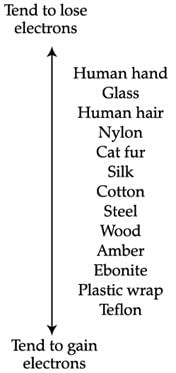
Name two materials which do not have a strong tendency to give up or accept electrons.
Detailed Solution: Question 7
Read the following text and answer the following questions on the basis of the same:
Tribo-electric series: The tribo-electric series is a list that ranks materials according to their tendency to gain or lose electrons. The process of electron transfer as a result of two objects coming into contact with one another and then separating is called tribo-electric charging. During such an interaction, one of the two objects will always gain electrons (becoming negatively charged) and the other object will lose electrons (becoming positively charged). The relative position of the two objects on the tribo-electric series will define which object gains electrons and which object loses electrons. In tribo-electric series, materials are ranked from high to low in terms of the tendency for the material to lose electrons. If an object high up on this list (Glass, for example) is rubbed with an object low down on the list (Teflon, for example), the glass will lose electrons to the teflon. The glass will, in this case, become positively charged and the teflon will become negatively charged. Materials in the middle of the list (steel and wood, for example) are items those do not have a strong tendency to give up or accept electrons.
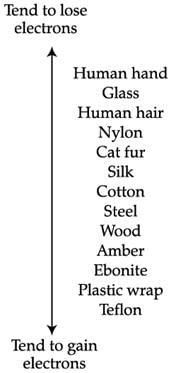
Tribo-electric charging is the process of electron transfer between two objects
Detailed Solution: Question 8
Read the following text and answer the following questions on the basis of the same:
Faraday Cage: A Faraday cage or Faraday shield is an enclosure made of conducting material. The fields within a conductor cancel out with any external fields, so the electric field within the enclosure is zero. These Faraday cages act as big hollow conductors you can put things in to shield them from electrical fields. Any electrical shocks the cage receives, pass harmlessly around the outside of the cage.
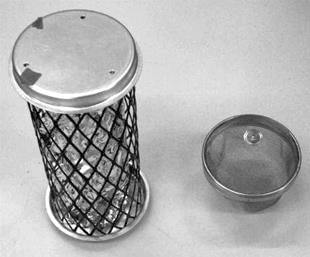
A point charge of 2 C is placed at centre of Faraday cage in the shape of cube with surface of 9 cm edge. The number of electric field lines passing through the cube normally will be :
Detailed Solution: Question 9
Read the following text and answer the following questions on the basis of the same:
Faraday Cage: A Faraday cage or Faraday shield is an enclosure made of conducting material. The fields within a conductor cancel out with any external fields, so the electric field within the enclosure is zero. These Faraday cages act as big hollow conductors you can put things in to shield them from electrical fields. Any electrical shocks the cage receives, pass harmlessly around the outside of the cage.
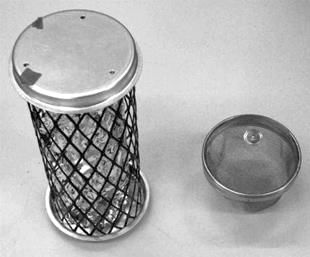
If isolated point charge +q is placed inside the Faraday cage. Its surface must have charge equal to :
Detailed Solution: Question 10
4 docs|149 tests |
