
Chapter Test: Alternating Current - 1 JEE Physics Free MCQs
MCQ Practice Test & Solutions: Chapter Test: Alternating Current - 1 (30 Questions)
You can prepare effectively for JEE Physics for JEE Main & Advanced with this dedicated MCQ Practice Test (available with solutions) on the important topic of "Chapter Test: Alternating Current - 1". These 30 questions have been designed by the experts with the latest curriculum of JEE 2026, to help you master the concept.
Test Highlights:
- - Format: Multiple Choice Questions (MCQ)
- - Duration: 60 minutes
- - Number of Questions: 30
Sign up on EduRev for free to attempt this test and track your preparation progress.

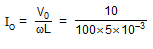
A coil of inductance 5.0 mH and negligible resistance is connected to an alternating voltage V = 10 sin (100 t). The peak current in the circuit will be :
Detailed Solution: Question 1
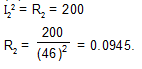
The overall efficiency of a transformer is 90%. The transformer is rated for an output of 9000 watt. The primary voltage is 1000 volt. The ratio of turns in the primary to the secondary coil is 5 : 1. The iron losses at full load are 700 watt. The primary coil has a resistance of 1 ohm.
In the above, the resistance of the secondary coil is approximately :
Detailed Solution: Question 2

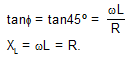
In an AC circuit, a resistance of R ohm is connected in series with an inductance L. If phase angle between voltage and current be 45°, the value of inductive reactance will be.
Detailed Solution: Question 3
An AC voltage source V = 200 sin 100 t is connected across a circuit containing an AC ammeter(it reads rms value) and capacitor of capacity 1 μF. The reading of ammeter is :
Detailed Solution: Question 4

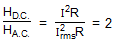
A direct current of 2 A and an alternating current having a maximum value of 2 A flow through two identical resistances. The ratio of heat produced in the two resistances in the same time interval will be:
Detailed Solution: Question 5
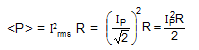
A sinusoidal AC current flows through a resistor of resistance R. If the peak current is Ip, then average power dissipated is :
Detailed Solution: Question 6
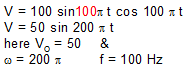
The voltage of an AC source varies with time according to the equation, V = 100 sin 100 π t cos 100 π t. Where t is in second and V is in volt. Then :
Detailed Solution: Question 7
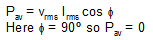
The potential difference V across and the current I flowing through an instrument in an AC circuit are given by :
V = 5 cos ω t volt
I = 2 sin ω t volt
The power dissipated in the instrument is :
Detailed Solution: Question 8
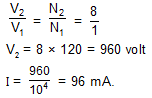
A power transformer (step up) with an 1 : 8 turn ratio has 60 Hz, 120 V across the primary; the load in the secondary is 104 W. The current in the secondary is
Detailed Solution: Question 9
A transformer is used to light a 140 watt, 24 volt lamp from 240 V AC mains. The current in the main cable is 0.7 amp. The efficiency of the transformer is :
Detailed Solution: Question 10

A 100 volt AC source of angular frequency 500 rad/s is connected to a LCR circuit with L = 0.8 H, C = 5 μF and R = 10 Ω, all connected in series. The potential difference across the resistance is
Detailed Solution: Question 11
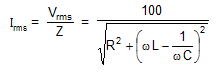

Detailed Solution: Question 12

In a step-up transformer the voltage in the primary is 220 V and the current is 5A. The secondary voltage is found to be 22000 V. The current in the secondary (neglect losses) is
Detailed Solution: Question 13
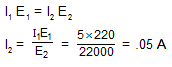

Detailed Solution: Question 14
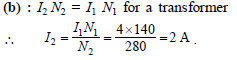
What is the rms value of an alternating current which when passed through a resistor produces heat, which is thrice that produced by a D.C. current of 2 ampere in the same resistor in the same time interval?
Detailed Solution: Question 15


Detailed Solution: Question 16
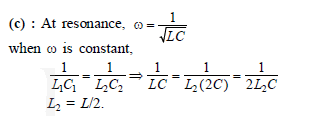
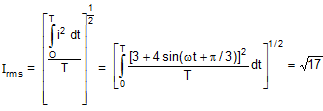
r.m.s. value of current i = 3 + 4 sin (ω t + π/3) is:
Detailed Solution: Question 17
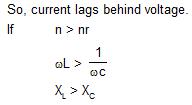
A resistor R, an inductor L and a capacitor C are connected in series to an oscillator of frequency u. If the resonant frequency is ur, then the current lags behind voltage, when :
Detailed Solution: Question 18

Detailed Solution: Question 19
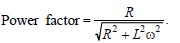
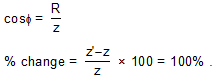
By what percentage the impedance in an AC series circuit should be increased so that the power factor changes from (1/2) to (1/4) (when R is cosntant) ?
Detailed Solution: Question 20
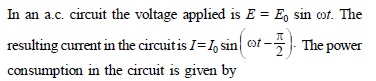
Detailed Solution: Question 21
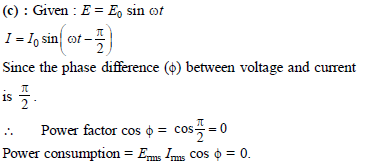
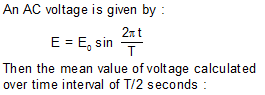
Detailed Solution: Question 22
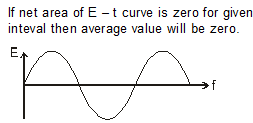
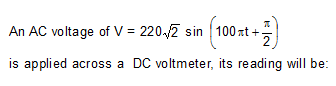
Detailed Solution: Question 23
In an AC circuit the potential differences across an inductance and resistance joined in series are respectively 16 V and 20 V. The total potential difference across the circuit is
Detailed Solution: Question 24

If in a series LCR AC circuit, the rms voltage across L, C and R are V1, V2 and V3 respectively, then the voltage of the source is always :
Detailed Solution: Question 25
An LC circuit contains a 20 mH inductor and a 50 μF capacitor with an initial charge of 10 mC. The resistance of the circuit is negligible. Natural frequency of the circuit is
Detailed Solution: Question 26
A hair dryer meant for 110V 60Hz is to be used in India . If 220 V is the supply voltage in India , the turns ratio for a transformer would be
Detailed Solution: Question 27
You have a 200.0 ΩΩ resistor, a 0.400-H inductor, 5.0 μF a capacitor, and a variable frequency ac source with an amplitude of 3.00 V. You connect all four elements together to form a series circuit. Current amplitude at an angular frequency of 400 rad/s is
Detailed Solution: Question 28
A 100 μF capacitor in series with a 40 Ω resistance is connected to a 110 V, 60 Hz supply. Maximum current in the circuit and time lag between the current maximum and the voltage maximum are
Detailed Solution: Question 29
Average power supplied to a capacitor over one complete cycle
Detailed Solution: Question 30
258 videos|856 docs|206 tests |
