
Chapter Test: Dual Nature of Matter and Radiation - 1 JEE Physics Free
MCQ Practice Test & Solutions: Chapter Test: Dual Nature of Matter and Radiation - 1 (30 Questions)
You can prepare effectively for JEE Physics for JEE Main & Advanced with this dedicated MCQ Practice Test (available with solutions) on the important topic of "Chapter Test: Dual Nature of Matter and Radiation - 1". These 30 questions have been designed by the experts with the latest curriculum of JEE 2026, to help you master the concept.
Test Highlights:
- - Format: Multiple Choice Questions (MCQ)
- - Duration: 60 minutes
- - Number of Questions: 30
Sign up on EduRev for free to attempt this test and track your preparation progress.

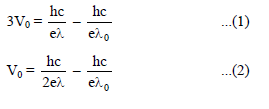
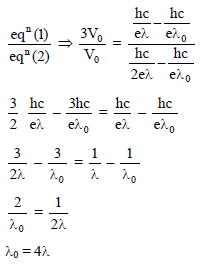
When a metallic surface is illuminated with monochromatic light of wavelength λ, stopping potential for photoelectric current is 3 V0. When the same metallic surface is illuminated with a light of wavelength 2λ, the stopping potential is V0. The threshold wavelength for the surface is-
Detailed Solution: Question 1
Detailed Solution: Question 2

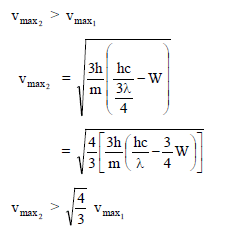
In a photo emissive cell with executing wavelength λ, the fastest electron has speed v. If the exciting wavelength is changed to 3λ/4, the speed of the fastest emitted electron will be -
Detailed Solution: Question 3
A source of light is placed at a distance of 1 m from a photocell and cut-off potential is found to be V0. If the distance is doubled, the cut-off potential will be -
Detailed Solution: Question 4
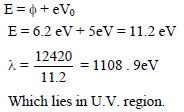
The threshold frequency for a metallic surface corresponds to an energy of 6.2 eV, and the stopping potential for a radiation incident on this surface is 5V. The incident radiation lies in -
Detailed Solution: Question 5
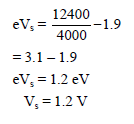
Light of wavelength 400 nm is incident continuously on a cesium ball (work function 1.9 eV) The maximum potential to which the ball will be charged is-
Detailed Solution: Question 6
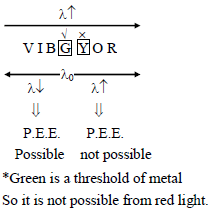
A metallic surface ejects photoelectrons when hit by green light but none when hit by yellow light. Will the electrons be ejected if the same surface is hit by red light ?
Detailed Solution: Question 7
Detailed Solution: Question 8

Detailed Solution: Question 9
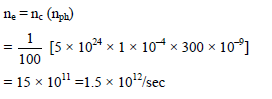
Ultraviolet light of wavelength 300 nm and intensity 1.0 watt/m2 falls on the surface of a photosensitive material. If 1% of the incident photons produce photoelectrons, then the number of photoelectrons emitted from an area of 1.0 cm2 of the surface is nearly -
Detailed Solution: Question 10
The rest mass of a photon is -
Detailed Solution: Question 11
A photocell employs photoelectric effect to convert -
Detailed Solution: Question 12

Detailed Solution: Question 13

Detailed Solution: Question 14


Detailed Solution: Question 15
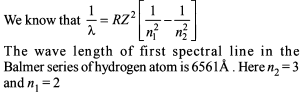
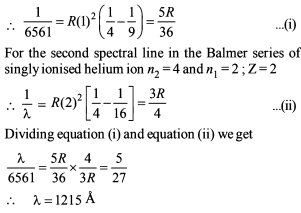
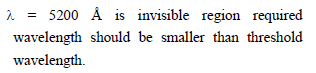
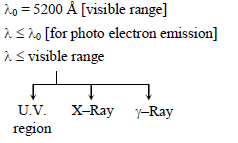
Threshold wavelength for photoelectric emission from a metal surface is 5200 Å. Photoelectrons will be emitted when this surface is illuminated with monochromatic radiation from -
Detailed Solution: Question 16
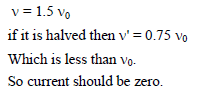
Light of frequency 1.5 times the threshold frequency is incident on a photosensitive material, photoelectric current is emitted. If the frequency of light is halved and intensity is doubled, the photoelectric current becomes -
Detailed Solution: Question 17
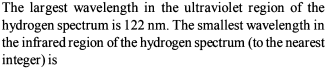
Detailed Solution: Question 18
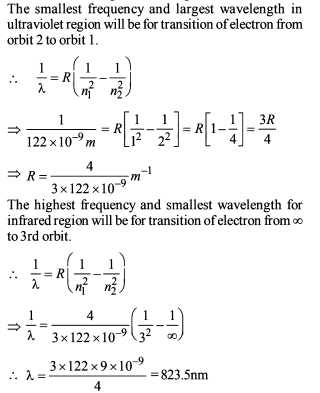

Detailed Solution: Question 19
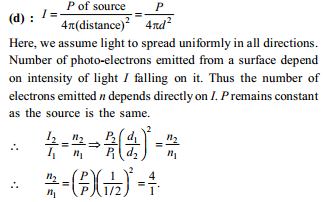
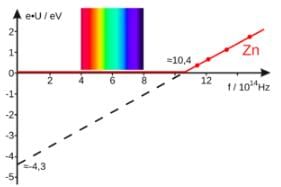
The graph between the frequency of incident light and the stopping potential is a -
Detailed Solution: Question 20
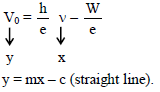
An image of the sun is formed by a lens of focal length 30 cm on the metal surface of a photoelectric cell and it produces a current I. The lens forming the image is then replaced by another lens of the same diameter but of focal length of 15 cm. The photoelectric current in this case will be -
(In both cases the plate is kept at focal plane and normal to the axis lens)
Detailed Solution: Question 21
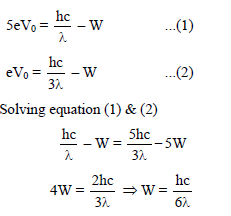
When a metallic surface is illuminated with monochromatic light of wavelength λ, the stopping potential is 5V0. When the same surface is illuminated with light of wavelength 3λ, the stopping potential is V0. Then the work function of the metallic surface is -
Detailed Solution: Question 22
The threshold wavelength for photoelectric emission from a material is 5200 Å. Photoelectrons will be emitted when this material is illuminated with monochromatic radiation from a
Detailed Solution: Question 23
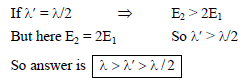
Light of wavelength λ strikes a photo-sensitive surface and electrons are ejected with kinetic energy E. If the kinetic energy is to be increased to 2E, the wavelength must be changed to λ' where -
Detailed Solution: Question 24
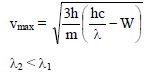
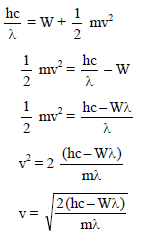
The maximum velocity of an electron emitted by light of wavelength λ incident on the surface of a metal of work function W is -
Detailed Solution: Question 25
Given h = 6.6 × 10⁻³⁴ joule sec, the momentum of each photon in a given radiation is 3.3 × 10⁻²⁹ kg metre/sec. The frequency of radiation is
Detailed Solution: Question 26
If the work function of a material is 2eV, then minimum frequency of light required to emit photo-electrons is
Detailed Solution: Question 27
The maximum kinetic energy of photoelectrons emitted from a surface when photons of energy 6 eV fall on it is 4 eV. The stopping potential is
Detailed Solution: Question 28
In an experiment of photoelectric emission for incident light of 4000 Â, the stopping potential is 2V. If the wavelength of incident light is made 3000 Â, then stopping potential will be
Detailed Solution: Question 29
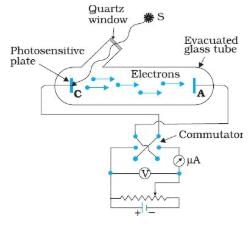
In the above experimental set up for studying photoelectric effect, if keeping the frequency of the incident radiation and the accelerating potential fixed, the intensity of light is varied, then
Detailed Solution: Question 30
258 videos|856 docs|206 tests |
