
Chapter Test: Dual Nature of Matter and Radiation - 2 JEE Physics Free
MCQ Practice Test & Solutions: Chapter Test: Dual Nature of Matter and Radiation - 2 (30 Questions)
You can prepare effectively for JEE Physics for JEE Main & Advanced with this dedicated MCQ Practice Test (available with solutions) on the important topic of "Chapter Test: Dual Nature of Matter and Radiation - 2". These 30 questions have been designed by the experts with the latest curriculum of JEE 2026, to help you master the concept.
Test Highlights:
- - Format: Multiple Choice Questions (MCQ)
- - Duration: 60 minutes
- - Number of Questions: 30
Sign up on EduRev for free to attempt this test and track your preparation progress.


Detailed Solution: Question 1
Detailed Solution: Question 2
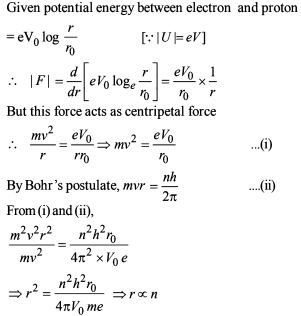

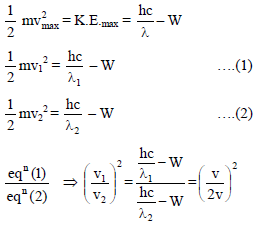
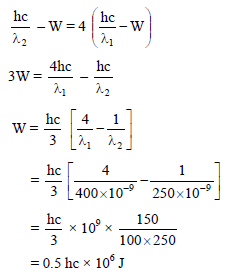
When a metal surface is illuminated by light of wavelengths 400 nm and 250 nm, the maximum velocities of the photoelectrons ejected are v and
2v respectively. The work function of the metal is - (h = Planck's constant, c = velocity of light in air)
Detailed Solution: Question 3
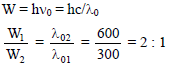
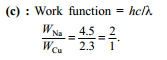
When light of wavelength 300 nm (nanometer) falls on a photoelectric emitter, photoelectrons are liberated. For another emitter, however light of 600nm wavelength is sufficient for creating photoemission. What is the ratio of the work functions of the two emitters ?
Detailed Solution: Question 4
Detailed Solution: Question 5
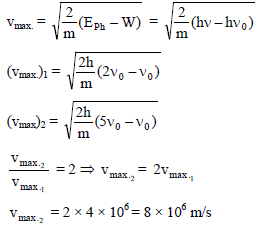
The threshold frequency for a certain metal is v0. When light of frequency V = 2v0 is incident on it, the maximum velocity of photoelectrons is 4 × 10⁶ m/s. If the frequency of incident radiations is increased to 5v0, then the maximum velocity of photoelectrons in m/s will be -
Detailed Solution: Question 6
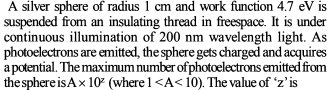
Detailed Solution: Question 7
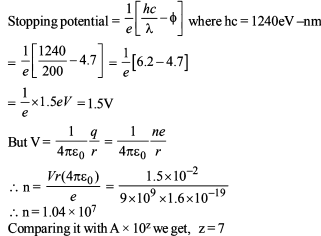
When radiation of wavelength λ is incident on a metallic surface, the stopping potential is 4.8 volts. If the same surface is illuminated with
radiation of double the wavelength, then the stopping potential becomes 1.6 volts. Then the threshold wavelength for the surface is -
Detailed Solution: Question 8
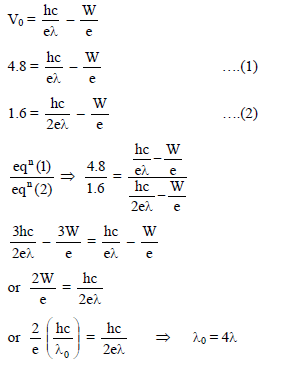
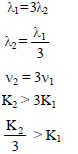
If K1 and K2 are the maximum kinetic energies of photoelectrons emitted when lights of wavelength λ1 and λ2 respectively incident on a metallic surface and λ1 = 3λ2 , then -
Detailed Solution: Question 9

Detailed Solution: Question 10


Detailed Solution: Question 11

Detailed Solution: Question 12
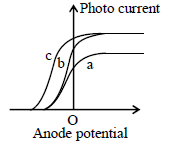
The figure shows the variation of photo current with anode potential for a photo-sensitive surface for three different radiations. Let Ia, Ib and Ic be the intensities and fa, fb and fc be the frequencies for the curves a, b and c respectively -
Detailed Solution: Question 13



Detailed Solution: Question 14
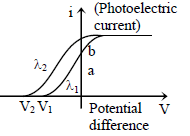
In the following diagram if V2 > V1 then -
Detailed Solution: Question 15

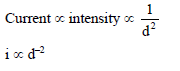
If the distance of a 100 watt lamp is increased from a photo cell, the saturation current I in the photocell varies with the distance d as -
Detailed Solution: Question 16
Detailed Solution: Question 17

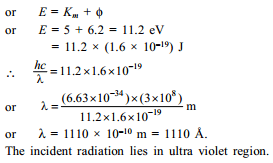

Detailed Solution: Question 18
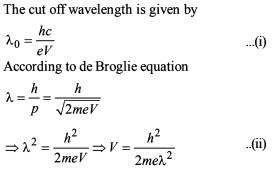
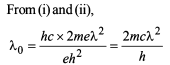
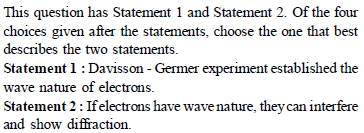
Detailed Solution: Question 19
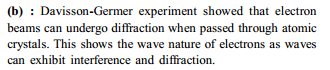
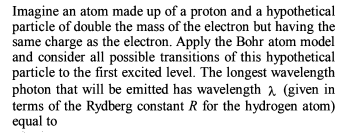
Detailed Solution: Question 20
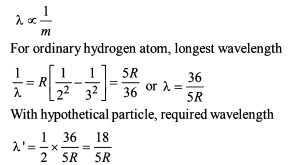
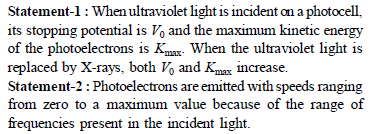
Detailed Solution: Question 21
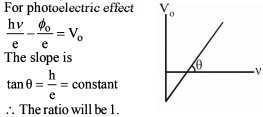
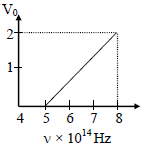
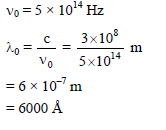
The stopping potential (V0) versus frequency (v) plot of a substance is shown in figure, the threshold wavelength is –
Detailed Solution: Question 22
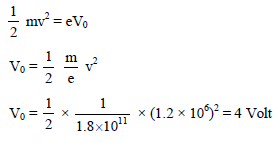
Maximum velocity of the photoelectrons emitted by a metal surface is 1.2 × 10⁶ ms–1 . Assuming the specific charge of the electron to be 1.8 × 10¹¹
C Kg–1, the value of the stopping potential in volt will be -
Detailed Solution: Question 23

Detailed Solution: Question 24
A cesium photocell, with a steady potential difference of 60 V across, is illuminated by a bright point source of light 50 cm away. When the same light is placed 1 m away, the photoelectrons emitted from the cell -
Detailed Solution: Question 25
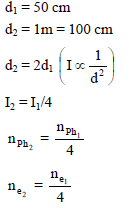
Let nr and nb be respectively the number of photons emitted by a red bulb and a blue bulb of equal power in a given time.
Detailed Solution: Question 26
10-3 W of 5000 Å light is directed on a photoelectric cell. If the current in the cell is 0.16 mA, the percentage of incident photons which produce photoelectrons, is
Detailed Solution: Question 27
The stopping potential for the photo electrons emitted from a metal surface of work function 1.7eV is 10.4 V. Identify the energy levels corresponding to the transitions in hydrogen atom which will result in emission of wavelength equal to that of incident radiation for the above photoelectric effect
Detailed Solution: Question 28
A point source causes photoelectric effect from a small metal plate. Which of the following curves may represent the saturation photocurrent as a function of the distance between the source and the metal?
Detailed Solution: Question 29
Photons with energy 5eV are incident on a cathode C, on a photoelectric cell. The maximum energy of the emitted photoelectrons is 2eV. When photons of energy 6eV are incident on C, no photoelectrons will reach the anode A if the stopping potential of A relative to C is
Detailed Solution: Question 30
258 videos|856 docs|206 tests |
