
Chapter Test: Elasticity (Mechanical Properties of Solids) - 1 JEE Physics
MCQ Practice Test & Solutions: Chapter Test: Elasticity (Mechanical Properties of Solids) - 1 (30 Questions)
You can prepare effectively for JEE Physics for JEE Main & Advanced with this dedicated MCQ Practice Test (available with solutions) on the important topic of "Chapter Test: Elasticity (Mechanical Properties of Solids) - 1". These 30 questions have been designed by the experts with the latest curriculum of JEE 2026, to help you master the concept.
Test Highlights:
- - Format: Multiple Choice Questions (MCQ)
- - Duration: 60 minutes
- - Number of Questions: 30
Sign up on EduRev for free to attempt this test and track your preparation progress.


Detailed Solution: Question 1
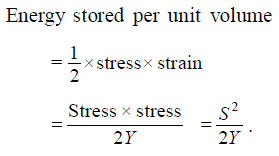
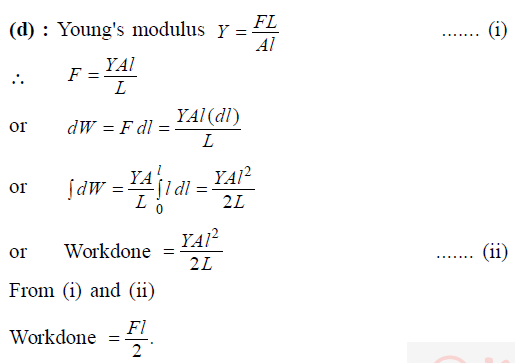
A wire suspended vertically from one of its ends is stretched by attaching a weight of 200 N to the lower end. The weight stretches the wire by 1mm. Then the elastic energy stored in the wire-
Detailed Solution: Question 2


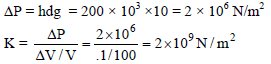
A ball falling in a lake of 200 m shows a decrease of 0.1% in its volume. The Bulk modulus of elasticity of the material of the ball is -(take g =10 m/s2)
Detailed Solution: Question 3
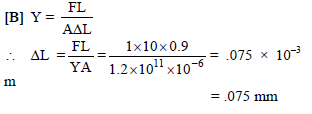
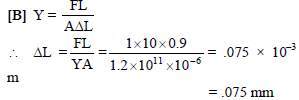
A copper wire of length 0.9 m and crosssectional area 1.0 mm2 is stretched by a load of 1kg. Young's modulus for copper is 1.2 × 10¹¹ N/m2 and g = 10m/s2. The extension in wire in mm is -
Detailed Solution: Question 4
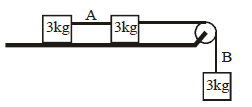
Three equal masses of 3 kg are connected by two massless strings of cross sectional area 0.005 cm2 and Young modulus is 2 × 10¹¹ N/m2 each.The longitudinal strain in the wires
Detailed Solution: Question 5
Detailed Solution: Question 6
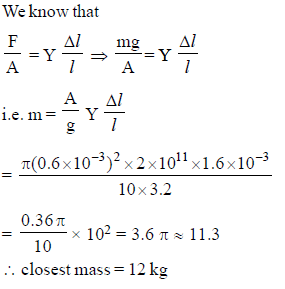
A steel wire, 3.2 m long, has a diameter of 1.2 mm. The wire stretches by 1.6 mm when it bears a load. Young's modulus for steel is 2.0 × 10¹¹ Pa. The mass of the load is closest to:
Detailed Solution: Question 7

Detailed Solution: Question 8
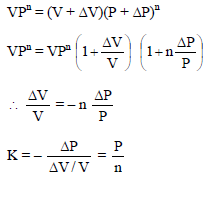
A gas undergoes a process in which the pressure and volume are related by VPn = constant. The bulk modulus of the gas is –
Detailed Solution: Question 9
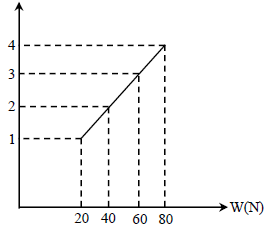
Detailed Solution: Question 10
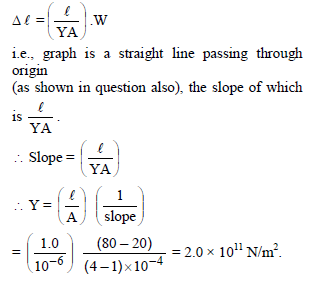
Given the following values for an elastic material: Young's modulus = 7 × 10¹⁰ Nm–2 and Bulk modulus = 11 × 1010 Nm–2 . The Poisson's ratio of the material is -
Detailed Solution: Question 11
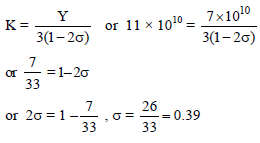
A gas undergoes a process in which the pressure and volume are related by VPn = constant. The bulk modulus of the gas is –
Detailed Solution: Question 12
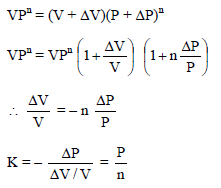
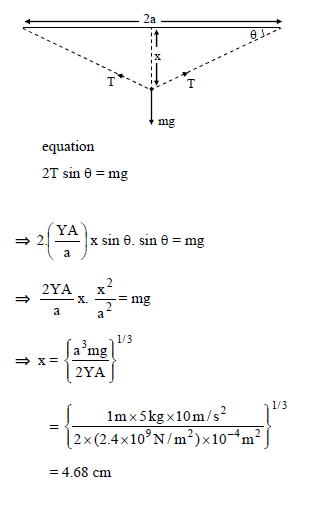
A wire of length '2m' is clamped horizontally between two fixed support. A mass m = 5 kg is hanged from middle of wire. The vertical depression in wire in equilibrium is (young modulus of wire = 2.4 × 10⁹ N/m2, crosssectional area = 1 cm2) -
Detailed Solution: Question 13
Detailed Solution: Question 14
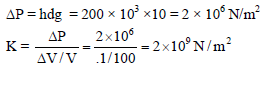
A ball falling in a lake of 200 m shows a decrease of 0.1% in its volume. The Bulk modulus of elasticity of the material of the ball is -
(take g =10 m/s2)
Detailed Solution: Question 15
Detailed Solution: Question 16
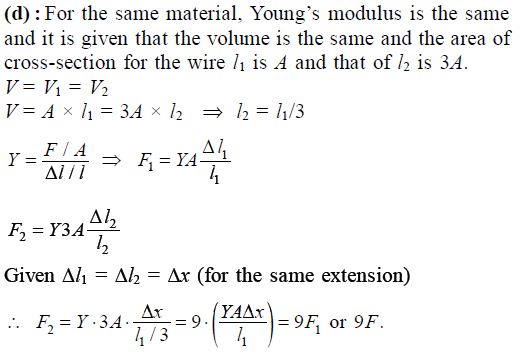
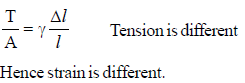
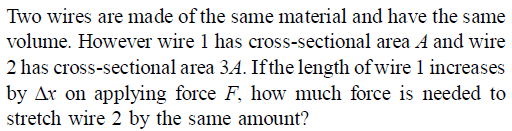
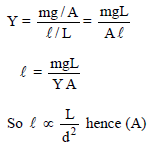
The following four wires are made of the same material. Which of these will have the largest extension when the same tension is applied -
Detailed Solution: Question 17
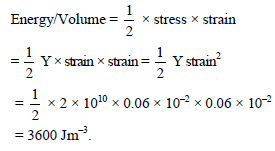
A metal rod of Young's modulus 2 × 10¹⁰ Nm–2 undergoes an elastic strain of 0.06%. The enrgy per unit volume stored in Jm–3 is -
Detailed Solution: Question 18
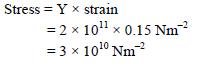
n steel, the young's modulus and the strain at the breaking point are 2 × 10¹¹ Nm–2 and 0.15 respectively. The stress at the break point for steel is –
Detailed Solution: Question 19
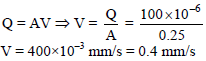
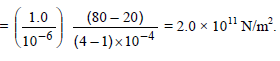
Blood is flowing at the rate of 100 cm3/s in a capillary of cross sectional area 0.25m2. The velocity of flow is -
Detailed Solution: Question 20
Detailed Solution: Question 21
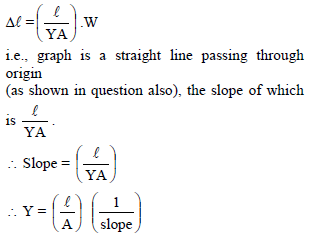
In steel the Young's modulus and the strain at the breaking point are 2 × 10¹¹ Nm–2 and 0.15 respectively. The stress at the break point for steel is-
Detailed Solution: Question 22
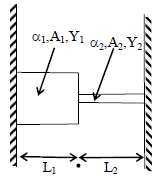
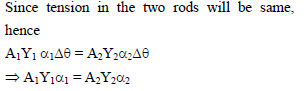
Two elastic rods are joined between fixed supports as shown in the figure. Condition for no change in the lengths of individual rods with the increase of temperature is –
(α1,β2 = linear expansion coefficient, A1, A2 = Area of rods, Y1,Y2 = young modulus )
Detailed Solution: Question 23
A copper wire of length 0.9 m and crosssectional area 1.0 mm2 is stretched by a load of 1kg. Young's modulus for copper is 1.2 × 10¹¹
N/m2 and g = 10m/s2. The extension in wire in mm is -
Detailed Solution: Question 24
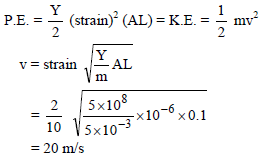
The rubber cord catapult has a cross-section area 1 mm2 and total unstretched length 10 cm. It is stretched to 12 cm and then released to project a stone of mass 5 gm. Taking Young’s modulus Y of rubber as 5 × 10⁸ N/m2, the velocity of projection will be -
Detailed Solution: Question 25
A steel rod 2.0 m long has a cross-sectional area of 0.30 cm2 . It is hung by one end from a support, and a 550-kg milling machine is hung from its other end. Determine the resulting strain. Young's Modulus of Steel (Y) = 20×1010 Pa
Detailed Solution: Question 26
A piece of copper having a rectangular cross-section of 15.2 mm × 19.1 mm is pulled in tension with 44,500 N force, producing only elastic deformation. Calculate the resulting strain? Take Young's modulus of copper as 42 × 109Pa
Detailed Solution: Question 27


What diameter should a 10-m-long steel wire have if we do not want it to stretch more than 0.5 cm under a tension of 940 N? Take Young's modulus of steel as 20 × 1010 Pa
Detailed Solution: Question 28
Elasticity is the property of a body, by virtue of which
Detailed Solution: Question 29
Elastomers are materials
Detailed Solution: Question 30
258 videos|856 docs|206 tests |
