
Chapter Test: Electromagnetic Induction - 2 JEE Physics Free MCQs
MCQ Practice Test & Solutions: Chapter Test: Electromagnetic Induction - 2 (30 Questions)
You can prepare effectively for JEE Physics for JEE Main & Advanced with this dedicated MCQ Practice Test (available with solutions) on the important topic of "Chapter Test: Electromagnetic Induction - 2". These 30 questions have been designed by the experts with the latest curriculum of JEE 2026, to help you master the concept.
Test Highlights:
- - Format: Multiple Choice Questions (MCQ)
- - Duration: 60 minutes
- - Number of Questions: 30
Sign up on EduRev for free to attempt this test and track your preparation progress.

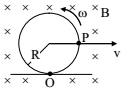
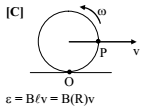
A metallic ring of radius R moves in a vertical plane in the presence of a uniform magnetic field B perpendicular to the plane of the ring. At any given instant of time its centre of mass moves with a velocity v while ring rotates in its COM frame with angular velocity ω as shown in the figure. The magnitude of induced e.m.f. between points O and P is -
Detailed Solution: Question 1
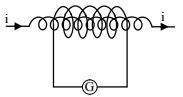
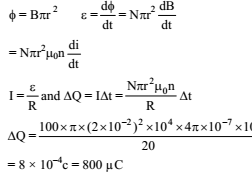
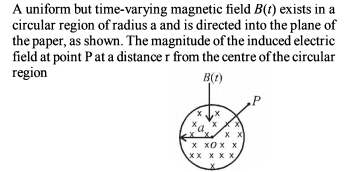
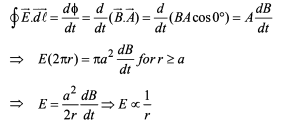
A long solenoid of radius 2 cm has 100 turns/cm and is surrounded by a 100 turn coil of radius 4 cm having a total resistance 20Ω. If current changes from 5 A to – 5A, find the charge through galvanometer.
Detailed Solution: Question 2

A coil of inductance L = 0.2 H and of resistance R = 62.8 Ω is connected to the mains alternating voltage of frequency 50 Hz. What can be the capacitance of the capacitor connected in series with the coil if the useful power has to remain unchanged?
Detailed Solution: Question 3
A conducting wire frame is placed in a magnetic field, which is directed into the paper. The magnetic field is increasing at a constant rate.
The directions of induced currents in wires AB and CD are -
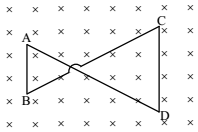
The directions of induced currents in wires AB and CD are -
Detailed Solution: Question 4
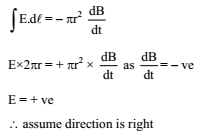
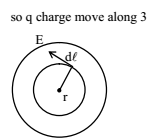
A uniform but time varying magnetic field exists in cylindrical region and directed into the paper. If field decrease with time and a positive
charge placed at any point inside the region, then it moves -
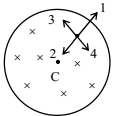
charge placed at any point inside the region, then it moves -
Detailed Solution: Question 5
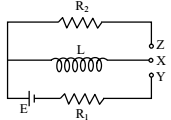
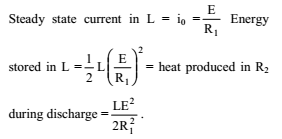
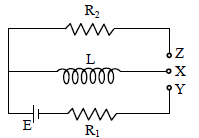
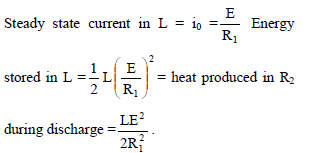
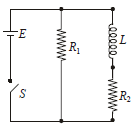
In the circuit shown X is joined to Y for a long time and then X is joined to Z. The total heat produced in R2 is –
Detailed Solution: Question 6
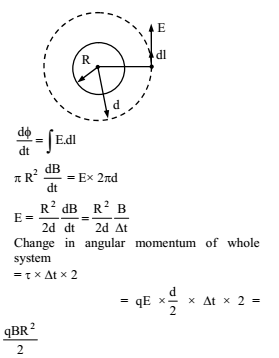
Two small pith balls, each carrying a charge q are attached to the ends of a light rod of length d, which is suspended from the ceiling by a thin torsion free fibre as shown in figure. There is a uniform magnetic field B pointing straight down, in the cylindrical region of radius R
around the fibre. The system is initially at rest. If the magnetic field is turned off, which of the following happen to the system -
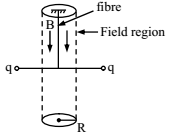
around the fibre. The system is initially at rest. If the magnetic field is turned off, which of the following happen to the system -
Detailed Solution: Question 7
In the circuit shown X is joined to Y for a long time and then X is joined to Z. The total heat produced in R2 is –
Detailed Solution: Question 8
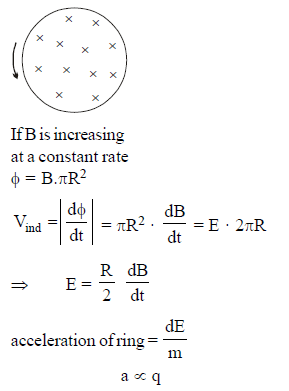
A uniform circular ring of radius R, mass m has uniformly distributed charge q. The ring is free to rotate about its own axis (which is vertical) without friction. In the space, a uniform magnetic field B, directed vertically downwards, exists in a cylindrical region. Cylindrical region of magnetic field is coaxial with the ring and has radius, greater than R. If induction of magnetic field starts increasing at a constant rate. The angular acceleration of the ring will be :
Detailed Solution: Question 9

Detailed Solution: Question 10
Detailed Solution: Question 11

Detailed Solution: Question 12
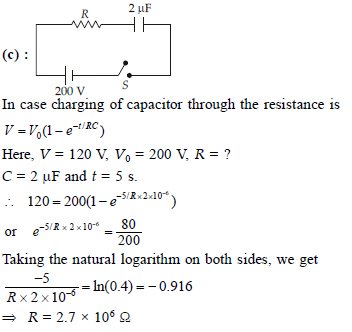
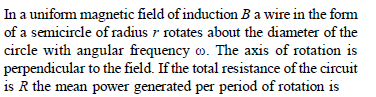
Detailed Solution: Question 13
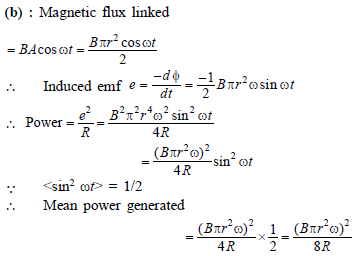
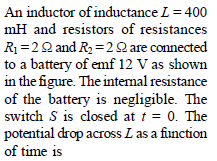
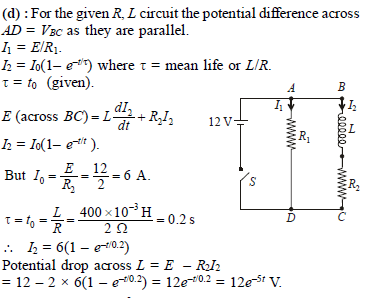
Detailed Solution: Question 14
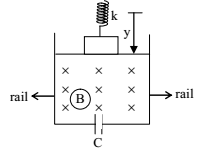
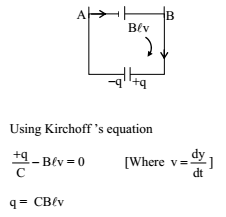
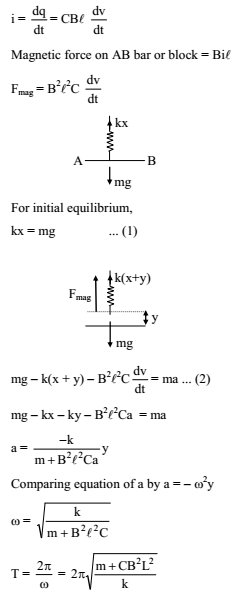
A heavy block is attached to the ceiling by a spring that has a force constant ‘k’. A conducting rod is attached to block. The combined mass of the block and the rod is m. The rod can slide without friction along two vertical parallel rails, which are a distance L apart. A capacitor of known capacitance C is attached to the rails by the wires. The entire system is placed in a uniform magnetic field B. Find the time period T of the vertical oscillations of the block. Neglect the electrical resistance of the rod and all wires –
Detailed Solution: Question 15
Detailed Solution: Question 16
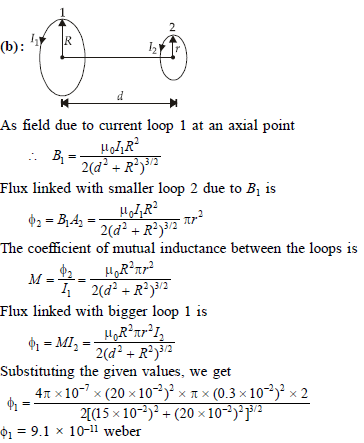
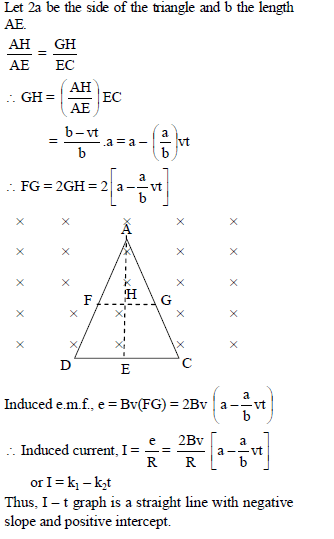
An equilateral triangular loop ADC of uniform specific resistivity having some resistance is pulled with a constant velocity v out of a uniform magnetic field directed into the paper. At time t = 0 , side DC of the loop is at the edge of the magnetic field. The induced current (I) versus time (t) graph will be as :
Detailed Solution: Question 17
Detailed Solution: Question 18
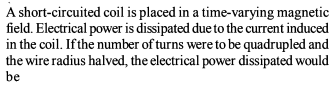
Detailed Solution: Question 19
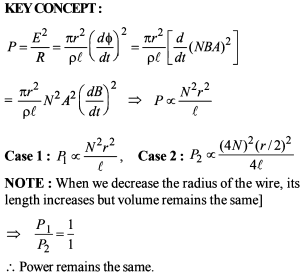
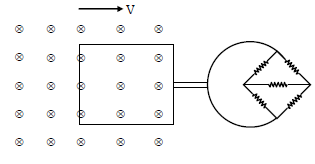
A square metal loop of side 10 cm and resistance 1 Ω is moved with a constant velocity partly inside a uniform magnetic field of 2 Wbm–2, directed into the paper, as shown in the figure. The loop is connected to a network of five resistors each of value 3 Ω. If a steady current of 1 mA flows in the loop, then the speed of the loop is -
Detailed Solution: Question 20
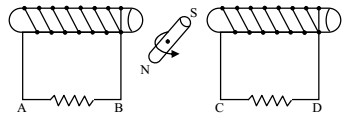
The magnet in fig. rotates as shown on a pivot through its centre. At the instant shown, what are the directions of the induced currents
Detailed Solution: Question 21
A conducting rod AB of length l = 1m is moving at a velocity v = 4 m/s making an angle of 30° with its length. A uniform magnetic field
B = 2T exist in a direction perpendicular to the plane of motion, then -
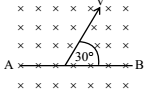
B = 2T exist in a direction perpendicular to the plane of motion, then -
Detailed Solution: Question 22
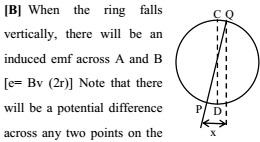
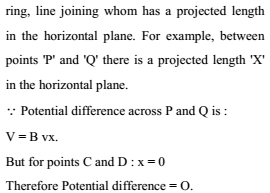
A vertical conducting ring of radius R falls vertically with a speed v in a horizontal uniform magnetic field B which is perpendicular to the
plane of the ring -
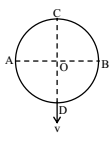
plane of the ring -
Detailed Solution: Question 23
Detailed Solution: Question 24
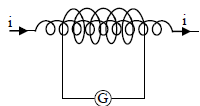
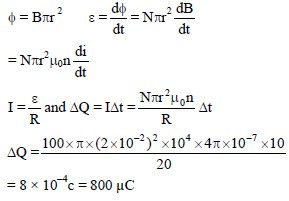
A long solenoid of radius 2 cm has 100 turns/cm and is surrounded by a 100 turn coil of radius 4 cm having a total resistance 20Ω. If current changes from 5 A to – 5A, find the charge through galvanometer.
Detailed Solution: Question 25
Detailed Solution: Question 26
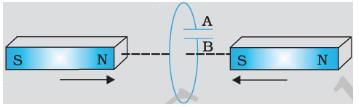
Polarity of the capacitor in the situation described by the adjacent figure is
Detailed Solution: Question 27
A 1.0 m long metallic rod is rotated with an angular frequency of 400 rad s−1 about an axis normal to the rod passing through its one end. The other end of the rod is in contact with a circular metallic ring. A constant and uniform magnetic field of 0.5 T parallel to the axis exists everywhere. Emf developed between the centre and the ring is
Detailed Solution: Question 28

On a cylindrical rod two coils are wound one above the other. What is the coefficient of mutual inductance if the inductance of each coil os 0.1H?
Detailed Solution: Question 29

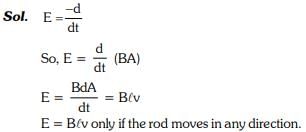
Two ends of a horizontal conducting rod of length l are joined to a voltmeter. The whole arrangement moves with a horizontal velocity v, the direction of motion being perpendicular to the rod. Vertical component of the earth's magnetic field is B. The voltmeter reads
Detailed Solution: Question 30

258 videos|856 docs|206 tests |
