
Chapter Test: Gravitation - 1 JEE Physics Free MCQs
MCQ Practice Test & Solutions: Chapter Test: Gravitation - 1 (30 Questions)
You can prepare effectively for JEE Physics for JEE Main & Advanced with this dedicated MCQ Practice Test (available with solutions) on the important topic of "Chapter Test: Gravitation - 1". These 30 questions have been designed by the experts with the latest curriculum of JEE 2026, to help you master the concept.
Test Highlights:
- - Format: Multiple Choice Questions (MCQ)
- - Duration: 60 minutes
- - Number of Questions: 30
Sign up on EduRev for free to attempt this test and track your preparation progress.

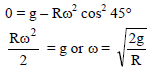
With what angular velocity the earth should spin in order that a body lying at 45° latitude may become weightless ?
Detailed Solution: Question 1
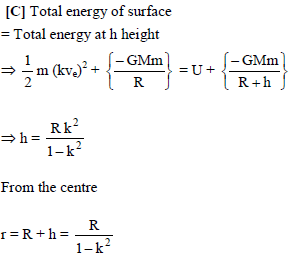
A particle is projected with velocity kve in vertically upward direction from the ground into the space (ve is escape velocity & k < 1) then the maximum height from the centre of earth to which it can go, will be -
Detailed Solution: Question 2

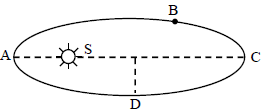
A planet revolves in elliptical orbit around the sun. The linear speed of the planet will be maximum at :
Detailed Solution: Question 3
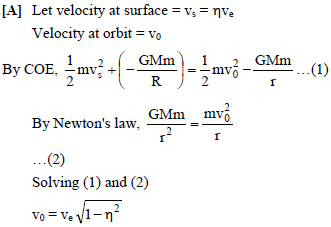
A projectile is fired from the surface of earth of radius R with a velocity η ve where ve is the escape velocity and η<1. Neglecting air resistance, the orbital velocity of projectile is -
Detailed Solution: Question 4
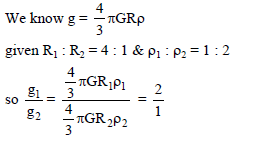
The diameters of two planets are in the ratio of 4 : 1 & mean density have ratio 1 : 2, then the ratio of g on the planets will be -
Detailed Solution: Question 5
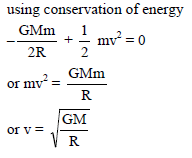
A particle is kept at rest at a distance R (Earth's radius) above the earth's surface. The minimum speed with which it should be projected so that it does not return is :
Detailed Solution: Question 6
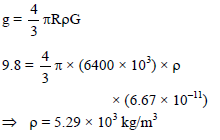
The value of g on the surface of earth is 9.8 m/s2 & the radius of earth is 6400 km. The avg. density of earth in kg/m3 will be -
Detailed Solution: Question 7
With what angular velocity the earth should spin in order that a body lying at 45º latitude may become weightless ?
Detailed Solution: Question 8

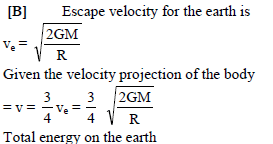
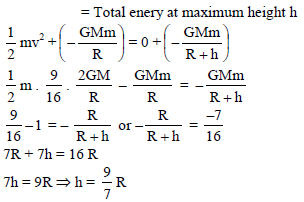
A body is projected up with a velocity equal to (3/4)th of the escape velocity from the surface of the earth. The height it reaches is-
(Radius of earth = R)
Detailed Solution: Question 9
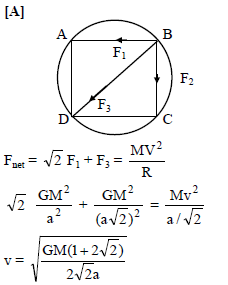
A, B, C and D are four masses each of mass M lying on the vertices of a square of side 'a'. They always move along a common circle with velocity v. Find v so that they always remain on the vertices of the square -
Detailed Solution: Question 10
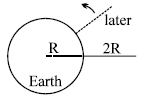
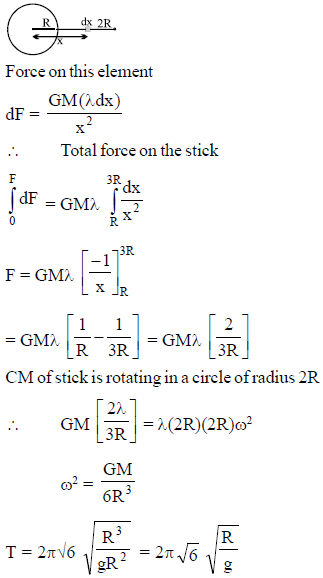
Consider a very long stick of length 2R, which extends from just above the surface of the earth, to a radius 3R. If initial conditions have been set up so that this stick moves in a circular orbit while always pointing radially. What is the period of this orbit. g represents acceleration due to gravity on surface of earth.
Detailed Solution: Question 11
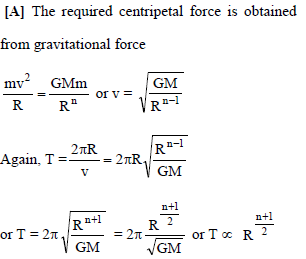
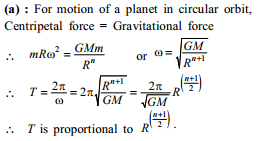
Suppose the gravitational force varies inversely as the nth power of distance. Then the time period of a planet in circular orbit of radius R around the sun will be proportional to -
Detailed Solution: Question 12

Detailed Solution: Question 13

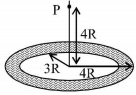
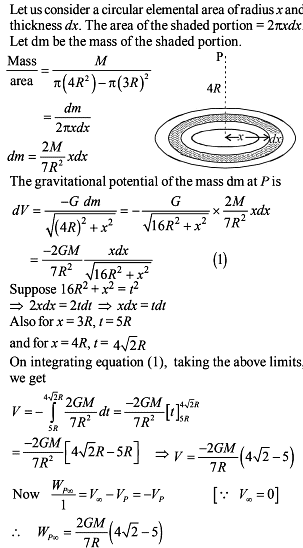
Detailed Solution: Question 14
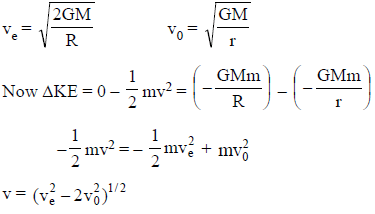
A satellite is revolving round the earth with orbital speed v0. If it is imagined to stop suddenly, the speed with which it will strike the surface of the earth would be (ve - escape speed of a body from earth’s surface)
Detailed Solution: Question 15
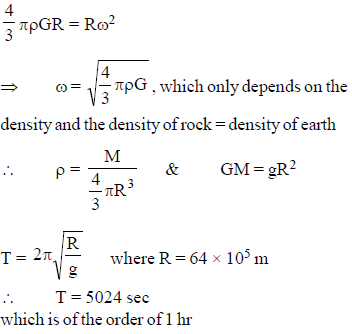
In the asteroid belt, a pebble is in close orbit around a spherical rock having density nearly same as that of earth. ("Close," meaning that the pebble goes around the rock very near to the rock's surface). Orbital period of the pebble around the rock is of the order of
Detailed Solution: Question 16
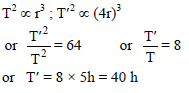
The time period of a satellite of earth is 5 hours. If the separation between the earth and the satellite is increased to 4 times the previous value, the new time period will become -
Detailed Solution: Question 17
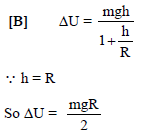
A body of mass m is taken from earth surface to the height h equal to radius of earth, the increase in potential energy will be -
Detailed Solution: Question 18
A point mass m0 is placed at distance R/3 from the centre of a spherical shell of mass m and radius R. The gravitational force on the point mass m0 is -
Detailed Solution: Question 19
The correct graph representing the variation of total energy(E), kinetic energy(K) & potential energy (u) of a satellite with its distance from the centre of earth is -
Detailed Solution: Question 20

Two bodies of masses m1 and m2 are initially at rest placed infinite distance apart. They are then allowed to move towards each other under mutual gravitational attraction. Their relative velocity when they are r distance apart is –
Detailed Solution: Question 21
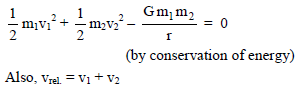
If the radius of earth were shrink by 1%, its mass remaining th same, the acceleration due to gravity on the earth's surface would -
Detailed Solution: Question 22


Detailed Solution: Question 23
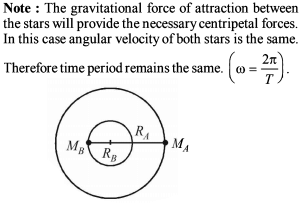
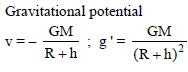
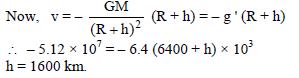
The gravitational potential at height h above the earth's surface is – 5.12 × 10⁷ J/kg and acceleration due to gravity at this point is 6.4 m s2. If radius of the earth is 6400 km, the value of h is :
Detailed Solution: Question 24
The velocity with which a projectile must be fired so that it escapes Earth's gravitation does not depend on -
Detailed Solution: Question 25
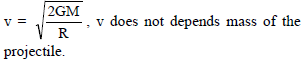
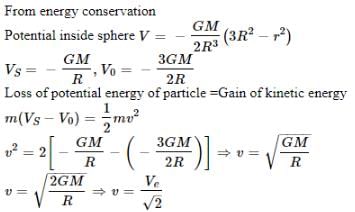
The escape velocity for a planet is ve. A tunnel is dug along a diameter of the planet and a small body is dropped into it at the surface. When the body reaches the centre of the planet, its speed will be
Detailed Solution: Question 26
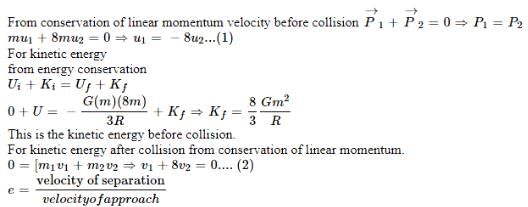
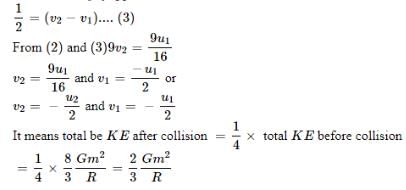
Two uniform spherical stars made of same material have radii R and 2R. Mass of the smaller planet is m. They start moving from rest towards each other from a large distance under mutual force of gravity. The collision between the stars is inelastic with coefficient of restitution 1/2.
Kinetic energy of the system just after the collision is
Detailed Solution: Question 27
A mass is at the center of a square, with four masses at the corners as shown.
(A)  (B)
(B) 
(C)  (D)
(D) 
Rank the choices according to the magnitude of the gravitational force on the center mass.
(B) (D) Detailed Solution: Question 28
A geostationary satellite is at a height h above the surface of earth. If earth radius is R
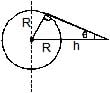
Detailed Solution: Question 29
For a satellite to orbit around the earth, which of the following must be true ?
Detailed Solution: Question 30
258 videos|856 docs|206 tests |
