
Chapter Test: Mechanical Properties of Fluids JEE Physics Free MCQs
MCQ Practice Test & Solutions: Chapter Test: Mechanical Properties of Fluids (30 Questions)
You can prepare effectively for JEE Physics for JEE Main & Advanced with this dedicated MCQ Practice Test (available with solutions) on the important topic of "Chapter Test: Mechanical Properties of Fluids". These 30 questions have been designed by the experts with the latest curriculum of JEE 2026, to help you master the concept.
Test Highlights:
- - Format: Multiple Choice Questions (MCQ)
- - Duration: 60 minutes
- - Number of Questions: 30
Sign up on EduRev for free to attempt this test and track your preparation progress.

A cube of density 0.5 g/cm3 is placed in vessel and a liquid of density 1 g/cm3 is gradually filled in the vessel at a constant rate then the graph representing variation of normal reaction of vessel on cube and time is -
Detailed Solution: Question 1
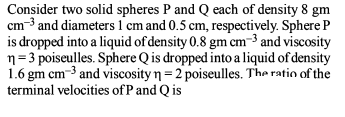
Detailed Solution: Question 2
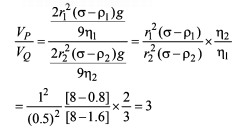

When a loaded boat enters into the sea from a river, it rises because :
Detailed Solution: Question 3
A travelling microscope gives the view of meniscus as -
Detailed Solution: Question 4

Detailed Solution: Question 5
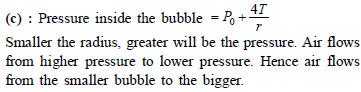
A liquid having area of free surface 'A' has an orifice at a depth 'h' with an area 'a' below liquid surface, then the velocity V of flow through the orifice is -
Detailed Solution: Question 6
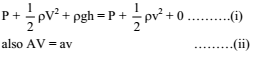
A capillary tube (P) is dipped in water. Another identical tube (Q) is dipped in a soap water solution. Which of the following shows the
relative nature of the liquids columns in the two tubes ?
relative nature of the liquids columns in the two tubes ?
Detailed Solution: Question 7
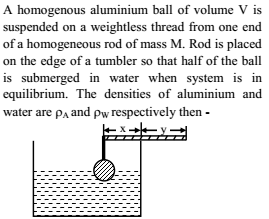
Detailed Solution: Question 8
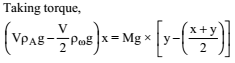
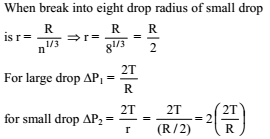
A water drop is divided into eight equal droplets the pressure difference between the inner and outer side of the big drop will be -
Detailed Solution: Question 9
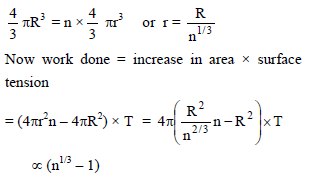
The work done to get 'n' smaller equal size spherical drops from a bigger size spherical drop of water is proportional to -
Detailed Solution: Question 10
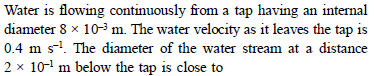
Detailed Solution: Question 11
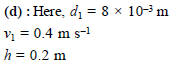
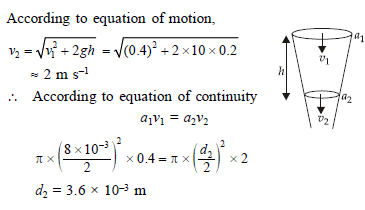
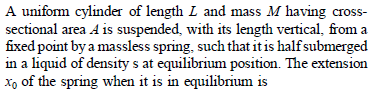
Detailed Solution: Question 12
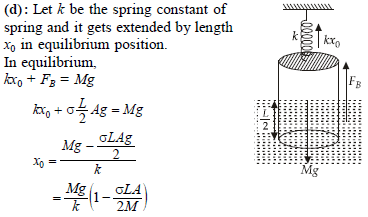
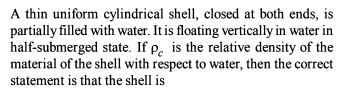
Detailed Solution: Question 13
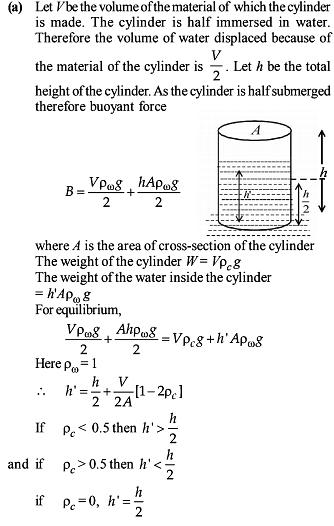
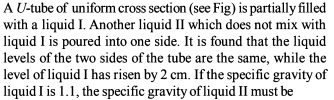
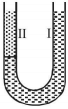
Detailed Solution: Question 14
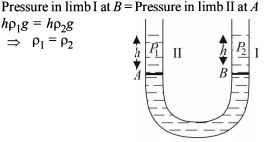
A capillary tube (P) is dipped in water. Another identical tube (Q) is dipped in a soap water solution. Which of the following shows the relative nature of the liquids columns in the two tubes ?
Detailed Solution: Question 15
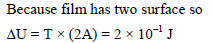
The surface tension of a liquid is 5 N/m. If a film is held on a ring of area 0.02 m2, its total surface energy is about -
Detailed Solution: Question 16


Detailed Solution: Question 17

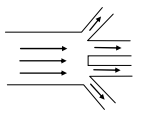
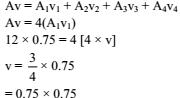
Water is flowing through a channel that is 12 m wide with a speed of 0.75 m/s. The water then flows into four identical channels that have a width of 4.0m. The depth of the water does not change as it flows into the four channels. What is speed of the water in one of the smaller channels ?
Detailed Solution: Question 18

A wooden cube just floats inside water when a 200 g mass is placed on it. When the mass is removed, the cube is 2 cm above the water level. What is the size of each sides of the cube?
Detailed Solution: Question 19

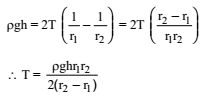
In a U-tube the radii of two columns are
respectively r1 and r2. When a liquid of density
ρ(θ = 0º) is filled in it, a level difference of h is
observed on two arms, then the surface tension
of the liquid is -
respectively r1 and r2. When a liquid of density
ρ(θ = 0º) is filled in it, a level difference of h is
observed on two arms, then the surface tension
of the liquid is -
Detailed Solution: Question 20
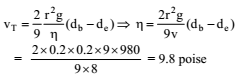
A small metal ball of diameter 4 mm and density 10.5 g/cm3 is dropped in glycerine of density 1.5 g/cm3. The ball attains a terminal velocity of 8 cm/s, the coefficient of viscosity of glycerine is -
Detailed Solution: Question 21
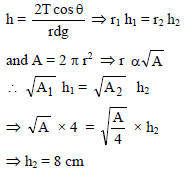
A very narrow capillary tube records a rise of 20 cm when dipped in water. When the area of cross section is reduced to one fourth of the
former value, water will rise to a height of -
former value, water will rise to a height of -
Detailed Solution: Question 22
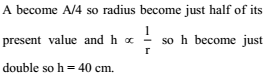
In a capillary tube, water rises to a height of 4 cm. If the cross-sectional area of the tube were one-fourth, water would have risen to a height of -
Detailed Solution: Question 23
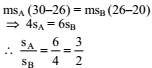
Liquids A and B are at 30°C and 20°C respectively. When mixed in equal masses, the temperature of the mixture is found to be 26°C, The specific heats of A and B are in the ratio of-
Detailed Solution: Question 24
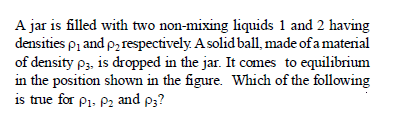
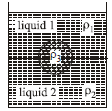
Detailed Solution: Question 25
If drops and bubbles do not collapse under the effect of gravity, it indicates that
Detailed Solution: Question 26
When a capillary tube of radius r is dipped in a liquid of density ρ and surface tension S, the liquid rises or falls through a distance
Detailed Solution: Question 27
The excess pressure inside an air bubble is
Detailed Solution: Question 28

Detailed Solution: Question 29
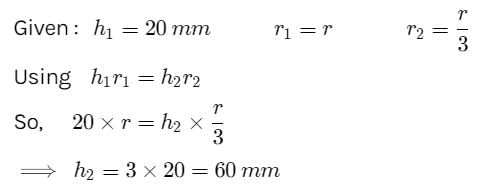
Water rises to a height of 20 mm in a capillary. If the radius of the capillary is made 1/3 rd of its previous value, to what height will the water now rise in the tube?
Detailed Solution: Question 30
258 videos|856 docs|206 tests |
