JEE Exam  >  JEE Test  >  Physics Main & Advanced  >  Chapter Test: Ray Optics and Optical Instruments - 1 - JEE MCQ

Chapter Test: Ray Optics and Optical Instruments - 1 JEE Physics Free MCQs


MCQ Practice Test & Solutions: Chapter Test: Ray Optics and Optical Instruments - 1 (30 Questions)

You can prepare effectively for JEE Physics for JEE Main & Advanced with this dedicated MCQ Practice Test (available with solutions) on the important topic of "Chapter Test: Ray Optics and Optical Instruments - 1". These 30 questions have been designed by the experts with the latest curriculum of JEE 2026, to help you master the concept.

Test Highlights:

  • - Format: Multiple Choice Questions (MCQ)
  • - Duration: 60 minutes
  • - Number of Questions: 30

Sign up on EduRev for free to attempt this test and track your preparation progress.

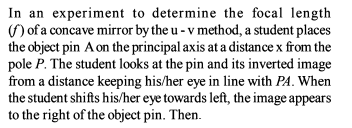
Chapter Test: Ray Optics and Optical Instruments - 1 - Question 1


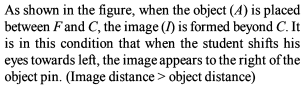
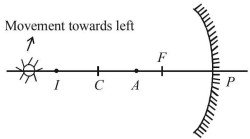
Detailed Solution: Question 1


Chapter Test: Ray Optics and Optical Instruments - 1 - Question 2


Detailed Solution: Question 2


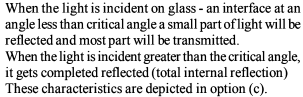
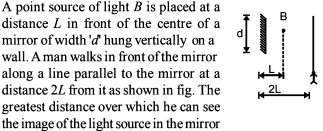
Chapter Test: Ray Optics and Optical Instruments - 1 - Question 3


Detailed Solution: Question 3


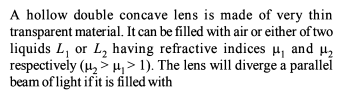
Chapter Test: Ray Optics and Optical Instruments - 1 - Question 4


Detailed Solution: Question 4

Option D is correct.

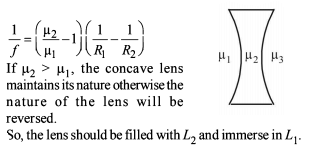
1/f = (μ_inside / μ_outside - 1) (1/R1 - 1/R2)

This is the lens-maker form for a thin lens when the lens substance (here the fluid filling the hollow lens) has refractive index μ_inside and the surrounding medium has refractive index μ_outside. The geometrical factor (1/R1 - 1/R2) for a double-concave shape is negative.

Therefore the sign of f (whether the lens is converging or diverging) follows the sign of (μ_inside / μ_outside - 1). To keep the concave lens diverging (negative focal length), we require μ_inside / μ_outside > 1, i.e., the filling must have a higher refractive index than the surrounding medium.

Given μ2 > μ1, choosing μ_inside = μ2 and μ_outside = μ1 (that is, filling with L2 and immersing in L1) satisfies this condition, so the lens remains diverging.

For reference: if the lens is filled with air and placed in air then μ_inside / μ_outside = 1 and f → ∞ (no lensing). If the filling has a smaller index than the surrounding medium (μ_inside < μ_outside), the concave shape would act as a converging lens.

Final: fill with L2 and immerse in L1 (Option D).

Chapter Test: Ray Optics and Optical Instruments - 1 - Question 5


Detailed Solution: Question 5


Chapter Test: Ray Optics and Optical Instruments - 1 - Question 6

Detailed Solution: Question 6

Chapter Test: Ray Optics and Optical Instruments - 1 - Question 7

Detailed Solution: Question 7


Chapter Test: Ray Optics and Optical Instruments - 1 - Question 8


Detailed Solution: Question 8


Chapter Test: Ray Optics and Optical Instruments - 1 - Question 9


Detailed Solution: Question 9


Chapter Test: Ray Optics and Optical Instruments - 1 - Question 10


Detailed Solution: Question 10

Chapter Test: Ray Optics and Optical Instruments - 1 - Question 11

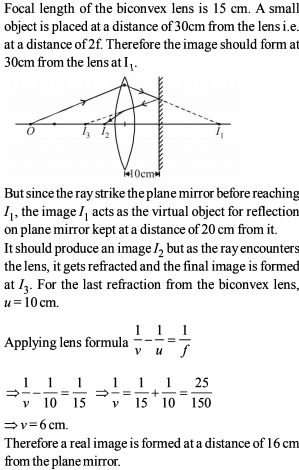
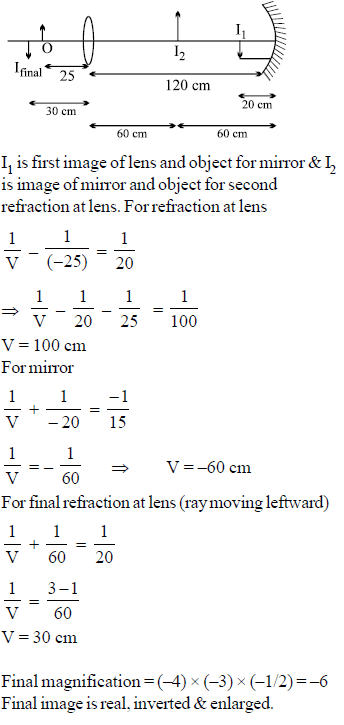
An object was placed upright 25 cm in front of a converging lens with a focal length of 20 cm. A concave mirror with a focal length of 15 cm was placed 120 cm behind the lens. Which of these describes the final image?

Detailed Solution: Question 11

Chapter Test: Ray Optics and Optical Instruments - 1 - Question 12

Detailed Solution: Question 12


Chapter Test: Ray Optics and Optical Instruments - 1 - Question 13


Detailed Solution: Question 13


Chapter Test: Ray Optics and Optical Instruments - 1 - Question 14

Detailed Solution: Question 14


Chapter Test: Ray Optics and Optical Instruments - 1 - Question 15


Detailed Solution: Question 15

Chapter Test: Ray Optics and Optical Instruments - 1 - Question 16

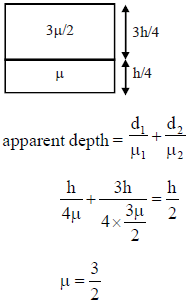
A vessel is quarter filled with a liquid of refractive index μ. The remaining parts of the vessel is filled with an immiscible liquid of refractive index 3μ/2 . The apparent depth of the vessel is 50% of the actual depth. The value of μ is

Detailed Solution: Question 16

Chapter Test: Ray Optics and Optical Instruments - 1 - Question 17

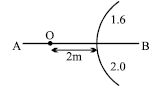
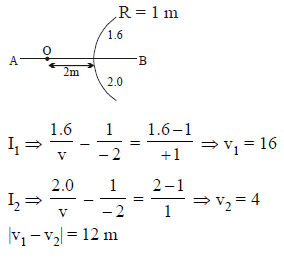
In the figure shown a point object O is placed in air. A spherical boundary separates various media of radius of curvature 1.0 m. AB is principal axis. The refractive index above AB is 1.6 and below AB is 2.0. The separation between the images formed due to refraction at spherical surface is :

Detailed Solution: Question 17

Chapter Test: Ray Optics and Optical Instruments - 1 - Question 18

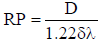
The resolving power of a compound microscope

Detailed Solution: Question 18

Chapter Test: Ray Optics and Optical Instruments - 1 - Question 19


Detailed Solution: Question 19

Chapter Test: Ray Optics and Optical Instruments - 1 - Question 20


Detailed Solution: Question 20


Chapter Test: Ray Optics and Optical Instruments - 1 - Question 21


Detailed Solution: Question 21


Chapter Test: Ray Optics and Optical Instruments - 1 - Question 22


Detailed Solution: Question 22


Chapter Test: Ray Optics and Optical Instruments - 1 - Question 23


Detailed Solution: Question 23


Chapter Test: Ray Optics and Optical Instruments - 1 - Question 24


Detailed Solution: Question 24


Chapter Test: Ray Optics and Optical Instruments - 1 - Question 25

Detailed Solution: Question 25

Chapter Test: Ray Optics and Optical Instruments - 1 - Question 26

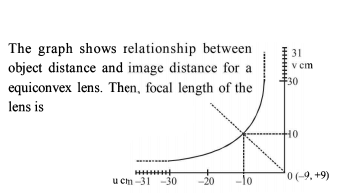
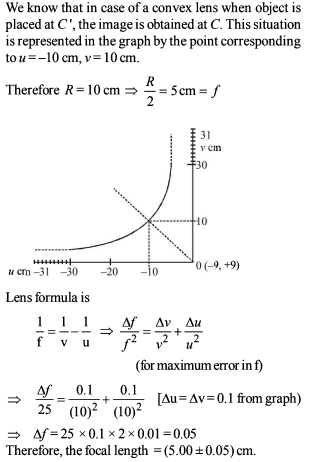
The graph drawn with object distance along abscissa & image as ordinate for a convex lens is

Detailed Solution: Question 26
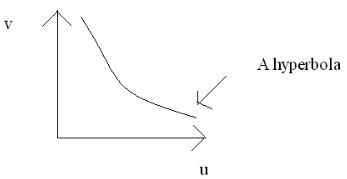
In a convex lens,  (1/v)−(1/u)=(1/f)​
Or (1/v)​−(1/f)​=(1/u)​ where u is always negative and f is always positive.
(1/v)​=(1/f)​−(1/u)​
So, as u is increased 1/u will decrease and  (1/f)​−(1/u)​  will increase, so, 1/v​ increases or v decreases.
So, its graph will be a hyperbola

Chapter Test: Ray Optics and Optical Instruments - 1 - Question 27

A lens of power + 2.0 D is placed in contact with another lens of power – 1.0 D. The combination will behave like

Detailed Solution: Question 27

P=P1​+P2​=+2−1=+1 dioptre, lens behaves as convergent
F=1​/P=1/1​=1m=100cm

Chapter Test: Ray Optics and Optical Instruments - 1 - Question 28

A short pulse of white light is incident from air to a glass slab at normal incidence. After travelling through the slab, the first colour to emerge is

Detailed Solution: Question 28

In air, all the colours of light travel with the same velocity with the same velocity, but in glass, velocities of different colours are different. Velocity of red colour is largest and velocity of violet colour is smallest. Therefore, after travelling through the glass slab, red colour will emerge first.

Chapter Test: Ray Optics and Optical Instruments - 1 - Question 29

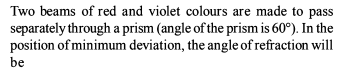
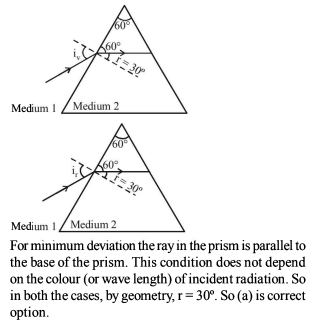
At the minimum deviation Dm, the refracted ray inside the prism

Detailed Solution: Question 29
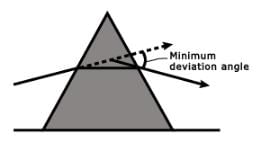
When the deviation is minimum, then the incidence angle and emergence angle are equal and this is possible only when the refracted ray inside the prism is parallel to the base of the prism. 
Minimum deviation is given by δ=2i−A, where A is prism angle.

Chapter Test: Ray Optics and Optical Instruments - 1 - Question 30

Magnifying power of a compound microscope is high if

Detailed Solution: Question 30

Magnifying power of a compound- microscope is given by m=− (l​D​/f0​fe​)
where, l is length of tube
D is least distance of clear vision
f0​ is focal length of objective
fe​ is focal length of eyepiece
So, clearly, it can be seen that focal length of objective and eyepiece needs to be decreased so that magnifying power increases.
 

258 videos|856 docs|206 tests
Information about Chapter Test: Ray Optics and Optical Instruments - 1 Page
In this test you can find the Exam questions for Chapter Test: Ray Optics and Optical Instruments - 1 solved & explained in the simplest way possible. Besides giving Questions and answers for Chapter Test: Ray Optics and Optical Instruments - 1, EduRev gives you an ample number of Online tests for practice
258 videos|856 docs|206 tests
Download as PDF