
Chapter Test: Wave Optics JEE Physics Free MCQs
MCQ Practice Test & Solutions: Chapter Test: Wave Optics (30 Questions)
You can prepare effectively for JEE Physics for JEE Main & Advanced with this dedicated MCQ Practice Test (available with solutions) on the important topic of "Chapter Test: Wave Optics". These 30 questions have been designed by the experts with the latest curriculum of JEE 2026, to help you master the concept.
Test Highlights:
- - Format: Multiple Choice Questions (MCQ)
- - Duration: 60 minutes
- - Number of Questions: 30
Sign up on EduRev for free to attempt this test and track your preparation progress.


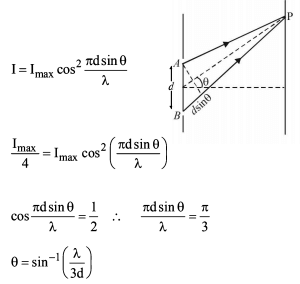
Detailed Solution: Question 1

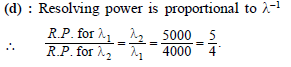
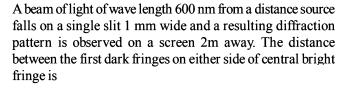
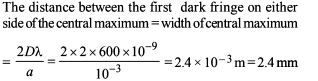
Detailed Solution: Question 2

Detailed Solution: Question 3
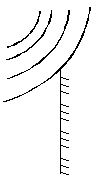
Spherical wave fronts shown in figure, strike a plane mirror. Reflected wave fronts will be as shown in

Detailed Solution: Question 5

Detailed Solution: Question 6

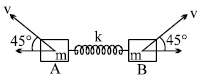
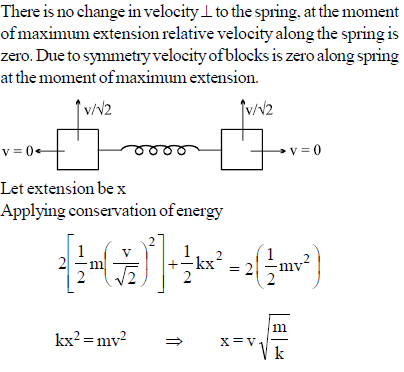
Blocks A & B of mass m each are connected with spring of constant k. Both blocks lie on frictionless ground and are imparted horizontal velocity v as shown when spring is unstretched. Find the maximum stretch of spring.
Detailed Solution: Question 7
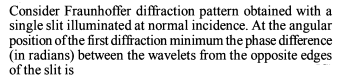
Detailed Solution: Question 8

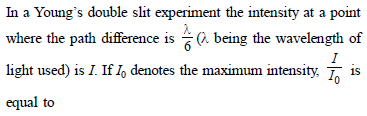
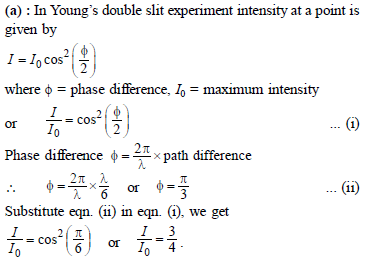
Detailed Solution: Question 9
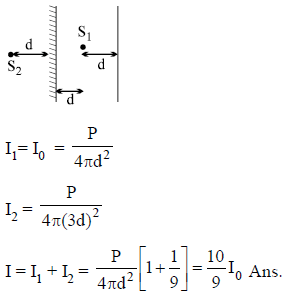
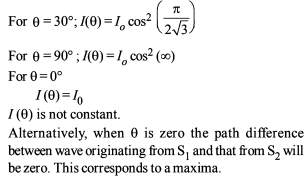
A point source of light 'S' at a distance d from the screen A produces light intensity I0 at the centre of the screen. If a completely reflecting mirror M is placed at a distance d behind the source as shown in the figure, find the intensity at the centre of the screen
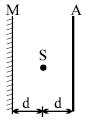
Detailed Solution: Question 10

Detailed Solution: Question 11
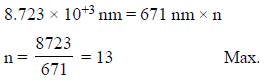
Optical path difference of waves from two coherent sources at some point in space is 8.723 μm. What will be the result of interference at this point, if the wavelength is 671 nm :
Detailed Solution: Question 12
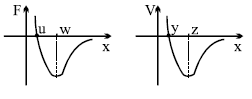
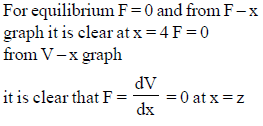
Two atoms interact with each other according to the following force F and potential energy V diagrams. What is their equilibrium separation?
Detailed Solution: Question 13
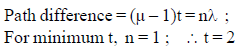
In the ideal double-slit experiment , when a glass-plate (refractive index 1.5) of thickness t is introduced in the path of one of the interfering beams (wave-length λ), the intensity at the position where the central maximum occurred previously remains unchanged. The minimum thickness of the glass-plate is
Detailed Solution: Question 14
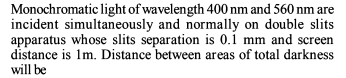
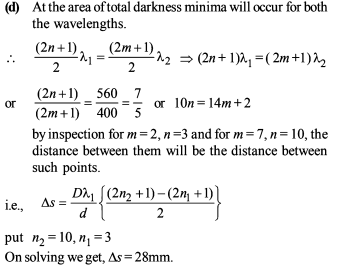
Detailed Solution: Question 15
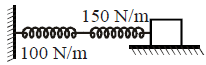
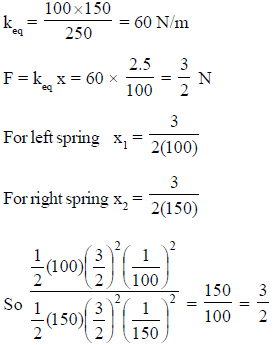
Two springs of force constant 100 N/m and 150 N/m are in series as shown. The block is pulled by a distance of 2.5 cm to the right from equilibrium position. What is the ratio of work done by the spring at left to the work done by the spring at right. :
Detailed Solution: Question 16
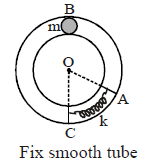
In the figure shown, there is a smooth tube of radius 'R', fixed in the vertical plane. A ball 'B' of mass 'm' is released from the top of the tube. B slides down due to gravity and compresses the spring. The end 'C' of the spring is fixed and the end A is free. Initially the line OA makes an angle of 60° with OC and finally it makes an angle of 30° after compression. Find the spring constant of the spring.
Detailed Solution: Question 17
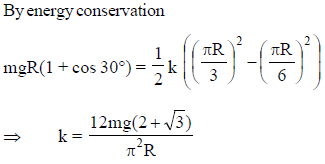
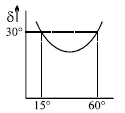
Figure shows graph of deviation δ versus angle of incidence for a light ray striking a prism. Angle of prism is
Detailed Solution: Question 18

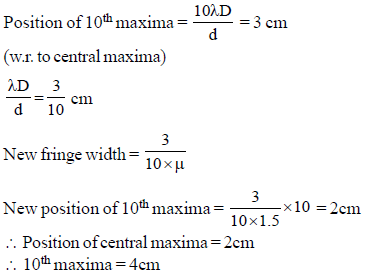
In young's double slit experiment a coordinate axis is printed on the screen. The y co-ordinates of central maxima and 10th maxima are 2cm and 5cm respectively. When the YDSE apparatus is immersed in a liquid of refractive index 1.5, the corresponding y-co-ordinates will be
Detailed Solution: Question 19
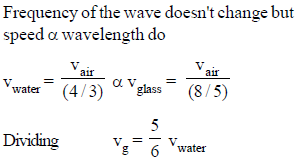
When a ray of light of frequency 6 ×10¹⁴ Hz travels from water of refractive index 4/3 to glass of refractive index 8/5, its
Detailed Solution: Question 20
Detailed Solution: Question 21


Detailed Solution: Question 22
Detailed Solution: Question 23
Detailed Solution: Question 24
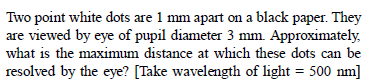
Detailed Solution: Question 25
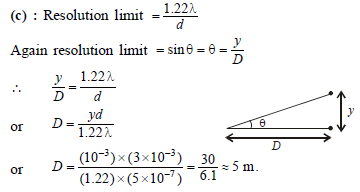
In a Young’s double-slit experiment, the slits are separated by 0.28 mm and the screen is placed 1.4 m away. The distance between the central bright fringe and the fourth bright fringe is measured to be 1.2 cm. Determine the wavelength of light used in the experiment
Detailed Solution: Question 26
Detailed Solution: Question 27
A beam of light consisting of two wavelengths, 650 nm and 520 nm, is used to obtain interference fringes in a Young’s double-slit experiment. The distance between the slit and the screen is 1.4m and the distance between the slits is 0.28mm. Find the distance of the third bright fringe on the screen from the central maximum for wavelength 650 nm.
Detailed Solution: Question 28
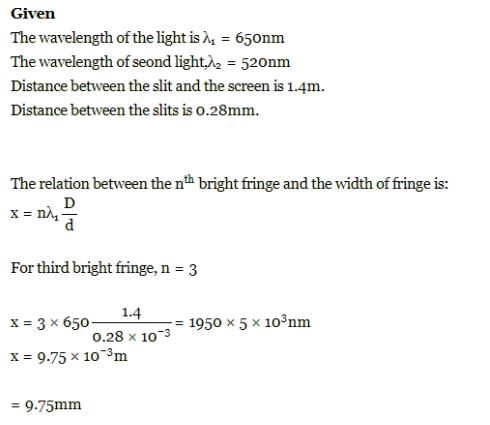
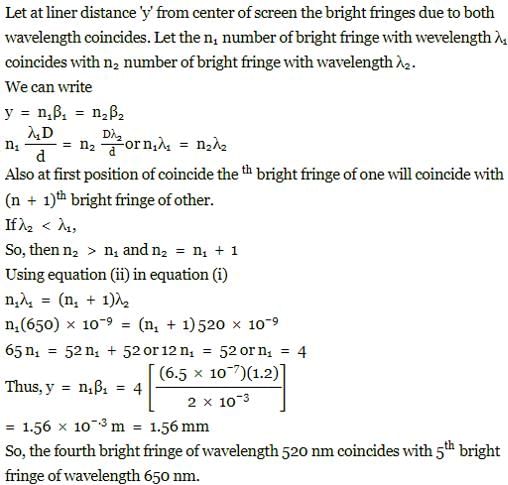
A beam of light consisting of two wavelengths, 650 nm and 520 nm, is used to obtain interference fringes in a Young’s double-slit experiment. What is the least distance from the central maximum where the bright fringes due to both the wavelengths coincide?
Detailed Solution: Question 29
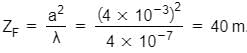
Estimate the distance for which ray optics is good approximation for an aperture of 4 mm and wavelength 400 nm.
Detailed Solution: Question 30
258 videos|856 docs|206 tests |
