JEE Exam  >  JEE Test  >  Chemistry Main & Advanced  >  Chemical Bonding - 1 - JEE MCQ

Chemical Bonding - 1 - Free MCQ Test with solutions for JEE Chemistry


MCQ Practice Test & Solutions: Chemical Bonding - 1 (30 Questions)

You can prepare effectively for JEE Chemistry for JEE Main & Advanced with this dedicated MCQ Practice Test (available with solutions) on the important topic of "Chemical Bonding - 1". These 30 questions have been designed by the experts with the latest curriculum of JEE 2026, to help you master the concept.

Test Highlights:

  • - Format: Multiple Choice Questions (MCQ)
  • - Duration: 60 minutes
  • - Number of Questions: 30

Sign up on EduRev for free to attempt this test and track your preparation progress.

Chemical Bonding - 1 - Question 1

A : tetracyanomethane                           B : Carbondioxide

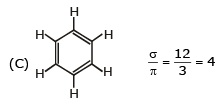
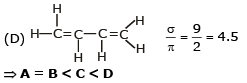
C : Benzene                                           D : 1, 3-buta-di-ene

Ratio of σ and π bond is in order:

Detailed Solution: Question 1
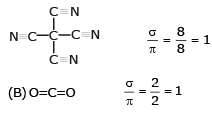
(A) Tetra cyanomethane


Chemical Bonding - 1 - Question 2

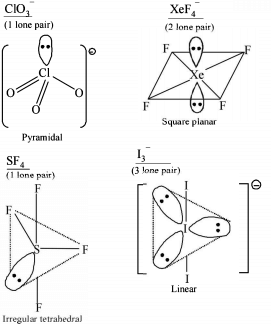
In  , the shape is square planer. The number of bond pair-lone pair repulsion at 90° are :

Detailed Solution: Question 2


⇒ No of bond pair-lone pair repulsion = 8

Chemical Bonding - 1 - Question 3

Compound with maximum ionic character is formed from :

Detailed Solution: Question 3

for maximum ionic character,
* IE of cation must be less
* EA of anion must be larger
⇒ CS and  F
⇒ (B)

Chemical Bonding - 1 - Question 4

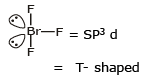
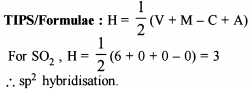
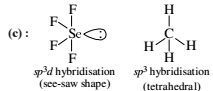
The hybridisation and geometry of BrF3 molecules are :

Detailed Solution: Question 4

Chemical Bonding - 1 - Question 5

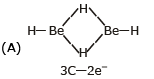
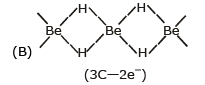
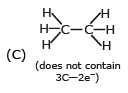
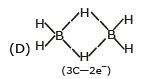
The molecule is not having 3c-2e bond.

Detailed Solution: Question 5


Chemical Bonding - 1 - Question 6

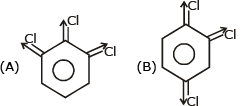
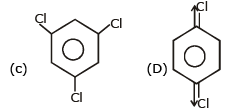
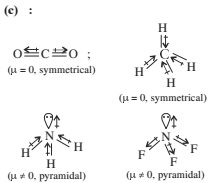
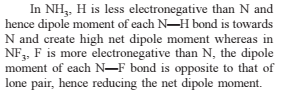
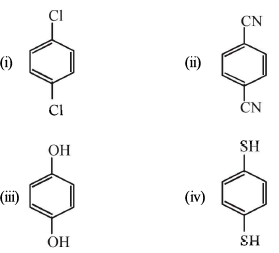
Which has maximum dipole moment ?

Detailed Solution: Question 6


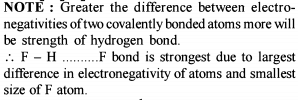
Chemical Bonding - 1 - Question 7


Detailed Solution: Question 7


Chemical Bonding - 1 - Question 8


Detailed Solution: Question 8

Chemical Bonding - 1 - Question 9


Detailed Solution: Question 9


Chemical Bonding - 1 - Question 10

Which of the following combination will not form π-bond?

Detailed Solution: Question 10

s-orbital does not undergo sideways overlapping.

Chemical Bonding - 1 - Question 11

Detailed Solution: Question 11

To determine the correct order of interactions based on their strength, let’s examine each type:

  1. Van der Waals’ Forces: These are the weakest interactions and include London dispersion forces. They are generally weaker than dipole-dipole interactions, hydrogen bonds, and covalent bonds.

  2. Dipole-Dipole Interactions: These are stronger than van der Waals’ forces but weaker than hydrogen bonds and covalent bonds.

  3. Hydrogen Bonding: Hydrogen bonds are typically stronger than dipole-dipole interactions and van der Waals’ forces but weaker than covalent bonds.

  4. Covalent Bonds: Covalent bonds are strong chemical bonds that involve sharing electrons between atoms. They are much stronger than hydrogen bonds, dipole-dipole interactions, and van der Waals’ forces.

Given this order of strength:

Answer: (c) Van der Waals’ < Dipole-Dipole < Hydrogen Bonding < Covalent

Chemical Bonding - 1 - Question 12


Detailed Solution: Question 12


Chemical Bonding - 1 - Question 13


Detailed Solution: Question 13


Chemical Bonding - 1 - Question 14


Detailed Solution: Question 14


Chemical Bonding - 1 - Question 15


Detailed Solution: Question 15


Chemical Bonding - 1 - Question 16

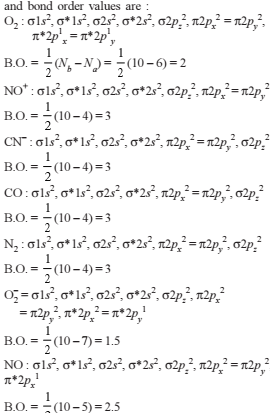
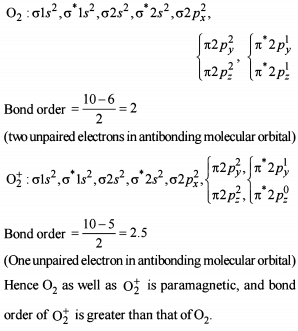
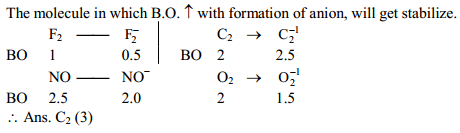
Among the following, the molecule expected to be stabilized by anion formation is :
C2, O2, NO, F2

Detailed Solution: Question 16

Chemical Bonding - 1 - Question 17


Detailed Solution: Question 17


Chemical Bonding - 1 - Question 18


Detailed Solution: Question 18

Chemical Bonding - 1 - Question 19


Detailed Solution: Question 19

Chemical Bonding - 1 - Question 20

Detailed Solution: Question 20


Chemical Bonding - 1 - Question 21


Detailed Solution: Question 21


Chemical Bonding - 1 - Question 22


Detailed Solution: Question 22


Chemical Bonding - 1 - Question 23


Detailed Solution: Question 23


Chemical Bonding - 1 - Question 24

Detailed Solution: Question 24


Chemical Bonding - 1 - Question 25


Detailed Solution: Question 25


Chemical Bonding - 1 - Question 26


Detailed Solution: Question 26


Chemical Bonding - 1 - Question 27


Detailed Solution: Question 27


Chemical Bonding - 1 - Question 28


Detailed Solution: Question 28


Chemical Bonding - 1 - Question 29

Detailed Solution: Question 29

Chemical Bonding - 1 - Question 30


Detailed Solution: Question 30


335 videos|697 docs|300 tests
Information about Chemical Bonding - 1 Page
In this test you can find the Exam questions for Chemical Bonding - 1 solved & explained in the simplest way possible. Besides giving Questions and answers for Chemical Bonding - 1, EduRev gives you an ample number of Online tests for practice
Download as PDF