CUET Exam  >  CUET Test  >   UG Mock Test Series 2026  >  Chemistry: CUET Mock Test - 5 - CUET MCQ

CUET UG Chemistry: Mock Test - 5 Free Online Test 2026


Full Mock Test & Solutions: Chemistry: CUET Mock Test - 5 (50 Questions)

You can boost your CUET 2026 exam preparation with this Chemistry: CUET Mock Test - 5 (available with detailed solutions).. This mock test has been designed with the analysis of important topics, recent trends of the exam, and previous year questions of the last 3-years. All the questions have been designed to mirror the official pattern of CUET 2026 exam, helping you build speed, accuracy as per the actual exam.

Mock Test Highlights:

  • - Format: Multiple Choice Questions (MCQ)
  • - Duration: 60 minutes
  • - Total Questions: 50
  • - Analysis: Detailed Solutions & Performance Insights

Sign up on EduRev for free and get access to these mock tests, get your All India Rank, and identify your weak areas to improve your marks & rank in the actual exam.

Chemistry: CUET Mock Test - 5 - Question 1

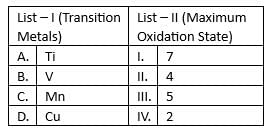
Match list I with list II


Choose the correct answer from the options given below:

Detailed Solution: Question 1

Outer electron configuration of Ti = 3d24s2
So, Maximum O.S. of Ti = +4
Outer E.C. of V = 3d34s2
So, Maximum O.S. of V = +5 Outer E.C. of Mn = 3d54s2
So, Maximum O.S. of Mn = +7
Outer E.C. of Cu = 3d104s1
So, Maximum O.S. of Cu = +2
So, correct option is : A-II, B-III, C-I, D-IV

Chemistry: CUET Mock Test - 5 - Question 2

The following statements are related to the rate law and rate constant of a chemical reaction:
(A) The rate constant k is independent of the concentration of reactants
(B) The unit of rate constant for a first-order reaction is s-1
(C) The rate law for a reaction can be determined theoretically from the balanced chemical equation
(D) The order of a reaction with respect to a reactant can be a fraction
Choose the correct answer from the options given below:

Detailed Solution: Question 2

The rate constant k depends only on temperature (through the Arrhenius equation) and is completely independent of the concentration of reactants, making statement (A) correct. For a first-order reaction, the rate = k[A], and since rate has units of mol L-1 s-1 and concentration has units of mol L-1, the unit of k works out to s-1, confirming statement (B). Statement (C) is incorrect; the rate law cannot be deduced from the stoichiometric equation of a reaction. It must be determined experimentally because it depends on the mechanism of the reaction. The order of a reaction can indeed be a fraction (e.g., 1/2 or 3/2), as seen in complex reactions, confirming statement (D).

Chemistry: CUET Mock Test - 5 - Question 3

The following statements describe the half-life of a reaction:
(A) The half-life of a first-order reaction is independent of the initial concentration of the reactant
(B) The half-life of a zero-order reaction is directly proportional to the initial concentration
(C) The half-life of a second-order reaction is independent of the initial concentration
(D) For a first-order reaction, t(1/2) = 0.693/k
Choose the correct answer from the options given below:

Detailed Solution: Question 3
For a first-order reaction, t(1/2) = 0.693/k, which is a constant that does not depend on the initial concentration [A]0. This confirms both statements (A) and (D). For a zero-order reaction, the integrated rate equation gives t(1/2) = [A]0 / (2k), meaning the half-life is directly proportional to the initial concentration of the reactant, confirming statement (B). Statement (C) is incorrect; for a second-order reaction, t(1/2) = 1 / (k[A]0), which means the half-life is inversely proportional to the initial concentration, not independent of it. Therefore, statements (A), (B), and (D) are correct.

Chemistry: CUET Mock Test - 5 - Question 4

Match List-I with List-II

Detailed Solution: Question 4

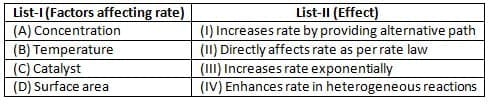
Concentration directly affects the rate of reaction as described by the rate law expression — rate = k[A]ᵐ[B]n (II). Temperature increases the rate exponentially as described by the Arrhenius equation, since more molecules acquire the activation energy at higher temperatures (III). A catalyst increases the rate of reaction by providing an alternative pathway of lower activation energy, without being consumed (I). Surface area plays a critical role in heterogeneous reactions — finely divided solids expose more surface area, increasing the frequency of effective collisions (IV).

Chemistry: CUET Mock Test - 5 - Question 5

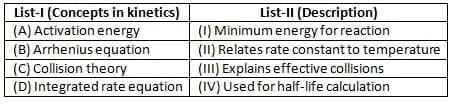
Match List-I with List-II

Detailed Solution: Question 5

Activation energy (Ea) is the minimum amount of energy that reacting molecules must possess for a collision to result in a chemical reaction (I). The Arrhenius equation, k = Ae^(−Ea/RT), mathematically relates the rate constant k to temperature T and activation energy (II). Collision theory explains that reactions occur when molecules collide with sufficient energy and proper orientation — only such effective collisions lead to product formation (III). The integrated rate equation is derived by integrating the differential rate law and is used to determine the half-life of a reaction and concentration at any given time (IV).

Chemistry: CUET Mock Test - 5 - Question 6

Arrange the following transition elements in decreasing order of their maximum oxidation state:
(A) V (Vanadium)
(B) Sc (Scandium)
(C) Cr (Chromium)
(D) Mn (Manganese)
Choose the correct order:

Detailed Solution: Question 6

The maximum oxidation state of a transition element generally equals the total number of unpaired 3d and 4s electrons available. Mn can show a maximum of +7 (in KMnO₄, using all 3d⁵ and 4s² electrons), Cr shows +6 (in K₂Cr₂O₇), V shows +5 (in V₂O₅), and Sc shows only +3 (3d¹4s², only 3 electrons available). Therefore, the decreasing order is: Mn > Cr > V > Sc, i.e., (D) > (C) > (A) > (B).

Chemistry: CUET Mock Test - 5 - Question 7

Arrange the following ligands in increasing order of their crystal field splitting energy (Δ) as per the spectrochemical series:
(A) NH₃
(B) Cl⁾
(C) CN⁾
(D) H₂O
Choose the correct order:

Detailed Solution: Question 7

According to the spectrochemical series, ligands are arranged in increasing order of their field strength as: Cl⁾ < H₂O < NH₃ < CN⁾. Cl⁾ is a weak field (pi-donor) ligand causing small Δ; H₂O is a moderate field ligand; NH₃ is a stronger sigma-donor ligand; and CN⁾ is a strong field (pi- acceptor/sigma-donor) ligand causing the largest Δ. Therefore, increasing order of Δ: (B) < (D) < (A) < (C).

Chemistry: CUET Mock Test - 5 - Question 8

The metal from first transition series having positive value :

Detailed Solution: Question 8

Cu has positive value in 3d series.

In the first transition series, the standard electrode potential ((E0M2+/M) indicates the ease with which a metal can be reduced to its metallic form from its ion in aqueous solution. A positive value for (E0M2+/M) means that the reduction process is favorable, and the metal is relatively less reactive compared to those with negative values.

Among the given options:

Chromium (Cr) has a negative standard reduction potential.
Vanadium (V) also has a negative value.
Copper (Cu) has a positive standard reduction potential ((E0Cu2+/Cu = +0.34 V)), meaning it is readily reduced to its metallic state.
Nickel (Ni) has a negative standard reduction potential.

= 0.34 V

= –0.90 V

= –1.18 V

= = –0.25 V

Chemistry: CUET Mock Test - 5 - Question 9

Magnetic moment of Cr2+ is ______.

Detailed Solution: Question 9

  • The spin-only magnetic moment is given by μ = √[n(n + 2)] BM, where n is the number of unpaired electrons.
  • Cr ([Ar] 3d4 4s1) forms Cr2+ by losing two electrons: [Ar] 3d4.
  • In a high-spin d4 configuration, there are 4 unpaired electrons (n = 4).
  • Calculate: μ = √[4(4 + 2)] = √24 ≈ 4.90 BM.
  • Correct option: B


Chemistry: CUET Mock Test - 5 - Question 10

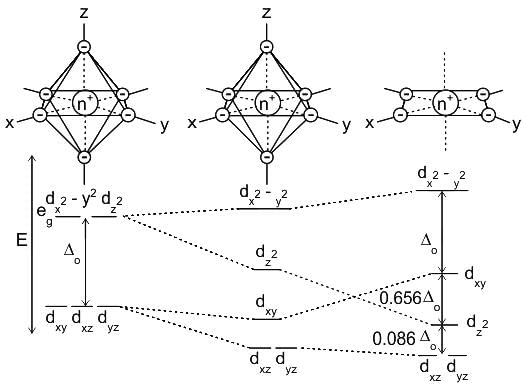
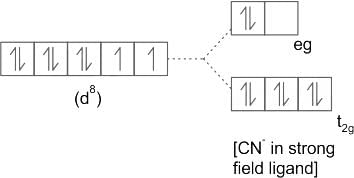
According to CFT (crystal field theory) [Ni(CN)4]2- has ___________.

Detailed Solution: Question 10
The correct answer is Square planar structure
Coordination Number
: The coordination number of the nickel ion (Ni2+) in the complex [Ni(CN)4]2- is 4. This is because there are four cyanide ions (CN-) surrounding the central metal ion.

Nature of Ligands: Cyanide ions (CN-) are strong-field ligands. In CFT, strong-field ligands typically lead to the pairing of d-electrons and the formation of low-spin complexes.

Electron Configuration of Ni2+: The electron configuration of the nickel ion (Ni2+) is [Ar] 3d8. In the presence of strong-field ligands, the electrons fill the lower-energy orbitals before pairing, leading to a low-spin configuration.

Geometry: In a square planar structure, the ligands approach the central metal ion along the x, y, and z axes, resulting in a flat, square arrangement. This is the favored geometry for low-spin d8 complexes with strong-field ligands.


Conclusion:-

According to CFT, [Ni(CN)4]2- is expected to have a square planar structure due to the combination of a coordination number of 4 and the strong-field nature of the cyanide ligands.

Chemistry: CUET Mock Test - 5 - Question 11

Consider the following statements regarding electrochemical cells:
(A) A higher standard electrode potential indicates a greater tendency to gain electrons.
(B) A negative standard electrode potential indicates a higher tendency to gain electrons.
(C) In a galvanic cell, the electrons flow from the anode to the cathode through the external circuit.
(D) In an electrolytic cell, the cathode is the site of oxidation.
Choose the correct statements:

Detailed Solution: Question 11

Analyzing the statements: -

(A) True: A higher standard electrode potential (`E⁰`) indicates a greater tendency for reduction (gain of electrons). 

(B) False: A negative `E⁰` indicates a lower tendency for reduction (more likely to lose electrons).

(C) True: In a galvanic cell, electrons flow from the anode (where oxidation occurs) to the cathode (where reduction occurs) through the external circuit.

(D) False: In an electrolytic cell, the cathode is the site of reduction, not oxidation.

Correct statements: (A) and (C).

Correct option: A

Chemistry: CUET Mock Test - 5 - Question 12

Consider the following statements regarding electrode potentials:
(A) Standard electrode potential is always measured under standard conditions (1 M concentration, 1 atm pressure, 25°C).
(B) The standard electrode potential of a cell is the sum of the cathode and anode potentials.
(C) A positive electrode potential indicates that the electrode is more likely to lose electrons.
(D) The standard electrode potential is a measure of the tendency of a species to gain electrons.
Choose the correct statements:

Detailed Solution: Question 12

Analyzing the statements:
- (A) True: Standard electrode potential (`E⁰`) is measured under standard conditions (1 M concentration, 1 atm pressure, 25°C).
- (B) False: The standard cell potential is `E⁰_cell = E⁰_cathode - E⁰_anode`.
- (C) False: A positive `E⁰` indicates a greater tendency to gain electrons (reduction), not lose electrons.
- (D) True: `E⁰` measures the tendency of a species to gain electrons (reduction potential).
Correct statements: (A) and (D).
Correct option: C

Chemistry: CUET Mock Test - 5 - Question 13

Consider the following statements about redox reactions:
(A) In a redox reaction, oxidation involves the loss of electrons.
(B) In a redox reaction, reduction involves the gain of electrons.
(C) A reducing agent is a substance that gains electrons and is reduced.
(D) An oxidizing agent is a substance that gains electrons and is reduced.
Choose the correct statements:

Detailed Solution: Question 13

Oxidation involves the loss of electrons, and reduction involves the gain of electrons. An oxidizing agent is reduced, and a reducing agent is oxidized.

Chemistry: CUET Mock Test - 5 - Question 14

Consider the following statements about reaction rate:
(A) The rate of a reaction is always constant for a given temperature.
(B) The rate of a reaction is defined as the change in concentration of reactants or products per unit time.
(C) The rate of reaction increases with temperature.
(D) The rate of reaction is unaffected by the concentration of reactants.
Choose the correct statements:

Detailed Solution: Question 14

Analyzing the statements:
- (A) False: The rate of a reaction is not constant; it depends on factors like concentration and temperature.
- (B) True: The rate of a reaction is defined as the change in concentration of reactants or products per unit time.
- (C) True: Reaction rate generally increases with temperature due to increased molecular collision frequency and energy.
- (D) False: The rate is affected by the concentration of reactants (rate law).
Correct statements: (B) and (C).
Correct option: B

Chemistry: CUET Mock Test - 5 - Question 15

A solution of Na2SO4 in water is electrolysed using Pt electrodes.The products at the cathode and anode are respectively -

Detailed Solution: Question 15

At cathode
4H2O + 4e → 4H2 + 4OH
At anode
2H2O → 4H+ + O2 + 4e
Thus at cathode we will get H2 whereas at anode we will get O2.

Chemistry: CUET Mock Test - 5 - Question 16

For the reaction system: 2NO(g) + O2(g) → 2NO2(g) volume is suddenly reduced to half its value by increasing the pressure on it. If the reaction is of first order with respect to O2 and second order with repect to NO, the rate of reaction will – 

  [AIEEE-2003]

Detailed Solution: Question 16

The correct answer is option A
rate=k[NO]2[O2]
As, C = n/V
On making the volume half, concentration doubles and rate of reaction becomes eight times.
 

Chemistry: CUET Mock Test - 5 - Question 17

Rate of reaction can be expressed by Arrhenius equation as k = Ae–E/RT , In this equation, E represents

[AIEEE 2006]

Detailed Solution: Question 17

The correct answer is Option A.

E represents the energy of activation which implies it is the energy below which colliding molecules will not react Arrhenius equation gives the dependence of the rate constant k of a chemical reaction on the absolute temperature T (in Kelvin), where A is the pre-exponential factor (or simply the prefactor), Ea is the activation energy, and R is the Universal gas constant:
By Arrhenius equation, k=Ae-Ea/RT

Chemistry: CUET Mock Test - 5 - Question 18

Which ion will show more paramagnetic behaviour ?

Detailed Solution: Question 18

Since the configuration of Fe3+ ion is (argon ) 3d5,which contains maximum number of unpaired electrons, hence more will be paramagnetic behavior.

Chemistry: CUET Mock Test - 5 - Question 19

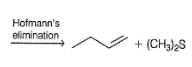
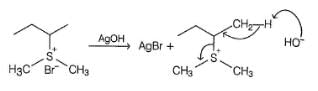
Which of the following gives 1-butene as the major product most easily on heating with AgOH?

Detailed Solution: Question 19

Chemistry: CUET Mock Test - 5 - Question 20

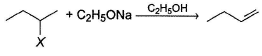
1-butene would be formed most easily in the following reaction when X is
Detailed Solution: Question 20

Rate of reaction in E2 reaction depends on acidity of β—H as well as steric hindrance at β-carbon. When X is F, acidity is maximum and there is less steric hindrance at less substituted β-carbon.

Chemistry: CUET Mock Test - 5 - Question 21

Which of the following compound is most likely to follow E1 cb mechanism when treated with C2H5ONa in ethanol?

Detailed Solution: Question 21

It forms resonance stabilised carbanion after abstraction of β—H hence, favours the most to E1cb mechanism.

Chemistry: CUET Mock Test - 5 - Question 22

How many structural isomers can compound with molecular formula ‘C3H6O’ have?

Detailed Solution: Question 22
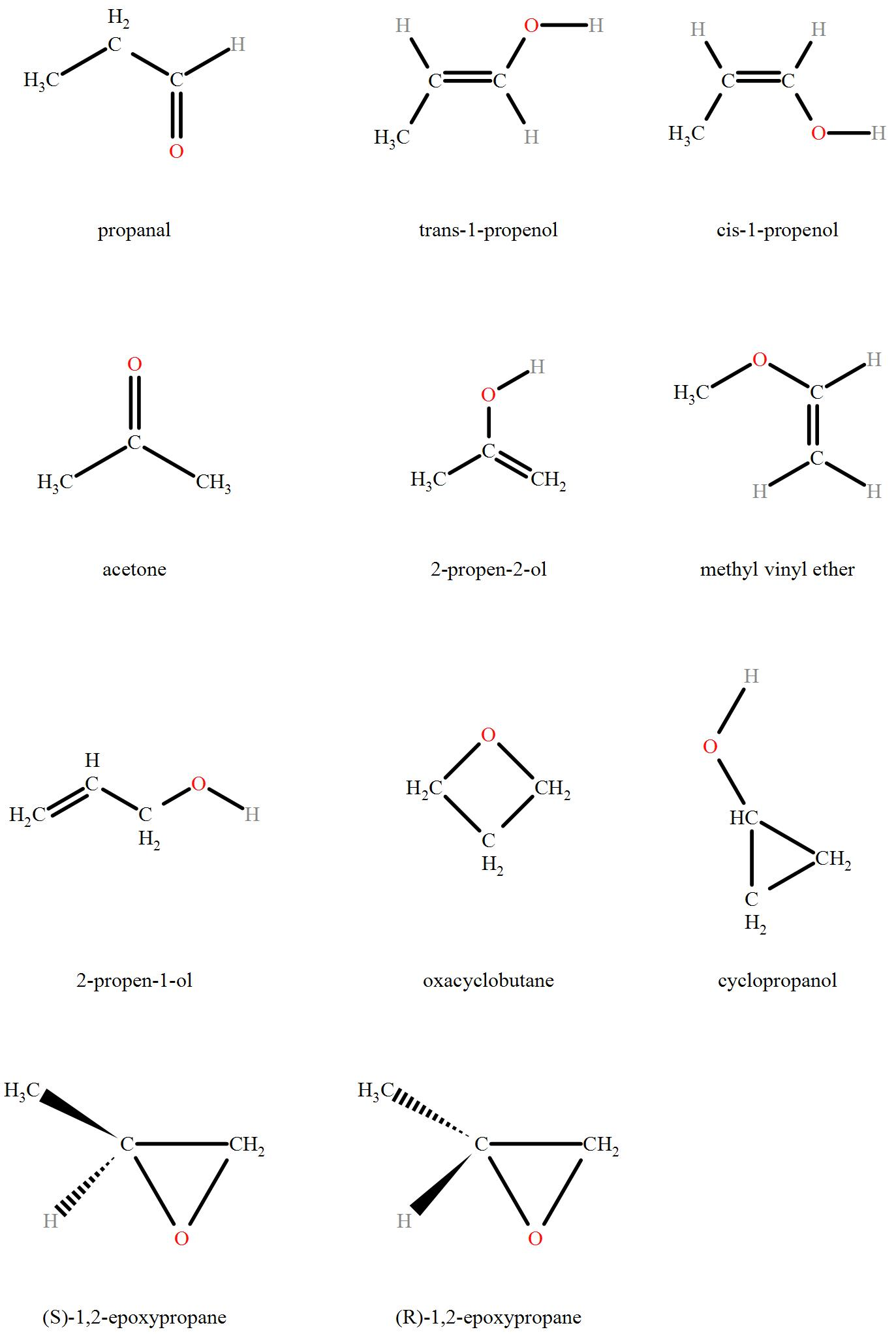
The Isomers of C3H6O include:

Hence we can see that a total of 11 isomers of C3H6O are possible.

Chemistry: CUET Mock Test - 5 - Question 23

What is the common name of 2-methyl-propanal?

Detailed Solution: Question 23

  • Isobutyraldehyde is the chemical compound with the formula (CH₃)₂CHCHO.
  • It is an aldehyde, isomeric with n-butyraldehyde.
  • Isobutyraldehyde is manufactured, often as a side-product, by the hydroformylation of propene. Its odour is described as that of wet cereal or straw.

Chemistry: CUET Mock Test - 5 - Question 24

Write the IUPAC name of (CH3)2CHCHO?

Detailed Solution: Question 24

The IUPAC name of (CH3)2CHCHO is 2-methylpropanal and its chemical name is Isobutyraldehyde.

Chemistry: CUET Mock Test - 5 - Question 25

Carbonyl compounds when oxidized easily to form carboxylic group involves

Detailed Solution: Question 25
AlcoholWhat Is the OH Functional Group Called? is the group in which (carbonyl) group is not present. Aldehydes, ketones and carboxylic acids all have a carbonyl group present in them. Aldehydes have group, ketones have a group and carboxylic acids have a group.

Hence A is correct.

Chemistry: CUET Mock Test - 5 - Question 26

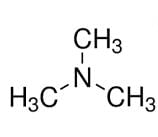
   is a tertiary amine with IUPAC name:

Detailed Solution: Question 26

The IUPAC name of tertiary methyl amine is N,N-Dimethyl-methanamine.

Chemistry: CUET Mock Test - 5 - Question 27

Which of the following polymer is stored in the liver of animals?

Detailed Solution: Question 27

Glycogen

Chemistry: CUET Mock Test - 5 - Question 28

A pigment protein in animals is-

Detailed Solution: Question 28

Haemoglobin

Chemistry: CUET Mock Test - 5 - Question 29

The main structural feature of proteins is-

Detailed Solution: Question 29

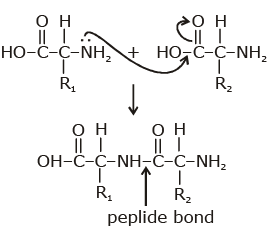
The peptide linkage

Chemistry: CUET Mock Test - 5 - Question 30

α-helical structure refers to the-

Detailed Solution: Question 30

Secondary structure of protein

View more questions
41 docs|160 tests
Information about Chemistry: CUET Mock Test - 5 Page
In this test you can find the Exam questions for Chemistry: CUET Mock Test - 5 solved & explained in the simplest way possible. Besides giving Questions and answers for Chemistry: CUET Mock Test - 5, EduRev gives you an ample number of Online tests for practice
Download as PDF