JEE Exam  >  JEE Test  >  Chemistry Main & Advanced  >  Classification of Elements and Periodicity in Properties - 1 - JEE MCQ

Classification of Elements and Periodicity in Properties - 1 - Free MCQ


MCQ Practice Test & Solutions: Classification of Elements and Periodicity in Properties - 1 (30 Questions)

You can prepare effectively for JEE Chemistry for JEE Main & Advanced with this dedicated MCQ Practice Test (available with solutions) on the important topic of "Classification of Elements and Periodicity in Properties - 1". These 30 questions have been designed by the experts with the latest curriculum of JEE 2026, to help you master the concept.

Test Highlights:

  • - Format: Multiple Choice Questions (MCQ)
  • - Duration: 60 minutes
  • - Number of Questions: 30

Sign up on EduRev for free to attempt this test and track your preparation progress.

Classification of Elements and Periodicity in Properties - 1 - Question 1

 Which is the correct order of ionic sizes (At. No. : Ce = 58, Sn = 50, Yb = 70 and Lu = 71)                [AIEEE-2002]

Detailed Solution: Question 1

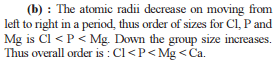
Generally as we move from left to right in a period, there is regular decrease in atomic radii and in a group as the atomic number increases the atomic radii also increases. Thus the atomic radius of Sn should be less than lanthanides. La > Sn. But due to lanthanide contraction, in case of lanthanides there is a continuous decrease in size with increase in atomic number. Hence the atomic radius follow the given trend:

Ce > Sn > Yb > Lu. 

Classification of Elements and Periodicity in Properties - 1 - Question 2

The reduction in atomic size with increase in atomic number is a characteristic of elements of -                              [AIEEE-2003]

Detailed Solution: Question 2

With increase in atomic number i.e. in moving down a group, the number of the principal shell increases and therefore, the size of the atom increases. But in case of f ­block elements there is a steady decrease in atomic size with increase in atomic number due to lanthanide contraction. As we move through the lanthanide series, 4f electrons are being added one at each step.

The mutual shielding effect of f electrons is very little. This is due to the shape of the f ­orbitals. The nuclear charge, however increases by one at each step. Hence, the inward pull experienced by the 4f electrons increases. This causes a reduction in the size of the entire 4fn shell.

Classification of Elements and Periodicity in Properties - 1 - Question 3

The atomic numbers of vanadium (V). Chromium (Cr), manganese (Mn) and iron (Fe) respectively 23, 24, 25 and 26. Which one of these may be expected to have the higher second ionization enthalpy ?  [AIEEE-2003]

Detailed Solution: Question 3

The electronic configurations are as follows;

V:(Ar)3d34s2
Cr:(Ar)3d54s1
Mn:(Ar)3d54s2
Fe:(Ar)3d64s2

The second ionization of Cr means removal of electron from the stable configuration of 3d5.
The highest second ionization enthalpy is Cr
Hence a is the correct answer.

Classification of Elements and Periodicity in Properties - 1 - Question 4

Which one of the following sets of ions represents the collection of isoelectronic species ?           [AIEEE-2004]

Detailed Solution: Question 4

Isoelectronic species are those which have same number of electrons.

K+ = 19 – 1 = 18 ; Ca2+ = 20 – 2 = 18

Sc3+ = 21 – 3 = 18 ; Cl = 17 + 1 = 18

Thus all these ions have 18 electrons in them.

Classification of Elements and Periodicity in Properties - 1 - Question 5

lanthanoid contraction is caused due to -                              [AIEEE-2006]

Detailed Solution: Question 5

The Lanthanide Contraction is caused by a poor shielding effect of the 4f electrons. Gd because as atomic number increases, the atomic radius decreases. These electrons are do not shield good, causing a greater nuclear charge.

Classification of Elements and Periodicity in Properties - 1 - Question 6

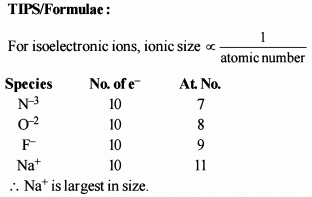
The increasing order of the ionic radii of the given isoelectronic species is:

Detailed Solution: Question 6

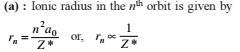
For isoelectronic species, as the z/e decreases, ionic radius increases
such as ionic radii ∝ 1/z.

Classification of Elements and Periodicity in Properties - 1 - Question 7

The increasing order of the ionic radii of the given isoelectronic species is:

Detailed Solution: Question 7

Among isoelectronic species, ionic radii increase as the charge increases.

Order of ionic radii:

The number of electrons remains the same, but the nuclear charge increases with an increase in the atomic number, causing a decrease in size. 

Classification of Elements and Periodicity in Properties - 1 - Question 8

Identify the correct order of the size of the following:

Detailed Solution: Question 8

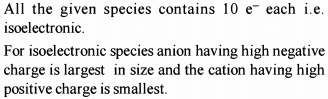
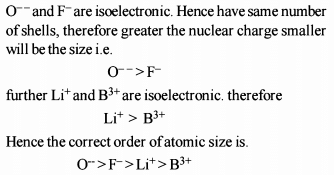
(a): Among isoelectronic ions, the ionic radii of anions is more than that of cations.
Further, the size of the anion increases with an increase in negative charge, and the size of the cation decreases with an increase in positive charge.

Classification of Elements and Periodicity in Properties - 1 - Question 9

Pauling’s electronegativity values for elements are useful in predicting

Detailed Solution: Question 9

Pauling introduced the electronegativity concept. He introduced the idea that the ionic character of a bond varies with the difference in electronegativity. A large difference in electronegativity leads to a bond with a high degree of polar character, i.e., the bond is predominantly ionic or vice versa.

Classification of Elements and Periodicity in Properties - 1 - Question 10

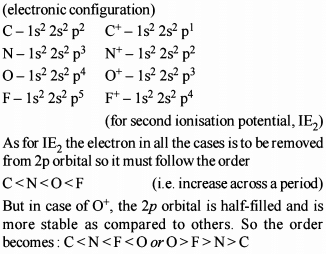
Amongst the elements with the following electronic configurations, which one of them may have the highest ionisation energy?

Detailed Solution: Question 10

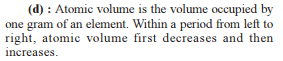
(d): Among options (a), (c), and (d), option (d) has the highest ionisation energy because of extra stability associated with a half-filled 3p-orbital.
In option (b), the presence of 3d¹⁰ electrons offers a shielding effect, as a result, the 4p electrons do not experience much nuclear charge and hence the electrons can be removed easily.

Classification of Elements and Periodicity in Properties - 1 - Question 11

The correct order of radii is

Detailed Solution: Question 11
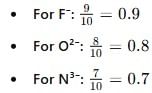
Effective nuclear charge (i.e. Z/e ratio) decreases from F⁻ to N³⁻, hence the radii follows the order:
F- < O2- < N3-

Z/e ratio calculations:

Classification of Elements and Periodicity in Properties - 1 - Question 12

Choose the correct order of the following:

Detailed Solution: Question 12

(A) For more polarity electronegativity difference should be more E.N. (P) ≈ E.N. (H)

N–H > As–H > Sb–H > P–H is the order, (B) and (C) more is the size is gaseous phase less is hydration thus less is

hydrated size ∴ more is ionic mobility.

(D) Lattice energy depends on charge of cation and anion and internuclear distance thus order

MgO > SrO > NaF

Classification of Elements and Periodicity in Properties - 1 - Question 13

Which has the most stable +2 oxidation state?

Detailed Solution: Question 13

(i) Ions having half-filled or fully filled orbitals have extra stability.
(ii) Larger the size of the cation, the more stable it will be.

Pb²⁺ (5d¹⁰ 6s²) has the most stable +2 oxidation state because its d-orbital is completely filled, making it more stable than Fe²⁺ (3d⁶).
Ag⁺ (4d¹⁰) is also more stable due to the completely filled d-orbital, and Ag²⁺ is not easily obtained.
Pb²⁺ is more stable than Sn²⁺ (4d¹⁰ 5s²) due to its larger size.

Classification of Elements and Periodicity in Properties - 1 - Question 14

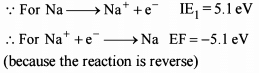
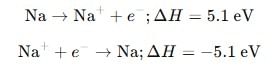
What is the value of electron gain enthalpy of Na⁺ if IE₁ of Na = 5.1 eV?

Detailed Solution: Question 14
Classification of Elements and Periodicity in Properties - 1 - Question 15

Atomic radii of fluorine and neon in Ångstrom units are respectively given by:

Detailed Solution: Question 15

(i) Noble gases do not have covalent radii. They have only van der Waal’s radii.
(ii) Covalent radii are always smaller than corresponding van der Waal’s radii.
The atomic radius of neon, being a van der Waal’s radius, is larger than that of fluorine, which in fact represents its covalent radius.

Classification of Elements and Periodicity in Properties - 1 - Question 16


Detailed Solution: Question 16


Classification of Elements and Periodicity in Properties - 1 - Question 17


Detailed Solution: Question 17


Classification of Elements and Periodicity in Properties - 1 - Question 18


Detailed Solution: Question 18


Classification of Elements and Periodicity in Properties - 1 - Question 19


Detailed Solution: Question 19


Classification of Elements and Periodicity in Properties - 1 - Question 20


Detailed Solution: Question 20


Classification of Elements and Periodicity in Properties - 1 - Question 21


Detailed Solution: Question 21


Classification of Elements and Periodicity in Properties - 1 - Question 22


Detailed Solution: Question 22

Classification of Elements and Periodicity in Properties - 1 - Question 23


Detailed Solution: Question 23


Classification of Elements and Periodicity in Properties - 1 - Question 24


Detailed Solution: Question 24


Classification of Elements and Periodicity in Properties - 1 - Question 25


Detailed Solution: Question 25


Classification of Elements and Periodicity in Properties - 1 - Question 26


Detailed Solution: Question 26


Classification of Elements and Periodicity in Properties - 1 - Question 27


Detailed Solution: Question 27


Classification of Elements and Periodicity in Properties - 1 - Question 28


Detailed Solution: Question 28


Classification of Elements and Periodicity in Properties - 1 - Question 29


Detailed Solution: Question 29

Classification of Elements and Periodicity in Properties - 1 - Question 30


Detailed Solution: Question 30


332 videos|699 docs|300 tests
Information about Classification of Elements and Periodicity in Properties - 1 Page
In this test you can find the Exam questions for Classification of Elements and Periodicity in Properties - 1 solved & explained in the simplest way possible. Besides giving Questions and answers for Classification of Elements and Periodicity in Properties - 1, EduRev gives you an ample number of Online tests for practice
Download as PDF