Mathematics Exam  >  Mathematics Test  >  Topic-wise Tests & Solved Examples  >  Differential Equations - 1 - Mathematics MCQ

Differential Equations - 1 - Free MCQ Test with solutions for Maths


MCQ Practice Test & Solutions: Differential Equations - 1 (20 Questions)

You can prepare effectively for Mathematics Topic-wise Tests & Solved Examples for Mathematics with this dedicated MCQ Practice Test (available with solutions) on the important topic of "Differential Equations - 1". These 20 questions have been designed by the experts with the latest curriculum of Mathematics 2026, to help you master the concept.

Test Highlights:

  • - Format: Multiple Choice Questions (MCQ)
  • - Duration: 60 minutes
  • - Number of Questions: 20

Sign up on EduRev for free to attempt this test and track your preparation progress.

Differential Equations - 1 - Question 1

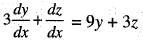
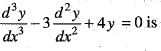
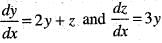
Let k be real constant. The solution of the differential equations  satisfies the relation
Detailed Solution: Question 1

we have dy/dx = 2y + z and ...(i)
dz/dx = 3y  ...(ii)
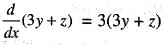
from 3 (i) l (ii), we get 

implies 
on integrating, we get

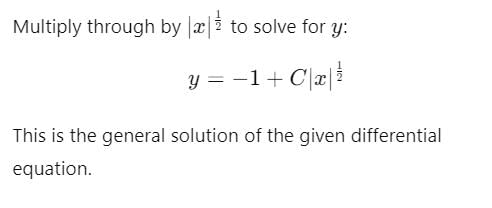
implies ln(3y + z) = 3x + c
So, 3y + z = ke3x

Differential Equations - 1 - Question 2

Find the General Solution of the given differential equation.

Detailed Solution: Question 2

This special case where D has a co-efficient is solved using Legendre’s method. 

Let log⁡(8x + 7) = z 

Then, ez = 8x + 7

Substituting this in the equation, 

8Dy + 2y = x 

y(8D + 2) = x 

Thus the auxiliary equation is 8D + 2 = 0 

Thus, D = -1 / 4

(Solving by substituting powers of ez)

The General solution is C.F + P.I =

Differential Equations - 1 - Question 3

The differential equation 2ydx - (3y - 2x)dy = 0

Detailed Solution: Question 3

  1. Option D is correct.

    M(x,y) = 2y and N(x,y) = 2x - 3y.

    Compute the partial derivatives: ∂M/∂y = 2 and ∂N/∂x = 2. Since these are equal, the differential form is exact.

    Both M and N are homogeneous of degree 1 (each term scales linearly with a common factor), so the equation is homogeneous.

    Rearrange to express dx/dydx/dy = (3y - 2x)/(2y) = 3/2 - x/y. This can be written as dx/dy + (1/y)·x = 3/2, which is a first-order linear equation in the dependent variable x with independent variable y.

    Therefore the equation is exacthomogeneous, and also linear when viewed as an ODE for x(y); hence option D is correct.

Differential Equations - 1 - Question 4

Consider the differential equation 2 cos (y2)dx - xy sin (y2)dy = 0

Detailed Solution: Question 4

2(cos(y²)) dx - xy sin(y²) dy  

∂M/∂y = -2 sin(y²) ⋅ (2y)  
       = -4y sin(y²)  

∂N/∂x = -y sin(y²)  

(∂M/∂y - ∂N/∂x) / N = (+3y sin(y²)) / (+x y sin(y²)) = 3/x  

∴ If I = e^(∫(3/x) dx) = x³.
 

Differential Equations - 1 - Question 5

If the general solutions of a differential equation are (y + c)2 = cx, where c is an arbitrary constant, then the order and degree of differential equation is  

Detailed Solution: Question 5
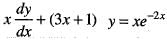
There will only one constant in the first-order differential equation. Differentiating the given equation.


Putting the value of c in Eq. (1) and simplifying we will get a first-order and second-degree equation. Hence, (A) is the correct answer.

Differential Equations - 1 - Question 6

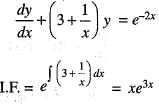
An integration factor of  is

Detailed Solution: Question 6

we have 

Differential Equations - 1 - Question 7

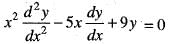
The general solution of 
(Here c1 and c2 are arbitrary constants.)

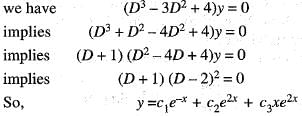
Detailed Solution: Question 7

Let z = log x, Then

The differential equation changes to

implies

So, 

Differential Equations - 1 - Question 8

Solution of the differential equation

Detailed Solution: Question 8


=> x2 ln⁡x dy - xy dy=xy dx – y2 ln⁡y dx …….dividing by x2 y2 then


on integrating we get

where c is a constant of integration.

Differential Equations - 1 - Question 9

Let y1(x) and y2(x) be linearly independent solution of the differential equation y" + P(x) y' + Q(x)y = 0, where P(x) and Q(x) are continuous functions on an interval I. Then y3(x) = ay1(x) + by2(x) and y4(x) = cy1(x) dy2(x) are linearly independent solutions of the given differential equations if

Detailed Solution: Question 9

y3(x) and y4(x) are linearly dependent if y3(x) = ky4(x) where k is any constant 

Since, y1(x) and y2(x) are independent
So, a - kc = 0
and b - kd = 0
or 
So, y3(x) and y4(x) are independent if

implies ad ≠ bc

Differential Equations - 1 - Question 10

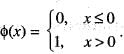
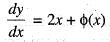
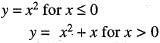
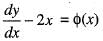
Consider the differential equations, satisfying y(0) = 0,  where  This initial value problem
Detailed Solution: Question 10

we have 
or, 
Thus, 
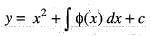
implies y = x2 + c for x ≤ 0,
but y(0) = 0 implies c = 0
So,
 

Differential Equations - 1 - Question 11

The particular integral of the differential equation 
y" + y' + 3y = 5 cos(2x + 3) is

Detailed Solution: Question 11
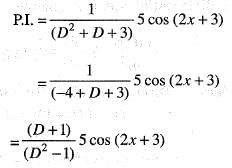
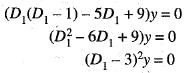
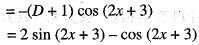
we have (D2 + D + 3)y = 5 cos(2x + 3)
So,

Differential Equations - 1 - Question 12

The general solution of differential equation
4x2y" - 8xy' + 9y = 0 is 

Detailed Solution: Question 12
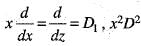
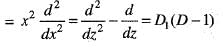
Let z = log x, Then 

So, The differential equation becomes

So, 

Differential Equations - 1 - Question 13

What is the order of the non-homogeneous partial differential equation,

Detailed Solution: Question 13

The order of an equation is defined as the highest order derivative present in the equation and hence from the equation,it is clear that it of 2nd order.

Differential Equations - 1 - Question 14

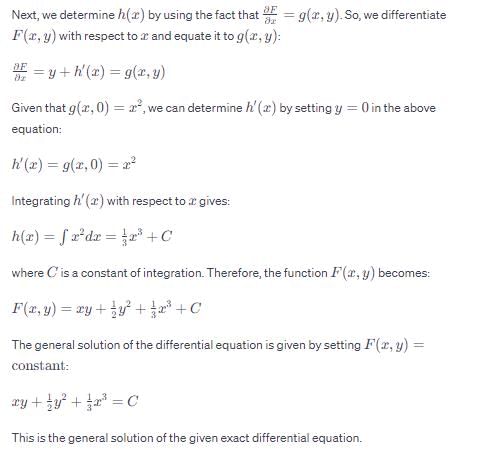
If g(x, y)dx + (x + y )dy = 0 is an exact differential equation and if g(x, 0) = x2, then the general solution of the differential equation is

Detailed Solution: Question 14
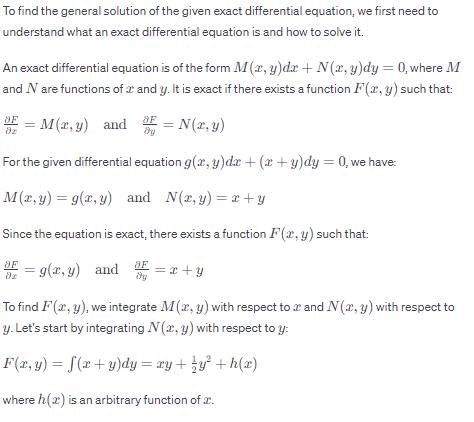

Differential Equations - 1 - Question 15

A general solution of the differential equation 

Detailed Solution: Question 15

Differential Equations - 1 - Question 16

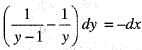
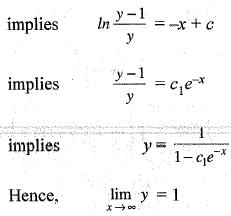
Consider the differential equation  Then   is equal to

Detailed Solution: Question 16

we have 
implies 

Differential Equations - 1 - Question 17

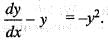
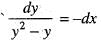
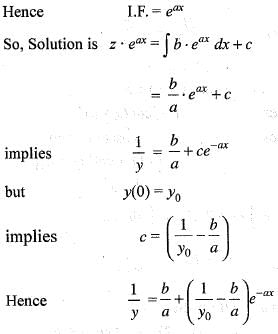
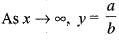
Consider the differential equation dy/dx = ay - by2,  where a, b > 0 and y(0) = y0.  As  x → + ∝, the solution y (x) tends to

Detailed Solution: Question 17
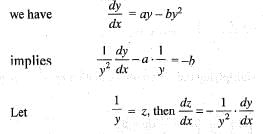

So, Equation becomes,


Differential Equations - 1 - Question 18

Orthogonal trajectories of the family of curves (x - 1)2 + y2 + 2ax = 0 are the solution of the differential equation

Detailed Solution: Question 18

Differentiating (x - 1)2 + y2 + 2ax = 0 with respect to x gives

2(x - 1) + 2y(dy/dx) + 2a = 0.

From the family equation, 2ax = -[(x - 1)2 + y2], so

a = -((x - 1)2 + y2)/(2x).

Substituting a into the differentiated equation and simplifying yields

x2 - y2 - 1 + 2xy(dy/dx) = 0.

For orthogonal trajectories, replace the slope of the given family, dy/dx, by the negative reciprocal of the slope of the orthogonal curves. Let dy/dx denote the derivative for the orthogonal trajectories; then substitute dy/dx_of_family = -1/(dy/dx).

Replacing and solving for dy/dx gives

dy/dx = 2xy / (x2 - y2 - 1).

Thus the differential equation of the orthogonal trajectories is dy/dx = 2xy / (x2 - y2 - 1), which corresponds to option A.

Differential Equations - 1 - Question 19

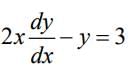
The solution of differential equation  represents the family of 

Detailed Solution: Question 19
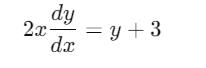
Given equation, 

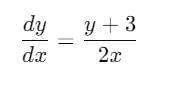
Dividing both sides by 2x, we get 

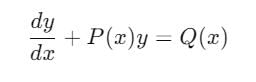
There is a linear differential equation of the form: 

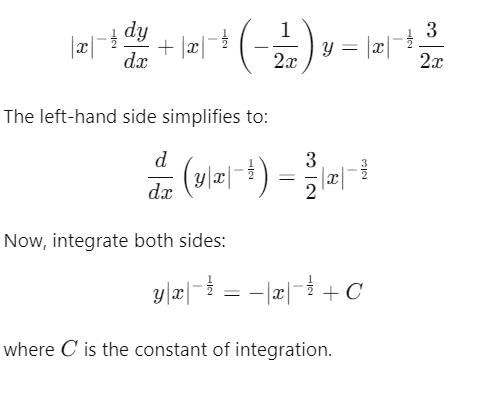
The integrating factor is found by:

Multiply both sides of the equation by the integrating factor:

The solution  represents a family of parabolas. This is because the equation has the form of a quadratic curve (which describes a parabola). 

Therefore, the answer is c) parabolas

Differential Equations - 1 - Question 20

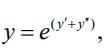
Let  then sum of degree and order of given ordinary differential equation is 

Detailed Solution: Question 20

Given, 

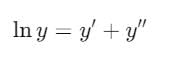
Taking the natural logarithm of both sides to eliminate the exponential term:

The order of a differential equation is the highest derivative present in the equation.

Here, the highest derivative is y′′y''y′′ (second derivative), so the order of the equation is 2.

The degree of a differential equation is the exponent of the highest derivative, provided that the equation is polynomial in the derivatives.

In this case, the equation llny=y′+y′′ is not polynomial in y′ and y′′ due to the presence of the logarithmic function. Therefore, the degree is 1.

The order is 2, and the degree is 1.

Thus, the sum of the degree and order is 2+1=3

(a) is the correct answer.

27 docs|150 tests
Information about Differential Equations - 1 Page
In this test you can find the Exam questions for Differential Equations - 1 solved & explained in the simplest way possible. Besides giving Questions and answers for Differential Equations - 1, EduRev gives you an ample number of Online tests for practice
Download as PDF