EMRS Exam  >  EMRS Test  >   TGT Mock Test Series 2026  >  EMRS TGT Science Mock Test - 3 - EMRS MCQ

EMRS TGT Science Mock Test - 3 Free Online Test 2026


Full Mock Test & Solutions: EMRS TGT Science Mock Test - 3 (130 Questions)

You can boost your EMRS 2026 exam preparation with this EMRS TGT Science Mock Test - 3 (available with detailed solutions).. This mock test has been designed with the analysis of important topics, recent trends of the exam, and previous year questions of the last 3-years. All the questions have been designed to mirror the official pattern of EMRS 2026 exam, helping you build speed, accuracy as per the actual exam.

Mock Test Highlights:

  • - Format: Multiple Choice Questions (MCQ)
  • - Duration: 180 minutes
  • - Total Questions: 130
  • - Analysis: Detailed Solutions & Performance Insights
  • - Sections covered: Reasoning Ability, Knowledge of ICT, Teaching Aptitude, Domain Knowledge, General English, General Hindi, English

Sign up on EduRev for free and get access to these mock tests, get your All India Rank, and identify your weak areas to improve your marks & rank in the actual exam.

EMRS TGT Science Mock Test - 3 - Question 1

Statements:
All the harmoniums are instruments.
All the instruments are flutes.

Conclusions:
(1) All the flutes are instruments.
(2) All the harmoniums are flutes.

Detailed Solution: Question 1
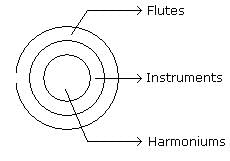
Since all the harmoniums are instruments and all instruments are flutes, then flutes include instruments and harmoniums. And instruments include harmoniums.
(i) All flutes cannot be instruments, because instruments are flutes, but flutes can contain something else as well.
(ii) All the harmoniums are flutes because harmoniums are instruments and instruments are flutes.

EMRS TGT Science Mock Test - 3 - Question 2

One day afternoon Arun and Mani were sitting in a garden and facing each other.Mani’s shadow fall exactly towards Arun’s right, Which direction was Mani facing ?

Detailed Solution: Question 2

EMRS TGT Science Mock Test - 3 - Question 3

P is 15m to the west of Q. R is 13m to the south of Q and 5m to the east of S. T is 20m to the north of S.T is 10m to the east of U…….

Q.

In which direction R with respect to P

EMRS TGT Science Mock Test - 3 - Question 4

N is more intelligent than M. M is not as intelligent as Y. X is more intelligent than Y but not as good as N. Who is the most intelligent of all ?

Detailed Solution: Question 4

According to the question,
N > M
Y > M
N > X > Y
On arranging the above data, we get
&becaul; N > X > Y > M
So, N is the most intelligent among them.

So Option A is correct

EMRS TGT Science Mock Test - 3 - Question 5

Q. In a queue, Rahul is fourteenth from the front and John is seventeenth from the end, while Alisha is in between Rahul and John. There are 48 persons in the queue, how many persons are there between Rahul and Alisha?

Detailed Solution: Question 5

Rahul’s position 14th from front
John’s Position 17th from last 
Alisha is between them


People between them 48 – (14+17) = 17
Where the midmost is Alisha 
So she has 8 people on either of her side.

So Option A is correct

EMRS TGT Science Mock Test - 3 - Question 6

In a hotel, there are five guests - X. Y, Z, W, and V staying on five different floors. The bottommost floor is numbered as 1, and the floor immediately above it is numbered as 2, and so on. X, Y, and Z do not have rooms on floor number 1. V stays on the topmost floor. Y stays on the floor number 3. X does not stay on floor number 2. On which floor number does W stay?

Detailed Solution: Question 6
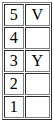
Given: Five guests - X, Y, Z, W, and V staying on five different floors (1 to 5).

1) V stays on the topmost floor.

2) Y stays on floor number 3.

3) X, Y, and Z do not have rooms on floor number 1. X does not stay on floor number 2.

From the condition "X, Y, and Z do not have rooms on floor number 1," we know that W is the only person who can be on Floor 1.

Now, we can place the remaining guests. The condition "X does not stay on floor number 2" means X must stay on the only remaining floor, which is 4. This leaves Z to stay on floor 2.

Thus, W stays on Floor 1.

Hence, the correct answer is "Option 4".

EMRS TGT Science Mock Test - 3 - Question 7

. ………………is the process of carrying out commands.

EMRS TGT Science Mock Test - 3 - Question 8

Given below are two statements:

Statement I: CPU executes software directly from secondary memory.

Statement II: A software is termed as Open Source Software if it can be downloaded from the Internet.

In the light of the above statements, Choose the correct answer from the options given below:

Detailed Solution: Question 8

Explanation

Statement I: CPU executes software directly from secondary memory.

How does CPU Executes Software?

  • The Primary Memory or Main Memory or Internal Memory is the main memory of the device/computer where the processing data exist and the secondary memory of a device/computer is an auxiliary memory that stores the data permanently
  • The CPU executes a program that is stored as a sequence of machine language instructions in the main memory or primary memory.
  • It does this by repeatedly reading, or fetching, an instruction from memory and then carrying out, or executing, that instruction.

Hence Statement I is false.

Statement II: A software is termed as Open Source Software if it can be downloaded from the Internet.

Open-source software (OSS) :

  • It refers to the computer software whose source is open means the general public can access and use it.
  • It is released through a license that makes its source code legally available to end-users.
  • It is software that is distributed with its source code, making it available for use, modification, and distribution with its original rights.
  • It is available in source code form without additional cost.

Hence statement II is false.

Therefore we conclude that both Statement I and Statement II are false.

EMRS TGT Science Mock Test - 3 - Question 9

Which of the following is not a voice assistant?

Detailed Solution: Question 9

The correct answer is Carvaan.

Important Points

  • A Voice Assistant is an intelligent personal assistant or a connected speaker, is a new type of product marketed by Apple, Amazon and Google and is based on natural language speech recognition.
  • Cortana is a virtual assistant developed by Microsoft, which uses the Bing search engine to perform tasks such as setting reminders and answering questions for the user.
  • Alexa is a voice-controlled virtual assistant.
    • She can play audio, control your smart home, answer questions and engage your favourite services to keep you organized, informed, safe, connected and entertained.
  • Siri is an intelligent assistant that offers a faster, easier way to get things done on your Apple devices.
  • Caravaan is a music player.
  • Hence Carvaan is the correct answer.

EMRS TGT Science Mock Test - 3 - Question 10

Which among the following is a non-cognitive characteristic of a learner?

Detailed Solution: Question 10

Awareness of learner’s characteristics helps the teacher to determine what approach, methods and strategies to use in the teaching and learning process. Learner characteristics can be physical, cognitive, social, emotional, moral or academic.

Explanation

Cognitive Characteristics of Learner: These relate to the thought processes, memory, attention span, symbolization, which determines how the learner processes, remember, perceives, solves problems and organizes information in their brain. It may include characteristics such as:

  • Awareness and understanding of one’s thinking process
  • Independent and logical thinking
  • Remembering and recalling past learnt concepts
  • Identifying and understanding the various sensory inputs
  • Ability to analyse, evaluate and experiment
  • Ability to solve simple or complex problems

Hence, it is clear from the given points that believing what is true is non- cognitive characteristic of a learner.

EMRS TGT Science Mock Test - 3 - Question 11

Which of the following technologies is commonly used in modern ICT-based teaching systems?

Detailed Solution: Question 11

The correct answer is 'Interactive whiteboards'

Explanation

  • Interactive whiteboards:
    • Interactive whiteboards are digital tools that allow for dynamic and interactive teaching methods.
    • They can display multimedia content, enable on-screen annotations, and support interactive activities.
    • These features make learning more engaging and cater to various learning styles.
    • Interactive whiteboards are widely used in modern classrooms due to their versatility and ability to integrate with other educational technologies.

EMRS TGT Science Mock Test - 3 - Question 12

Teaching is imparting theoretical knowledge to someone while training

Detailed Solution: Question 12

Teaching is imparting theoretical knowledge to someone while training helps in improving a particular skill.

Explanation

Concept of training:

  • Training is a physical task.
  • It is a method of improving a particular skill in the student.
  • Students cannot acquire this skill if lectures are given to them.
  • Practical methods have to be clear to them so that they can be expertise in the field.
  • Trainers give practical support to the students and improve their ability to accomplish a particular task.
  • Teaching is imparting theoretical knowledge to someone.
  • For example, it is possible to teach someone about buoyancy, fluid dynamics, water displacement, and coastline safety, but that knowledge will not make them a good swimmer.
  • Specific, practical, and applied training is necessary to use abstract knowledge to learn or master a skill. In many cases, teaching and training are complementary.
  • Vocational training programs often combine teaching and training quite nicely.

EMRS TGT Science Mock Test - 3 - Question 13

What are the elements of the evaluation plan?

a. Purpose

b. Resources

c. Analysis

d. Authority

Select the correct answer from the options given below:

Detailed Solution: Question 13
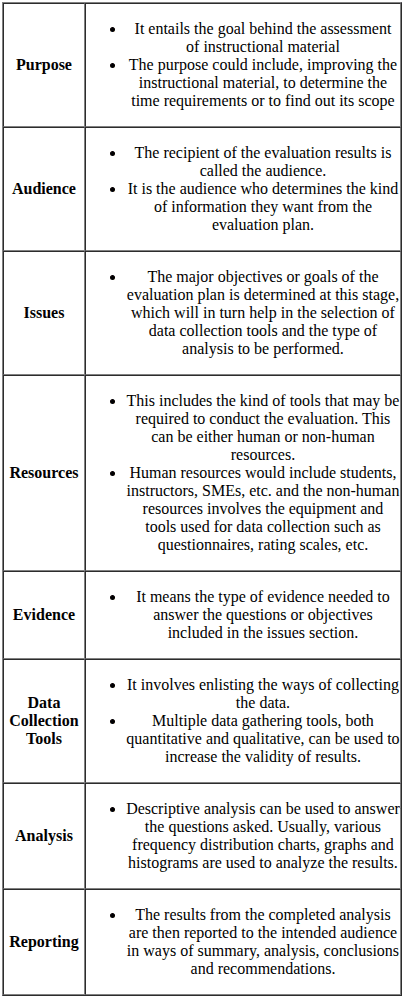
An evaluation is a systematic process of collecting and analyzing data to determine whether and to what degree, objectives have been achieved. An evaluation plan is a roadmap which shows how a particular instructional programme will be assessed and use the results to improve the overall programme.

Eight Elements of An Evaluation Plan:

Hence, it can be concluded from the above table that purpose, resources, analysis, etc. are the various elements of the evaluation plan.

EMRS TGT Science Mock Test - 3 - Question 14

Which describe the aims of formative assessment?

(a) Judging the worth of a program while the program activities are in progress.

(b) Identifying the specific learning error that needs to be corrected.

(c) Providing the student with feedback regarding his or her success or failure in attaining the instructional objectives.

(d) Focusing on the outcome and not on the process.

Detailed Solution: Question 14

Assessment is the systematic basis for making inferences about the learning and development of students. It is the process of defining, selecting, designing, collecting, analyzing, interpreting, and using information to increase students' learning and development.

Explanation

Formative assessment:
  • It is also known as formative evaluation, formative feedback, or assessment for learning, including diagnostic testing.
  • It is a range of formal and informal assessment procedures conducted by teachers during the learning process.
  • It is conducted to know the mastery in content.
  • The purpose is to monitor the learning progress of the learner.
  • It helps the learner to actively and continuously engage in learning in a non-threatening and supportive environment.
  • Effective formative assessment strategies involve asking students to answer well-thought-out, higher-order questions such as “why” and “how.” Higher-order questions require more in-depth thinking from the students and help the teacher discern the level and extent of the students' understanding.
  • It provides a chance for the learner to reflect on their performances and scope for improvement.
  • It provides feedback to students and teachers for effective learning.
  • It does not focus on the outcome but on the process of learning.
  • Examination, assignments, projects, quizzes, and competitions, group discussions are some of the techniques used in formative evaluation.
  • Examples of formative assessments include asking students to: draw a concept map in class to represent their understanding of a topic; submit one or two sentences identifying the main point of a lecture; turn in a research proposal for early feedback.

Thus, the correct solution is (a), (b) and (c) i.e. option 1.

EMRS TGT Science Mock Test - 3 - Question 15

A teacher in a constructivist classroom strives to help students develop their thinking by engaging them in collaborative problem-solving. However, this requires significant time management and careful coordination. Which of the following is most likely a pedagogical dilemma the teacher faces?

Detailed Solution: Question 15

The correct answer is 'Managing time to allow for collaborative activities without sacrificing the depth of content coverage.'

Explanation

  • Constructivist Classroom:
    • A constructivist classroom emphasizes student-centered learning where students construct their own understanding and knowledge through experiences and reflecting on those experiences.
    • Teachers facilitate rather than direct, aiming to develop critical thinking and problem-solving skills.
  • Time Management Challenge:
    • One of the significant challenges in a constructivist classroom is managing time effectively to allow for in-depth collaborative activities.
    • Teachers need to balance engaging students in meaningful, collaborative problem-solving tasks with the necessity of covering the required curriculum content.
    • This requires careful planning and coordination to ensure that learning objectives are met without compromising the quality of student interactions and learning experiences.

EMRS TGT Science Mock Test - 3 - Question 16

Which one of the following is a good approach for gaining more and better information about the student in continuity?

Detailed Solution: Question 16

Education is considered a process for the all-around development of a child in all dimensions i.e. intellectual, physical, social, moral, ethical, emotional, etc. The major objective of the elementary school curriculum is to foster the all-around or holistic development of the child i.e. his/her development in all aspects of life.

Explanation

  • Continuous and Comprehensive Evaluation (CCE) refers to a school-based evaluation, which covers all aspects of school activities related to a child’s development.
  • It emphasizes two-fold objectives such as continuity of evaluation and assessment of learning outcomes in a comprehensive manner.
  • It covers all the domains of learning i.e. cognitive, affective, and psychomotor domains.
  • It treats evaluation as a developmental process.
  • Evaluation in the cognitive domain is associated with the evaluation of cognitive abilities such as knowledge, understanding, application, etc.
  • Evaluation in the affective domain means the evaluation of attributes such as attitudes, motives, interests, and other personality traits.
  • Evaluation in the psychomotor domain involves assessing learners’ skills to use their hands (e.g. in handwriting, construction and projects). In CCE, students’ performance in both scholastic and co-scholastic activities is assessed.
  • CCE aims to reduce the curricular workload on students and to improve the overall abilities and skills of students by means of evaluating of students’ performance in both types of activities

Hence Continuous and Comprehensive Evaluation (CCE) is a good approach for gaining more and better information about the student in continuity.

EMRS TGT Science Mock Test - 3 - Question 17

Given below are the statements related to Nature of Teacher Education.

Assertion (A) : Teachers are not born but made.

Reason (R) : Teachers have to be equipped with necessary knowledge, as teaching is simultaneously thought of as an art and as a science.

In the light of the above statement choose the correct answer from the options given below.

Detailed Solution: Question 17

The correct answer is 'Both (A) and (R) are true and (R) is the incorrect explanation of (A).'

Explanation

  • Assertion (A): Teachers are not born but made:
    • This statement emphasizes the idea that teaching skills can be developed through education and training.
    • It suggests that effective teaching is not an innate ability but rather a skill set that can be acquired and honed over time.
    • Teacher education programs play a critical role in equipping individuals with the necessary pedagogical skills, knowledge, and competencies required for effective teaching.
  • Reason (R): Teachers have to be equipped with necessary knowledge, as teaching is simultaneously thought of as an art and as a science:
    • This statement explains the multifaceted nature of teaching, highlighting that it involves both artistic and scientific elements.
    • Teaching as an art refers to the creative and adaptive aspects of engaging students and fostering a positive learning environment.
    • Teaching as a science involves evidence-based practices, methodologies, and systematic approaches to instruction.

EMRS TGT Science Mock Test - 3 - Question 18

Which of the following is not a level of teaching-learning?

Detailed Solution: Question 18

Teaching- learning as the name suggests involves teaching the students the given concepts and children learning those concepts. Teaching-learning takes place on three different levels.

Explanation

  • Three levels of teaching-learning include reflective level, understanding level, and memory level.
  • Memory level resides at the bottom of the chart, whereas reflective level resides on top of the chart.
  • Memory level includes thoughtless teaching. Just memorize the given concept.
  • The understanding level includes thoughtful teaching. It involves thinking about the desired concept and understanding it.
  • The reflective level includes upper thoughtful teaching which includes reflecting the learning and teaching on others.
  • The teacher teaches the student at specific levels, in accordance with their needs and developments.

Thus, it can be concluded that differentiation is not the level of teaching-learning.

EMRS TGT Science Mock Test - 3 - Question 19

Statement 1: Traditional teaching methods generally rely on direct instruction, textbooks, and printed materials.

Statement 2: Modern teaching methods primarily focus on collaboration, problem-solving, and the use of digital tools.

Detailed Solution: Question 19

The correct answer is 'Both statements are true.'

Explanation

  • Traditional Teaching Methods:
    • Traditional teaching methods often involve direct instruction where the teacher plays a central role in delivering information to students.
    • Resources like textbooks and printed materials are commonly used to support learning.
    • These methods are typically more structured and may focus on rote memorization and standardized testing.
  • Modern Teaching Methods:
    • Modern teaching methods emphasize collaboration among students, encouraging them to work together to solve problems.
    • There is a significant focus on problem-solving skills, critical thinking, and applying knowledge in practical contexts.
    • The use of digital tools and technologies, such as interactive software, online resources, and digital assessments, is prevalent in modern teaching practices.

EMRS TGT Science Mock Test - 3 - Question 20

Which of the following is not true in relation to diagnostic evaluation?

Detailed Solution: Question 20

Diagnostic evaluation is specially conducted to identify and remove the learning difficulties of learner if it is observed and found during the formative evaluation. Note that:

  • Diagnostic evaluation is conducted along with formative evaluation during the instructional process.
  • It is carried out based on the data obtained from formative evaluation.
  • For example, if a learner couldn’t understand certain concepts in a particular subject and continuously performing poorly in that subject, we conduct diagnostic test to know the causes of the difficulties and accordingly provide them remedial treatment to overcome the difficulties.
  • The keyword in diagnostic evaluation is identifying ‘learning difficulties’.
  • Diagnostic evaluation not only solves the learning difficulties of learners but also identifies and provides remedies for personal, physical and psychological problems.
  • This can be exemplified as sometimes you may find that few students in your class are very nervous to come forward and say something, the tendency of fear towards the friends and teachers, suffering certain psycho-social disorders and physical disorders.

It should be noted that summative evaluation is conducted in the end.

Hence, we conclude that the degree of achievement is not considered at the end of the exam.

EMRS TGT Science Mock Test - 3 - Question 21

Assignment method of teaching is a combination of which of the following?

Detailed Solution: Question 21

The assignment method of teaching technique comprises guided information, self-learning, writing skills, and report preparation among the learners.

  • Heuristic method - The word heuristic is derived from the Greek word 'heurisco' which means "I find". It is called the 'discovery method'. It demands complete self-activity of self-learning on the part of the student. Through this method, the student learns to reason for himself. The teacher is not even required to guide, help, or encourage the student. This method helps in the development of a scientific attitude in the learner.
  • Problem Solving Method- It is used for teaching science is a technique that provides children an opportunity to solve scientific problems quite independently or through a guided approach by following systematic steps. In this method, teachers follow rigid and stereotyped curricula and rely heavily on texts and use punishment as a mode of getting assignments done.
  • Lecture-cum-demonstration method - The main purpose of a lecture-cum-demonstration is to convey information, generate understanding and to stimulate interest. It is made interesting by using appropriate stimulus variation techniques (voice tone. questioning, facial expressions, etc.) are important. This method is mostly teacher-centered while the 'Problem Solving Approach' is child-centered.
  • Laboratory method- In this method students perform laboratory experiments by their own hands individually or in small groups, under the supervision and guidance of their teacher. So, here students are more active and involved as compared to the Lecture-Demonstration method, where the teacher was performing experiments and most of the students in the class were just passive observers. The role of the teacher when using this method is that of a facilitator.
  • Project Method - It is one of the modern methods of teaching in which the curriculum content is considered from a child's point of view and is related to his needs and interest in the context of real-life situations. It implies that activities in the schools need to be closely connected 'with the child's daily life and needs.
  • Lecture Method - It is a method of teaching whereby the teacher attempts to explain facts, principles, or relationships to help students to understand. The teacher is an active participant, the students are passive listeners. It is a one-way method.
  • Field visit method- It is one of the most realistic methods of teaching, which gives the first-hand experience to the participants. In this method, participants are able to observe the workplace and activities being undertaken.

Hence, from the given points, it is clear that the Assignment method of teaching is a combination of Heuristic method and problem-solving method.

EMRS TGT Science Mock Test - 3 - Question 22

Which of the following is NOT a characteristic of a teacher-centered approach?

I. The students are writing down the dictation given by the teacher.
II. The students are developing different models using clay and paper in groups.
III. The students are doing mass drill in the field.

Detailed Solution: Question 22

Teacher Centred Method: Teacher is the dominant factor in all classroom activities. Everything that is done in the class, beginning from the sitting arrangements, fixing what and when to teach, maintaining discipline, asking questions, and the time and type of student evaluation is to be determined by the teacher.

Explanation

Some of the important characteristics of the teacher-centred approach of teaching-learning are:

  • Knowledge is transmitted from the teacher to the students.
  • The focus is on teaching/instructing/directing rather than on learning. For example, dictation.
  • The content and methods of teaching are decided by the teacher targeting the average students. The needs and interests of the individual students are rarely taken into account while teaching.
  • Emphasis is given on passive listening, reading and writing and reproducing things taught by or as directed by the teacher.
  • Students’ participation in classroom activities is dictated by the teacher. In most of the cases, the teacher gives little scope for debate and discussion and sharing of ideas.
  • Teacher is mostly concerned with the completion of the course contents.
  • The teacher concentrates on the right answer.
  • The classroom management is entirely dependent on teachers, on his/her experience capability and sometimes on his/her whims and caprices.
  • The principles of classroom discipline and their enforcement in the class are entirely controlled by the teacher.
  • The hallmark of classroom/school discipline is students’ absolute obedience to teachers.
  • Extrinsic modes of motivation like praise and rebuff, reward and punishment are generally used by the teachers.

Hence, we conclude that developing different models and doing mass drill in the field are not characteristics of teacher-centered method.

EMRS TGT Science Mock Test - 3 - Question 23

Which of the following is correct in respect of demonstration method?

Detailed Solution: Question 23

Demonstration method:

  • The demonstration method of teaching is a traditional classroom strategy used in technical and training colleges and in teacher education.
  • A method demonstration is a teaching method used to communicate an idea with the aid of visuals such as flip charts, posters, PowerPoint, etc.
  • A demonstration is a process of teaching someone how to make or do something in a step-by-step process.
  • Teacher demonstrations are important because they: provide students with experiences of real events, phenomena, and processes, helping them learn, raise students' interest and motivation. enable you to focus students on a particular phenomenon or event, such as the starch test for foods.

Explanation:

It focuses to achieve psychomotor and cognitive objectives.

Demonstration Strategy focus to achieve psychomotor and cognitive objectives. If we talk about its structure, it is given in three successive steps:

  1. Introduction: In this step objectives of the lesson are stated. The teacher may be called a demonstrator. He demonstrates the activity before the student that is to be developed.
  2. Development. Students try to initiate the demonstrated activity. If there is any query the teacher tries to satisfy them by further demonstration and illustrations.
  3. Integration. At this step, the teacher integrates all the activities and then these activities are rehearsed revised and evaluated.

Principles

This teaching strategy is based on the following principles

  1. Learning by doing maxim is followed
  2. Skills can be developed by a limitation
  3. The perception helps in imitation

EMRS TGT Science Mock Test - 3 - Question 24

NEP 2020 focuses on:

Detailed Solution: Question 24

The National Education Policy (NEP) 2020 of India emphasizes a shift from rote learning to fostering a more comprehensive understanding in students.

Explanation

  • One of the critical changes proposed by NEP 2020 in the assessment structure is the introduction of a 360° holistic progress card.
  • This progress card would not just focus on the academic achievements of the student but would provide a holistic overview, taking into account multiple facets of a student's development, including skills, behavior, interests, participation, and more.
  • The intention is to make the assessment more holistic and multi-dimensional, moving away from solely academic-focused evaluations.

Hence, we can conclude that NEP 2020 focuses on a 360° holistic progress card.

EMRS TGT Science Mock Test - 3 - Question 25

Which of the following is not a major shift as per NEP,2020?

Detailed Solution: Question 25

The National Education Policy (NEP) 2020 is a comprehensive policy document introduced by the Government of India to reform the education system in the country.

Explanation

Major changes proposed by NEP 2020:

  • Teacher-centric to learner-centric: Learner autonomy aligns with this shift. It encourages students to become more independent and self-directed in their learning.
  • Passive to active reception in learning: NEP promotes active learning methods where students engage with the material through activities, discussions, and projects, rather than passively absorbing information.
  • Learning in the four walls of the classroom to learning in the wider social context: NEP recognizes the importance of experiential learning and connecting classroom knowledge to real-world situations.
  • The NEP 2020 emphasizes a shift from teacher-centric to learner-centric education, encouraging learner autonomy and active participation in the learning process. Therefore, the transition from learner autonomy to teacher direction contradicts the spirit of the NEP 2020.

Therefore, learner autonomy to teacher direction goes against the grain of NEP 2020, which advocates for increased student autonomy in learning.

EMRS TGT Science Mock Test - 3 - Question 26

The essential element mentioned in NEP-2020 with regard to Primary Education in is :

Detailed Solution: Question 26

National Education Policy (NEP) 2020 is a comprehensive framework aimed at transforming India's education system, focusing on both the quality and inclusivity of education across all levels.

Explanation

  • The National Education Policy (NEP) 2020 emphasizes Foundational Literacy and Numeracy as an essential element in primary education.
  • This focus aims to ensure that every child achieves basic literacy and numeracy skills by the end of Grade 3.
  • It highlights the importance of building strong foundational skills in reading, writing, and mathematics, which are crucial for further academic success and overall development.

Thus, it is concluded that the essential element mentioned in NEP-2020 with regard to Primary Education in is Foundational Literacy and Numeracy.

EMRS TGT Science Mock Test - 3 - Question 27

Select the most appropriate meaning of the given idiom.
Your guess is as good as mine

Detailed Solution: Question 27

The correct answer is: Option 1.

Explanation

  • The idiom "Your guess is as good as mine" means that you do not know the answer to a question or problem. (आपको उत्तर का कोई अंदाजा नहीं है)
    • Example: When asked about the new project timeline, she shrugged and said, "Your guess is as good as mine."
  • "To have no idea of the answer" refers to being completely unaware or uncertain about the solution or information. (उत्तर का कोई अंदाजा न होना)
    • Example: I have no idea of the answer to this complex math problem.

Therefore, the correct answer is: Option 1.

EMRS TGT Science Mock Test - 3 - Question 28

निम्नलिखित में से कौन सा विकल्प सही विलोम-युग्म नहीं है I

Detailed Solution: Question 28

दिए गए विकल्पों में विलोम-युग्म 'प्रवर-प्रवृत्त' सही नहीं है।

  • प्रवर का अर्थ है 'वंश, कुल' तथा प्रवृत्त का अर्थ है 'किसी काम में लगा हुआ, तत्पर, उन्मुख'
  • अतः सही विकल्प 'प्रवर-प्रवृत्त' है।

EMRS TGT Science Mock Test - 3 - Question 29

Select the most appropriate synonym of the given word.

MUNDANE

Detailed Solution: Question 29

The correct answer is Option 2)

Explanation

  • The word "mundane" means something that is ordinary, commonplace, or lacking excitement; it often refers to the routine aspects of life. (साधारण)
    • Example: She longed for an adventure to escape her mundane existence.
  • "Ordinary" refers to something that is normal and not special or different in any way; it is often used to describe everyday things. (साधारण)
    • Example: He led an ordinary life, with a regular job and a happy family.
  • Hence, we can infer that the synonym of 'mundane' is 'ordinary'.

Therefore, the correct synonym of Mundane is Ordinary.

EMRS TGT Science Mock Test - 3 - Question 30

Choose the correct meaning of Idiom "To oil the hinges of silence".

Detailed Solution: Question 30

The correct answer is: Option 1 i.e. "To bribe someone to remain quiet".

Explanation

  • The idiom "To oil the hinges of silence" refers to taking action to ensure silence, often by bribing someone to remain quiet. (चुप रहने के लिए किसी को रिश्वत देना)
    • Example: The politician tried to oil the hinges of silence by offering money to the reporters who knew about the scandal.
  • In this context, the correct interpretation is "To bribe someone to remain quiet", which implies a deliberate act of ensuring silence by offering incentives. (चुप रहने के लिए किसी को रिश्वत देना)
    • Example: The company decided to oil the hinges of silence by compensating the whistleblower generously.

Therefore, the correct answer is: Option 1.

View more questions
5 docs|25 tests
Information about EMRS TGT Science Mock Test - 3 Page
In this test you can find the Exam questions for EMRS TGT Science Mock Test - 3 solved & explained in the simplest way possible. Besides giving Questions and answers for EMRS TGT Science Mock Test - 3, EduRev gives you an ample number of Online tests for practice
Download as PDF