Mechanical Engineering Exam  >  Mechanical Engineering Test  >  Mock Test Series for IES/ESE (ME)  >  ESE (ME) Paper II Mock Test - 2 - Mechanical Engineering MCQ

ESE (ME) Paper II Mock Test - 2 Free Online Test 2026


Full Mock Test & Solutions: ESE (ME) Paper II Mock Test - 2 (150 Questions)

You can boost your Mechanical Engineering 2026 exam preparation with this ESE (ME) Paper II Mock Test - 2 (available with detailed solutions).. This mock test has been designed with the analysis of important topics, recent trends of the exam, and previous year questions of the last 3-years. All the questions have been designed to mirror the official pattern of Mechanical Engineering 2026 exam, helping you build speed, accuracy as per the actual exam.

Mock Test Highlights:

  • - Format: Multiple Choice Questions (MCQ)
  • - Duration: 180 minutes
  • - Total Questions: 150
  • - Analysis: Detailed Solutions & Performance Insights

Sign up on EduRev for free and get access to these mock tests, get your All India Rank, and identify your weak areas to improve your marks & rank in the actual exam.

ESE (ME) Paper II Mock Test - 2 - Question 1

If pitch diameter is 200 mm and number of teeth are 20 then circular pitch of the gear will be:

Detailed Solution: Question 1

Concept:
Circular pitch is the distance measured along the pitch circle between two similar points on adjacent teeth.
PC = πD/T
where D is pitch diameter and T is the number of teeth on the gear.
Pitch diameter (D):
Pitch diameter or pitch circle diameter is the diameter of the pitch circle. The size of the gear is usually specified by the pitch circle diameter.
Calculation:
Given:
Pitch diameter (D) = 200 mm and Teeth (T) = 20
PC = πD/T = π x 200/20 = 31.4 mm

ESE (ME) Paper II Mock Test - 2 - Question 2

An automatic expansion valve is required to maintain constant

Detailed Solution: Question 2
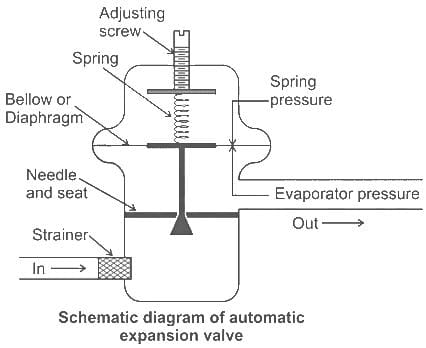
  • The automatic expansion valve maintains a constant pressure in the evaporator.
  • The constant pressure characteristics of the valve result from the interaction of two opposing forces, the evaporator pressure, and the spring pressure.
  • The evaporator pressure exerted on one side of the bellows or diaphragm acts to move the valve in a closing direction, whereas the spring pressure, acting on the opposite side of the bellows or diaphragm acts to move the valve in an opening direction. When the compressor is running, the valve functions to maintain the evaporator pressure in equilibrium with the spring pressure.

ESE (ME) Paper II Mock Test - 2 - Question 3

A point in space is represented by a vector 5i + 2j + 2k, and is translated by 5 units in x direction and by 4 units in y direction and 2 units in z direction. What will be the final position vector of the point after transformation?

Detailed Solution: Question 3

Concept:
Homogeneous transformation Matrix:

In 3-D space, a physical point is located and if we want to change from one coordinate to another
frame
then we need to use 4 X 4 homogenous transformation matrix.
It consists of four sub-matrices,
Generally given as
, where

  • 3 × 3 submatrix R is a rotation matrix.
  • 3 × 1 column vector P is a translation matrix.
  • 1 × 3 ηT is a perspective vector.
  • Scalar σ is a non-zero scale factor set to unity.

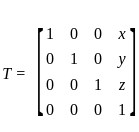
In case of pure translation , it takes the form of

The new vector will be
VN = T × Vo;
Where Vo - old vector, VN - new vector;
Calculation:
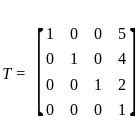
Given vector is Vo = 5i + 2j + 2k, x = 5, y = 4, z = 2;
Now the transformation matrix will be

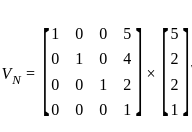
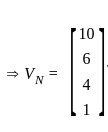
Now the new vector will be

ESE (ME) Paper II Mock Test - 2 - Question 4

Consider an ideal vapor compression refrigeration cycle. If the throttling process is replaced by an isentropic expansion process, keeping all the other processes unchanged, which one of the following statements is true for the modified cycle?

Detailed Solution: Question 4
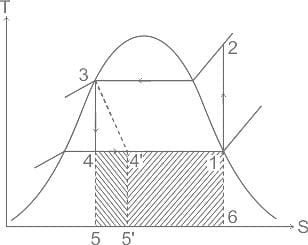
Concept:

For solving this question, you should have clear idea of T-S and p-h diagram, for vapour compression refrigeration cycle.

Figure: Cycle 1-2-3-4’-1; Ideal vapour compression refrigeration cycle (T-S plot)
Processes
1-2: Isentropic compression
2-3: Heat rejection
3-4: Isentropic expansion
3-4’: Isenthalpic expansion (Irreversible process)
4-1: Evaporation (Heat absorption)
We know that area under any process in T-S plot represents heat interaction
i.e.
When expansion process is isenthalpic (3-4’), heat absorption (refrigeration effect) is represented by area 4’-5’-6-1.
When expansion process is isentropic (3-4), refrigeration effect is represented by area 4-5-6-1.

…1)

Since, work input for both cycles is same (Process 1-2).
Area (4-5-6-1) > Area (4’-5’-6-1)
⇒ RE (Isentropic expansion) > RE (Isenthalpic expansion)
⇒ COP (isentropic expansion) > COP (isenthalpic expansion), {From 1)}
So, option 1) is correct
This can also be proved by drawing p-h chart


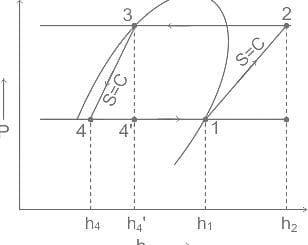
Figure: Pressure – enthalpy (p-h) chart for ideal VCR cycle
1-2: Isentropic compression
2-3: Heat rejection
3-4’: Isenthalpic expansion
3-4: Isentropic expansion
4-1: Heat addition (Evaporation)
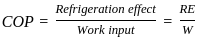
COP = RE/W
For original cycle: (Isenthalpic expansion:3-4’)
RE = h1 - h'4, W = h2 - h1 ⇒ COP|original = h1 - h'4/h2 - h1  …3)
For modified cycle: (Isentropic expansion) (3-4)
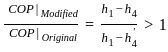
RE = h1 - h'4, W = h2 - h1 ⇒ COP|Modified = h1 - h'4/h2 - h1  …4)


{∵ h1 – h4 > h1 – h4’}
⇒ COP|Modified > COP|original
Key Points:
Remember T-S and p-h plot for vapour compression refrigeration cycle. Also understand the nature of constant entropy lines in p-h chart. Study the effect of various parameters like evaporator pressure, condenser pressure on COP.

ESE (ME) Paper II Mock Test - 2 - Question 5

What is the absolute pressure at a point 3 m below the free surface of a liquid having a density of 1.53 × 10³ kg/m3 if the atmospheric pressure is equivalent to 750 mm of mercury? The specific gravity of mercury is 13.6 and density of water is 1000 kg/m3.

Detailed Solution: Question 5
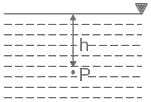
Concept:
Pressure in static fluid:

  • For incompressible fluids, the variation of pressure in the vertical direction in a static fluid is given by dp/dh = pg
  • In pressure measurement, we consider the downward direction as positive.​
  • Absolute pressure is the sum of atmospheric and gauge pressure Pm(abs) = Patm + ρgh

Calculation:
Given:
h = 3 m, ρliquid = 1.53 x 10³ kg/m3
hatm = 750 mm of mercury (Hg) = 0.75 m,
specific gravity ,SHg = 13.6, ρ = 13.6 x 1000 kg/m3
Patm = ρghatm = 13.6 x 1000 x 9.81 x 0.75 = 100,062 N/m2
Pabs = Patm + Pgauge
Pgauge = (ρgh)liquid = 1.53 x 103 x 9.81 x 3 = 45027.9 N/m2.
Pabs = Patm + Pgauge = 100062 + 45027.9 = 145090 N/m2.

ESE (ME) Paper II Mock Test - 2 - Question 6

If the laminar flow of the fluid having the viscosity μ is flowing through the pipe of the diameter D. Pressure gradient in the flow is . What is the average velocity of flow?

Detailed Solution: Question 6

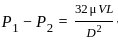
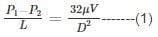
The pressure drop in a laminar flow through a circular pipe is given by:

where μ = viscosity of fluid, L = length of pipe, D = diameter of pipe, V = average velocity of flow
After rearranging

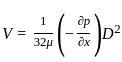
for a small length ∂x, the pressure gradient is
∴ Equation 1 becomes,

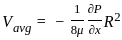
Average velocity is:

ESE (ME) Paper II Mock Test - 2 - Question 7

Which of the following is Active closed loop solar water heater?

Detailed Solution: Question 7

Concept:

The main components of a solar water heater are the solar collector, storage, and heat distribution.

Several configurations differ on the heat transport between the solar collector and the storage tank, as well as on the type of freeze protection.

The most successful solar heaters are the integrated collector and storage (ICS), Thermosiphon, drain-back, and drain-down systems

The ICS and thermosiphon are passive solar water heaters where fluid circulation occurs by natural convection.

In open-loop systems, the water that is pumped through the collectors is the same hot water to be used. These systems are not recommended for sites where freezing occurs. These active open-loop systems are called drain-down systems and they can operate in either manual or automatic mode

Drain-back system is a closed loop active solar heater.

Drain-down refers to draining the collector fluid out of the system; drain-back refers to draining the collector fluid back into the storage tank.

ESE (ME) Paper II Mock Test - 2 - Question 8

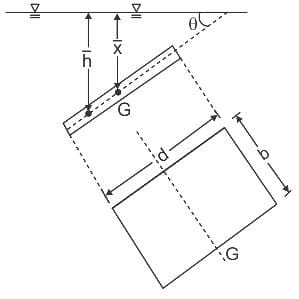
A square gate, 1.5 m × 1.5 m, on one of the vertical sides of a fully filled water tank, has one side on the free water surface. It is hinged on the lower horizontal side and is held in position by a force applied on the vertical central line at depth of 0.75 m below the free surface. The right magnitude of this force is

Detailed Solution: Question 8
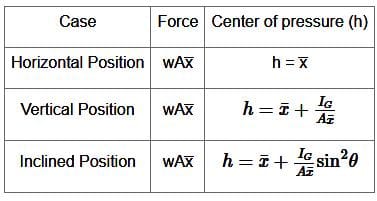
Concept:
Hydrostatic Forces on Submerged Surface


IG = bd3/12 (For rectangular plate)
IG = πd4/64 (For circular plate)
Here,
A = Area of surface touching fluid = b × d
IG = Area moment of inertia about centroidal axis.
= Vertical distance of C.O.G. of body from free surface
ω = Specific weight
θ = Angle at which the surface is inclined with horizontal
Calculation:

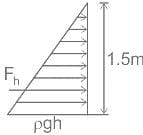
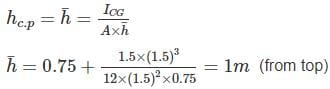
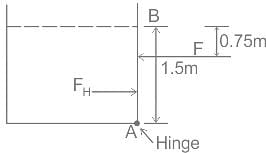
The hydrostatic press. Distribution on gate AB,

Magnitude of hyd. Force (FH


 = 0.75 m (CG of sq. plate)
FH = 1000 × 9.81 × (1.5)2 × 0.75 = 1687.5 × 9.81 N
Force will act at a distance of 

Taking moment about hinge A
FH × 0.5 = F × 0.75
⇒ 1687.5 × 9.81 × 0.5 = F × 0.75

ESE (ME) Paper II Mock Test - 2 - Question 9

A cube of dimension 2 m is floating in the water with immersing depth of 1 m. What is the weight (kN) of the cube? (Consider unit weight of water as 10 kN/m3)

Detailed Solution: Question 9
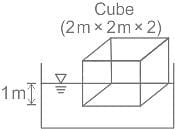
Concept:
When density of the body is less than that of the water, it floats. According to Archimedes' principle the upward buoyant force that is exerted on a body immersed in a fluid, whether fully or partially submerged, is equal to the weight of the fluid that the body displaces.
Weight of the body = Immersed volume x Density of water.
Calculations:


Weight of cube = Buoyancy Force
Buoyancy (B) = Immersed volume × density of water
Buoyancy = Area of cross section × Immersed depth × 10 kg/m3 = 2 m × 2 m × 1 m × 10 = 40 kN
Weight of cube = 40 kN

ESE (ME) Paper II Mock Test - 2 - Question 10

A pipe flows water at 15°C from one building to another. In the winter time the pipe loses an estimated 500 kW of heat transfer. What is the minimum required mass flow rate (in kg/s) that will ensure that the water does not freeze (i.e. reach 0°C)?
Use h = cpT; cp = 4.187 kJ/kgK

Detailed Solution: Question 10
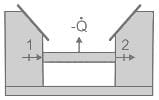
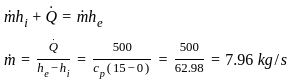
If the water is not supposed to freeze then its enthalpy should be higher than that of 0°C and it should also carry the heat which it is losing into the atmosphere to ensure that the water is not freeze

Energy Equation:

ESE (ME) Paper II Mock Test - 2 - Question 11

Statement (I): In a “Domestic Electrolux refrigerator” or “Three-fluids absorption system”, the partial pressures of the refrigerant vapor (ammonia) must be low in the evaporator, and higher in the condenser.
Statement (II): The partial pressure of ammonia is kept low in requisite parts of the circuit by concentrating hydrogen in those parts.

Detailed Solution: Question 11

Concept:
Domestic electrolux refrigerator:

  • This type of refrigerator is also called the “Three-fluids absorption system”. The three fluids used in this system are ammonia, hydrogen, and water.
  • The “ammonia” is used as a refrigerant because it possesses most of the desirable properties.
  • The “hydrogen” being the lightest gas, is used to increase the rate of evaporation (the lighter the gas, the faster is the evaporation) of the liquid ammonia passing through the evaporator.
  • The hydrogen is also non-corrosive and insoluble in water. This is used in the low-pressure side of the system.
  • The “water” is used as a solvent because it has the ability to absorb ammonia readily.
  • The ammonia liquid leaving the condenser enters the evaporator and evaporates into the hydrogen at the low-temperature corresponding to its low partial pressure.

Explanation:
For statement 1:
Role of Hydrogen:

By the presence of hydrogen, it is possible to maintain uniform total pressure throughout the system and at the same time permit the refrigerant to evaporate at low temperature in the evaporator corresponding to its partial pressure.
Thus, the condenser and evaporator pressures of the refrigerant are maintained as below:

  • In the condenser only ammonia is present, and the total pressure is the condensing pressure.
  • In the evaporator hydrogen and ammonia are present. Their relative masses are adjusted such that the partial pressure of ammonia is the required evaporator pressure.
  • Thus, the partial pressures of the refrigerant vapor (ammonia) must be low in the evaporator and higher in the condenser.

For statement 2:

  • Due to the presence of H2 in the low-pressure side of the system, the pressure of NH3 will be below that of NH3 on the condenser side. Thus, the NH3 can evaporate at low pressure. So, statement 2 is correct.

ESE (ME) Paper II Mock Test - 2 - Question 12

Consider the following statements regarding nano-materials.

1. They have a large fraction of surface atoms.

2. They have high surface energy.

3. They have large imperfections compare to the bulk material.

4. They are used in fuel cells.

Out of these statements:

Detailed Solution: Question 12

The most important property of nano material is that they have large surface to volume ratio due to this most of the atoms lies on the surface of nano material. Since they have high surface to volume ratio, they are highly reactive.

→ Nano material have reduced imperfection compare to bulk material due to small size.

Application of Nano-material:

1) Fuel cell

2) Catalysis

3) Medicine

4) Biomedical engineering

5) Sensors

6) Rechargeable batteries

7) Next generation computer chips

ESE (ME) Paper II Mock Test - 2 - Question 13

Wear performance of the brakes can be improved to

Detailed Solution: Question 13

From a functional and safety point of view following demands are put on the behaviour of friction materials-

  • High coefficient of friction
  • Stable coefficient of friction irrespective of temperature, velocity, pressure, humidity, wear, corrosion, and water spraying
  • The low wear rate of the friction material and long life
  • The low wear rate of the disc
  • Smooth braking without noise and vibrations
  • Regeneration of original properties after severe braking and with ageing
  • Environment-friendly raw materials
  • Low cost

A binder holds different components of a friction material together. Thermosetting phenolic resins are usually used as binders, with the addition of rubber for increased damping properties. The binder resin strongly affects the fade and wear resistance of friction material. The low bonding strength between constituent particles can improve the wear characteristics of the brake system.

The wear rate decreases with an increase in contact pressure between the brake surfaces under dry conditions while it increases with an increase in contact pressure under wet conditions.

On the other hand, the wear rate should be low at low temperatures but with an increase in temperature wear rate also increases because asperity present in contacting surfaces gets distributed with the influence of temperature and pressure. These deformed and broken asperity produce wear debris causing more heat generation on the surface.

In the case of the sliding velocity of the brake surface interface, the wear rate increases continuously with increasing sliding velocity. The rate of wear is slow at the medium velocity of sliding off the surface of the brake.

ESE (ME) Paper II Mock Test - 2 - Question 14

In which one of the following, the criticality of the item is most important than the cost factor of the item?

Detailed Solution: Question 14

ABC analysis -

  • A-B-C analysis is a basic analytical management tool, which enables any store manager to expand its effects and energy where the results will be best. This analysis is purely based on the Selective Management Principle or Pareto's Law.
  • It is also popularly known as "Always Better Control" or the alphabetical approach and has universal application in many areas of human endeavour.
  • A-B-C analysis does not depend on the unit cost of the items but only on their annual usage and not on their importance because all items are important. Analysts commonly classify inventory into three categories 'A', 'B', and 'C'.
  • The 'A' items have high annual usage in terms of money investment. 'B' items are average, while 'C' items have a low value of usage.

Every item in inventory is ranked and listed in order of items' annual value of usage. At the top of the list would be the high-value items, followed by a longer list of medium-value items, and finally a long list of Iow-value items.
The normal items in most organizations show the following pattern:
1) 10 percent to 15 percent of the top number of items account for about 70 percent of the total consumption value. These items are called 'A' items.
2) 20 percent to 25 percent of the number of items account for 20 percent of the total consumption value. These items are called 'B' items.
3) The remaining 65 percent to 70 percent of items account for the balance of 10 percent of the total issue value. These items are called 'C' items.

VED analysis -

  • The limitation of the A-B-C analysis is that it is based only on monetary value and the rate of consumption of the items. Sometimes, particularly in a hospital, an item of low monetary value and consumption (e.g. Injection Adrenaline, Anti-Snake Venom, etc.,) may be very vital or even life-saving. Their importance cannot be overlooked simply because they do not appear in A category of inventory.
  • V-E-D analysis is based on critical values and shortage costs of the item. Based on their criticality, the items could be classified into three categories -Vital, Essential, and Desirable.
  • V-E-D classification is applicable to a large extent in spare parts management. Stocking a spare part is based on strategies different from those of raw materials.

1) Vital items: There are several vital items in the inventory of a hospital, which could make difference between life and death. Such items should always be stocked in sufficient quantity to ensure their constant availability. Top management should control this group of items.

2) Essential items: The shortage of such items can be tolerated for a short period. If these items are not available for a few days or a week, the functioning of the hospital can be adversely affected (drugs like Antibiotics, etc.). Top middle level management ' should preferably control these items.

3) Desirable item: The shortage of these items will not adversely affect patient care or hospital function even if the shortage is prolonged (Items like vitamins). Middle or lower-level management should control desirable items.

ESE (ME) Paper II Mock Test - 2 - Question 15

An oil of viscosity 10 poise flows between two parallel fixed plates which are kept at a distance of 50 mm apart. What is the rate of flow of oil between the plates if the drop of pressure in a length of 1.2 m be 0.3 N/cm2 and the width of the plate is 200 mm?

Detailed Solution: Question 15

Concept:
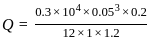
Volume Flow Rate in case of Laminar Flow through Parallel Plate is given by

where ΔP = Pressure Difference, h = Distance between parallel plates, b = Width of Plate, L = Length of Plate,  μ = Viscosity
Calculation:
Given:
ΔP = 0.3 N/cm2 = 0.3 × 10⁴ N/m2, h = 50 mm = 0.05 m, b = 200 mm = 0.2 m, L = 1.2 m,  μ = 10 Poise = 1 Pa.s

Q = 5.208 × 10⁻³ m3/sec = 5.208 L/s

ESE (ME) Paper II Mock Test - 2 - Question 16

An ammonia ice plant operates between a condenser temperature of 35°C and an evaporator temperature of -15°C. It produces 10 tons of ice per day from water at 30°C to ice at -5°C. Assume simple saturation cycle, what is the capacity of the refrigeration plant? (Take Specific heat of ice is 1⋅94 kJ/kg.K; Specific heat of water is 4⋅1868 kJ/kg.K; latent heat of fusion of ice at 0°C is 335 kJ/kg)

Detailed Solution: Question 16

Concept:
Sensible heat (S.H):

  • Sensible heat is the heat which increases or decreases the temperature of the body.
  • Mathematically, it is expressed as:

S.H = m × c × ΔT

Where m = mass, c = specific heat, ΔT = Temperature difference

Latent Heat (L.H):

  • Latent heat is the heat which is absorbed or released during phase change.​
  • Mathematically, it is expressed as:

L.H = m × LH

Where LH = Latent heat

Total heat, Q = SH + LH

And refrigeration capacity (in KW) = Q/Time
Calculation:
Given:
m = 10 tons = 10 × 1000 Kg, Cice = 1.94 KJ / Kg-K, Latent heat of water = 335 KJ / Kg, Cwater = 4.1868 KJ / Kg-K, time, t = 24 hours = 86400 seconds

Sensible heat = m × c × ΔT = 10 × 103 × [4.186 × (30 - 0) + 1.94 × {0 - (-10)}] = 10 × 103 × 144.98 KJ = 1449.8 MJ

Latent heat = m × LH = 10 × 103 × 335 KJ = 3350 MJ

∴ Total heat, Q = SH + LH = 1449.8 + 3350 = 4799.8 MJ

So, Refrigeration capacity

ESE (ME) Paper II Mock Test - 2 - Question 17

For fully developed laminar pipe flow, the average velocity is

Detailed Solution: Question 17
Concept:

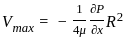
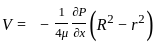
In a fully developed laminar flow through circular pipes velocity distribution according to Hagen-Poiseuille’s equation is

V is maximum at r = 0,

Average velocity is given by

⇒ Vavg = Vmax/2

ESE (ME) Paper II Mock Test - 2 - Question 18

A refrigerator unit having a mass of 35 kg is to be supported on three springs, each having spring stiffness. The unit operates at 480 rpm. If only 10% of the shaking force is allowed to transmit to the supporting structure, the value of stiffness will be nearly

Detailed Solution: Question 18
Concept:

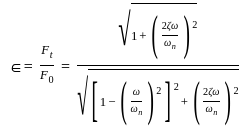
Transmissibility is defined as the ratio of force transmitted to the shaking force.

where, Ft = Transmitted force, Fo = shaking force

Calculation:

Given:

m = 35 kg

N = 480 rpm

ω = 2πN/60 = 50.27 rad/s

As Damper is not used

ζ = 0

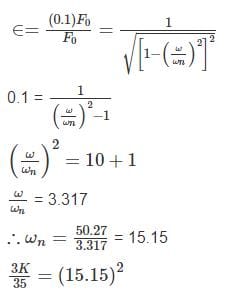
Ft = (0.1) Fo


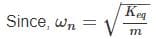
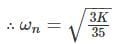
The three springs will be in parallel, therefore Keq = 3K

For zero damping, the Transmissibility equation gets reduced to:

K = 2677.76 N/m = 2.67 N/mm ≃ 2.7 N/mm

ESE (ME) Paper II Mock Test - 2 - Question 19

A steel specimen is subjected to the following principal stresses: 120 MPa tensile, 60 MPa tensile and 30 MPa compressive. If the proportionality limit for the steel specimen is 250 MPa; the factor of safety as per maximum shear stress theory will be nearly

Detailed Solution: Question 19

Concept:

The Maximum Shear Stress Theory was given by Guest and Tresca,

i.e. Maximum shear stress τmax = larger of |(σ1−σ2),(σ2−σ3),(σ3−σ2)| ≤ Syt/N

Tensile yield strength (Proportionality limit) = Syt = 250 MPa

Calculation:

Given:

The three principal stresses are σ1 = 120 MPa, σ2 = 60 MPa and σ3 = -30 Mpa

= larger of |(120  − 60),(60 − (−30)),((−30) − 120)| ≤ 250/N MPa

= larger of |60, 90, −150| ≤ 250/N MPa

⇒ 150 ≤ 250/N

Therefore, Factor of safety, N = 1.7

Note:

Maximum shear stress theory is used for Ductile materials and it is an oversafe and expensive.

The best theory for Ductile material used in market is Maximum Distorsion Energy theory and it is safe and economical.

ESE (ME) Paper II Mock Test - 2 - Question 20

The double riveted joint with two cover plates for boiler shell is 1.5 m in diameter subjected to steam pressure of 1 MPa. If the joint efficiency is 75%, allowable tensile stress in the plate is 83 MN/m2, compressive stress is 138 MN/m2 and shear stress in the rivet is 55 MN/m2, the diameter of rivet hole will be nearly

Detailed Solution: Question 20
Concept:

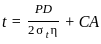
for a boiler shell, the thickness of the boiler shell is given by:

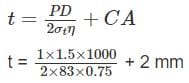
where P is pressure, D is the diameter of the shell, σt = tensile stress in the plate, CA is corrosion allowance, η = joint efficiency

when t ≥ 8mm,

we use Unwin formula to find the diameter of the rivet (d) hole which is:

d = 6√t

Calculation:

Given:

P = 1 MPa, D = 1.5 m, η = 0.75

Allowable tensile stress in the plate σt = 83 MN/m­­2

Allowable compressive stress in the plate σc = 138 MN/m2

Allowable shear stress in the rivet τ = 55 MN/m2

thickness of the boiler shell is:

t = 14.04 mm ≥ 8 mm

Since t > 8 mm, So using Unwin’s formula we get:

The diameter of the rivet (d) is

d = 6√t

d = 6√14.04 = 22.48 mm

ESE (ME) Paper II Mock Test - 2 - Question 21

A rod of length 2 m and diameter 50 mm is elongated by 5 mm when an axial force of 400 kN is applied. The modulus of elasticity of the material of the rod will be nearly

Detailed Solution: Question 21

Concept:

The stress and strain under uniaxial load are given by

Young’s modulus is given by

Calculation:

Given l = 2m, d = 50 mm, Δl = 5 mm, P = 400 kN;

Nearest option is 82 GPa

ESE (ME) Paper II Mock Test - 2 - Question 22

Consider the following statements for fluidized bed boilers:
1. Fluidized bed boilers produce steam from fossil and waste fuels by using a technique called fluidized bed combustion.
2. Cyclone separators are gas cleaning devices that utilize the centrifugal force created by a spinning gas stream to separate particles from a gas.
3. In a pressurized fluidized bed boiler, the combustion process takes place in a pressurized environment resulting in a compact furnace and improved combustion efficiency.
Which of the above statements are correct?

Detailed Solution: Question 22

Statement 1:
Fluidized bed combustion (FBC) is a combustion technology used to burn solid fuels.
Statement 2:
Cyclonic separation is a method of removing particulates from an air, gas or liquid stream, without the use of filters, through vortex separation. When removing particulate matter from liquid, a hydrocyclone is used; while from gas, a gas cyclone is used. Rotational effects and gravity are used to separate mixtures of solids and fluids. The method can also be used to separate fine droplets of liquid from a gaseous stream.
Statement 3:
The PFBC system combines a fluidized-bed combustion boiler with a gas turbine. The gas turbine supplies the combustion air at high pressure to the combustor, and the gas after being cleaned in cyclones drive the gas turbine. Steam is simultaneously generated in the tube bundles in the combustor and drives the steam turbine. It is a coal-fired combined cycle.

ESE (ME) Paper II Mock Test - 2 - Question 23

The constant pressure gas turbine works on

Detailed Solution: Question 23

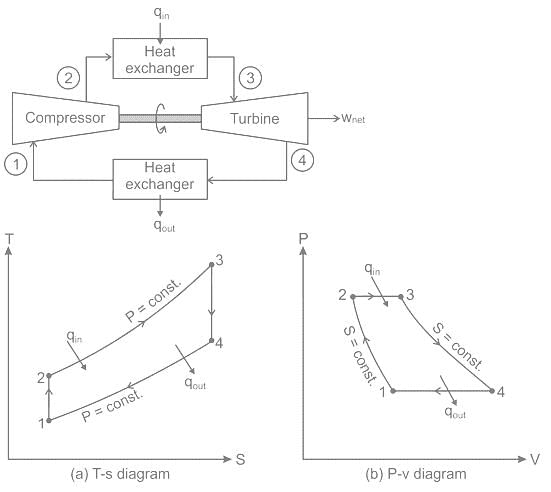
Brayton cycle:
Gas turbines operate on the Brayton cycle/Joule cycle. The Joule cycle consists of four internally reversible processes:

  • Isentropic compression (in a compressor)
  • Constant-pressure heat addition
  • Isentropic expansion (in a turbine)
  • Constant-pressure heat rejection

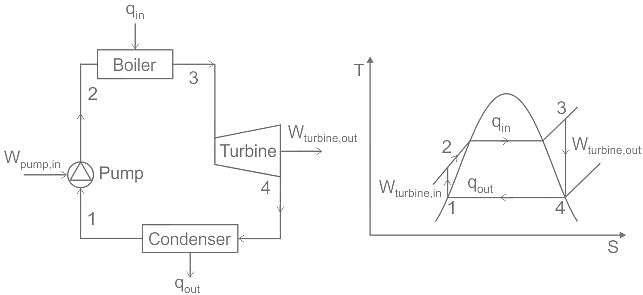
Rankine Cycle:
Process 1 – 2: Isentropic compression
Process 2 – 3: Isobaric heat addition
Process 3 – 4: Isentropic expansion
Process 4 – 1: Isobaric heat rejection

Though the Rankine cycle is a constant pressure cycle, it does not come under gas-turbine as the working fluid is water here.
Atkinson Cycle:
In the case of the Atkinson Cycle heat is supplied at constant volume and rejected at constant pressure.
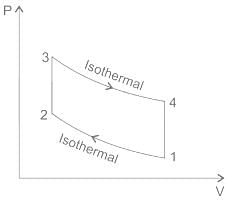
Stirling cycle:
A Stirling cycle consists of two reversible isothermal and two reversible constant volume (isochoric) processes.

ESE (ME) Paper II Mock Test - 2 - Question 24

An air cooled condenser has 6 m2 of surface with a removal of 50 kJ-hr-1m-2°C-1. What is the refrigerant temperature to dissipate 5235 kJ/hr, if the room temperature is 25°C?

Detailed Solution: Question 24

Concept:
Heat removal per unit area is:
q = Q̇/A
Calculation:
Given:
Area = 6 m2, q = 50 kJ-hr-1m-2°C-1, Q̇ = 5235 kJ/hr, Troom = 25°C
q = Q̇/A
Q̇ = 50 × 6 = 300 kJ-hr-1°C-1
Temperature difference = 5235/300 = 17.45∘C
Tref - Troom = 17.45
Tref = 17.45 + 25 = 42.45°C

ESE (ME) Paper II Mock Test - 2 - Question 25

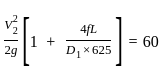
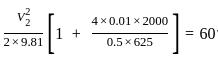
The head of water at the inlet of a pipe 2000 m long and 500 mm diameter is 60 m. A nozzle of diameter 100 mm at its outlet is fitted to the pipe. What is the velocity of water at the outlet of the nozzle if f = 0.01 for the pipe? (Take g = 9.81 m/s2)

Detailed Solution: Question 25
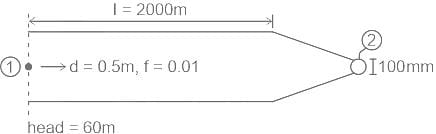
Concept:
Bernoulli's equation:

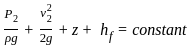
P/ρg + v2/2g + Z = Constant
where constant is the total head available.

Since the pipe diameter is constant before nozzle, the velocity will be same throughout.
Due to the length of the pipe there will be head loss due to friction as well.
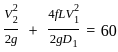
The loss of head due to friction in the pipe is given as:

Where f = friction coefficient,
Calculation:
Given:
l = 2000 m, D1 = 500 mm = 0.5 m, Constant = 60 m
D2 = 100 mm = 0.1 m, f = 0.01, g = 9.81 m/s2

Considering point 2 at the nozzle outlet, P2 and z will be zero.

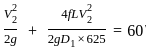
Applying continuity equation:
A1V1 = A2V2
D12V1 = D22V2
(0.5)2 × V1 = (0.1)2 × V2
V1 = V2/25


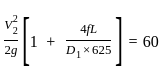
V2 = 30.61 m/sec

ESE (ME) Paper II Mock Test - 2 - Question 26

Consider the following statements for the symmetric beam under pure bending :
1. In the elastic range, the normal stress varies linearly with the distance from the neutral surface.
2. As long as the stresses remain in the elastic range, the neutral axis passes through the centroid of the section.
3. If stresses are in the plastic range, the neutral axis passes through the centroid of the section.
Which of the above statements is/are correct?

Detailed Solution: Question 26

Properties of Pure Bending:

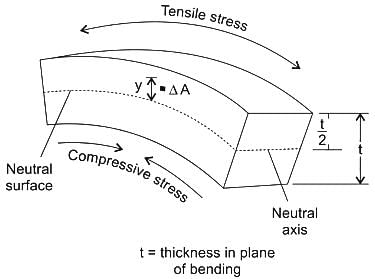
When loaded by a bending force, the beam bends so that the inner surface is in compression and the outer surface is in tension. The neutral plane is the surface within the beam between these zones, where the material of the beam is not under stress (either compression or tension).

As there is no lengthwise stress force on the neutral plane, there is no strain so when the beam bends, the length of the neutral plane remains constant.

The neutral axis is an axis in the cross-section of a beam (a member resisting bending) or shaft along which there are no longitudinal stresses or strains.

If the section is symmetric, isotropic, and is not curved before a bend occurs, then the neutral axis is at the geometric centroid.

All fibers on one side of the neutral axis are in a state of tension, while those on the opposite side are in compression.

As long as the stresses are under elastic range, the extension or compression does not effect the location of neutral axis, whereas if the stresses goes beyond the elastic range the shape of the beam is distorted, such that the neutral axis is also displaced.

From Pure Bending equation:


we can conclude that normal stress varies linearly with distance from the neutral axis.

ESE (ME) Paper II Mock Test - 2 - Question 27

Consider the following statements for ductile fracture:

1. The material undergoes substantial plastic deformation with high energy absorption before fracture.

2. Presence of cracks on the surface of material initiates this type of failure.

3. Fracture occurs due to necking.

Which of the above statements is/are correct?

Detailed Solution: Question 27
Ductile Fracture:

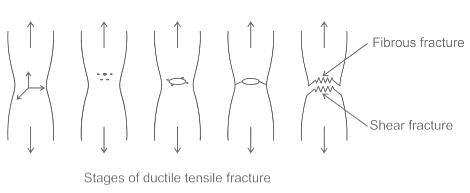
  • Most ductile metals fracture preceded by a moderate amount of necking, followed by the formation of voids, cracks and finally shear. Hence we can say that ductile fracture takes place after necking with little sound.
  • This gives a characteristic cup-and-cone fracture. In this central interior region has an irregular and fibrous appearance, which signifies plastic deformation.
  • Different progressive stages of ductile fracture are shown in figure.
  • As the cross-sectional areas is getting reduced at subsequent stages high energy is absorbed before fracture happens.

Additional Information
Brittle Fracture:

  • The brittle fracture that takes place with little or no preceding plastic deformation. It occurs, often at unpredictable levels of stress, by rapid crack propagation.
  • The direction of crack propagation is very nearly perpendicular to the direction of applied tensile stress. This fracture is also said to be trans granular because crack propagates through grains.
  • Thus, it has a grainy or faceted texture.
  • Most brittle fractures occur in a transgranular manner. However, the brittle fracture can occur in an intergranular manner i.e. crack propagates along grain boundaries.

ESE (ME) Paper II Mock Test - 2 - Question 28

Consider the following statements regarding polymeric materials :

1. A plastic material that requires heat to make it formable (plastic) and upon cooling, retains its shape is known as thermosetting plastic.

2. The chemical reaction in which high molecular mass molecules are formed from two or more monomers is called chain polymerization.

3. A polymer chain consisting of two or more types of monomeric units is called a copolymer.

Which of the above statements is/are correct?

Detailed Solution: Question 28

Plastics can be divided into two types thermoplastics and thermosetting plastics.
Thermoplastics:

  • They are polymers that can be deformed on heating and can be reformed into different shapes.
  • Examples: Polythene and PVC.

Thermosetting plastics:

  • They are polymers that cannot be deformed on heating or remoulded into a new shape.
  • Thermosetting plastics are polymers that become irreversibly rigid on heating.
  • Initially, it is in liquid form or soft solid, heat provides energy for covalent bond formation, crosslinking the polymer subunits. Thus the polymer becomes rigid.
  • Examples: Bakelite, epoxy resin, melamine, etc.

Copolymers:

  • Copolymers are those polymers which are made by the copolymerisation of more than one monomeric species.
  • They have different properties than the homopolymers.
  • It contains multiple units of each monomer used in the same polymeric chain.
  • They can be made either by chain growth polymerisation or by step growth polymerisation.
  • Ex. butadiene-styrene copolymer, ethylene-vinyl acetate etc.

Polymerization
The process by which the monomers get linked up is called polymerization.
Types of Polymerization

  • Depending upon the mode of reaction, polymerization is classified as :
    1. Addition polymerization
    2. Condensation polymerization

Addition Polymerization:

  • This process involves the addition of monomer units to themselves to form a growing chain by a chain reaction mechanism.
  • It is for this reason that the process is also known as chain growth polymerization.
  • Addition polymerization is achieved by adding a catalyst (known as initiator), which provides some reactive species like free radicals.

Condensation Polymerization:

  • In this, the monomers combine with the elimination of a small molecule like H2O, ROH or NH3 , etc.
  • The reaction is called (step growth) condensation polymerization and the product formed is called condensation polymer.
  • The process involves the elimination of by product molecules, therefore, the molecular mass of the polymer is not the integral multiple of the monomer units

ESE (ME) Paper II Mock Test - 2 - Question 29

Which of the following factors can cause misalignment of the teeth on the pinion relative to those on the gear?

1. Inaccurate gear teeth

2. Misalignment of the axes of shafts carrying gears

3. Thermal distortions during operation

Select the correct answer using the code given below

Detailed Solution: Question 29

Cause misalignment of the teeth on the pinion relative to those on the gear:

  • Check the compatibility/level of gear accuracy with the specified tolerances before actual use, i.e., to assure required accuracy and quality.
  • Provide an insight into the performance of the gear manufacturing process including the setup of the gear-making machine tools (misalignment), condition of the gear cutting tools, machine tool control, and basic machining practices.
  • Determine the thermal distortions caused by possible heat treatment to facilitate corrective action.
  • Minimize the overall cost of manufacture by controlling rejection and scrapping.

ESE (ME) Paper II Mock Test - 2 - Question 30

The major limitation with displacement or proximity probes is

Detailed Solution: Question 30

Displacement Probes: Displacement, or eddy-current, probes are designed to measure the actual movement (i.e., displacement) relative to the probe. Therefore, the displacement probe must be rigidly mounted to a stationary structure to gain accurate, repeatable data.

  • Permanently mounted displacement probes will provide the most accurate data on machines with a low-relative to the casing and support structure-rotor weight.
  • Displacement transducers permanently mounted at key measurement locations to acquire data for the program.
  • The useful frequency range for displacement probes is from 10 to 1.000 Hz or 600 to 60.000 rpm.
  • Frequency components below or above this range will be distorted and therefore unreliable for determining machine condition.
  • The major limitation with displacement or proximity probes is cost . The typical cost for installing a single probe, including a power supply, signal conditioning, and so on.

View more questions
7 tests
Information about ESE (ME) Paper II Mock Test - 2 Page
In this test you can find the Exam questions for ESE (ME) Paper II Mock Test - 2 solved & explained in the simplest way possible. Besides giving Questions and answers for ESE (ME) Paper II Mock Test - 2, EduRev gives you an ample number of Online tests for practice
Download as PDF