CUET Exam  >  CUET Test  >   UG Mock Test Series 2026  >  English Language Mock Test - 4 - CUET MCQ

CUET UG English Language Mock Test - 4 Free Online Test 2026


Full Mock Test & Solutions: English Language Mock Test - 4 (50 Questions)

You can boost your CUET 2026 exam preparation with this English Language Mock Test - 4 (available with detailed solutions).. This mock test has been designed with the analysis of important topics, recent trends of the exam, and previous year questions of the last 3-years. All the questions have been designed to mirror the official pattern of CUET 2026 exam, helping you build speed, accuracy as per the actual exam.

Mock Test Highlights:

  • - Format: Multiple Choice Questions (MCQ)
  • - Duration: 60 minutes
  • - Total Questions: 50
  • - Analysis: Detailed Solutions & Performance Insights

Sign up on EduRev for free and get access to these mock tests, get your All India Rank, and identify your weak areas to improve your marks & rank in the actual exam.

English Language Mock Test - 4 - Question 1

Convert the following sentence into its Exclamatory form:

"I wish that I were young again."

Detailed Solution: Question 1

The correct answer is 'Option 3' i.e. 'Ah! that I were young again!'

Key Points

  • To convert the given sentence into its exclamatory form, it is important to maintain the essence of wishing to be young again while incorporating an exclamation to express strong emotion or desire.
  • "Ah!" is an interjection that effectively conveys a sense of longing or wistful desire, making it suitable for the given context.
  • The original sentence expresses a desire or wish for something that is not true in the present, reflecting a hypothetical or wishful thinking scenario.
  • An exclamatory sentence expresses a strong feeling or emotion, such as surprise, pleasure, or wish, and is punctuated at the end with an exclamation mark.

Therefore, the correct answer is 'Ah! that I were young again!'

Additional Information

  • Option 1 'Alas if I were young again!' uses 'Alas', which generally conveys sorrow or regret, not quite fitting the wishful longing to be young again.
  • Option 2 'Hurrah! I could be young again!' uses 'Hurrah!', which expresses joy or approval, not aligning with the wistful, longing tone of the original sentence.
  • Option 4 'Oh! if I were young!' is close but truncates the original sentiment by omitting "again," slightly altering the depth of the expressed wish.

Important Points

  • "I were" is used in the subjunctive mood for wishes or hypothetical situations.
    • Example: "I wish I were a bird, so I could fly away."

English Language Mock Test - 4 - Question 2

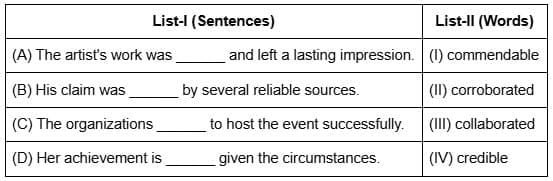
Complete the sentences in List-I with the appropriate words from List-II.
Detailed Solution: Question 2

"Commendable" describes praiseworthy artistic work. "Corroborated" means confirmed by evidence. "Collaborated" refers to working jointly. "Credible" indicates believability. Thus Option D correctly matches all sentences.

English Language Mock Test - 4 - Question 3

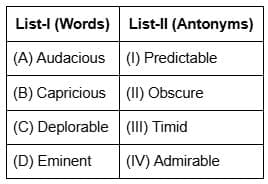
Match the words in List-I with their antonyms in List-II.
Detailed Solution: Question 3

"Audacious," meaning bold or daring, opposes "timid," which suggests fearfulness. "Capricious," indicating unpredictable whims, contrasts with "predictable." "Deplorable," describing something shameful, is antonymous to "admirable." "Eminent," referring to prominent status, opposes "obscure." Antonyms provide contrast, helping in vocabulary building by exploring word polarities in meaning.

English Language Mock Test - 4 - Question 4

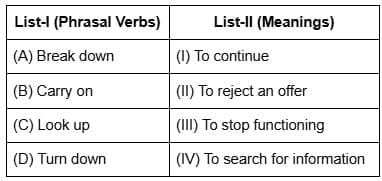
Match the phrasal verbs in List-I with their meanings in List-II.
Detailed Solution: Question 4

"Break down" means to cease operating, as in machinery failing, fitting (III). "Carry on" implies persisting or continuing an activity, matching (I). "Look up" refers to seeking information in a reference source, aligning with (IV). "Turn down" denotes refusing something offered, corresponding to (II). Phrasal verbs combine verbs with prepositions or adverbs to create meanings different from the individual words, essential for idiomatic English proficiency.

English Language Mock Test - 4 - Question 5

Re-arrange the following phrases in the right sequence to form a meaningful sentence.
(A) expressing deep emotions
(B) about love and loss
(C) under the starry night
(D) the poet wrote verses

Detailed Solution: Question 5

The correct sequence forms the sentence: "The poet wrote verses under the starry night, expressing deep emotions about love and loss." Location follows action, with participial and prepositional phrases for content. Poetic analyses structure to evoke atmosphere before thematic depth.

English Language Mock Test - 4 - Question 6

Re-arrange the following phrases in the right sequence to form a meaningful sentence.
(A) that seemed unrelated
(B) the detective solved the mystery
(C) at first glance
(D) by piecing together clues

Detailed Solution: Question 6

The correct sequence forms the sentence: "The detective solved the mystery by piecing together clues that seemed unrelated at first glance." Action leads, followed by method and relative clause with qualifier. Mystery genre writing integrates qualifiers to heighten intrigue and resolution.

English Language Mock Test - 4 - Question 7

Re-arrange the following phrases in the right sequence to form a meaningful sentence.
(A) using innovative materials
(B) for efficient transportation
(C) the engineer designed a bridge
(D) that spanned the wide river

Detailed Solution: Question 7

The correct sequence forms the sentence: "The engineer designed a bridge using innovative materials that spanned the wide river for efficient transportation." Method precedes relative clause and purpose. Engineering texts use this to highlight innovation and functionality.

English Language Mock Test - 4 - Question 8

Re-arrange the following phrases in the right sequence to form a meaningful sentence.
(A) against all odds
(B) feeling triumphant
(C) the mountain climber reached the summit
(D) after a challenging ascent

Detailed Solution: Question 8

The correct sequence forms the sentence: "The mountain climber reached the summit after a challenging ascent against all odds, feeling triumphant." The main action comes first, followed by time, adversity, and finally the emotional result.

English Language Mock Test - 4 - Question 9

Re-arrange the following phrases in the right sequence to form a meaningful sentence.
(A) from the medieval era
(B) the historian documented events
(C) preserving knowledge for future generations
(D) in detailed manuscripts

Detailed Solution: Question 9

The correct sequence forms the sentence: "The historian documented events in detailed manuscripts from the medieval era, preserving knowledge for future generations." Action and medium lead, followed by time and purpose. Historical writing positions preservation as a culminative goal.

English Language Mock Test - 4 - Question 10

Fill in the blank with the correct option.
The company's profits ______ due to the economic downturn.

Detailed Solution: Question 10

Profits "plummeted" means they dropped sharply, logically tied to an economic downturn's negative effects. This differs from "soared" or "surged," which indicate rises. Economic analyses use this vocabulary to depict financial fluctuations and market impacts.

English Language Mock Test - 4 - Question 11

Fill in the blank with the correct option.
The traveler's ______ stories fascinated everyone at the gathering.

Detailed Solution: Question 11

"Anecdotal" stories are personal and informal accounts, captivating listeners with relatable experiences. Unlike "factual" or "empirical," which emphasize evidence, this word suits narrative sharing. Storytelling traditions highlight it for engaging social interactions.

English Language Mock Test - 4 - Question 12

Fill in the blank with the correct option.
She maintained a ______ demeanor even in the face of criticism.

Detailed Solution: Question 12

A "stoic" demeanor implies calm endurance without showing emotion, ideal for handling criticism resiliently. Unlike "emotional" or "volatile," which indicate instability, this term reflects philosophical composure. Psychology texts describe it as a trait for emotional regulation.

English Language Mock Test - 4 - Question 13

Fill in the blank with the correct option.
The detective uncovered a ______ plot that involved multiple suspects.

Detailed Solution: Question 13

A "nefarious" plot involves wicked or criminal intent, suitable for a detective story with suspects. This contrasts with "benevolent" or "altruistic," which suggest goodwill. Mystery and crime genres use this word to build tension around illicit schemes.

English Language Mock Test - 4 - Question 14

What is the meaning of the phrase ‘Feather in one's cap’.

Detailed Solution: Question 14

The correct answer is Option (1) i.e. "something that you have achieved and are proud of"

Key Points

  • Feather in one's cap: - A noteworthy achievement of which one is proud. (एक उल्लेखनीय उपलब्धि जिस पर गर्व है)
    • Example: Winning the science fair was a feather in her cap.
  • something that you have achieved and are proud of: (कुछ ऐसा जो आपने हासिल किया है और जिस पर आपको गर्व है) - (An accomplishment or achievement that one is proud of)

​Therefore, the correct answer is "something that you have achieved and are proud of."

Additional Information

  • something that is fragile and thus important to you: (कुछ ऐसा जो नाजुक है और इसलिए आपके लिए महत्वपूर्ण है)
  • something that exists in colors and makes you stand out: (कुछ ऐसा जो रंगों में मौजूद है और आपको खास बनाता है)
  • something that makes you feel soft and delicate: (कुछ ऐसा जो आपको नरम और नाजुक महसूस कराता है)

English Language Mock Test - 4 - Question 15

Fill in the blank with the correct Preposition:-

The gift was so beautiful that he was overwhelmed ______ joy.

Detailed Solution: Question 15

The correct answer is 'Option 1' i.e. 'with'.

Key Points

  • The phrase "overwhelmed with joy" is a common English expression used to describe a strong feeling of happiness.
  • The preposition "with" is often used after "overwhelmed" to indicate the reason or cause of the overwhelming feeling.
    • Example: She felt overwhelmed with work.

Therefore, the correct answer is- The gift was so beautiful that he was overwhelmed with joy.

Additional Information

  • Option 2 ('for'): The preposition "for" is used to indicate purpose or a reason for something, but it does not fit naturally with "overwhelmed" in this context.
  • Option 3 ('to'): "To" is used to indicate direction, place, or position, and it doesn't make sense in the context of being overwhelmed by an emotion.
  • Option 4 ('in'): Although "in" can sometimes be used with emotions, like "in love" or "in despair," the correct and most natural preposition to use with "overwhelmed" in this context is "with," not "in."

English Language Mock Test - 4 - Question 16

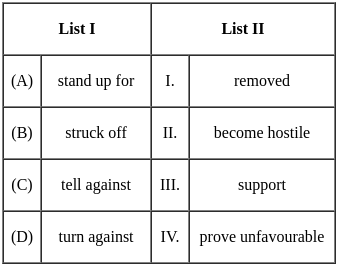
Match the words in List I with their meanings in List II

Choose the correct answer from the options given below:

Detailed Solution: Question 16

The correct answer is Option (3) i.e. A - III, B - I, C - IV, D - II

Key Points

  • A. Stand Up For (का समर्थन करना) - To defend or support a particular cause or person, especially in the face of adversity.
  • Example: She always stands up for her friends when they need her.
    • (III) Support (समर्थन करना) - To bear all or part of the weight of; to hold up or give assistance, encouragement to someone or something.
    • Example: The entire community came together to support the family after the fire.
  • B. Struck Off (हटा दिया गया) - To remove someone from a professional list or register, typically as a punishment.
  • Example: After the scandal, the doctor was struck off the medical register.
    • (I) Removed (हटाया गया) - To take away or take off from a position or place; to eliminate.
    • Example: The painting was carefully removed from the gallery for restoration.
  • C. Tell Against (विपक्ष में जाना) - To have a negative impact or contribute adversely in a consideration or judgment.
  • Example: The lack of evidence might tell against the prosecution's case in the trial.
    • (IV) Prove Unfavourable (अनुकूल नहीं साबित होना) - To result in a disadvantageous or adverse outcome.
    • Example: The weather conditions proved unfavourable for the outdoor event.
  • D. Turn Against (विरोधी बन जाना) - To become hostile or unfriendly towards someone or something that one was previously in favor of or neutral towards.
  • Example: After the scandal, many of his former supporters turned against him.
    • (II) Become Hostile (शत्रुतापूर्ण हो जाना) - To adopt an aggressive or unfriendly attitude towards someone or something.
    • Example: The negotiations broke down and the factions became hostile towards each other

Therefore, the correct answer is A - III, B - I, C - IV, D - II

English Language Mock Test - 4 - Question 17

Choose the correct Passive form of the sentence:

"This book will change your life".

Detailed Solution: Question 17

The correct answer is Option 3 i.e. "Your life will be changed by this book."

Key Points

  • The given sentence is in the active voice and the future simple tense.
  • The subject of the sentence is "This book", and the object is "your life".
  • In active voice and future simple tense, the format is: Subject + will + base form of the verb (V1) + Object.
  • To convert this into passive voice for the future simple tense, the format is: Subject (Objective case) + will + be + past participle of the verb (V3) + by + Object (Subjective case).
  • Example:
    • Active: The chef will prepare the meal. (Passive Voice: The meal will be prepared by the chef.)

Therefore, the correct answer is- "Your life will be changed by this book"

Important Points

  • When changing from active to passive voice (or vice versa):
    • The tense of the sentence should not be changed.
    • Only the structure is altered to shift focus between the doer and the receiver of the action.

English Language Mock Test - 4 - Question 18

Identify the indirect speech that expresses the following sentence:

Sara says, "I can sing very well."

Detailed Solution: Question 18

The correct answer is "Sara says that she can sing very well."

Key Points

  • The sentence is in direct speech, present ability ("I can sing very well").
  • The sentence in indirect speech will maintain the tense, so "I can sing" becomes "she can sing".
  • The correct sentence is: "Sara says that she can sing very well."
  • It keeps the correct subject ‘she’ (referencing ‘I’ in the original sentence).

Therefore, the correct answer is option 3.

Additional Information

  • Let's consider other options:
    • Sara says that she could sing very well: This would be correct if the original sentence was in past form, "I could sing very well."
    • Sara says that she can sings very well: This is grammatically incorrect.
    • Sara said that I can sing very well: This incorrectly changes 'says' to 'said' and it does not change the subject reference despite being reported speech.

English Language Mock Test - 4 - Question 19

Select the option that expresses the given sentence in future continuous tense.

A. They will meet at 3 PM tomorrow.

B. They are meeting at 3 PM tomorrow.

C. They meet at 3 PM tomorrow.

D. They will be meeting at 3 PM tomorrow.

Detailed Solution: Question 19

The correct answer is: C

Key Points

  • The future continuous tense is used to describe an ongoing action that will be happening at a specified time in the future.
  • It emphasizes the duration or continuity of an action in the future.
    • Structure: Subject + will be + present participle (-ing form of the verb) + Object
    • Example: We will be celebrating New Year's Eve with friends.
  • "They will be meeting at 3 PM tomorrow," is in the future continuous tense.
  • It follows the structure for the future continuous tense, with the subject "they," the modal auxiliary verb "will," "be," and the present participle of the main verb in "-ing" form: "meeting".
  • This construction conveys the idea that the meeting will be in progress at a specific time in the future, which is 3 PM tomorrow.

Therefore, the correct answer is option 3.

Additional Information

  • Option A is in the simple future tense ("will meet").
  • Option B is in the present continuous tense ("are meeting").
  • Option C is in the simple present tense ("meet").

English Language Mock Test - 4 - Question 20

Fill up the blank with the correct option.

Nobody __________ the fact.

Detailed Solution: Question 20

The correct answer is 'Option 1) Knows'.

Key Points

  • 'Nobody' is a singular pronoun and therefore needs a singular verb.
  • 'Knows' is the singular form of the verb 'to know' in the present tense.
  • The context of the sentence is in present tense and thus 'knows' aligns with this tense.
  • Hence, 'knows' is the right word to fill in the blank.

Therefore, the correct answer is - 'knows'

Additional Information

  • 'Know' is used with plural pronouns or with singular pronouns like 'I' and 'You'. It doesn't agree with 'Nobody'.
  • 'Knowing' and 'Known' are different verb forms that don't fit this context as 'Nobody' requires a simple present tense verb.

English Language Mock Test - 4 - Question 21

Select the option that can be used as a one-word substitute for the given group of words.

Weakness and poor health

Detailed Solution: Question 21

The correct answer is 'Frailty'.

Key Points

  • The most appropriate word for the given group of words is 'Frailty'.
  • Frailty: weakness of a person’s body or character. (व्‍यक्ति के शरीर या चरित्र की दुर्बलता)
    • Example: She died after a long period of increasing frailty.
  • Let's look at the meaning of other words:
    • Geniality: the quality of having a friendly and cheerful manner. (एक दोस्ताना और हंसमुख तरीके से होने की गुणवत्ता)
    • Hospitality: looking after guests and being friendly and welcoming towards them. (आतिथ्‍य-सत्‍कार, मेहमाननवाज़ी)
    • Obscurity: the state of being unknown, inconspicuous, or unimportant. (अप्रसिद्धि, दुर्बोधता)

Correct Answer: Frailty.

English Language Mock Test - 4 - Question 22

Choose the word that can substitute the given group of words.

One who hates institution of marriage

Detailed Solution: Question 22

The correct answer is option 4, Misogamist.

Key Points

  • Misogamist refers to a person who hates the institution of marriage (विवाह से घृणा करने वाला).
    • Example: In her own case Aunt Ida is a misogamist ; yet she urges marriage on me.
  • Option 1, Coquette, refers to a woman who flirts with men to gain attention. (मोहिनी स्त्री किसी भी योगी का ध्यान भंग कर सकती है)
  • ​Option 2, Pedantic, refers to a person who is overly concerned with minor details and rules. (नियमों और विवरणों पर अत्‍यधिक ध्यान रखने वाला; पंडिताऊ)
  • Option 3, Polyglot, refers to a person who knows and speaks multiple languages. (एक से अधिक भाषा का ज्ञान या उसमें लेखन; बहुभाषी)

Additional Information

  • The term "misogamist" comes from the Greek words "misos" meaning "hatred" and "gamos" meaning "marriage."
  • A misogynist, on the other hand, is someone who dislikes, distrusts, or prejudices against women.

English Language Mock Test - 4 - Question 23

Select the word OPPOSITE in meaning to the underlined word.
The story was incredible.

Detailed Solution: Question 23

"Incredible" means something that is hard to believe or extraordinary. In this context, we’re focusing on its meaning as "unbelievable." The opposite would be something that can be believed. "Amazing" and "fantastic" are synonyms of "incredible" in the sense of being impressive, and "unbelievable" is a synonym, not an antonym. "Believable" means capable of being believed, which is the opposite of "incredible." Therefore, the correct answer is a) believable.

English Language Mock Test - 4 - Question 24

Fill in the blank with the correct option.
She ____ to school every day.

Detailed Solution: Question 24

The subject "She" is third-person singular, and the phrase "every day" indicates a habitual action in the present tense. The verb "go" takes the form "goes" for third-person singular subjects in the present tense. "Go" is used for I/you/we/they, "going" is the present participle, and "gone" is the past participle (used with "have"). "Goes" is the correct form here. Hence, the correct answer is b) goes.

English Language Mock Test - 4 - Question 25

Choose the correct sentence.

Detailed Solution: Question 25

The word "yesterday" indicates a past event, so the verb must be in the past tense. Option a) uses "am going," which is present continuous and doesn’t match the past context. Option c) uses "go," which is present tense. Option d) uses "will go," which is future tense. Option b) uses "went," the simple past tense of "go," which correctly matches the past time frame indicated by "yesterday." Therefore, the correct answer is b) I went to the market yesterday.

English Language Mock Test - 4 - Question 26

Identify the part of speech of the underlined word.
The happy child played all day.

Detailed Solution: Question 26

In the sentence, "happy" describes the noun "child," indicating its emotional state. A noun is a person, place, or thing (e.g., "child"). A verb shows action (e.g., "played"). An adjective describes a noun, and an adverb modifies a verb, adjective, or another adverb (e.g., "happily" would be an adverb). Since "happy" is describing the noun "child," it is an adjective. Hence, the correct answer is c) adjective.

English Language Mock Test - 4 - Question 27

What is one primary advantage of technology in education?

Detailed Solution: Question 27

The passage highlights that technology allows for personalized learning, where lessons can be tailored to individual student needs, enhancing their learning experience.

English Language Mock Test - 4 - Question 28

What challenge related to technology in education is mentioned in the passage?

Detailed Solution: Question 28

The passage mentions the digital divide, where students in remote or underprivileged areas may not have access to technology, creating inequalities in education.

English Language Mock Test - 4 - Question 29

Which skill does technology help develop according to the passage?

Detailed Solution: Question 29

The passage notes that technology supports the development of digital literacy, which is an essential skill for students in the 21st century.

English Language Mock Test - 4 - Question 30

What is one of the possible disadvantages of using technology in education?

Detailed Solution: Question 30

The passage mentions that over-reliance on technology can reduce face-to-face interactions, which are important for developing social and emotional skills.

View more questions
41 docs|160 tests
Information about English Language Mock Test - 4 Page
In this test you can find the Exam questions for English Language Mock Test - 4 solved & explained in the simplest way possible. Besides giving Questions and answers for English Language Mock Test - 4, EduRev gives you an ample number of Online tests for practice
Download as PDF