GATE Engineering Sciences 2027 Sciences Mock Test - 1 Free Online Test
Full Mock Test & Solutions: GATE Engineering Sciences Mock Test - 1 (65 Questions)
You can boost your GATE Engineering Sciences 2026 exam preparation with this GATE Engineering Sciences Mock Test - 1 (available with detailed solutions).. This mock test has been designed with the analysis of important topics, recent trends of the exam, and previous year questions of the last 3-years. All the questions have been designed to mirror the official pattern of GATE Engineering Sciences 2026 exam, helping you build speed, accuracy as per the actual exam.
Mock Test Highlights:
- - Format: Multiple Choice Questions (MCQ)
- - Duration: 180 minutes
- - Total Questions: 65
- - Analysis: Detailed Solutions & Performance Insights
- - Sections covered: General Aptitude, Engineering Mathematics (XE-A), Engineering Sciences (XE-B) & (XE-D)
Sign up on EduRev for free and get access to these mock tests, get your All India Rank, and identify your weak areas to improve your marks & rank in the actual exam.

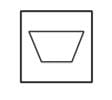
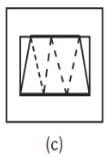
A figure is presented in this problem, followed by four intricate figures, each designed such that the element of the question figure is incorporated within one and only one of them. Identify the answer figure that conceals the question figure.
Detailed Solution: Question 1
The chairman asked the dissatisfied shareholders to __________________ him.
Detailed Solution: Question 2

Even with a series of disappointing performances, the likelihood of K. L. Rahul being selected for the team remains ____.
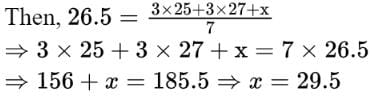
The mean temperature for the initial three days of the week is 25° C, while for the subsequent three days, it is 27° C. If the average temperature for the entire week is 26.5° C, what is the temperature recorded on the last day of the week?
Detailed Solution: Question 4
In a partnership business, the monthly contributions made by three friends during the first six months are in the ratio of 3: 4: 5. Following this period, they needed to raise their monthly contributions by 10%, 15%, and 20%, respectively, based on their original monthly investments. The ratio of their new investments remained unchanged for the subsequent six months.
What is the proportion of their shares in the total profit (in the same order) at the year's end, such that the share corresponds to their individual total investments throughout the year?
An equation can be expressed in the form of a determinant as
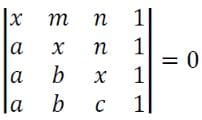
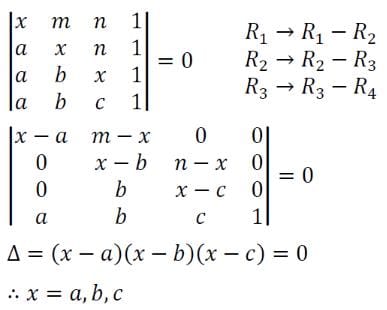
The solutions to the equations are
The solutions to the equations are
Detailed Solution: Question 6
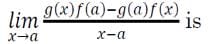
Given that f(a) = 2, f'(a) = 1, g(a) = -1, and g'(a) = 2, determine the following:
Detailed Solution: Question 7
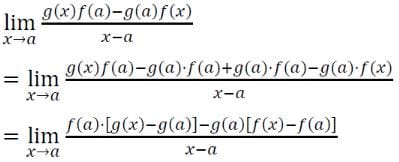
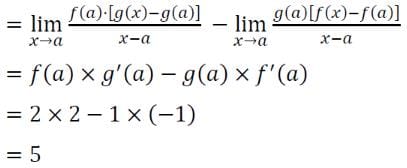
What is the highest gradient of the curve defined by the equation y - x3 3x2 2x - 27?
Detailed Solution: Question 8
The Newton-Raphson technique for determining the roots of nonlinear equations is classified as _______________ methods.
Detailed Solution: Question 9
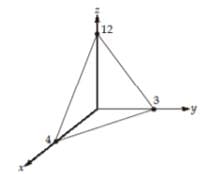
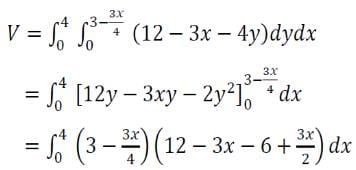
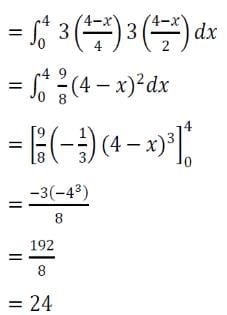
What is the volume V of the tetrahedron formed by the coordinate planes and the plane defined by the equation z = 12 - 3x 4y?
Detailed Solution: Question 10
Which of the following devices used for measuring discharge through a pipe operates based on Archimedes' principle?
Detailed Solution: Question 11
A boundary layer forms as a result of a steady two-dimensional flow over a flat horizontal plate. Consider a vertical line extending from the wall to the boundary layer's edge, located away from the leading edge. Which of the following quantity/quantities is/are not constant along this vertical line? Here, u and v denote the velocity components in the direction parallel to the plate and perpendicular to it, respectively, while x is measured along the length of the plate and p represents the pressure. Neglect any body forces.
An unsteady incompressible 2D velocity field is given by:
V = (2 + x) î + (1 + 2 sin πt − y) ĵ
The magnitude of acceleration of the particle in the x-direction at (1,1) and at time = 2 s (in m/s²) is ____.
Detailed Solution: Question 13
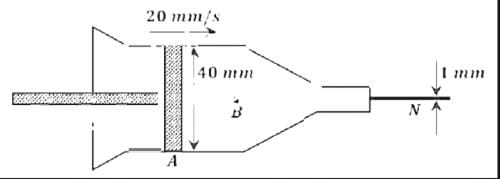
A pump generates pressure in the syringe, resulting in the plunger A moving at a speed of 20 mm/s. Given that the density of the saline fluid is 1050 kg/m³, what is the pressure created in the syringe at point B (in kPa)?
Detailed Solution: Question 14
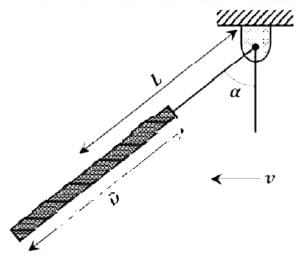
A circular disc is suspended in an airflow from a pivoted structure as depicted in the figure. During a wind tunnel test conducted in air at a speed of 15 m/s with a disc of 25 mm in diameter, the angle α was recorded at 10°. Based on these parameters, calculate the mass of the disc (in grams). It is assumed that the drag coefficient for the disc is applicable when considering the wind speed component that is perpendicular to the disc.
Neglect the drag on the structure and the friction in the pivot.
Use ρ = 1.225 kg/m3; Cd = 1.17
Neglect the drag on the structure and the friction in the pivot.
Use ρ = 1.225 kg/m3; Cd = 1.17
Detailed Solution: Question 15
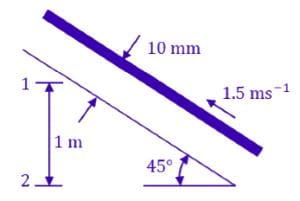
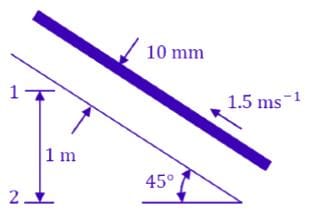
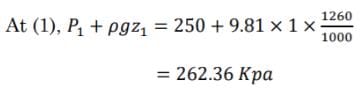
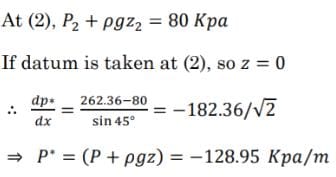
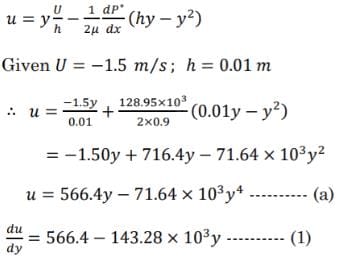
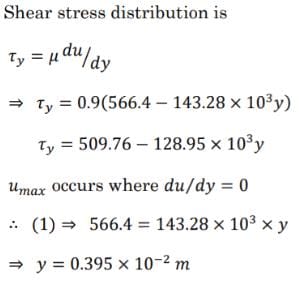
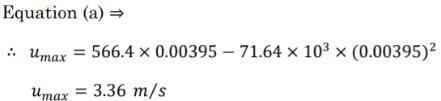
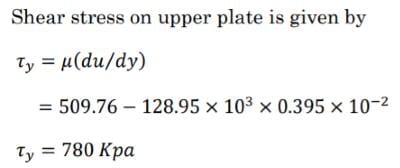
A fluid with a viscosity of g = 0.9 N. s/m2 and a density of 1260 kg/m3 flows between two parallel plates that are extensively wide and inclined at an angle of 45°C to the horizontal, with a separation of 10 mm between them. The upper plate is moving at a speed of 1.5 m/s in the opposite direction to the fluid flow relative to the lower plate. Pressure gauges placed at two points that are 1 m apart vertically on the upper plate measure pressures of 250 Kpa and 80 Kpa, respectively.
Detailed Solution: Question 16
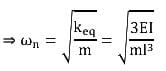
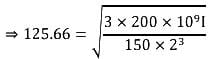
A 150 kg machine is situated at the end of a steel cantilever beam that is 2 m in length (with E = 200 GPa). If the machine exhibits a natural frequency of 20 Hz during vibrations, what is the moment of inertia of the beam's cross-section about its neutral axis?
Detailed Solution: Question 17
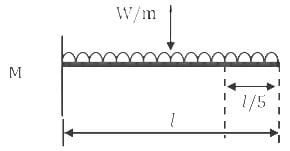
In the diagram provided, the peak bending moment at the fixed end of the cantilever due to the uniformly distributed load (UDL) is referred to as M. What is the bending moment at a point located l / 5 from the free end?
Detailed Solution: Question 18
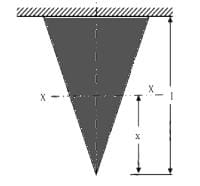
A solid conical rod with a circular cross-section is held in a vertical position as depicted in the figure. Given that the length of the rod is l and the weight per unit volume of the rod's material is ‘w’ N/m³, calculate the total elongation of the rod caused by its own weight.
A) wl2 / 4E
B) wl2 / 3E
C) wl2 / 6E
D) wl2 / 12E
Detailed Solution: Question 19
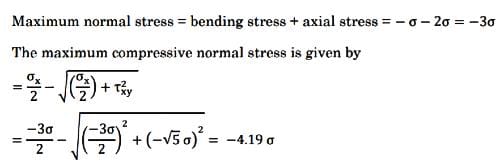
A circular shaft experiences a combination of bending, twisting, and axial loading. The resulting maximum bending stress (σ), maximum shearing force (√5σ), and uniform axial stress (2σ) are all compressive in nature. What will be the maximum compressive normal stress generated in the shaft?
Detailed Solution: Question 20
Identify the members of the truss depicted in the figure that are under zero force.
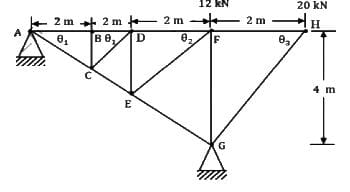
Detailed Solution: Question 21
Mohr's stress circle is utilized to ascertain which of the following:
a) Normal stresses on a single plane
b) Normal and tangential stresses on two distinct planes
c) Principal stresses in all three orientations
d) Orientation of principal planes
Detailed Solution: Question 22
A vehicle weighing 500 kg is supported by springs such that its static deflection measures 1.5 mm. What is the frequency of oscillations (in rad/s)?
Detailed Solution: Question 23
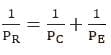
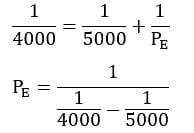
In the case of a medium column, the buckling load according to Rankine’s formula is 4000 N, while the crushing load is 5000 N. What is Euler's buckling load for this column?
Detailed Solution: Question 24
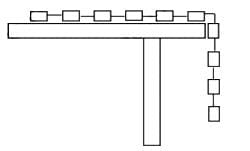
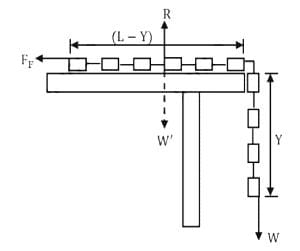
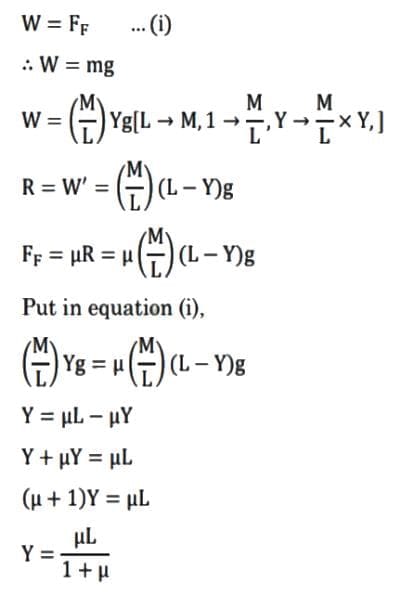
Given that the length of a chain is L and the coefficient of static friction is μ, what is the maximum length of the chain that can extend beyond the edge of a table without slipping?
Detailed Solution: Question 25
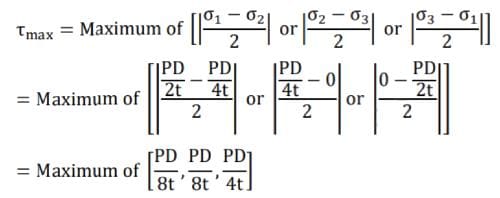
A cylindrical storage tank holds liquefied propane at a pressure of 1.5 MPa and a temperature of 38°C. Given that the tank has an inner diameter of 320 mm and a wall thickness of 3 mm, what is the approximate maximum absolute shearing stress within the tank?
Detailed Solution: Question 26
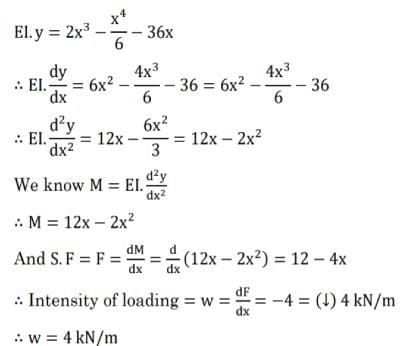
The equation for the deflected shape of a beam carrying a uniformly distributed load and simply supported at the ends is given by
y = (1 / EI)(2x³ - x⁴ / 6 - 36x)
The magnitude of the load carried by the beam is _____ kN/m. (EI unit is kNm²)
Detailed Solution: Question 27
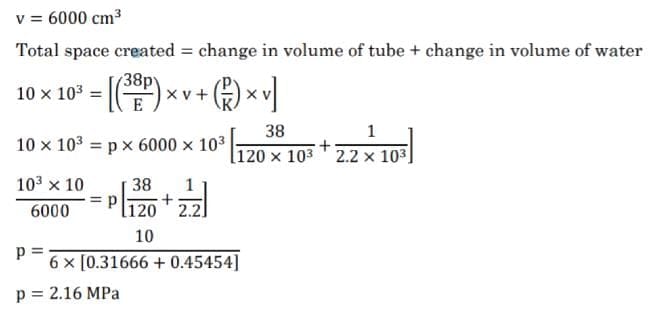
A copper tube with a volume of 6000 cm3 is filled with water under pressure. If the volumetric strain in the tube, denoted as 38P, arises from a change in pressure, and an additional 10 cm3 of water can be added to the tube, what will be the change in pressure in MPa? Consider the Young's modulus (E) for copper to be 1.2 x 10⁵ N/mm2 and the bulk modulus (K) of water to be 2.2 x 10³ N/mm2, where p represents the change in pressure, E is the Young's modulus of the tube material, and K is the bulk modulus of water.
Detailed Solution: Question 28
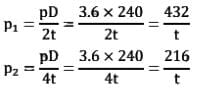
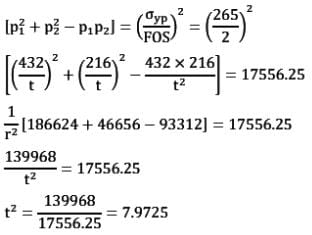
A slender cylinder with a diameter of 240 mm is subjected to an internal pressure of 3.6 MPa. Assume a Factor of Safety (FOS) of 2, with a yield strength of σyp = 265 N/mm², and a Poisson's ratio of ν = 0.29. According to the shear strain energy theory, what is the thickness of the cylinder in mm? Neglect the radial stress.
Detailed Solution: Question 29
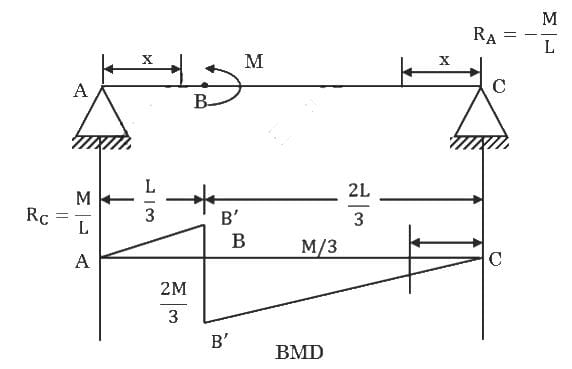
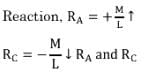
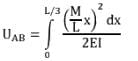
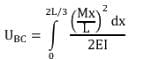
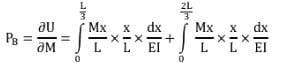
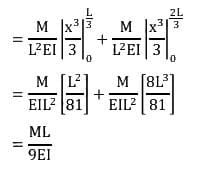
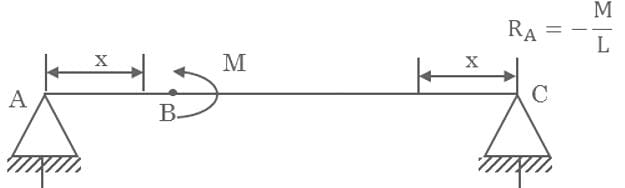
A beam ABC, supported at both ends A and C, spans a length L and experiences a counterclockwise moment M at point B, which is situated at a distance of L/3 from A. The angle of inclination at B is given by the formula ML / kEI. Determine the value of k.
Detailed Solution: Question 30