
GATE Engineering Sciences 2027 Sciences Mock Test - 2 Free Online Test
Full Mock Test & Solutions: GATE Engineering Sciences Mock Test - 2 (65 Questions)
You can boost your GATE Engineering Sciences 2026 exam preparation with this GATE Engineering Sciences Mock Test - 2 (available with detailed solutions).. This mock test has been designed with the analysis of important topics, recent trends of the exam, and previous year questions of the last 3-years. All the questions have been designed to mirror the official pattern of GATE Engineering Sciences 2026 exam, helping you build speed, accuracy as per the actual exam.
Mock Test Highlights:
- - Format: Multiple Choice Questions (MCQ)
- - Duration: 180 minutes
- - Total Questions: 65
- - Analysis: Detailed Solutions & Performance Insights
- - Sections covered: General Aptitude, Engineering Mathematics (XE-A), Engineering Sciences (XE-B) & (XE-E)
Sign up on EduRev for free and get access to these mock tests, get your All India Rank, and identify your weak areas to improve your marks & rank in the actual exam.

Gauri mentioned that she is able to play the keyboard __________ her sister.
During a press conference regarding the recent scam, the minister stated, "The responsibility lies here." What was the meaning conveyed by the minister's remark?
Detailed Solution: Question 2

Select the pair that most closely represents the relationship found in the capitalized pair.
DRILL: BORING ::
DRILL: BORING ::
Detailed Solution: Question 3
The act of listening to music while exercising is known to enhance performance and lessen discomfort. Researchers investigated the impact of music on students' learning capabilities while studying, but the findings were inconclusive. Students who required external stimulation for effective studying performed worse, whereas those who did not need any external stimulation experienced benefits from music.
Which of the following statements represents the CORRECT inference from the passage above?
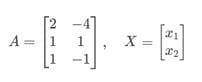
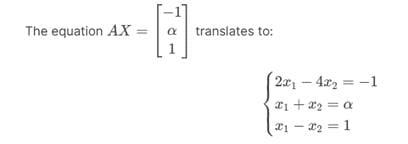
Consider the equation represented by 
If  , what is the value of α?
If
, what is the value of α?Detailed Solution: Question 5
An individual, who tells the truth 3 out of 4 times, rolls a fair six-sided die and reports that the result is 5. What is the probability that the actual result is indeed 5? (Round your answer to three decimal places.)
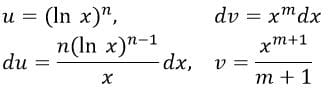
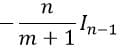
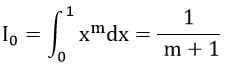
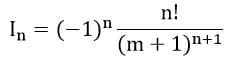
The expression 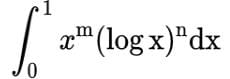 (with m > 0 and n being a natural number) is equal to what?
(with m > 0 and n being a natural number) is equal to what?Detailed Solution: Question 7


Consider the function f(x, y) = x4 y4 − 2x2 4xy − 2y2 α, which is a real-valued function. Which of the following statements is TRUE for every value of α?
Consider the line segment C1 extending from the point (0, 1) to  and the arc C2 of the circle defined by x2 y2 = 1, which stretches from (0, 1) to
  . If
. If 
where 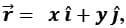 , then determine the value of α2 β2 (rounded to two decimal places).
and the arc C2 of the circle defined by x2 y2 = 1, which stretches from (0, 1) to . If where
, then determine the value of α2 β2 (rounded to two decimal places).Consider I as the identity matrix of order 7, and let A be a 7 × 7 real matrix whose characteristic polynomial is given by CA(λ) = λ2(λ - 1)α(λ 2)β, where α and β are positive integers. Given that A is diagonalizable and satisfies the condition rank(A) = rank(A 2I), determine the value of rank(A - I) ____________ (as an integer).
Match List - I with List - II and choose the correct answer from the codes provided below the lists:
List - I
P. Stokes law
Q. Bluff body
R. Streamline body
S. Karman Vortex Street
List - II
1. Strouhal number
2. Creeping motion
3. Pressure drag
4. Skin friction drag
List - I
P. Stokes law
Q. Bluff body
R. Streamline body
S. Karman Vortex Street
List - II
1. Strouhal number
2. Creeping motion
3. Pressure drag
4. Skin friction drag
Detailed Solution: Question 11

Which of the following statements is CORRECT?
Which of the following criteria must be met for a fluid to be in a steady state condition?
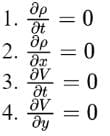
Detailed Solution: Question 13
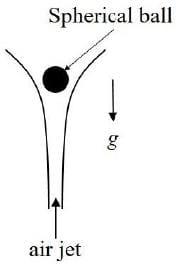
A spherical ball is being held steady against the force of gravity by an upward jet of air, as depicted in the accompanying figure. Assume the acceleration due to gravity is g = 10 m/s2. The rate of air mass flow directed towards the ball is 0.01 kg/s, and the air has an upward velocity of 3 m/s when it reaches the ball. Ignoring the buoyancy force and applying the principle of integral momentum balance, determine the mass (in grams, rounded to one decimal place) of the ball is ____.
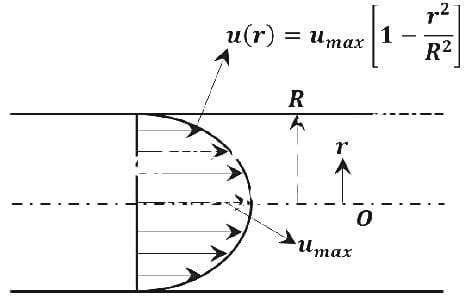
A Newtonian fluid flows in a one-dimensional manner through a circular pipe.
The velocity distribution for laminar flow is expressed as:
ν(r) = umax [1 − (r2 / R2)]
Here, R = 0.08 m represents the radius of the pipe, while r indicates the radial distance from the pipe's center. The maximum velocity, umax, is found at the center of the pipe.
The drag force acting on the pipe (in N) is:
Consider ρfluid = 0.0010 Pa·s, L = 30 m, and umax = 7 m/s.
ν(r) = umax [1 − (r2 / R2)]
Detailed Solution: Question 15
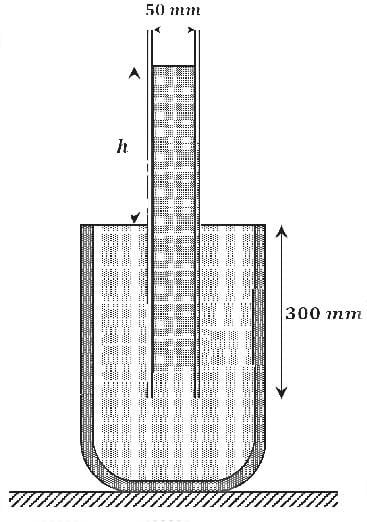
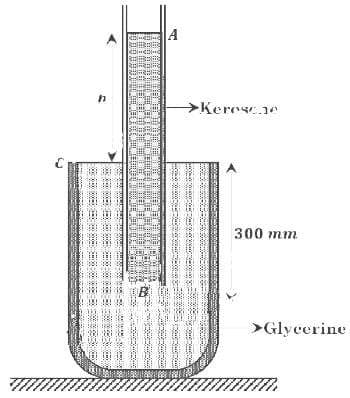
A cylindrical container with a diameter of 150 mm is completely filled with glycerin, and a pipe with a diameter of 50 mm is submerged in the glycerin to a depth of 300 mm. When kerosene is introduced into the pipe, the glycerin displaced by the kerosene spills over the top, ensuring that the kerosene does not exit from the bottom end of the pipe.
The volume of kerosene inside the pipe (in m³) is:
Given ρker = 814 kg/m³ and ρgly = 1260 kg/m³.
Detailed Solution: Question 16
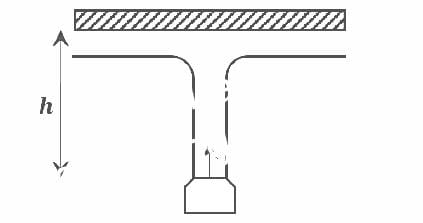
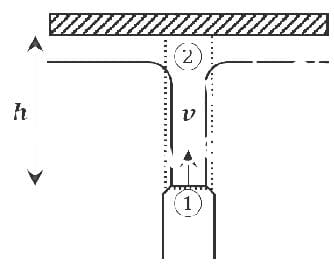
A vertical jet with a velocity of 10 m/s is directed at a horizontal plate that has a total load of 200 N. The fluid used is oil with a density of 800 kg/m³, and the diameter of the nozzle exit is 60 mm. Calculate the height necessary to elevate the plate and keep it stationary (in m):
Detailed Solution: Question 17
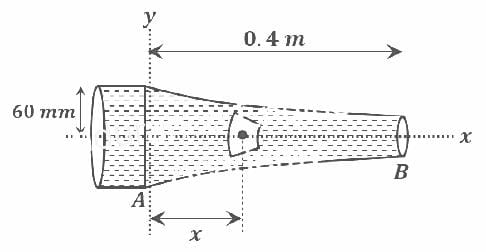
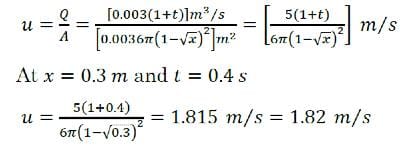
The radius of a circular duct is described by the equation:
r = 0.06(1 - √x) m, where x is measured in meters.
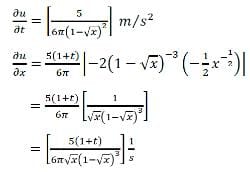
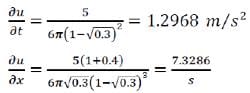
At point A, the flow of water is given as Q = 0.03 m³/s at t = 0, with an increase rate of dQ/dt = 0.003 m²/s². If a water particle is located at x = 0.3 m when t = 0.4 s, what is the acceleration at that point (in m/s²)?
Assume average velocities at the cross-section.
Detailed Solution: Question 18

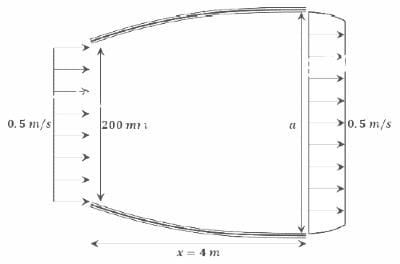
Air moves through a very broad duct as illustrated in the figure. To sustain a consistent free stream velocity of 0.5 m/s across the central core of 200 mm, if the flow is laminar, the displacement thickness is δ* = (1.721x) / √Rex, and in the case of turbulent flow, the displacement thickness is δ* = (0.020x) / (Rex)1/7. Determine the necessary value of a (in mm) when x = 4 m. Assume steady flow and take v = 18.9 × 10⁻⁶ m2/s.
Detailed Solution: Question 19


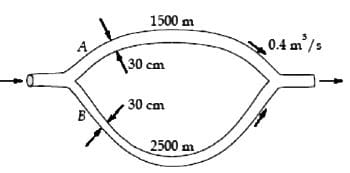
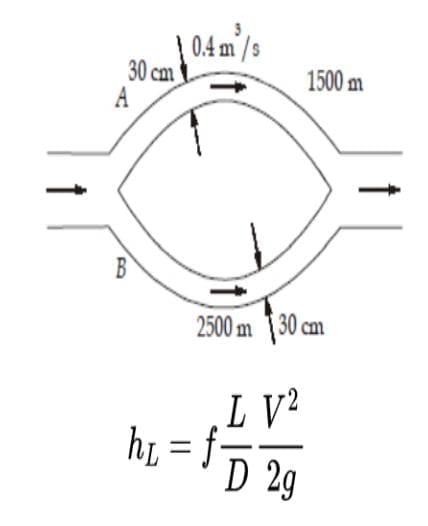
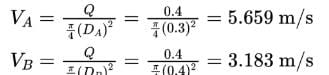
A certain part of cast iron piping of a water distribution system involves a parallel section. Both parallel pipes have a diameter of 30 cm, and the flow is fully turbulent. One of the branches (pipe A) is 1500 m long, while the other branch (pipe B) is 2500 m long. If the flow rate through pipe A is 0.4 m³/s, determine the flow rate (in m³/s) through pipe B, assuming no minor losses.
(Correct up to three decimal places)
Detailed Solution: Question 20
A conical pipe has a diameter of 30 cm at point A (elevation 2 m) and a diameter of 40 cm at point B (elevation 10 m). The kinetic energy correction factors at sections A and B are 1.1 and 1.3, respectively. The head loss through the pipe can be disregarded. Given that the pressure at point A is 100 kPa and the flow rate is 0.4 m3/s of water, what is the pressure at point B (in kPa)?
Detailed Solution: Question 21




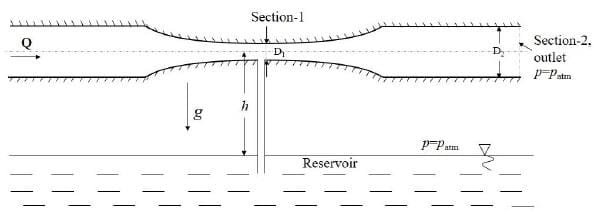
Water is moving through a horizontal circular pipe with a flow rate of Q. In the venturi section (Section-1 in the diagram), a low pressure is created, causing water to be drawn upward from a reservoir through a connecting pipe as illustrated. Assume the acceleration due to gravity, g, is 10 m/s2. Given that the flow rate Q = 0.1 m3/s, D1 = 8 cm, and D2 = 20 cm, determine the maximum height (h, in meters, rounded to one decimal place) of the venturi above the reservoir that is just sufficient to lift the liquid to Section-1 is _____.
Air with a density of 0.5 kg/m3 flows horizontally into a jet engine at a constant velocity of 200 m/s through an inlet area of 1.0 m2. After entering the engine, the air moves through the combustion chamber, and the exhaust gases exit the jet engine horizontally at a steady speed of 700 m/s. The mass flow rate of the fuel introduced into the combustion chamber is insignificant compared to the mass flow rate of the air. Additionally, disregard the pressure difference between the incoming air and the exhaust gases. The absolute magnitude of the horizontal force (in kN, rounded to one decimal place) acting on the jet engine is__________.
In a fully-developed, incompressible laminar flow of a Newtonian fluid within a pipe, as illustrated in the figure, the velocity distribution across a cross-section is represented by 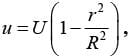 where U denotes a constant value. The length of the pipe is L and the dynamic viscosity of the fluid is µ. The power P needed to maintain this flow is given by the equation P = cμLU2, with c being a dimensionless constant. Determine the value of the constant c (to one decimal place) as _________.
\n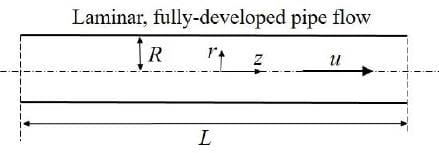
where U denotes a constant value. The length of the pipe is L and the dynamic viscosity of the fluid is µ. The power P needed to maintain this flow is given by the equation P = cμLU2, with c being a dimensionless constant. Determine the value of the constant c (to one decimal place) as _________.\n
A steel tank holds 6 kg of propane (both liquid and vapor) at a temperature of 20°C, occupying a volume of 0.015 m³. The critical specific volume vc is 0.00454 m³/kg. As the tank is gradually heated, what will occur to the liquid level within?
- Mass is 6 kg
- Mass is 1 kg instead of 6 kg
Detailed Solution: Question 25
A quantity of 1 kg of air at a pressure of 1 bar and a temperature of 27°C is subjected to heating in a closed system, maintaining constant pressure, until it reaches a temperature of 177°C. The heat is supplied from a reservoir that maintains a constant temperature of 577°C. Assume the surrounding atmospheric temperature is 20°C. Calculate the percentage of heat added per kg of air as the available energy (in %):
Take Cp = 1.005 kJ/kgK
Take Cp = 1.005 kJ/kgK
Detailed Solution: Question 26
A single mole of a monoatomic ideal gas undergoes four distinct thermodynamic processes.
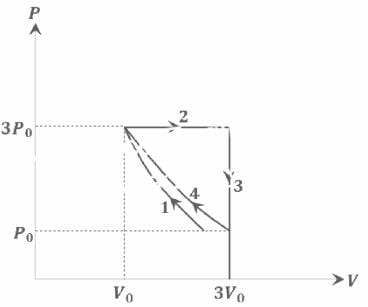
Detailed Solution: Question 27
A perfect gas occupying 55 l at a pressure of 125 kPa and a temperature of 300 K is subjected to isentropic compression until its temperature reaches 380 K. The work performed during this process is 5.1 kJ. Given that the characteristic gas constant R is 260 J/kg·K.
Detailed Solution: Question 28
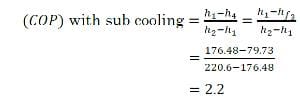
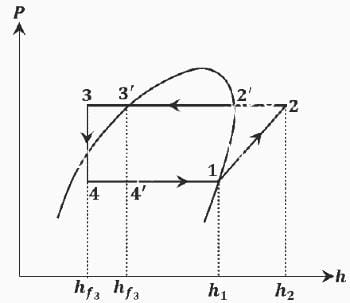
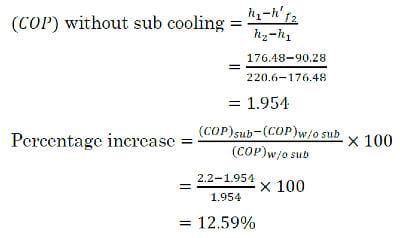
A commercial refrigeration unit functions between pressures of 1.24 bar and 13.672 bar. If the liquid is cooled to 10°C after the condensation process, what is the percentage increase in the coefficient of performance (COP) (in %)?
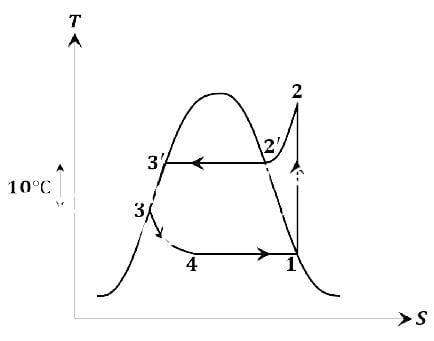
Use data:
h1 = 176.48 kJ/kg
h2 = 220.6 kJ/kg
hf = 79.73 kJ/kg
h'f = 90.28 kJ/kg
h1 = 176.48 kJ/kg
h2 = 220.6 kJ/kg
hf = 79.73 kJ/kg
h'f = 90.28 kJ/kg
Detailed Solution: Question 29
A container has a double wall where the wall cavity is filled with carbon dioxide at room temperature and pressure. When the container is filled with a cryogenic liquid at 100 K, the carbon dioxide will freeze so that the wall cavity has a mixture of solid and vapor carbon dioxide at the sublimation pressure. At -90°C, Psub = 38.1 kPa and hfg = 574.5 kJ/kg.
The pressure in the wall cavity at 100 K is __________ × 10⁻² Pa.
Assume R = 0.188 kJ/kgK. (Round off to two decimal places)
Assume R = 0.188 kJ/kgK. (Round off to two decimal places)
Detailed Solution: Question 30
