GATE Engineering Sciences 2027 Sciences Mock Test - 3 Free Online Test
Full Mock Test & Solutions: GATE Engineering Sciences Mock Test - 3 (65 Questions)
You can boost your GATE Engineering Sciences 2026 exam preparation with this GATE Engineering Sciences Mock Test - 3 (available with detailed solutions).. This mock test has been designed with the analysis of important topics, recent trends of the exam, and previous year questions of the last 3-years. All the questions have been designed to mirror the official pattern of GATE Engineering Sciences 2026 exam, helping you build speed, accuracy as per the actual exam.
Mock Test Highlights:
- - Format: Multiple Choice Questions (MCQ)
- - Duration: 180 minutes
- - Total Questions: 65
- - Analysis: Detailed Solutions & Performance Insights
- - Sections covered: General Aptitude, Engineering Mathematics (XE-A), Engineering Sciences (XE-B) & (XE-E)
Sign up on EduRev for free and get access to these mock tests, get your All India Rank, and identify your weak areas to improve your marks & rank in the actual exam.

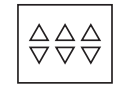
A sheet of transparent paper is folded in a specific way and a design is either cut or punched through it. Upon unfolding, the paper displays a pattern as illustrated in the provided answer figure. Select the correct answer figure shown below.

Detailed Solution: Question 1
In a queue, Mr. X occupies the fourteenth position from the front, while Mr. Y is placed seventeenth from the back. Mr. Z is positioned exactly between Mr. X and Mr. Y. Given that Mr. X is in front of Mr. Y and there are a total of 48 individuals in the queue, how many individuals are situated between Mr. X and Mr. Z?
Detailed Solution: Question 2


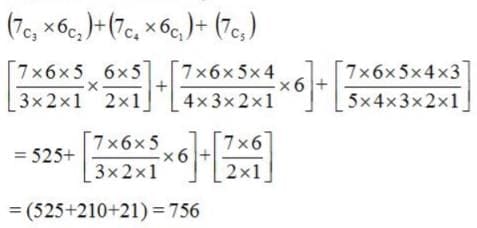
A committee of five members is to be formed from a group consisting of 7 men and 6 women, with the condition that the committee must include at least 3 men. How many different ways can this selection be made?
Detailed Solution: Question 3
Given the matrix M = [[12 9i, -i], [i, 12 - 9i]], where i represents √-1, what is the inverse of the matrix M?
Detailed Solution: Question 4
A scientist is employing the bisection method to determine the root of f(x) = 0. Initially, during an iteration, the lower and upper bounds for the root are designated as xl and xu. What would be the absolute relative approximate error in the estimated root value at the conclusion of the iteration?
Detailed Solution: Question 5
Consider the following two complex numbers:
Z1 = (7 / √3) 7i
Z2 = 9 (9√3)i
The angle of the product Z1Z2 (in degrees) is _____.
Z1 = (7 / √3) 7i
Z2 = 9 (9√3)i
Detailed Solution: Question 6
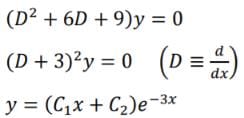
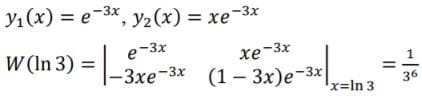
y'' + 6y' + 9y = 0, y₁(x) = p(x), y₂(x) = q(x), y₁(0) = 1, y₁'(0) = -3, y₂(0) = 0, y₂'(0) = 1. Then, 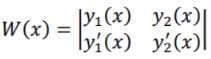 at x = ln 3
at x = ln 3Detailed Solution: Question 7
Consider An = 1 2 3 ... n and define Tn = (A2 / (A2 - 1)) × (A3 / (A3 - 1)) × (A4 / (A4 - 1)) × ... × (An / (An - 1)), where n ∈ N (n ≥ 2).
Determine the value of lim (n → ∞) Tn.
Detailed Solution: Question 8
Evaluate the following statements:
- Streamlines represent the motion of each individual particle at a specific moment.
- Path lines depict the motion of a particular particle at every instant.
- The velocity component perpendicular to the streamline is consistently zero.
- In an unsteady flow, streak lines are also aligned with pathlines and streamlines.
Which of the statements listed above is/are CORRECT?
Detailed Solution: Question 9
A submarine is operating at a depth of 15 m beneath the surface of the ocean. If the submarine's speed is 16 km/hr, what is the gauge pressure at the front stagnation point (in kPa)?
Assume ρ_sea water = 1026 kg/m³
Assume ρ_sea water = 1026 kg/m³
Detailed Solution: Question 10
A model of a canal with a scale of 1/10 is constructed to analyze wave motion. In this model, a wave takes 10 seconds to cover a specific distance. The duration for the wave to traverse the equivalent distance in the actual prototype is ___ × 10¹/² s.
Detailed Solution: Question 11
The kinematics of fluid flow in vector notation can be expressed through the following statements:
The divergence is a mathematical operator that operates on a vector function and is denoted as 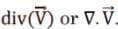 . The outcome of this operation is always a scalar.
The divergence indicates the flux that originates from any point within the specified vector function, effectively describing the rate of loss of a particular quantity.
The curl is a mathematical operator that functions on a vector function and is represented as  . The result of this operation is consistently a vector and denotes the infinitesimal rotation of a vector function.
The Laplacian is a mathematical operator applied to a scalar function and is expressed as ∇²f. Its result is always a scalar and signifies the divergence of the gradient of a scalar function.
Which of the statements above is/are accurate?
The divergence is a mathematical operator that operates on a vector function and is denoted as . The outcome of this operation is always a scalar.
The divergence indicates the flux that originates from any point within the specified vector function, effectively describing the rate of loss of a particular quantity.
The curl is a mathematical operator that functions on a vector function and is represented as . The result of this operation is consistently a vector and denotes the infinitesimal rotation of a vector function.
The Laplacian is a mathematical operator applied to a scalar function and is expressed as ∇²f. Its result is always a scalar and signifies the divergence of the gradient of a scalar function.
Detailed Solution: Question 12
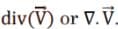 . The result is always a scalar.
 . The result is always a vector. The curl represents the infinitesimal rotation of a vector function.
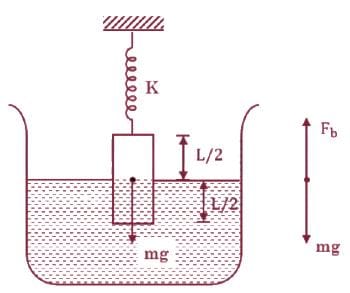
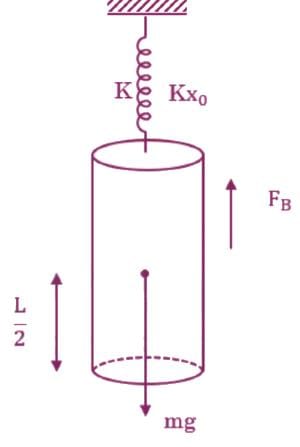
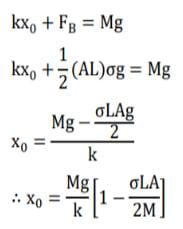
A uniform cylinder with a length of L and a mass of M, which has a cross-sectional area A, is suspended vertically from a fixed point using a massless spring. At its equilibrium position, the cylinder is half submerged in a liquid with a density of σ. What is the extension xo of the spring when the cylinder is in equilibrium?
Detailed Solution: Question 13
The drag coefficient for an aircraft is expressed by the equation:
CD = (2FD) / (ρV2L2). Given that the drag force acting on a model airplane tested at sea level is 0.3 N, and that the speed of the actual prototype is 20 times greater than that of the model at an altitude of 3 km, with the length of the prototype being 15 times that of the model. Calculate the drag force acting on the prototype (in kN).
Use ρprototype = 0.9092 kg/m3 at an altitude of 3 km and ρmodel = 1.225 kg/m3.
Use ρprototype = 0.9092 kg/m3 at an altitude of 3 km and ρmodel = 1.225 kg/m3.
Detailed Solution: Question 14
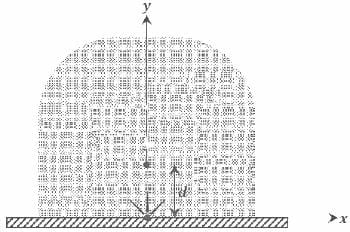
A source q is determined from the wall while fluid flow is directed towards the wall. The stream function is given by ψ = (4xy 80) m²/s, where x and y are measured in meters. The stagnation point is located along the y-axis. The value of d (in m) is __________. (Round off to three decimal places)
Detailed Solution: Question 15
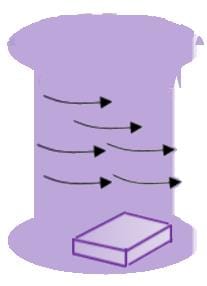
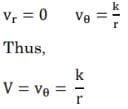
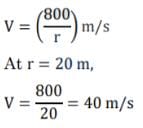
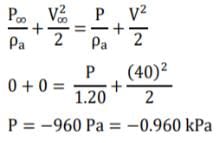
A building with a flat roof is situated 20 m away from the center of a tornado. This building lies within the tornado's free vortex, where the wind speed reaches 20 m/s at a distance of 40 m from the center. The air density is given as pa = 1.20 kg/m3. Assume a steady ideal fluid flow and that elevation changes can be neglected. What is the magnitude of the uplift pressure on the roof in __________Pa?
Detailed Solution: Question 16
Two immiscible liquids are positioned between two infinite parallel plates separated by a distance of 2h, with each fluid layer having a thickness of h. The dynamic viscosity of the fluid on the upper side is three times that of the fluid on the lower side. With the lower plate held stationary and the upper plate moving at a constant speed of U = 6.1 m/s, the pressure gradient in the flow direction is zero. What is the velocity at the interface, in m/s? Assume laminar flow and round your answer to two decimal places.
Detailed Solution: Question 17

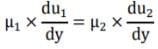
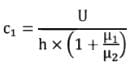
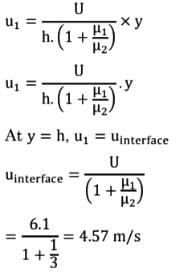
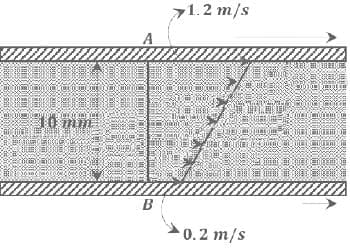
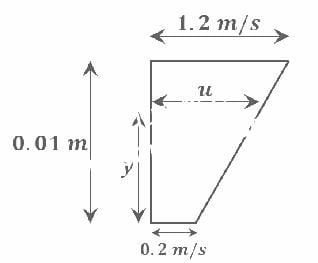
A liquid trapped between two plates that are moving exhibits a linear velocity profile. Given that the pressure at the upper surface of the lower plate is 600 N/m2, what is the pressure at the lower surface of the upper plate (in kPa)?
Assume ρ = 1.2 × 10³ kg/m3.
Detailed Solution: Question 18
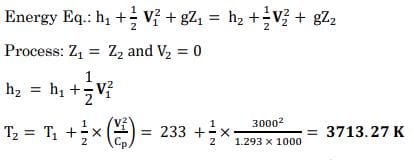
You work as a Scientist at ISRO. A meteorite recently enters the upper atmosphere at a speed of 3000 m/s, where the atmospheric pressure measures 0.1 atm and the temperature is −40°C. Estimate the temperature of the air immediately in front of the meteorite, assuming no heat transfer occurs during this adiabatic stagnation process. Use Cp of air = 1.293 kJ/kgK and consider the specific heat to be constant.
Detailed Solution: Question 19
Examine the application of the Clapeyron equation:
Which of the statements listed above is(are) accurate?
Detailed Solution: Question 20

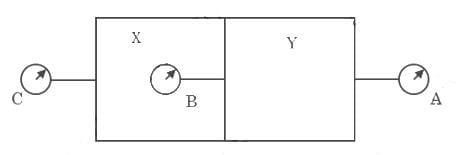
A container depicted in the figure contains two sections at varying pressures. The pressure gauges A and B indicate 6 bar gauge and 4 bar gauge, respectively. The barometric pressure is 760 mm of Hg. What will be the reading at gauge C in ________ bar gauge? Consider that 760 mm corresponds to 1.013 bar.
Detailed Solution: Question 21
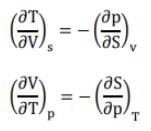
Below are Maxwell's relations; which of the following statements are accurate?
Detailed Solution: Question 22
Air is moving uniformly through an insulated duct. The pressure and temperature readings of the air at two locations, A and B, are provided below. It is assumed that for air, the specific heat cp is constant at 1.005 kJ/kg.K, h = cpT, and v/T = 0.287/p, where P, v, and T denote pressure (in kPa), specific volume (m3/kg), and temperature (in K), respectively.
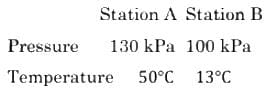
Select the correct statement.
Detailed Solution: Question 23
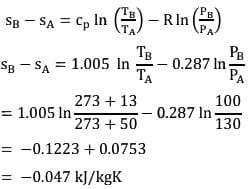
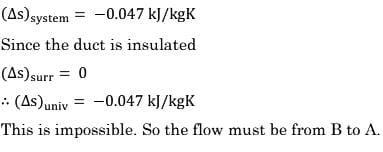
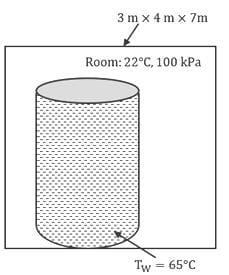
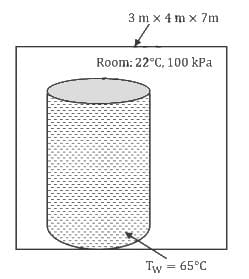
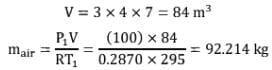
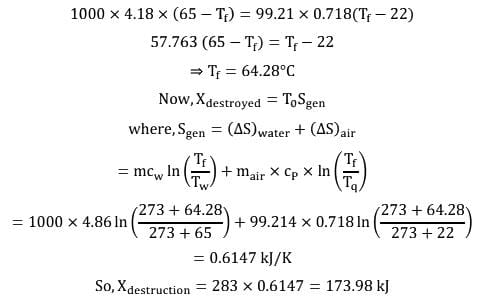
One ton of liquid water at 65°C is brought into a well-insulated and well-sealed 3m x 4m x 7m room initially at 22°C and 100 kPa. Assuming constant specific heats for both the air and water at room temperature, the exergy of destruction is when T₀ = 10°C.
Detailed Solution: Question 24
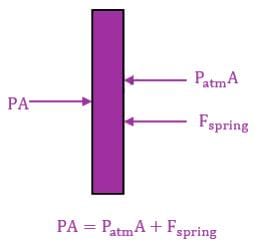
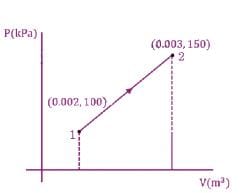
A piston-cylinder assembly containing warm air is positioned horizontally as illustrated in the figure. The air undergoes a slow cooling process, reducing its volume from an initial value of 0.003 m³ to a final value of 0.002 m³. Throughout this process, the spring applies a force that decreases linearly from an initial force of 900 N to a final force of zero. The atmospheric pressure is 100 kPa, and the area of the piston face measures 0.018 m². Assume that friction between the piston and the cylinder wall is negligible for the air. What is the amount of work done?
Detailed Solution: Question 25

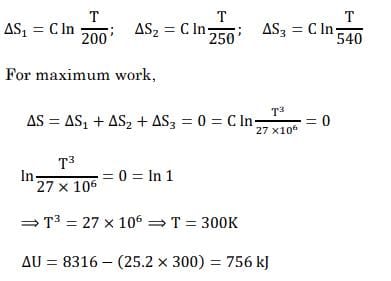
Consider three identical objects with temperatures of 200K, 250K, and 540K, each having an internal energy described by the equation 8.4 x T kJ (where T is the temperature in K). If these objects are combined and allowed to reach a common final temperature, what is the maximum possible internal energy change in kJ?
Detailed Solution: Question 26
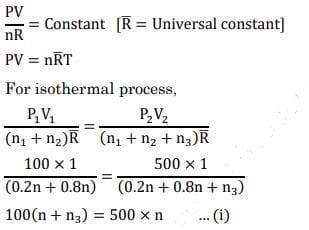
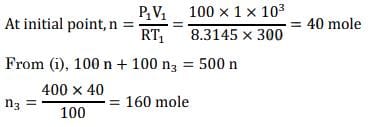
A cylinder of volume 1 m³ contains a mixture of CO₂ (20% mol) and O₂ (80% by mol) at 100 kPa and 300 K. This cylinder is connected to a 1 MPa pressure line carrying N₂ at 300 K. The cylinder is filled isothermally till the pressure of the gas mixture inside it becomes 500 kPa, and then the filling is stopped. The amount of N₂ gas that has entered the cylinder is ________ (in mole, 2 decimal places). The universal gas constant is 8.3145 J/(mol·K).
Detailed Solution: Question 27
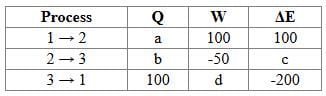
A system experiences a cycle made up of the three processes shown in the table. ΔE = ΔU+ΔKE+ΔPE, the total of a b c d is ______ kJ. All values are in kJ.
Detailed Solution: Question 28
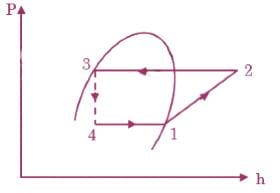
In an ideal vapor compression refrigeration cycle, the specific enthalpy values of the refrigerant at different stages are provided as follows:
- Condenser inlet: 1700 kJ/kg
- Condenser outlet: 400 kJ/kg
- Evaporator outlet: 1200 kJ/kg
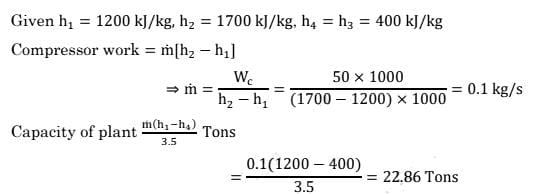
If the power requirement of the compressor is 50 kW, what is the plant capacity in __ tons?
Detailed Solution: Question 29
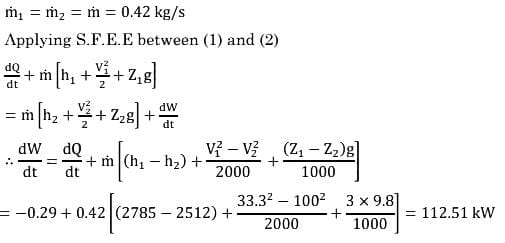
A turbine functions under steady flow conditions and receives steam at the following parameters: pressure of 1.2 MPa, temperature of 188°C, enthalpy of 2785 kJ/kg, a velocity of 33.3 m/s, and an elevation of 3 m. The steam exits the turbine with the following characteristics: pressure of 20 kPa, enthalpy of 2512 kJ/kg, a velocity of 100 m/s, and an elevation of 0 m. There is heat loss to the surroundings at a rate of 0.29 kJ/s. Given that the steam flow rate through the turbine is 0.42 kg/s, calculate the power output of the turbine (in kW). Assume g = 9.81 m/s².
Detailed Solution: Question 30