GATE Engineering Sciences 2027 Sciences Mock Test - 4 Free Online Test
Full Mock Test & Solutions: GATE Engineering Sciences Mock Test - 4 (65 Questions)
You can boost your GATE Engineering Sciences 2026 exam preparation with this GATE Engineering Sciences Mock Test - 4 (available with detailed solutions).. This mock test has been designed with the analysis of important topics, recent trends of the exam, and previous year questions of the last 3-years. All the questions have been designed to mirror the official pattern of GATE Engineering Sciences 2026 exam, helping you build speed, accuracy as per the actual exam.
Mock Test Highlights:
- - Format: Multiple Choice Questions (MCQ)
- - Duration: 180 minutes
- - Total Questions: 65
- - Analysis: Detailed Solutions & Performance Insights
- - Sections covered: General Aptitude, Engineering Mathematics (XE-A), Engineering Sciences (XE-B) & (XE-E)
Sign up on EduRev for free and get access to these mock tests, get your All India Rank, and identify your weak areas to improve your marks & rank in the actual exam.

Team sports such as baseball exhibit significant socialist characteristics due to their demands for individuals to subordinate themselves to the leadership of coaches and managers.
Which of the following conclusions cannot be deduced from the information provided above?
Detailed Solution: Question 1
A group of 12 men can complete a task in 20 days. Similarly, 18 women can accomplish the same task in 16 days, while 24 children can finish it in 18 days. After 9 days of work, 8 women and 16 children left the project. How many days will it take for 10 men to finish the remaining portion of the project?
Detailed Solution: Question 2

Detailed Solution: Question 3
If  represents the imaginary unit where i = √(-1), which of the following statements is accurate?
represents the imaginary unit where i = √(-1), which of the following statements is accurate?Detailed Solution: Question 4

Consider a 3 × 3 upper triangular matrix A with real number entries. Given that a11 = 1, a22 = 2, and a33 = 3, determine the relationship between α, β, and γ such that A-1 = αA2 βA γI.
Detailed Solution: Question 5
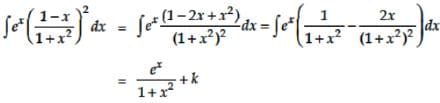
If ∫ ex ( (1 - x) / (1 x2) )2 dx = e(xc) / (a bx2) k, what is the total of a, b, and c?
Detailed Solution: Question 6
A cylindrical object with a diameter of 3 m is spinning at a rate of 600 revolutions per minute. An air stream with a velocity of 100 m/s flows across the surface of the cylinder. What is the lift force per unit length of the cylinder (in kN/m)? Assume ρair = 1 kg/m³
Detailed Solution: Question 7
For which scenarios is Euler's equation of fluid mechanics applicable?
A fish tank is being transported in a vehicle that is accelerating horizontally at a constant rate. The water level will
Detailed Solution: Question 9
Temperature of air in the atmosphere is changing with T = t₀ - Kz, where z is in meters and measured from the earth’s surface upwards. If the pressure and temperature at the earth's surface are 101.325 kPa and 300 K respectively, the pressure at a height of 1 km (in bar) is ___________.
Take K = 9 × 10⁻³ °C/m.
Take K = 9 × 10⁻³ °C/m.
Detailed Solution: Question 10
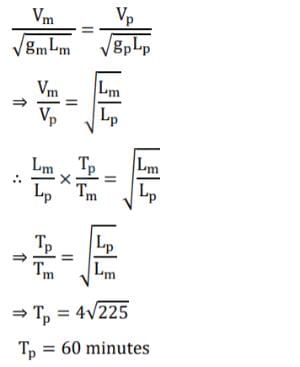
A reservoir model is emptied in 4 minutes when a sluice gate is opened. Given that the scale ratio of the model is 1 : 225, what is the duration required to drain the full-scale prototype in minutes?
Detailed Solution: Question 11
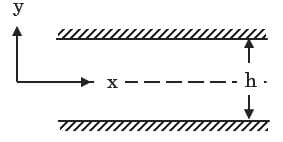
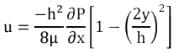
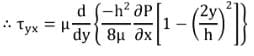
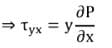
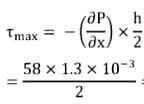
A fluid with a viscosity of μ = 1.15 N·s/m² flows steadily between two parallel plates. The flow is fully developed and occurs in a laminar manner. The separation between the plates is h = 1.3 mm. Assume that ∂P/∂x = −58 Pa/m. What is the value of the maximum shear stress in Pa?
Detailed Solution: Question 12
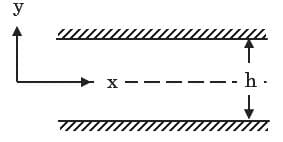
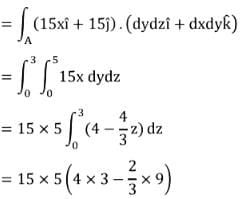
In the figure, a shaded area is shown in the velocity field where the velocity is given by:  = ax î + by ĵ and a = b = 15 s⁻¹, the coordinates are measured in meters. The volume flow rate through the shaded area is ____ m³/s.
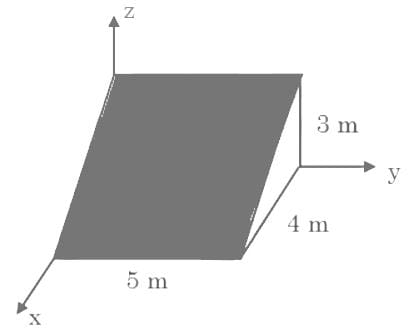
= ax î + by ĵ and a = b = 15 s⁻¹, the coordinates are measured in meters. The volume flow rate through the shaded area is ____ m³/s.Detailed Solution: Question 13

 = ax î + by ĵ
 = 15x î + 15y ĵ
A steady, incompressible, and 2-Dimensional fluid flow field is represented by:
V = (x − 2y + 10)î + (2x − y − 20)ĵ
In this fluid flow field, the stagnation point is represented by (x, y) as:
V = (x − 2y + 10)î + (2x − y − 20)ĵ
Detailed Solution: Question 14

A bend pipe carries a mass flow rate of a liquid (ṁ) shown in the figure on a horizontal plane.
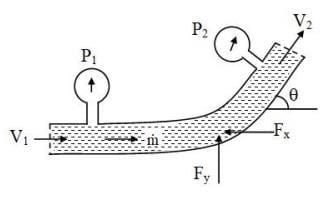
Pressure gauges P₁ and P₂, and velocities V₁ and V₂ are shown. The correct equations to be used to find out forces Fx and Fy due to the bend on the fluid are:
Detailed Solution: Question 15
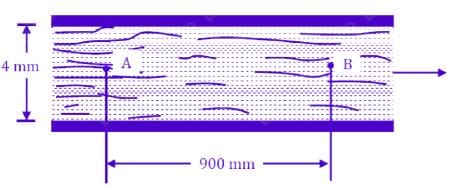
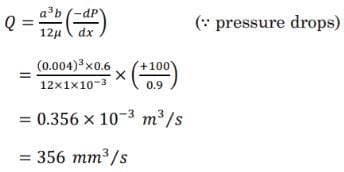
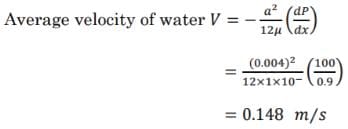
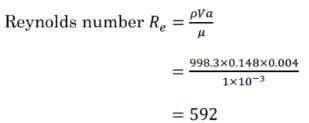
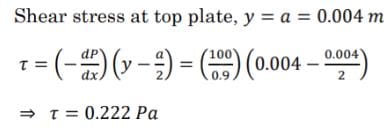
A crude oil with a viscosity of 1 x 10⁻³ Pa.s is flowing between two stationary parallel plates that are spaced 4 mm apart, due to a pressure drop of 100 Pa from point A to point B. If the plates have a width of 600 mm, which of the following statement(s) is/are accurate? Consider the density, pw, to be 998.3 kg/m3.
Detailed Solution: Question 16
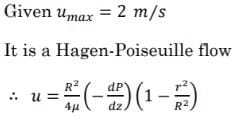
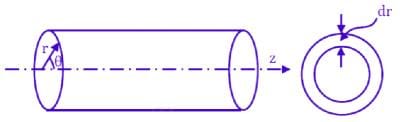
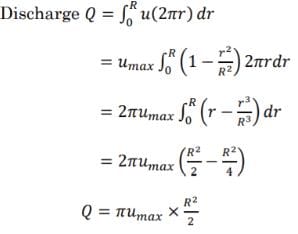
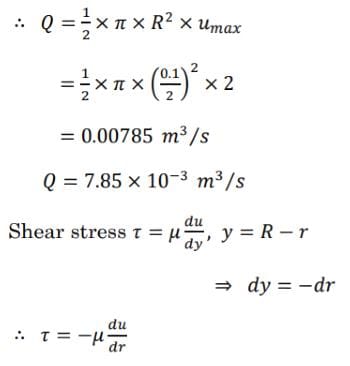
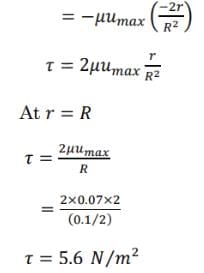
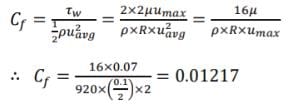
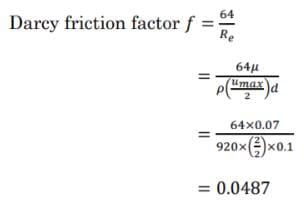
The flow velocity at the centerline of the Hagen-Poiseuille flow in a pipe with a diameter of 0.1m is measured at 2 m/s. Given that the fluid's viscosity is 0.07 kg/ms and its specific gravity is 0.92, which of the following statements is(are) correct?
Detailed Solution: Question 17
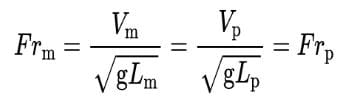
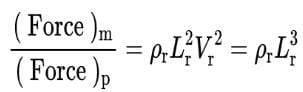
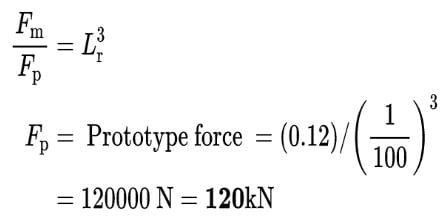
A scaled-down model boat, which is 1/100 the size of its original, experiences a resistance of 0.12 N while mimicking a speed of 5 m/s of the original boat. Water serves as the fluid in both scenarios. What would be the equivalent resistance in the original boat? [Disregard the frictional forces].
(Resistance in kN)
(Resistance in kN)
Detailed Solution: Question 18
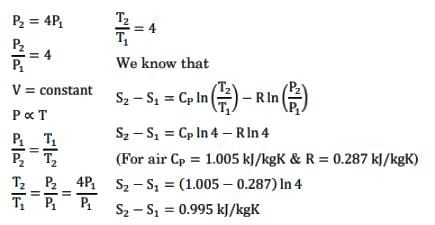
Heat is added to air while maintaining a constant volume until the pressure becomes four times the initial pressure. What is the change in entropy of the air?
Detailed Solution: Question 19
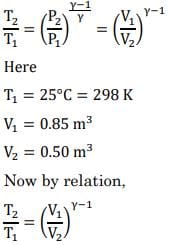
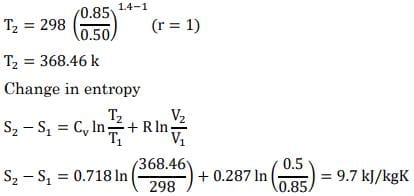
A mass of 1 kg of air (R = 0.287 kJ/kgK) experiences an adiabatic transformation from equilibrium state 1 (25°C, 0.85 m3) to state 2, where the volume decreases to 0.50 m3. What is the change in entropy (in kJ/kgK)?
Detailed Solution: Question 20
When a solid is subjected to intense heating below the temperature of its triple point, the resulting process will ultimately lead to
Given the equations dφ = f(T)dT (T/V)dV and dψ = Tdp (T/p²)dV, the options are:
Which of the following statements is incorrect?
At a temperature of 273.15 K, the specific volumes of ice and water are 0.001 m3/kg and 0.001091 m3/kg respectively, while the latent heat of fusion for ice is 334 kJ/kg. Calculate the increase in the melting point resulting from a pressure rise of 1 atm.
Detailed Solution: Question 24
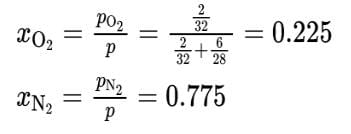
Determine the change in entropy when 2 kg of oxygen at 600 °C is combined with 6 kg of nitrogen at the same temperature. The initial pressure of each component is 103 kPa, which is equal to that of the resulting mixture.
Detailed Solution: Question 25

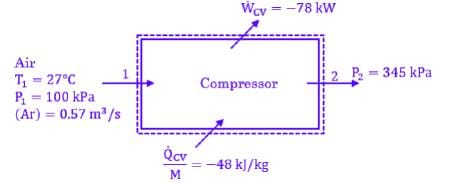
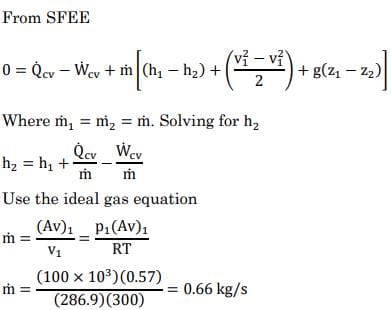
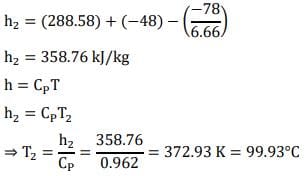
Air is drawn into a compressor functioning under steady-state conditions at a pressure of 100 kPa and a temperature of 27°C, with a volumetric flow rate of 0.57 m3/s. The air exits the compressor at a pressure of 345 kPa, and there is a heat transfer from the compressor to its environment at a rate of 48 kJ/kg for the air flowing through it. Given that the power input to the compressor is 78 kW, what is the exit temperature in °C? Use an inlet enthalpy of 288.58 kJ/kg and a specific heat at constant pressure (cp) for air of 0.962 kJ/kgK. (Round off your answer to one decimal place)
Detailed Solution: Question 26
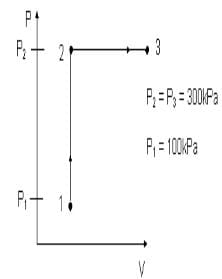
Air is enclosed within a piston-cylinder arrangement, where the piston is initially resting on a set of stops, and a pressure of 300 kPa is necessary to move the piston. At the outset, the air has a pressure of 100 kPa and a temperature of 270 °C, occupying a volume of 0.4 m3. The work done in kJ while raising the temperature to 1200 K is _________________
Detailed Solution: Question 27
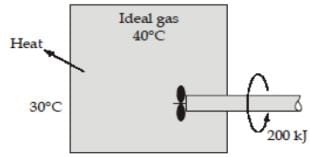
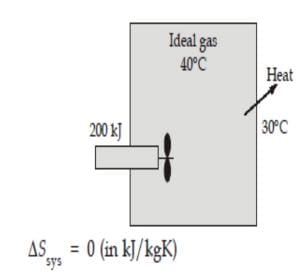
A rigid container holds an ideal gas at a temperature of 400 °C, which is being agitated by a paddle wheel. The paddle wheel performs 200 kJ of work on the ideal gas. During this process, it is noted that the temperature of the ideal gas remains unchanged due to heat exchange with the surroundings, which are at 300 °C. Consequently, the change in entropy of the ideal gas is calculated as (in kJ/kgK).
Detailed Solution: Question 28
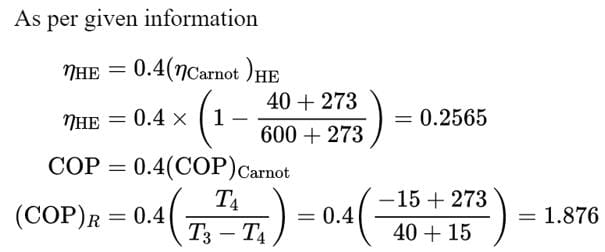
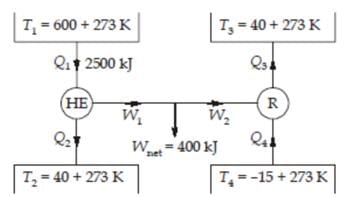
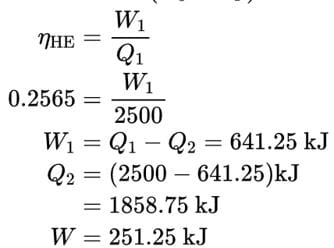
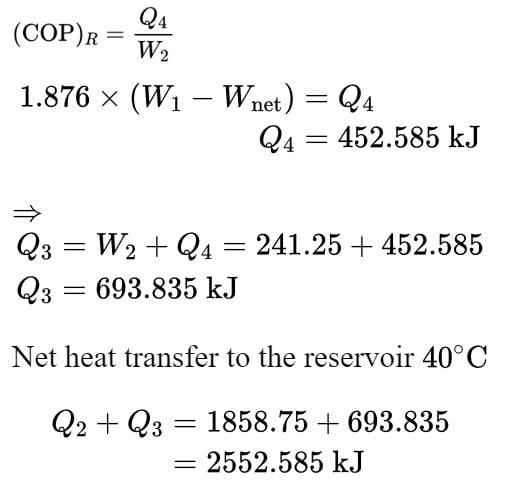
A heat engine operates between two thermal reservoirs at temperatures of 6000°C and 400°C, while simultaneously driving a refrigerator that functions between reservoirs at 400°C and –150°C. The heat absorbed by the heat engine amounts to 2500 kJ, and the overall work output from the combined system of the engine and refrigerator is 400 kJ. Given that the efficiency of the heat engine and the coefficient of performance (COP) of the refrigerator are both 40% of their respective maximum possible values, what is the net heat transfer to the reservoir at 40°C____________ in (kJ) (rounded to two decimal places)?
Detailed Solution: Question 29
 .
.
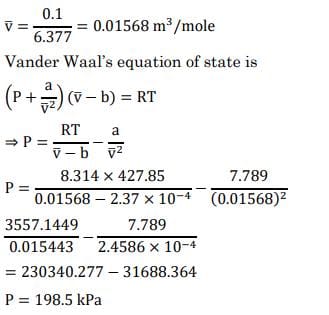
A cylinder with a volume of 0.1 m3 contains 0.727 kg of n-octane (C8H18) at a temperature of 427.85 K. It is assumed that n-octane follows the Vander Waals equation of state. The constants a and b for n-octane are 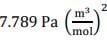
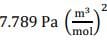 and 2.37 x 10⁻⁴ m3 Imol respectively. What is the pressure of the gas in the cylinder in _____kPa?
and 2.37 x 10⁻⁴ m3 Imol respectively. What is the pressure of the gas in the cylinder in _____kPa?Detailed Solution: Question 30