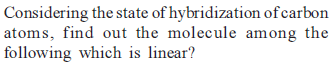
JEE Exam  >  JEE Test  >  Chemistry Main & Advanced  >  General Organic Chemistry (GOC) - 1 - JEE MCQ

General Organic Chemistry (GOC) - 1 - Free MCQ Test with solutions


MCQ Practice Test & Solutions: General Organic Chemistry (GOC) - 1 (30 Questions)

You can prepare effectively for JEE Chemistry for JEE Main & Advanced with this dedicated MCQ Practice Test (available with solutions) on the important topic of "General Organic Chemistry (GOC) - 1". These 30 questions have been designed by the experts with the latest curriculum of JEE 2026, to help you master the concept.

Test Highlights:

  • - Format: Multiple Choice Questions (MCQ)
  • - Duration: 60 minutes
  • - Number of Questions: 30

Sign up on EduRev for free to attempt this test and track your preparation progress.

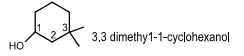
General Organic Chemistry (GOC) - 1 - Question 1


Detailed Solution: Question 1


General Organic Chemistry (GOC) - 1 - Question 2

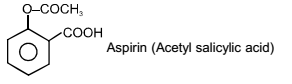
Aspirin is known as :

Detailed Solution: Question 2


General Organic Chemistry (GOC) - 1 - Question 3

The IUPAC name of the compound
CH₃CH=CHC≡CH is:

Detailed Solution: Question 3

If a molecule contains both carbon-carbon double or triple bonds, the two are treated as per in seeking the lowest number combination. However, if the sum of numbers turns out to be the same starting from either of the carbon chains, then the lowest number is given to the C=C double bond.

Thus, the correct name is pent-3-en-1-yne.

General Organic Chemistry (GOC) - 1 - Question 4

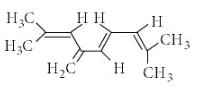
The total number of π-bond electrons in the following structure is:
Detailed Solution: Question 4

There are four double bonds. Hence, the number of π-electrons is 2 × 4 = 8.

General Organic Chemistry (GOC) - 1 - Question 5

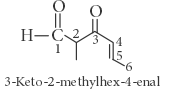
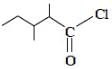
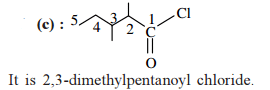
The IUPAC name of the compound shown below is

Detailed Solution: Question 5


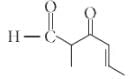
General Organic Chemistry (GOC) - 1 - Question 6

The correct decreasing order of priority for the functional groups of organic compounds in the IUPAC system of nomenclature is
 

Detailed Solution: Question 6
- The correct order of priority for functional groups in the IUPAC system is determined by their reactivity and presence in naming conventions.
- Carboxylic acids -COOH have the highest priority due to their strong acidic nature.
- Sulfonic acids -SO3H  come next because of similar acidity.
- Amides -CONH2 follow due to their derivation from carboxylic acids.
- Aldehydes -CHO have lower priority than the above groups.
- Therefore, the correct order is: -COOH, -SO3H, -CONH2, -CHO, which corresponds to option D.

General Organic Chemistry (GOC) - 1 - Question 7


Detailed Solution: Question 7


General Organic Chemistry (GOC) - 1 - Question 8

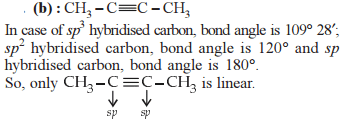
In which of the following compounds is there more than one kind of hybridization (sp, sp², sp³) for carbon?

Detailed Solution: Question 8

General Organic Chemistry (GOC) - 1 - Question 9

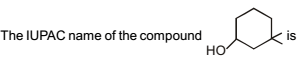
The IUPAC name of the compound 
​​​​​​​ is ______.

Detailed Solution: Question 9

General Organic Chemistry (GOC) - 1 - Question 10

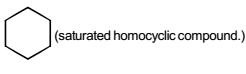
Which of the following is saturated homocyclic compound.

Detailed Solution: Question 10

General Organic Chemistry (GOC) - 1 - Question 11

In the structure of 4-Isopropyl-2,4,5-trimethylheptane, number of 10, 20 & 30 H’s are respectively.
 

Detailed Solution: Question 11
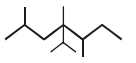
1º, 2º & 3º H’s are that which is attach at 1º , 2º & 3º carbon respectively.


General Organic Chemistry (GOC) - 1 - Question 12

IUPAC nomenclature of the given organic compound will be : (CH3)2C(CH2CH3)CH2CH(Cl)CH3 :

Detailed Solution: Question 12

The correct IUPAC name for the compound is:

2-Chloro-4,4-dimethylhexane

Here's how we arrive at this name:

  • The main chain consists of six carbon atoms, making it a hexane derivative.
  • There are two methyl groups attached to the fourth carbon in the chain.
  • A chlorine atom is attached to the second carbon.

This systematic approach ensures that we accurately represent the structure of the compound through its IUPAC name.

General Organic Chemistry (GOC) - 1 - Question 13

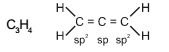
In allene (C3H4), the type(s) of hybridisation of the carbon atoms is (are) :

Detailed Solution: Question 13

General Organic Chemistry (GOC) - 1 - Question 14

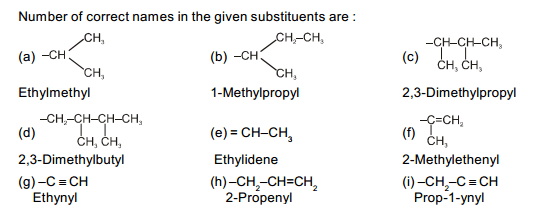
Detailed Solution: Question 14

To solve the question in the image regarding the number of correct names for given substituents, we need to analyze each structure and compare it to the IUPAC naming rules for organic substituents:

  1. (a) Ethylmethyl: Correct. The substituent has an ethyl group attached to a central carbon, which is also connected to a methyl group.

  2. (b) 1-Methylpropyl: Correct. The main chain has three carbons (propyl), with a methyl group attached to the first carbon.

  3. (c) 2,3-Dimethylpropyl: Incorrect. The correct name should be isobutyl or 2-methylpropyl, as the main chain is a propyl with two methyls attached to the second carbon.

  4. (d) 2,3-Dimethylbutyl: Correct. The main chain has four carbons (butyl), with methyl groups attached to the second and third carbons.

  5. (e) Ethylidene: Incorrect. This group is actually an ethyl group with a double bond at the end carbon, so it should be called vinyl or ethenyl.

  6. (f) 2-Methylethenyl: Correct. The main chain has two carbons with a double bond (ethenyl), and a methyl group attached to the second carbon.

  7. (g) Ethynyl: Correct. This structure has a triple bond with a carbon at the end, which is characteristic of an ethynyl group.

  8. (h) 2-Propenyl: Correct. The structure represents a three-carbon chain with a double bond starting from the first carbon; however, the correct name is allyl.

  9. (i) Prop-1-ynyl: Correct. This name represents a three-carbon chain with a triple bond at the first carbon, which is accurately described.

Counting the correct names:

  • Correct names: (a), (b), (d), (f), (g), (i)

  • Incorrect names: (c), (e), (h)

There are 6 correct names among the options given. Thus, the answer to the question is Option B: 6.

General Organic Chemistry (GOC) - 1 - Question 15

A hydrocarbon (R) has six membered ring in which there is no unsaturation. Two alkyl groups are attached to the ring adjacent to each other. One group has 3 carbon atoms with branching at 1st carbon atom of chain and another has 4 carbon atoms. The larger alkyl group has main chain of three carbon atoms of which second carbon is substituted. Number of 2° carbons in R are :

Detailed Solution: Question 15
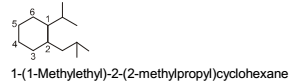
A is correct: the molecule contains 5 secondary (2°) carbons.

A secondary carbon is bonded to exactly two other carbon atoms.

In the cyclohexane ring, the two carbons bearing the alkyl substituents are each bonded to three carbon atoms (two ring neighbours plus the substituent) and so are tertiary; the remaining four ring carbons are each bonded to two carbons and are therefore secondary.

The isopropyl substituent has a central carbon bonded to three carbons (tertiary) and two methyl carbons which are primary; it contributes 0 secondary carbons.

The 2-methylpropyl substituent (CH2-CH(CH3)-CH3) has the CH2 that attaches to the ring bonded to two carbons and is therefore secondary; the internal CH is tertiary and the methyls are primary, so this substituent contributes 1 secondary carbon.

Adding contributions gives 4 (ring) + 1 (side chain) = 5 secondary carbons; hence option A (5) is correct.

General Organic Chemistry (GOC) - 1 - Question 16

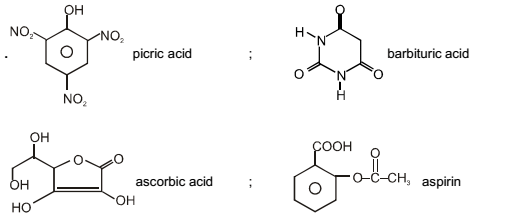
The carboxyl functional group (– COOH) is present in :

Detailed Solution: Question 16

General Organic Chemistry (GOC) - 1 - Question 17

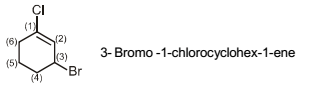
The IUPAC name of the compound 
 is ______.

Detailed Solution: Question 17

General Organic Chemistry (GOC) - 1 - Question 18

The correct IUPAC name for the compound
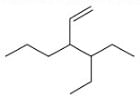
is ______.

Detailed Solution: Question 18

General Organic Chemistry (GOC) - 1 - Question 19

The correct IUPAC name for the compound

 is ______.

Detailed Solution: Question 19

General Organic Chemistry (GOC) - 1 - Question 20

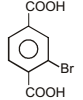
IUPAC name of the following molecule is

Detailed Solution: Question 20

The IUPAC name of the molecule is:

2-Bromobenzene-1,4-dicarboxylic acid.

The structure can be described as follows:

  • It features a bromine atom at the second position of the benzene ring.
  • Two carboxylic acid groups are attached at the first and fourth positions of the ring.

This specific arrangement gives the molecule its distinct chemical properties and influences its reactivity. The use of "1,4" indicates the positions of the carboxylic acid groups relative to the bromine substituent.

General Organic Chemistry (GOC) - 1 - Question 21

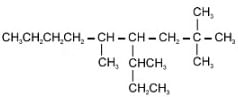
IUPAC name of the compound  is 

Detailed Solution: Question 21

The IUPAC name of the compound is:

2, 2, 5-Trimethyl-4-(1-methylpropyl) nonane.

  • This name indicates the structure of the compound.
  • It features a nonane backbone with specific methyl and propyl substituents.
  • Understanding the nomenclature helps in identifying the compound's molecular arrangement.

General Organic Chemistry (GOC) - 1 - Question 22

In above compound total number of 2º hydrogen atoms are :

Detailed Solution: Question 22


General Organic Chemistry (GOC) - 1 - Question 23

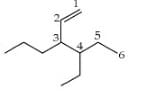
The IUPAC name of the following compound is - 
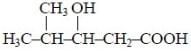
Detailed Solution: Question 23
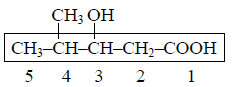
General Organic Chemistry (GOC) - 1 - Question 24

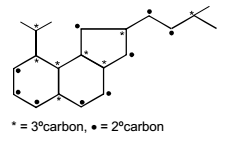
Number of 3º and 2º carbon atoms in the following compound are.
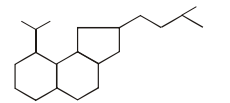
Detailed Solution: Question 24

General Organic Chemistry (GOC) - 1 - Question 25

Which of the following statements is not correct?

Detailed Solution: Question 25

Sigma bond is stronger than π-bond because of better overlap. All single bonds are σ bonds and all multiple bonds contain one σ and other π bonds.

General Organic Chemistry (GOC) - 1 - Question 26

Observe the following compound and write the number of hydrogen atom involved in hyperconjugation ?

Detailed Solution: Question 26

Understanding Hyperconjugation: Hyperconjugation involves the interaction of sigma (σ) bonds (typically C-H bonds) of alkyl groups directly attached to a positively charged carbon (C⁺) or an unsaturated system (like a double bond).

Structure Analysis:

  • In the given structure, the positively charged carbon (C⁺) is directly attached to two methyl groups (−CH₃) and a hydrogen atom.
  • Each −CH₃ group contributes 3 hydrogens for hyperconjugation.
  • The single hydrogen atom attached to the positively charged carbon also participates in hyperconjugation.

Total Hydrogens Involved:

  • Contribution from the two methyl groups: 3 + 3 = 6
  • Contribution from the single hydrogen atom on the positively charged carbon: 1
  • Total: 6 + 1 = 7

General Organic Chemistry (GOC) - 1 - Question 27

Which of the following groups cannot participate in resonance with benzene :
 

Detailed Solution: Question 27

Resonance and Benzene

Resonance in aromatic compounds like benzene involves the delocalisation of electrons. Certain groups can participate in this process, while others cannot.

  • The key factor determining participation in resonance is the presence of a vacant orbital.
  • Groups that lack a vacant orbital are unable to engage in resonance with benzene.
  • Among the groups provided, identify which one does not meet this criterion.

General Organic Chemistry (GOC) - 1 - Question 28

Among the following four compounds:

(i) Phenol

(ii) Methyl phenol

(iii) Meta-nitrophenol

(iv) Para-nitrophenol

The acidity order is:

Detailed Solution: Question 28

In phenols, the presence of electron releasing groups decreases the acidity, whereas the presence of electron withdrawing groups increases the acidity, compared to phenol. Among the meta and para-nitrophenols, the latter is more acidic as the presence of -NO₂ group at the para position stabilizes the phenoxide ion to a greater extent than when it is present at the meta position. Thus, the correct order of acidity is:

Para-nitrophenol > meta-nitrophenol > phenol > methyl phenol

General Organic Chemistry (GOC) - 1 - Question 29

Which of the following compounds will not show geometrical isomerism?

Detailed Solution: Question 29

Geometrical isomerism requires restricted rotation around a double bond and different groups on each carbon of the double bond.

  • CH3CH2CH=CH2​ does not show geometrical isomerism because one carbon of the double bond has two identical groups (H and H).

  • The other compounds have different groups on each carbon of the double bond, allowing geometrical isomerism.

General Organic Chemistry (GOC) - 1 - Question 30

In the compound CH3CH2CH(CH3)CH2CH3, how many primary (1°), secondary (2°), and tertiary (3°) carbon atoms are present?

Detailed Solution: Question 30

Answer: Option A.

Primary (1°) carbon is bonded to one other carbon.

Secondary (2°) carbon is bonded to two other carbons.

Tertiary (3°) carbon is bonded to three other carbons.

There are three methyl carbons (two terminal methyl groups and one methyl substituent). Each methyl carbon is bonded to one carbon, so there are 3 primary carbons.

There are two methylene carbons (each bonded to two carbons), so there are 2 secondary carbons.

There is one methine carbon bonded to three carbons, so there is 1 tertiary carbon.

Final count: 3 primary, 2 secondary, 1 tertiary → Option A.

335 videos|697 docs|300 tests
Information about General Organic Chemistry (GOC) - 1 Page
In this test you can find the Exam questions for General Organic Chemistry (GOC) - 1 solved & explained in the simplest way possible. Besides giving Questions and answers for General Organic Chemistry (GOC) - 1, EduRev gives you an ample number of Online tests for practice
Download as PDF