JEE Exam  >  JEE Test  >  Chemistry Main & Advanced  >  General Principles and Processes of Isolation of Metals - 2 - JEE MCQ

General Principles and Processes of Isolation Metals - 2 - Free MCQ Test


MCQ Practice Test & Solutions: General Principles and Processes of Isolation of Metals - 2 (30 Questions)

You can prepare effectively for JEE Chemistry for JEE Main & Advanced with this dedicated MCQ Practice Test (available with solutions) on the important topic of "General Principles and Processes of Isolation of Metals - 2". These 30 questions have been designed by the experts with the latest curriculum of JEE 2026, to help you master the concept.

Test Highlights:

  • - Format: Multiple Choice Questions (MCQ)
  • - Duration: 60 minutes
  • - Number of Questions: 30

Sign up on EduRev for free to attempt this test and track your preparation progress.

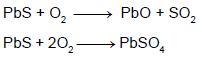
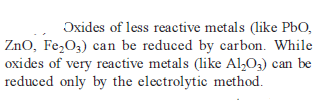
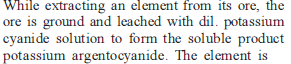
General Principles and Processes of Isolation of Metals - 2 - Question 1


Detailed Solution: Question 1


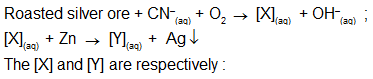
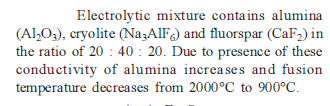
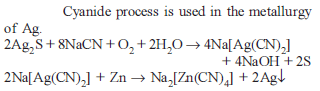
General Principles and Processes of Isolation of Metals - 2 - Question 2


Detailed Solution: Question 2


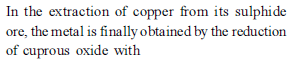
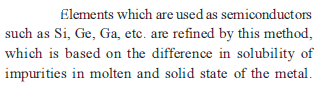
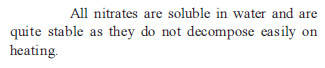
General Principles and Processes of Isolation of Metals - 2 - Question 3


Detailed Solution: Question 3


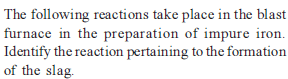
General Principles and Processes of Isolation of Metals - 2 - Question 4


Detailed Solution: Question 4


General Principles and Processes of Isolation of Metals - 2 - Question 5

Assertion : For the extraction of iron, haematite ore is used.
Reason : Haematite is a carbonate ore fo iron.

Detailed Solution: Question 5

Extration of Fe is done from Haematite or this is true but reason is strong as Haematitte is Fe2O3.
∴ Ans. 4

General Principles and Processes of Isolation of Metals - 2 - Question 6

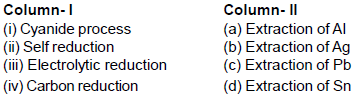
Match column (I) with column (II) and select the correct answer using codes given below in the lists.

Detailed Solution: Question 6

Cyanide process → Ag; Self reduction → Pb; Electrolytic reduction → Al, Carbon reduction → Sn.

General Principles and Processes of Isolation of Metals - 2 - Question 7

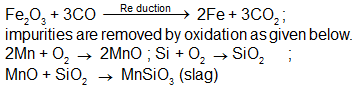
The chemical processes in the production of steel from haematite ore involve :

Detailed Solution: Question 7

General Principles and Processes of Isolation of Metals - 2 - Question 8


Detailed Solution: Question 8


General Principles and Processes of Isolation of Metals - 2 - Question 9

Which does not represent correct method ?

Detailed Solution: Question 9

Calcination.

General Principles and Processes of Isolation of Metals - 2 - Question 10

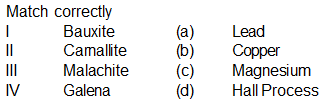
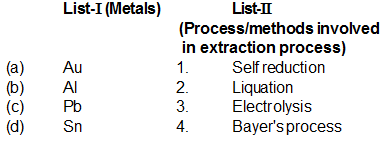
Match List-I with List-II and select the correct answer using the codes given below the lists.

Detailed Solution: Question 10

In the Bayer's process pure aluminium oxide is obtained from the bauxite ore. A low melting metal like tin can be refined by liquation method. Electrolysis is used in the refining of gold.

General Principles and Processes of Isolation of Metals - 2 - Question 11


Detailed Solution: Question 11


General Principles and Processes of Isolation of Metals - 2 - Question 12


Detailed Solution: Question 12


General Principles and Processes of Isolation of Metals - 2 - Question 13

Main function of frothers is:

General Principles and Processes of Isolation of Metals - 2 - Question 14


Detailed Solution: Question 14

(a) → van – Arkel method for Zr – Hg

→ Based on volatile nature of halides of methods.

General Principles and Processes of Isolation of Metals - 2 - Question 15

With respect to an ore, Ellingham diagram helps to predict the feasibility of its -

Detailed Solution: Question 15

Thermal reduction

Reduction by (C) and (CO)

General Principles and Processes of Isolation of Metals - 2 - Question 16

Among the following statements, the incorrect one is :

Detailed Solution: Question 16

(A) Calamine = ZnCO3 , Siderite = FeCO3

(B) Argentite = Ag2S and cuprite = Cu2O

(C) Zinc blende = ZnS, Pyrites = FeS2

(D) Malachite = CuCO3 Cu(OH)2 , Azurite = 2CuCO3 Cu(OH)2

General Principles and Processes of Isolation of Metals - 2 - Question 17


Detailed Solution: Question 17


General Principles and Processes of Isolation of Metals - 2 - Question 18

Main function of frothers is:

General Principles and Processes of Isolation of Metals - 2 - Question 19

Which does not represent correct method ?

Detailed Solution: Question 19

Calcination.

General Principles and Processes of Isolation of Metals - 2 - Question 20

The one that is not a carbonate ore is :

Detailed Solution: Question 20

Malachite = CuCO3. Cu(OH)2
Bauxite = Al2O3 . 2H2O or AlOx . (OH)3–2x (where D < x < 1)
Calamine = ZnCO3
Siderite = FeCO3
Ans is Bauxite option-2.

General Principles and Processes of Isolation of Metals - 2 - Question 21


Detailed Solution: Question 21


General Principles and Processes of Isolation of Metals - 2 - Question 22


Detailed Solution: Question 22


General Principles and Processes of Isolation of Metals - 2 - Question 23


Detailed Solution: Question 23


General Principles and Processes of Isolation of Metals - 2 - Question 24


Detailed Solution: Question 24


General Principles and Processes of Isolation of Metals - 2 - Question 25


Detailed Solution: Question 25


General Principles and Processes of Isolation of Metals - 2 - Question 26

NaCN is sometimes added in the froth flotation process as a depressant when ZnS and PbS minerals are expected because :

Detailed Solution: Question 26

ZnS + 4NaCN → Na2[Zn(CN)4] (soluble complex) + Na2S

General Principles and Processes of Isolation of Metals - 2 - Question 27

The chemical composition of “slag“ formed during the smelting process in the extraction of copper is :

Detailed Solution: Question 27
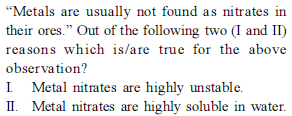
FeO + SiO2 → FeSiO3

General Principles and Processes of Isolation of Metals - 2 - Question 28


Detailed Solution: Question 28


General Principles and Processes of Isolation of Metals - 2 - Question 29

Which of the following statements is correct regarding the slag obtained during the extraction of a metal like copper or iron ?

General Principles and Processes of Isolation of Metals - 2 - Question 30

When haematite ore is burnt in air with coke along with lime at 200°C, the process not only produces steel but also produces an important compound (A), which is useful in making building materials. The compound (A) is

332 videos|699 docs|300 tests
Information about General Principles and Processes of Isolation of Metals - 2 Page
In this test you can find the Exam questions for General Principles and Processes of Isolation of Metals - 2 solved & explained in the simplest way possible. Besides giving Questions and answers for General Principles and Processes of Isolation of Metals - 2, EduRev gives you an ample number of Online tests for practice
Download as PDF