CBSE Class 7  >  Class 7 Test  >  Science (Old NCERT)  >  Important Questions Test: Respiration in Organisms - Class 7 MCQ

Respiration in Organisms - Free MCQ Test with solutions, Class 7 Science


MCQ Practice Test & Solutions: Important Questions Test: Respiration in Organisms (15 Questions)

You can prepare effectively for Class 7 Science Class 7 (Old NCERT) with this dedicated MCQ Practice Test (available with solutions) on the important topic of "Important Questions Test: Respiration in Organisms". These 15 questions have been designed by the experts with the latest curriculum of Class 7 2026, to help you master the concept.

Test Highlights:

  • - Format: Multiple Choice Questions (MCQ)
  • - Duration: 20 minutes
  • - Number of Questions: 15

Sign up on EduRev for free to attempt this test and track your preparation progress.

Important Questions Test: Respiration in Organisms - Question 1

Identify X in the given equation of aerobic respiration. 

Glucose + X  →  CO2 + H2O + Energy

Detailed Solution: Question 1

- The equation for aerobic respiration is: Glucose + Oxygen → CO2 + H2O + Energy.
- In this process, glucose (a sugar) reacts with oxygen.
- Oxygen is essential for breaking down glucose to release energy.
- The byproducts of this reaction are carbon dioxide and water.
- Therefore, in the equation, X represents oxygen, making it crucial for sustaining life through energy production.

Important Questions Test: Respiration in Organisms - Question 2

The following word equation shows a chemical process that take place in an organism Y. 

What is organism Y?

Detailed Solution: Question 2

The given word equation is:

Glucose → Ethyl alcohol + Carbon dioxide

This equation represents the process of fermentation, which is a type of anaerobic respiration where glucose is broken down without oxygen to produce ethyl alcohol (ethanol) and carbon dioxide.

Now, let's analyze the options:

  • Algae: Algae primarily perform photosynthesis and aerobic respiration, not fermentation producing ethanol and CO2.
  • Protozoan: Protozoans generally perform aerobic respiration and do not typically carry out fermentation producing ethanol.
  • Yeast: Yeast is a fungus known for carrying out fermentation. It converts glucose into ethanol and carbon dioxide anaerobically. This is the classic example of fermentation used in baking and alcohol production.
  • Hydra: Hydra is a multicellular aquatic organism that relies on aerobic respiration, not fermentation.

Conclusion: Organism Y, which carries out the fermentation process producing ethyl alcohol and carbon dioxide from glucose, is Yeast.

Final answer: Option C - Yeast

Important Questions Test: Respiration in Organisms - Question 3

What will happen when diaphragm relaxes and curves upwards?

Detailed Solution: Question 3

When structure diaphragm relaxes and curve upwards air is forced out of the lungs.

Important Questions Test: Respiration in Organisms - Question 4

The classification table given below shows how different organisms breathe.

Which of these organisms are correctly represented by X, Y and Z?   

Detailed Solution: Question 4

Option (a)
X = Tadpole with gills is correct.
Y = Whale with lungs is correct.
Z = Earthworm with skin is correct.
Therefore option (a) is fully correct.

Option (b)
X = Fish with gills is correct.
Y = Crocodile with lungs is correct.
Z = Cockroach with skin is wrong because cockroach breathes through tracheae, not skin.

Option (c)
X = Frog with gills is wrong because only tadpoles have gills, adult frogs use lungs and skin.
Y = Shark with lungs is wrong because sharks breathe with gills, not lungs.
Z = Toad with skin is wrong because toads mainly breathe with lungs and only partly through skin.

Option (d)
X = Prawn with gills is correct.
Y = Grasshopper with lungs is wrong because grasshoppers breathe through tracheae.
Z = Cockroach with skin is wrong because cockroaches also breathe through tracheae.

Thus the only correct option is (a).
Important Questions Test: Respiration in Organisms - Question 5

When we inhale, we breathe in air into the lungs. What do we breathe out when we exhale?

Detailed Solution: Question 5

During exhalation, the air we breathe out contains a higher concentration of carbon dioxide and less oxygen compared to inhaled air. This is due to the body expelling CO2 produced during cellular respiration.

Important Questions Test: Respiration in Organisms - Question 6

What is the function of the hair in the nose?

Detailed Solution: Question 6

The hair in the nose serves a crucial function.

  • It helps to trap dust particles and other foreign materials.

  • This filtering action assists in keeping the air we breathe cleaner.

  • Additionally, it aids in preventing irritants from reaching the lungs.

Overall, nasal hair plays a significant role in maintaining respiratory health.

Important Questions Test: Respiration in Organisms - Question 7

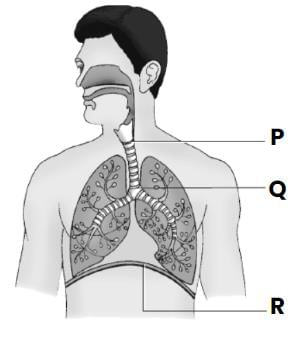
Identify the labelled parts P, Q and R in the figure given below. 

Detailed Solution: Question 7

The trachea, commonly known as the windpipe, is a tube about 4 inches long and less than an inch in diameter in most people. The trachea begins just under the larynx (voice box) and runs down behind the breastbone (sternum). The trachea then divides into two smaller tubes called bronchi: one bronchus for each lung.
The diaphragm is an unpaired, dome shaped skeletal muscle that is located in the trunk. It separates the thoracic and abdominal cavities from each other by closing the inferior thoracic aperture. The diaphragm is the primary muscle that is active in inspiration.

Important Questions Test: Respiration in Organisms - Question 8

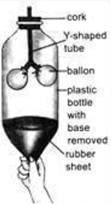
What will happen when the thin rubber sheet is pushed upwards?

Detailed Solution: Question 8

In the given experimental setup when the rubber sheet is pushed upwards air is forced out.

Important Questions Test: Respiration in Organisms - Question 9

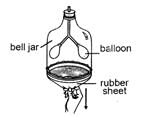
What will happen when the thin rubber sheet is pulled downwards as shown in figure given below? 

Detailed Solution: Question 9

When the thin rubber sheet is pulled downwards, the following occurs:

  • The balloons attached to the tube will inflate.
  • This happens because pulling the sheet downwards creates a vacuum inside the bottle.
  • The vacuum causes air to be drawn into the balloons, making them expand.
  • As the rubber sheet is pushed back up, the balloons will deflate due to the increased pressure.

This model effectively demonstrates the mechanism of breathing in humans, where the diaphragm's movement changes the volume of the chest cavity, allowing air to flow in and out.

Important Questions Test: Respiration in Organisms - Question 10

Which of the following organisms respire through tracheal system?

Detailed Solution: Question 10

  • The tracheal system is a network of tubes that transport air directly to the tissues.
  • Cockroaches and other insects use this system for respiration, allowing efficient gas exchange.
  • Earthworms respire through their skin, fish use gills, and frogs have lungs and skin for gas exchange.
  • Thus, among the options, only the cockroach relies on the tracheal system for respiration.

Important Questions Test: Respiration in Organisms - Question 11

Why do we get, muscle cramps after heavy exercise?

Detailed Solution: Question 11

Muscle cramps after heavy exercise are primarily caused by the accumulation of lactic acid. During intense physical activity, when oxygen levels are low, muscles rely on anaerobic respiration. In this process:

  • Glucose is partially broken down into lactic acid.
  • This leads to the buildup of lactic acid in the muscles.

This accumulation can cause:

  • Muscle fatigue
  • Cramps as it interferes with muscle function.

Important Questions Test: Respiration in Organisms - Question 12

Which of the following statements is correct for anaerobic respiration?

Detailed Solution: Question 12

Food is broken down in the absence of oxygen to form alcohol, carbon dioxide and energy in anaerobic respiration.

Important Questions Test: Respiration in Organisms - Question 13

An example of aerobes is

Detailed Solution: Question 13

Aerobes are organisms that require oxygen for their survival and growth. Cats, dogs, and human beings are examples of aerobes as they rely on aerobic respiration to generate energy.

Important Questions Test: Respiration in Organisms - Question 14

Which of these are parts of the human respiratory system?

(i) Larynx 

(ii) Nostrils

(iii) Gullet

(iv) Windpipe

(v) Lungs

Detailed Solution: Question 14

The human respiratory system includes:

  • Nostrils → for intake of air

  • Larynx → voice box/sound box, passage of air

  • Windpipe (trachea) → tube carrying air to lungs

  • Lungs → main organs of respiration

  • Gullet means the food pipe, medically called the oesophagus.It is a muscular tube that carries food and liquids from the mouth to the stomach during swallowing. It is not a part of respiratory system.

Therefore, (i), (ii), (iv) and (v) are the parts of human respiratory system.
So, Correct Option:B

Important Questions Test: Respiration in Organisms - Question 15

What happens when we breathe in?

(i) Size of our chest increases.

(ii)  Size of our chest decreases.

(iii) Carbon dioxide is removed from our body

(iv) Air enters our lungs.

Detailed Solution: Question 15

  • When we breathe in air.
  • Air enters lungs and there is an increase in the size of the chest.

112 videos|286 docs|28 tests
Information about Important Questions Test: Respiration in Organisms Page
In this test you can find the Exam questions for Important Questions Test: Respiration in Organisms solved & explained in the simplest way possible. Besides giving Questions and answers for Important Questions Test: Respiration in Organisms, EduRev gives you an ample number of Online tests for practice
112 videos|286 docs|28 tests
Download as PDF