JEE Exam  >  JEE Test  >  Mock Tests Main and Advanced 2026  >  JEE Main Practice Mock Test - 9 - JEE MCQ

JEE Main Practice Mock Test - 9 Free Online Test 2026


Full Mock Test & Solutions: JEE Main Practice Mock Test - 9 (75 Questions)

You can boost your JEE 2026 exam preparation with this JEE Main Practice Mock Test - 9 (available with detailed solutions).. This mock test has been designed with the analysis of important topics, recent trends of the exam, and previous year questions of the last 3-years. All the questions have been designed to mirror the official pattern of JEE 2026 exam, helping you build speed, accuracy as per the actual exam.

Mock Test Highlights:

  • - Format: Multiple Choice Questions (MCQ)
  • - Duration: 180 minutes
  • - Total Questions: 75
  • - Analysis: Detailed Solutions & Performance Insights
  • - Sections covered: Physics - Section A, Physics - Section B, Chemistry - Section A, Chemistry - Section B, Mathematics - Section A, Mathematics - Section B

Sign up on EduRev for free and get access to these mock tests, get your All India Rank, and identify your weak areas to improve your marks & rank in the actual exam.

JEE Main Practice Mock Test - 9 - Question 1

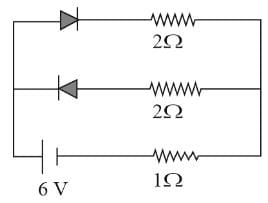
Find the current through 1 Ω resistance. (Assume diode to be ideal)
Detailed Solution: Question 1
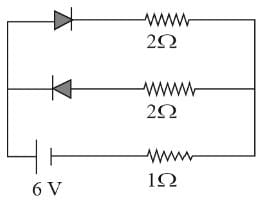
We are given a circuit, we need to find the current across  1 Ω resistance.

In the given figure, upper diode is in forward bias and lower diode is in reverse bias.

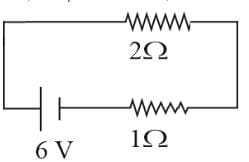
Thus, the equivalent circuit is,

In forward bias mode, diode behaves like  on state and in reverse bias mode, diode behaves like  off state.
Current through the circuit ,  I = V / R 
⇒I = 6 / 2 + 1 = 6 / 3 = 2 A

JEE Main Practice Mock Test - 9 - Question 2

A body of mass 32 kg is suspended by a spring balance from the roof of a vertically operating lift and going downward from rest. At the instants the lift has covered 20 m and 50 m, the spring balance showed 30 kg & 36 kg respectively. The velocity of the lift is:

Detailed Solution: Question 2
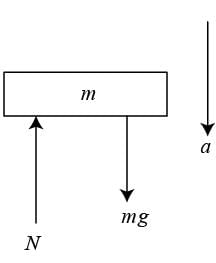
N = m(g − a),N < mg if a(↓) and N > mg if a (↑)
Reading of spring balance is less than m if a(↓) and reading of spring balance is

greater than m if a(↑)

JEE Main Practice Mock Test - 9 - Question 3

The temperature of 5 moles of a gas at constant volume is changed from 100C to 120C. The change in internal energy is 80 J. The total heat capacity of the gas at constant volume will be in J/K is :

Detailed Solution: Question 3

n = 5 moles, T₁ = 100°C

T₂ = 120°C, ΔU = 80 J

Rise in temperature Δt = 120 – 100 = 20°C

ΔU = msΔt

80 / 5 = 1 × s × 20

s = 0.8 J

∴ For 5 moles, s = 0.8 × 5 J/K

= 4 J/K

JEE Main Practice Mock Test - 9 - Question 4

A wheel of moment of inertia 2.5 Kg-m2 has an initial angular velocity of 40 rads −1. A constant torque of 10 Nm acts on the wheel. The time during which the wheel is accelerated to 60 rads−1 is

Detailed Solution: Question 4

Given, MI = 2.5 kg m⁻²

W = 40 rad s⁻¹

T = 10 Nm

As T = Iα

10 = 2.5α

α = 4 rad s⁻²

Now, ω = ω₀ + αt

60 = 40 + 4 × t

20 = 4t

t = 5 s

JEE Main Practice Mock Test - 9 - Question 5

A plank is held at an angle α to the horizontal on two fixed supports A and B. The plank can slide against the supports (without friction) because of its weight Mg. Acceleration and direction in which a man of mass m should move so that the plank does not move is:

Detailed Solution: Question 5
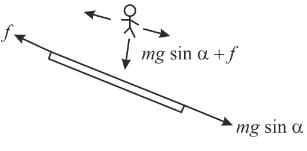
F.B.D. of man and plank are


For plank to be at rest, applying Newton's second law to plank along the incline
Mgsinα = f                   ...(1)
and applying Newton's second law to man along the incline.
mgsinα + f = ma           ...(2)
a = gsinα(1 + M/m)down the incline

JEE Main Practice Mock Test - 9 - Question 6

A simple pendulum of length l is suspended from the ceiling of a cart which is sliding without friction on an inclined plane of inclination θ. What will be the time period of the pendulum?

Detailed Solution: Question 6

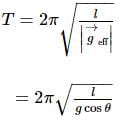
Here, the point of suspension has an acceleration.  (down the plane). Further,  can be resolved into two components gsinθ (along the plane) and gcosθ (perpendicular to the plane).
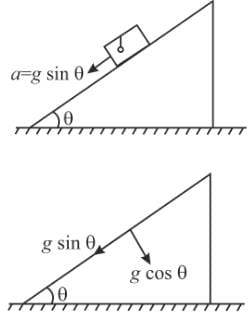
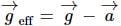
= gcosθ (perpendicular to plane)

JEE Main Practice Mock Test - 9 - Question 7

In the adjacent diagram, CP represents a wavefront and AO & BP, the corresponding two rays. Find the condition of θ for constructive interference at PP between the ray BP and reflected ray OP.
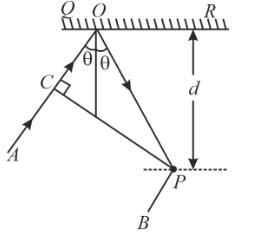
Detailed Solution: Question 7
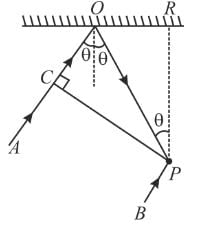
PR = d
∴ PO = d sec θ
and CO = PO cos 2θ = d sec θ cos 2θ
Path difference between the two rays is,
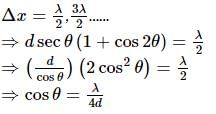
Δx = PO + OC = (d sec θ + d sec θ cos 2θ)
Phase difference between the two rays is
Δϕ = π (one is reflected, while another is direct)
Therefore, the condition for constructive interference should be,

JEE Main Practice Mock Test - 9 - Question 8

An unknown frequency x produces 8 beats per second with a frequency of 250 Hz and 12 beats per second with 270 Hz source. Then x is

Detailed Solution: Question 8

The beat frequency is given as |f₁ - f₂|.
With 250 Hz, x produces 8 beats per second.
⇒ |250 - x| = 8
⇒ 250 - x = ±8
⇒ x = 242 Hz or 258 Hz ...(1)
Also, x produces 12 beats per second with 270 Hz.
⇒ |270 - x| = 12
⇒ 270 - x = ±12
⇒ x = 258 Hz or 282 Hz ...(2)
From (1) and (2), we get:
x = 258 Hz

JEE Main Practice Mock Test - 9 - Question 9

A biconvex lens of focal length 40 cm is placed in front of an object at a distance of 20 cm. Now a slab of refractive index 4/3 is placed somewhere in between the lens and the object. The shift in the image formed after the introduction of slab equals (Thickness of the slab is 2 mm )

Detailed Solution: Question 9

Before the slab is introduced:
f = 40 cm, u = -10 cm
1/v - 1/u = 1/f
1/v + 1/20 = 1/40
v = -40 cm
The shift in the image of O due to the slab:
du = t (1 - 1/μs)
= 2 (1 - 3/4)
= 12 mm = 0.5 mm
Also,
dv/du = v²/u²
dv = (v²/u²) * du
(40/20)² * du = 4 × 0.5 mm
= 2 mm

JEE Main Practice Mock Test - 9 - Question 10

If 2 kg mass is rotating on a circular path of radius 0.8 m with angular velocity of 44 rad s−1. If radius of the path becomes 1 m, then what will be the value of angular velocity?

Detailed Solution: Question 10

Given:

  • Mass (m) = 2 kg
  • Initial radius of the path (r₁) = 0.8 m
  • Initial angular velocity (ω₁) = 44 rad/s
  • Final radius of the path (r₂) = 1 m

Moment of inertia calculations:

  • I₁ = m r₁² = 2 × (0.8)² = 1.28 kg·m²
  • I₂ = m r₂² = 2 × (1)² = 2 kg·m²

Using the law of conservation of angular momentum:
I₁ω₁ = I₂ω₂
Solving for ω₂:
ω₂ = (I₁ × ω₁) / I₂ = (1.28 × 44) / 2
ω₂ = 28.16 rad/s-1

JEE Main Practice Mock Test - 9 - Question 11

A block of mass m is connected rigidly with a smooth wedge (plank) by a light spring of stiffness k. If the wedge is moved with constant velocity v0, find the work done by the external agent till the maximum compression of the spring.
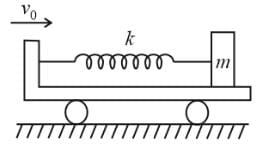
Detailed Solution: Question 11
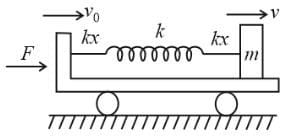
Let us take wedge + spring + block as a system. The forces responsible for performing work are spring force kx and the external force F.

Work Energy theorem for block + plank relative to ground :
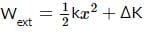
Applying work-energy theorem, we have Wext + Wsp = ΔK
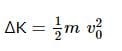
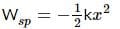
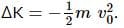
where Wsp the total work done by the spring on wedge and block −1/2kx2 and ΔK = change in KE of the block (because the plank does not change its kinetic energy)
Then,

As the block was initially stationary and it will acquire a velocity v0 equal to that of the plank at the time of maximum compression of the spring, the change in kinetic energy of the block relative to ground is

Substituting ΔK in the above equation, we have

W-E theorem for block+ plank relative to the plank Wext + Wsp = DK The plank moves with constant velocity, there is no pseudo-force acting on the block. Wext = O Then the net work done on the system (block + plank), due to the spring, can be given as

As the relative velocity between the observer (plank) and block decreases from v0 to zero at the time of maximum compression of the spring, the change in kinetic energy of the block is 
Substituting WsP and ΔK in above equation

JEE Main Practice Mock Test - 9 - Question 12

The speed of light (c), gravitational constant (G) and Planck’s constant (h) are taken as fundamental units in a system. The dimensions of time in this new system should be:

Detailed Solution: Question 12
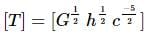
Let time, T ∝ cX GY hZ

⇒ T = k cX GY hZ

Taking dimensions on both sides:

[M⁰ L⁰ T¹] = [L T⁻¹]X [M⁻¹ L³ T⁻²]Y [M L² T⁻¹]Z

i.e.,

[M⁰ L⁰ T¹] = [MY+Z L(X+3Y+2Z) T(-X-2Y-Z)]

Equating powers of M, L, and T on both sides, we get:

  1. -Y + Z = 0 ...(1)
  2. X + 3Y + 2Z = 0 ...(2)
  3. -X - 2Y - Z = 1 ...(3)

From equation (1):
Y = Z

Adding (2) and (3):
Y + Z = 1

Since Z = Y, we get:
2Y = 1
∴ Z = Y = 1/2

Substituting these values in (2):
X + 3(1/2) + 1 = 0
X + 3/2 + 1 = 0
X = -5/2
Hence, 

*Answer can only contain numeric values
JEE Main Practice Mock Test - 9 - Question 13

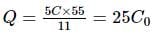
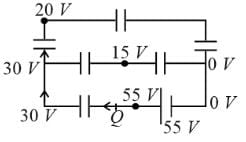
In the arrangement shown in figure, find the potential difference VB − VA(in V). (Take V0 = 55)
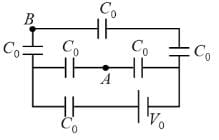

Detailed Solution: Question 13
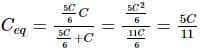


JEE Main Practice Mock Test - 9 - Question 14

Mg(OH)₂ is precipitated when NaOH is added to a solution of Mg²⁺. If the final concentration of Mg²⁺ is 10⁻¹⁰ M, the concentration of OH⁻ (M) in the solution is:
[Solubility product for Mg(OH)₂ = 5.6 × 10⁻¹²]

Detailed Solution: Question 14

In the saturated solution of a sparingly soluble electrolyte, the ionic product of ions is constant at constant temperature and it is known as the Solubility Product.

Here,
Mg(OH)₂ → [Mg²⁺] + [OH⁻]²

Given,
Kₛₚ for Mg(OH)₂ = 5.6 × 10⁻¹²

[Mg²⁺] = 10⁻¹⁰ M

Substituting the value, we get:

Kₛₚ = [Mg²⁺] [OH⁻]² ⇒ 5.6 × 10⁻¹² = [10⁻¹⁰] [OH⁻]² ⇒ OH⁻ = 0.24 M

Hence, the concentration of [OH⁻] = 0.24 M

JEE Main Practice Mock Test - 9 - Question 15

2 g of a non-electrolyte solute (molar mass is 500 g mol−1 ) was dissolved in 57.3 g of xylene. If the freezing point depression constant Kf of xylene is 4.3 K kg mol−1. Then, the depression in freezing point of xylene is..........

Detailed Solution: Question 15

ΔTf = K_f × (w₁ × 1000) / (w₂ × m₁)

w₁ = weight of solute  
w₂ = weight of solvent  
m₁ = molar mass of solute  
Kf = 4.3 K kg mol⁻¹  

Now,  
ΔTf = 4.3 × (2 × 1000) / (57.3 × 500)  

= 17.2 / 57.3 = 0.30 K

JEE Main Practice Mock Test - 9 - Question 16

The electronic configurations for some neutral atoms are given below:
(I) 1s², 2s² 2p⁶, 3s²
(II) 1s², 2s² 2p⁶, 3s¹
(III) 1s², 2s² 2p⁶, 3s² 3p²
(IV) 1s², 2s² 2p⁶, 3s² 3p³
Which of these is expected to have the highest second ionisation enthalpy?

Detailed Solution: Question 16

B atom after losing outermost electron acquires noble gas configuration (stable configuration). It is difficult to remove the next electron from B+(1s2, 2s2 2p6) ion.

JEE Main Practice Mock Test - 9 - Question 17

Select the compound which cannot act as an oxidising agent and reducing agent?

Detailed Solution: Question 17

In HClO4,Cl is at maximum oxidation state so can't act as reducing agent.

JEE Main Practice Mock Test - 9 - Question 18

More number of oxidation states are exhibited by the actinoids than those by the Lanthanoids, the main reason being

Detailed Solution: Question 18

Actinoids show different oxidation states such as +2, +3, +4, +5, +6 and +7. However, +3 oxidation state is most common among all the  lanthanoids. The wide range of oxidation states of actinoids is attributed to the fact that the 5f ,6d and 7s energy levels are of comparable energies. Therefore, all these three subshells can participate.

JEE Main Practice Mock Test - 9 - Question 19

Which of the given statement is correct?

Detailed Solution: Question 19

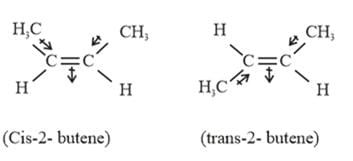
Boiling point of Cis−2−butene is more than trans−2−butene

Cis −2− butene is polar so boiling point is increase.
trans−2− butene is non polar because dipole moment is zero so boiling point is less.

JEE Main Practice Mock Test - 9 - Question 20

A graph plotted between log k versus 1/T for calculating activation energy is shown by:

Detailed Solution: Question 20
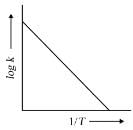
A graph plotted between  log k versus 1/T for calculating activation energy is shown as:

From the Arrhenius equation

Comparing with the equation of straight line, y = mx + c, we get a straight line having positive intercept on y-axis and negative slope.

*Answer can only contain numeric values
JEE Main Practice Mock Test - 9 - Question 21

If 5.79 A current for 20000 sec. is passed in electrolysis of 0.3 molar, 1 litre CuSO4 (aq) using Pt electrode then ratio of volume of gas liberated at cathode and anode at STP is x:1. The value of x is


Detailed Solution: Question 21

nₑ = (5.79 × 20000) / 96500 = 1.2 mole

Cathode:

Cu⁺² + 2e⁻ → Cu
0.3 mole ⇒ 0.6 mole

2H₂O(l) + 2e⁻ → H₂ ↑ + 2OH⁻
0.6 mole ⇒ 0.3 mole

Anode:

2H₂O(l) → O₂ + 4H⁺ + 4e⁻
1.2 mole

VO₂ = (1.2 / 4) = 0.3 mole

VH₂ / Vₒ₂ = 0.3 / 0.3 = 1

*Answer can only contain numeric values
JEE Main Practice Mock Test - 9 - Question 22

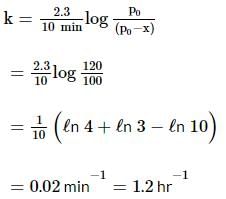
The gaseous decomposition reaction, A(g) → 2B(g) + C(g) is observed to be first order over the excess of liquid water at 25°C. It is found that after 10 minutes, the total pressure of the system is 188 torr, and after a very long time, it is 388 torr. The rate constant of the reaction (in hr⁻¹) is x /10, then the value of x is (nearest integer).
[Given: Vapor pressure of H₂O at 25°C is 28 torr]
(ln 2 = 0.7, ln 3 = 1.1, ln 10 = 2.3)


Detailed Solution: Question 22
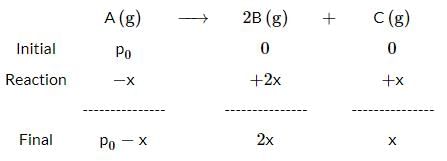


The sum of partial pressures is given by:
Σpartial pressures = p0 − x + 2x + x + 28(Vapor pressure of moisture)
= p0 + 2x + 28 = 188
⇒p0 + 2x = 160 mm Hg   (i)
After a long time, when PA = 0, we have:
PB = 2P0 and PC = P0
So,

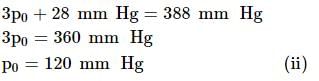
From equation (i) & (ii), we get,
∴  x = 20 mm Hg

JEE Main Practice Mock Test - 9 - Question 23

If the foot of the perpendicular from the point A(p + 1, -1, 11) on the line x/2 = (y - 2)/3 = (z - 3)/4 is B(q, 5, 7) then the value of (p - q) is ...

Detailed Solution: Question 23

Point on the line = (2t, 2 + 3t, 3 + 4t)

Equating to B(q, 5, 7), we get t = 1 and hence q = 2

∴ B = (2, 5, 7)

D.R.s of AB are (p - 1, -6, 4)

AB is perpendicular to the line ⇒ (p - 1)(2) + (-6)(3) + (4)(4) = 0

∴ p = 2 and p - q = 0

JEE Main Practice Mock Test - 9 - Question 24

A relation R is defined as (x, y) ∈ R ⇒ xʸ = yˣ for x, y ∈ I - {0}, where I is the set of all integers. Then the relation R is:

Detailed Solution: Question 24

∴ (x, y) ∈ R ⇒ xʸ = yˣ

∴ (x, x) ∈ R as xˣ = xˣ ∀ x ∈ I - {0}

∴ R is reflexive

Now, (x, y) ∈ R ⇒ xʸ = yˣ ⇒ yˣ = xʸ

⇒ (y, x) ∈ R ∴ R is symmetric

Now, (x, y) ∈ R ⇒ xʸ = yˣ and (y, z) ∈ R ⇒ yᶻ = zʸ

∴ xʸ = yˣ ⇒ y = xʸ / x and yᶻ = zʸ

⇒ yᶻ = zʸ ⇒ (xʸ / x) ᶻ = zʸ

⇒ xʸᶻ = z ʸᶻ / x = zˣ

⇒ xʸᶻ ≠ zˣ² ⇒ (x, z) ∉ R

R is not transitive.

JEE Main Practice Mock Test - 9 - Question 25

Let A = {1, 2, 3, 4}. Let R be a relation on A defined by xRy if and only if x ≤ 2y.
Let m be the total number of elements in R.
Let n be the minimum number of elements to be added to make R symmetric, and p be the minimum number of elements to be added to make R reflexive.
Find m  2n + p.

Detailed Solution: Question 25

R = {(1, 1),(1, 2),(1, 3),(1, 4),
(2, 1),(2, 2),(2, 3),(2, 4),
(3, 2),(3, 3),(3, 4)
(4, 2),(4, 3),(4, 4)}
So, m = 14
To make R symmetric, we need to add (3, 1) and (4, 1).
So, n = 2
Since, R is already reflexive, p = 0

JEE Main Practice Mock Test - 9 - Question 26

Let a, b, c > 1, and a³, b³, c³ be in A.P. Also, given that logₐb, logcₐ, and logbₐ are in G.P., we set:
If the sum of the first 20 terms of an A.P., whose first term is a + 4b + c/3 and the common difference is a - 8b + c/10, is -444, then the value of abc is:

Detailed Solution: Question 26

Let a, b, c > 1, and a³, b³, c³ be in A.P.
This implies:
2b³ = a³ + c³
Also, given that logₐb, logcₐ, and logbₐ are in G.P., we set:
(logₐb)(logbₐ) = (logcₐ)²
Now, the sum of the first 20 terms of an A.P. is given by:
S₂₀ = (20/2) [2(a + 4b + c/3) + 19(a - 8b + c/10)]
Setting this equal to -444 and solving for abc, we get:
abc = 216
Thus, the correct answer is B) 216.

JEE Main Practice Mock Test - 9 - Question 27

Two medians drawn from acute angles vertices of a right angled triangle intersects at an angle π/6. If the length of the hypotenuse of the triangle is 3units, then area of the triangle (in sq. units) is

Detailed Solution: Question 27
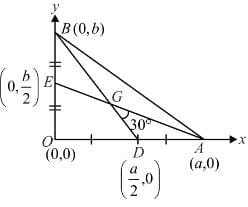

Let the sides of the right-angle triangle be coinciding with the coordinate axes and the vertices of △OAB be O(0, 0), A(a, 0) & B(0, b).
Also, let BD & AE are the medians cutting the sides at D & E.
So, coordinates of D = (a/2, 0) & E = (0, b/2).
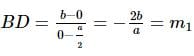
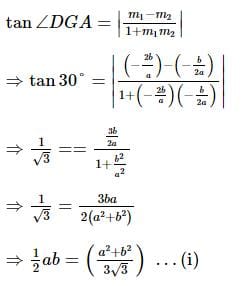
Now Slope of (let say)
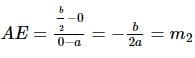
Also, slope of (let say)

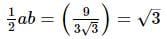
Since, by Pythagoras theorem in △OAB,

Putting equations (ii) in equation (i), we get


Hence, area of triangle is √3 Sq. units

JEE Main Practice Mock Test - 9 - Question 28

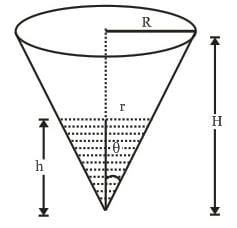
A right circular cone with radius R and height H contains a liquid which evaporates at a rate proportional to its surface area in contact with air (proportionality constant = k > 0). The time after which the cone is empty is

Detailed Solution: Question 28
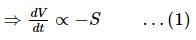
Given, liquid evaporates at a rate proportional to its surface are.

We know, volume of cone = 13πr2h


The surface area is given by:
S = πr²
The volume is given by:
V = (1/3) πr²h
Also, we have:
tanθ = R / H
and r / h = tanθ
From equations (2) and (3), we get:
V = (1/3) πr³ cotθ
and S = πr³
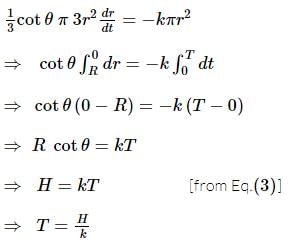
On substituting Eq. (4) into Eq. (1), we get:

∴ Required time after which the cone is empty, T = H/k

*Answer can only contain numeric values
JEE Main Practice Mock Test - 9 - Question 29

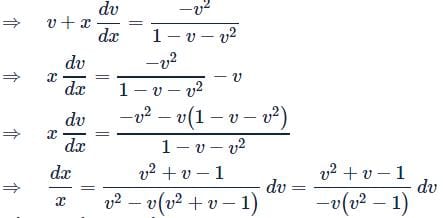
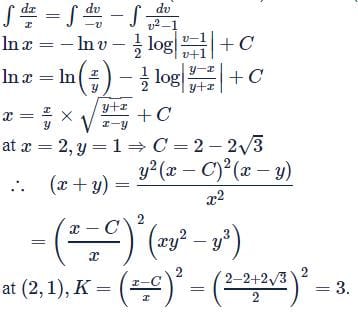
If the solution for the differential equation y² dx + (x² - xy - y²) dy = 0 at (2,1) is x + y = k(xy² - y³), then k = ?


Detailed Solution: Question 29
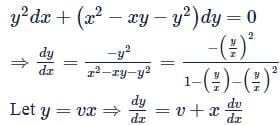
*Answer can only contain numeric values
JEE Main Practice Mock Test - 9 - Question 30

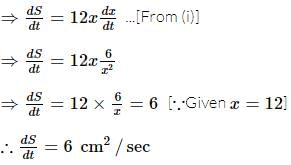
The volume of a cube is increasing at the rate of 18 cm3 per second. When the edge of the cube is 12 cm, then the rate in cm2/s at which the surface area of the cube increases, is


Detailed Solution: Question 30

Let, x be the length of an edge, V be the volume and S be the surface area of the cube.

S = 6x2

View more questions
360 docs|100 tests
Information about JEE Main Practice Mock Test - 9 Page
In this test you can find the Exam questions for JEE Main Practice Mock Test - 9 solved & explained in the simplest way possible. Besides giving Questions and answers for JEE Main Practice Mock Test - 9, EduRev gives you an ample number of Online tests for practice
Download as PDF