SSC CGL Exam  >  SSC CGL Test  >  Quantitative Aptitude  >  MCQ: Cone - 1 - SSC CGL MCQ

Cone - 1 - Free MCQ Practice Test with solutions, SSC CGL Quant Aptitude


MCQ Practice Test & Solutions: MCQ: Cone - 1 (10 Questions)

You can prepare effectively for SSC CGL Quantitative Aptitude for SSC CGL with this dedicated MCQ Practice Test (available with solutions) on the important topic of "MCQ: Cone - 1". These 10 questions have been designed by the experts with the latest curriculum of SSC CGL 2026, to help you master the concept.

Test Highlights:

  • - Format: Multiple Choice Questions (MCQ)
  • - Duration: 10 minutes
  • - Number of Questions: 10

Sign up on EduRev for free to attempt this test and track your preparation progress.

MCQ: Cone - 1 - Question 1

The height of a right circular cone is trisected by two planes parallel to its base at equal distances. The volumes of the three solids, so obtained, starting from the top, are in the ratio:

Detailed Solution: Question 1
The height of a right circular cone is trisected by two planes parallel to its base at equal distances.

Formula used:

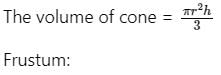
Cone:


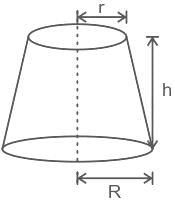
The volume of frustum

Calculation:

According to the question, the required figure is:

Now, 

The volume of the cone AB''D'',

The volume of frustum cone B'D'BD,


The required ratio 

∴ 1 : 7 : 19 is the requried ratio.

MCQ: Cone - 1 - Question 2

What is the total surface area of a cone whose radius is 10 cm, and height is 24 cm?

Detailed Solution: Question 2
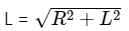
Given:

Radius of the cone = 10 cm

Height of the cone = 24 cm

Formula:

Total surface of area of a cone = πR(L + R)

Where, R = Radius of the base, H = Height of the cone,

L = Slant height of the cone

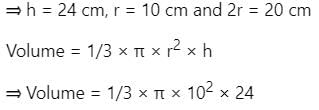
Calculation:

Total surface area of the cone

⇒ π x 10 x (26 + 10)

⇒ 22/7 x 10 x 36

⇒ 7920/7 = 1131.428 ≈ 1131.43 cm2

∴ The total surface area of the cone is 1131.43 cm2.

MCQ: Cone - 1 - Question 3

A cone of slant height 26 cm. The height and radius of the cone are in ratio 12:5. Find the height, twice the radius, and volume of the cone.

Detailed Solution: Question 3

The slant height of cone (l) = 26 cm

The volume of cone = 800π cm3

The ratio of height (h) and radius (r) = 12 : 5

Concept used:

The volume of the cone = 1/3 x π x r2 x h

l2 = r2 + h2

Calculation:

Let the height and radius be 12x and 5x


∴ Volume is 800π cm3

MCQ: Cone - 1 - Question 4

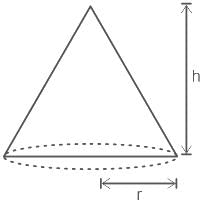
A conical tent of canvas is to be made whose radius of the base is 14 m, and its height is 48 m. How many meters of canvas will be required if the width of the canvas is 8 m?

Detailed Solution: Question 4
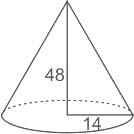
Given:

Radius = 14m

Height = 48m

Width of the canvas = 8m

Formula used:

Pythagoras Theorem,

Slant height2 = Radius2 + Height2

Curved Surface area of the cone = π r l [ where r is radius and l is slant height]

Calculation:

Curved Surface area of the cone = π r l


Canvas required if the width is 8m,

= 2200 / 8
= 275
Answer is 275.

MCQ: Cone - 1 - Question 5

A cone of radius 5 cm and height is 12 cm. Find the ratio of curved surface area to the base area of the cone.

Detailed Solution: Question 5
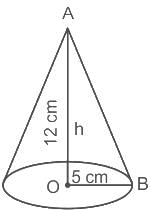
Given:

Radius of cone = 5 cm
Height of cone = 12 cm

Formula:

Curved surface area of cone = πrl
Base area of cone = πr2
l2 = r2 + h2

Calculation:

In an Δ OAB, using Pythagoras' theorem,

⇒ l2 = r2 + h2

⇒ l2 = 52 + 122

⇒ l2 = 25 + 144

⇒ l = √169

⇒ l = 13 cm

Required ratio = πrl : πr2

⇒ l : r

⇒ 13 : 5

MCQ: Cone - 1 - Question 6

he volume of frustum of a cone is 13244 m3. If the radius of the top circular surface is 9 m and the radius of the other circular surface is 11 m, then find the height of the frustum of a cone. (in m) (Take π = 22/7)

Detailed Solution: Question 6

Given:

The volume of frustum of a cone is 13244 m3.
The radius of the top circular surface is 9 m.
The radius of the other circular surface is 11 m.

Formula used:

Volume of frustum of a cone  


Where, 

The radius of the top circular surface is r.
The radius of the bottom circular surface is R.
The height of the frustum of a cone is h.

Calculation:

According to the question, the required figure is:

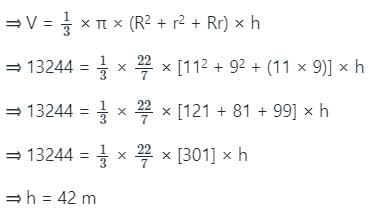
Let V be the volume of the frustum of a cone.

According to the question,

∴ The height of the frustum of a cone is 42 m.

MCQ: Cone - 1 - Question 7

If the curved surface area of a cone is 90% of the total surface area of the cone, then the volume of the cone is how much times the cube of the height of the cone?

Detailed Solution: Question 7

Let the radius, height and slant height of cone be ‘r’, ‘h’ and ‘l’ units respectively
Given, curved surface area = 90% of Total surface area of cone
⇒ πrl = (9/10) × πr(l + r)
⇒ 10l = 9l + 9r
⇒ l = 9r
Also, l2 = h2 + r2
⇒ 81r2 = h2 + r2
⇒ h2 = 80r2
⇒ r2 = h2/80
Now,
Volume of cone = (1/3)πr2h
⇒ Volume of cone = π/3 x h2/80 c h
⇒ Volume of cone = (π/240) x h3
∴ The volume of cone is (π/240) times the cube of the height of the cone

MCQ: Cone - 1 - Question 8

A frustum has a top radius of 20 cm and bottom diameter of 60 cm. The height of this frustum is 40 cm. Now, a right circular cone is to be filled over this frustum so that the structure formed is a right circular cone. What should be the height of the cone that is to be filled?

Detailed Solution: Question 8

Given:

Top radius of frustum (r1) = 20 cm
Bottom radius of frustum (r2) = 60/2 = 30 cm (as diameter is given)
Height of frustum (h1) = 40 cm

Calculation:

The ratio of height to radius

∴ The height of the cone that is to be filled should be 80 cm.

MCQ: Cone - 1 - Question 9

What is the volume of a tumbler having a height of 21 cm and the radii of both circular ends are 15 cm and 7 cm?

Detailed Solution: Question 9

Given:

Height =  21 cm
R = 15 cm
r = 7 cm

Formula:

Calculation:


∴ The volume of a tumbler 8338 cm3 

MCQ: Cone - 1 - Question 10

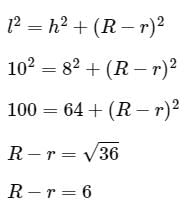
The slant height of a frustum of cone is 10 cm. If the height of the frustum is 8 cm, then find the difference of the radii of its two circular ends?

Detailed Solution: Question 10

The slant height of a frustum of cone is 10 cm and the height of the frustum is 8 cm.

Calculation:

We know, the relationship between slant height, height and radius

Let R and r be the radius of two circular ends.

Slant height is l = 10 cm

Height is h = 8 cm

Therefore, The difference of radii of its two circular ends is 6 cm.

319 videos|366 docs|157 tests
Information about MCQ: Cone - 1 Page
In this test you can find the Exam questions for MCQ: Cone - 1 solved & explained in the simplest way possible. Besides giving Questions and answers for MCQ: Cone - 1, EduRev gives you an ample number of Online tests for practice
Download as PDF