SSC CGL Exam  >  SSC CGL Test  >  Quantitative Aptitude  >  MCQ: Table Charts - 2 - SSC CGL MCQ

Table Charts - 2 - Free MCQ Practice Test with solutions, SSC CGL Quant


MCQ Practice Test & Solutions: MCQ: Table Charts - 2 (15 Questions)

You can prepare effectively for SSC CGL Quantitative Aptitude for SSC CGL with this dedicated MCQ Practice Test (available with solutions) on the important topic of "MCQ: Table Charts - 2". These 15 questions have been designed by the experts with the latest curriculum of SSC CGL 2026, to help you master the concept.

Test Highlights:

  • - Format: Multiple Choice Questions (MCQ)
  • - Duration: 15 minutes
  • - Number of Questions: 15

Sign up on EduRev for free to attempt this test and track your preparation progress.

MCQ: Table Charts - 2 - Question 1

The following table gives the percentage distribution of population of five states, P, Q, R, S and T on the basis of poverty line and also on the basis of sex.
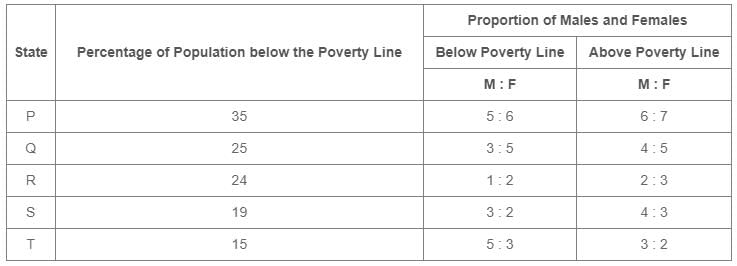
Q. If the male population above poverty line for State R is 1.9 million, then the total population of State R is?

Detailed Solution: Question 1
Let the total population of State R be x million.

Then, population of State R above poverty line

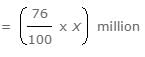
    = [(100 - 24)% of x] million

And so, male population of State R above poverty line

But, it is given that male population of State R above poverty line = 1.9 million.

∴ Total population of State R = 6.25 million.

MCQ: Table Charts - 2 - Question 2

The following table gives the percentage distribution of population of five states, P, Q, R, S and T on the basis of poverty line and also on the basis of sex.
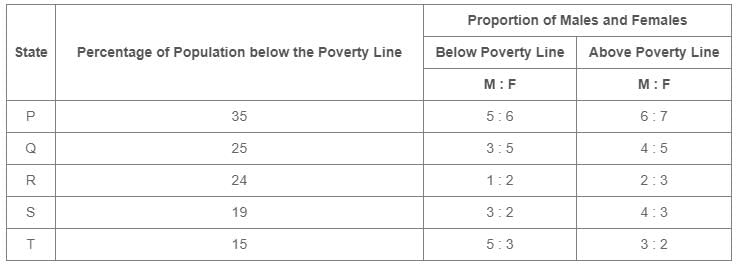
Q. What will be the male population above poverty line for State P if the female population below poverty line for State P is 2.1 million?

Detailed Solution: Question 2

Female population below poverty line for State P = 2.1 million

Let the male population below poverty line for State P be x million.

∴ Population below poverty line for State P = (2.1 + 1.75) million = 3.85 million.

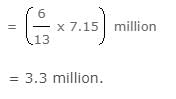
Let the population above poverty line for State P by y million.

Since, 35% of the total population of State P is below poverty line, therefore, 65% of the total population of State P is above poverty line i.e., the ratio of population below poverty line to that above poverty line for State P is 35 : 65.


∴ Population above poverty line for State P = 7.15 million and so, male population above poverty line for State P

MCQ: Table Charts - 2 - Question 3

The following table gives the percentage distribution of population of five states, P, Q, R, S and T on the basis of poverty line and also on the basis of sex.

Q. If the population of males below poverty line for State Q is 2.4 million and that for State T is 6 million, then the total populations of States Q and T are in the ratio?

Detailed Solution: Question 3

For State Q:

Male population below poverty line = 2.4 million.

Let the female population below poverty line be x million.

∴ Total population below poverty line = (2.4 + 4) = 6.4 million.

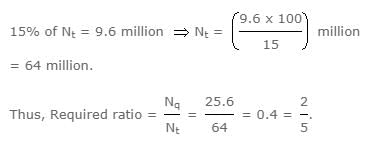
If Nq be the total population of State Q, then,

= 25.6 million.

For State T:

Male population below poverty line = 6 million.

Let the female population below poverty line be y million.

∴ Total population below poverty line = (6 + 3.6) = 9.6 million.

If Nt be the total population of State T, then,

MCQ: Table Charts - 2 - Question 4

The following table gives the percentage distribution of population of five states, P, Q, R, S and T on the basis of poverty line and also on the basis of sex.
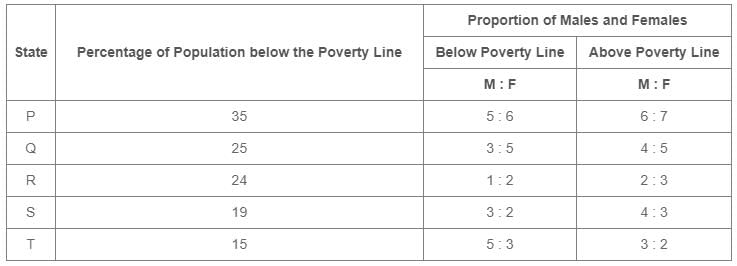
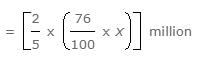
Q. What will be the number of females above the poverty line in the State S if it is known that the population of State S is 7 million?

Detailed Solution: Question 4
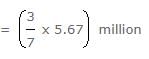
Total population of State S = 7 million.

∴ Population above poverty line

    = [(100 - 19)% of 7] million

    = (81% of 7) million

    = 5.67 million.

And so, the number of females above poverty line in State S

= 2.43 million.

MCQ: Table Charts - 2 - Question 5

A school has four sections A, B, C, D of Class IX students.
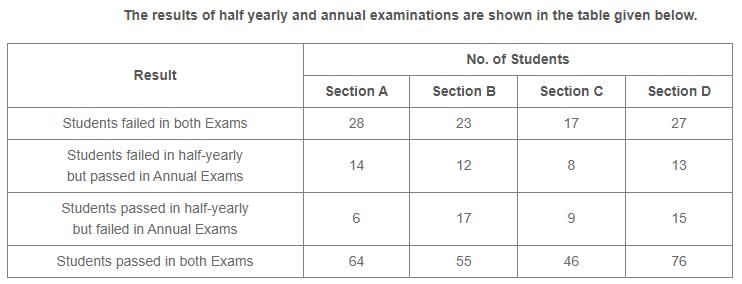
Q. Which section has the maximum success rate in annual examination?

Detailed Solution: Question 5
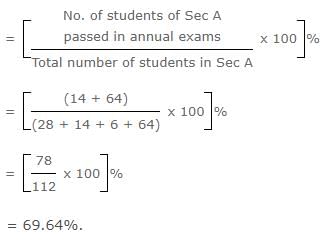
Total number of students passed in annual exams in a section

= [ (No. of students failed in half-yearly but passed in annual exams) + (No. of students passed in both exams)] in that section

∴ Success rate in annual exams in Section A

Similarly, success rate in annual exams in:

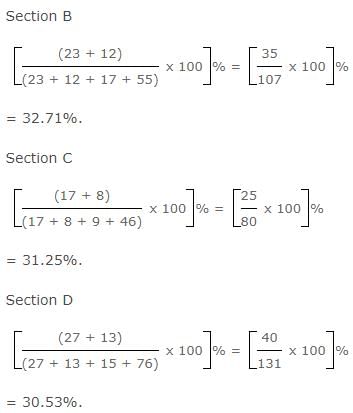
Section B

Clearly, the success rate in annual examination is maximum for Section A.

MCQ: Table Charts - 2 - Question 6

A school has four sections A, B, C, D of Class IX students.
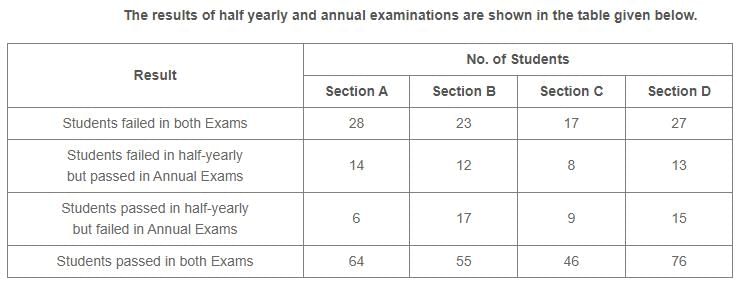
Q. Which section has the minimum failure rate in half yearly examination?

Detailed Solution: Question 6
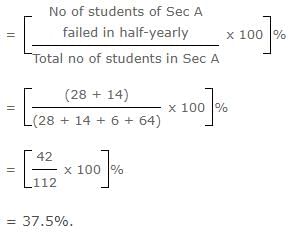
Total number of failures in half-yearly exams in a section

= [ (Number of students failed in both exams) + (Number of students failed in half-yearly but passed in Annual exams)] in that section

Therefore Failure rate in half-yearly exams in Section A

Similarly, failure rate in half-yearly exams in:

Clearly, the failure rate is minimum for Section D.

MCQ: Table Charts - 2 - Question 7

A school has four sections A, B, C, D of Class IX students.
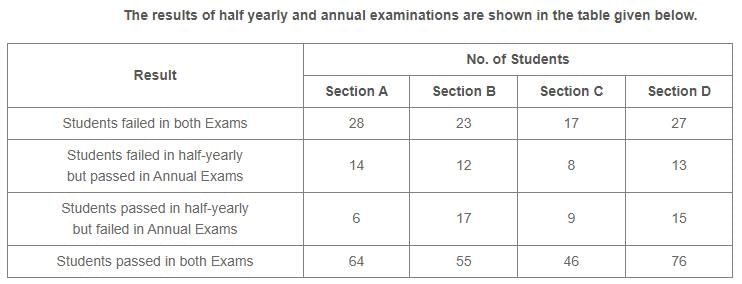
Q. How many students are there in Class IX in the school?

Detailed Solution: Question 7

Since the classification of the students on the basis of their results and sections form independent groups, so the total number of students in the class:

= (28 + 23 + 17 + 27 + 14 + 12 + 8 + 13 + 6 + 17 + 9 + 15 + 64 + 55 + 46 + 76)

= 430.

MCQ: Table Charts - 2 - Question 8

A school has four sections A, B, C, D of Class IX students.
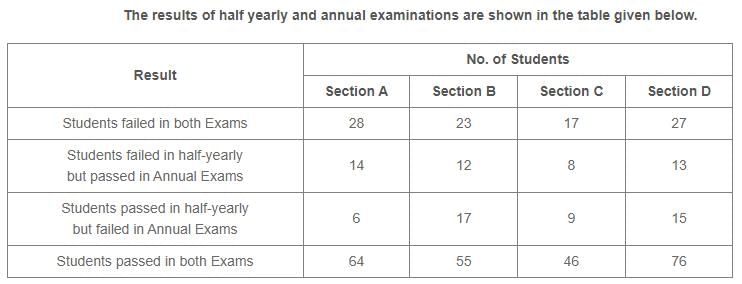
Q. If the number of students passing an examination be considered a criteria for comparison of difficulty level of two examinations, which of the following statements is true in this context?

Detailed Solution: Question 8

Number of students who passed half-yearly exams in the school

= (Number of students passed in half-yearly but failed in annual exams)
+ (Number of students passed in both exams)

= (6 + 17 + 9 + 15) + (64 + 55 + 46 + 76)

= 288.

Also, Number of students who passed annual exams in the school

= (Number of students failed in half-yearly but passed in annual exams)
+ (Number of students passed in both exams)

= (14 + 12 + 8 + 13) + (64 + 55 + 46 + 76)

= 288.

Since, the number of students passed in half-yearly = the number of students passed in annual exams. Therefore, it can be inferred that both the examinations had almost the same difficulty level.

Thus Statements (a), (b) and (d) are false and Statement (c) is true.

MCQ: Table Charts - 2 - Question 9

A school has four sections A, B, C, D of Class IX students.
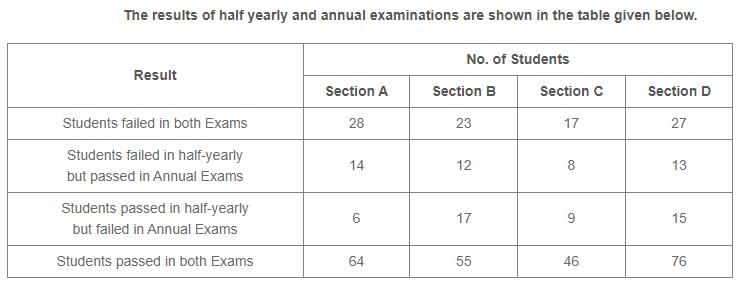
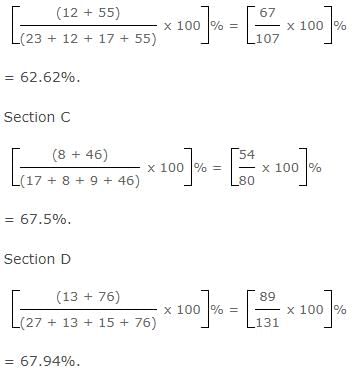
Q. Which section has the maximum pass percentage in at least one of the two examinations?

Detailed Solution: Question 9
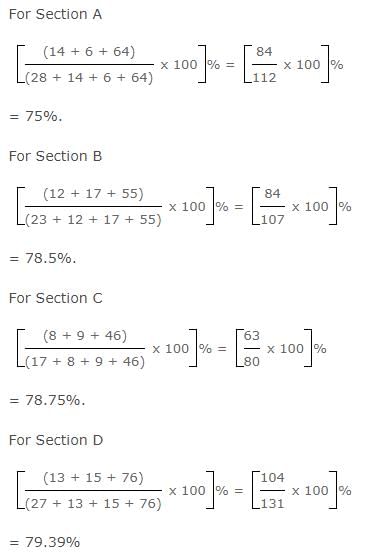
Pass percentages in at least one of the two examinations for different sections are:

Clearly, the pass percentage is maximum for Section D.

MCQ: Table Charts - 2 - Question 10

Study the following table and answer the questions.
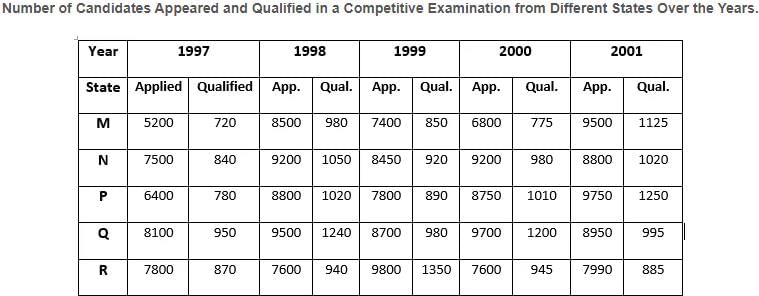
Q. Total number of candidates qualified from all the states together in 1997 is approximately what percentage of the total number of candidates qualified from all the states together in 1998?

Detailed Solution: Question 10
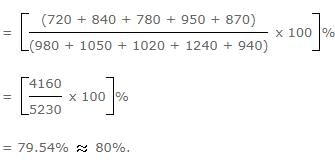
Required percentage

MCQ: Table Charts - 2 - Question 11

Study the following table and answer the questions.
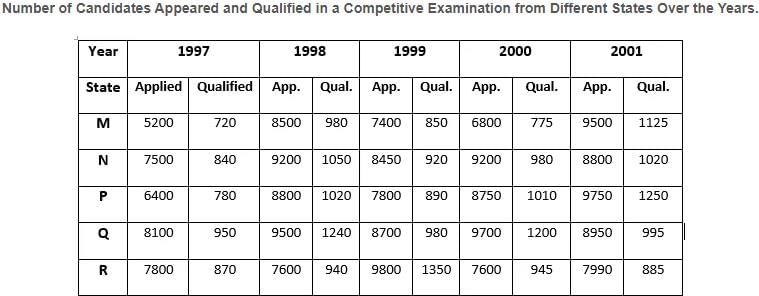
Q. The percentage of total number of qualified candidates to the total number of appeared candidates among all the five states in 1999 is?

Detailed Solution: Question 11
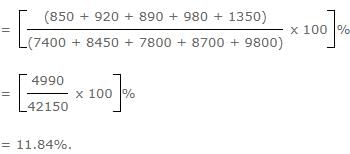
Required percentage

MCQ: Table Charts - 2 - Question 12

Study the following table and answer the questions.
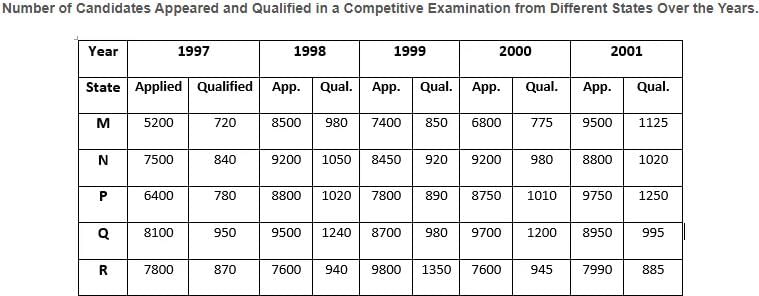
Q. What is the average candidates who appeared from State Q during the given years?

Detailed Solution: Question 12
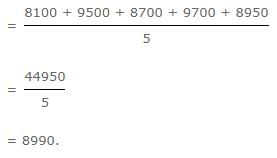
Required average

MCQ: Table Charts - 2 - Question 13

Study the following table and answer the questions.
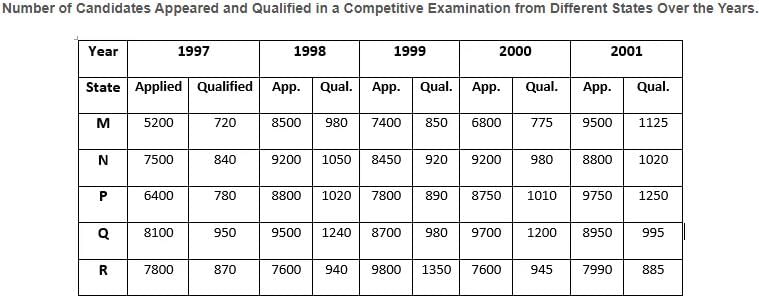
Q. In which of the given years the number of candidates appeared from State P has maximum percentage of qualified candidates?

Detailed Solution: Question 13
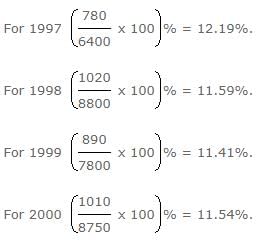
The percentages of candidates qualified to candidates appeared from State P during different years are:

∴ Maximum percentage is for the year 2001.

MCQ: Table Charts - 2 - Question 14

Study the following table and answer the questions.
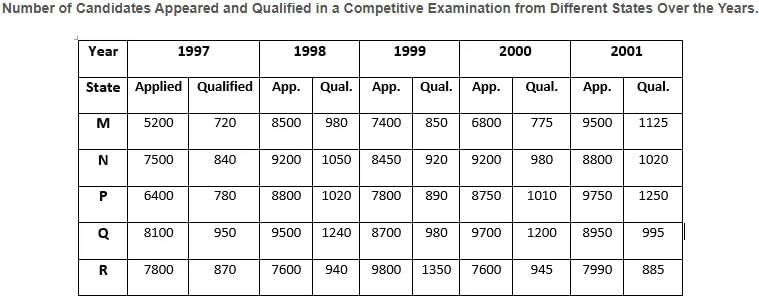
Q. What is the percentage of candidates qualified from State N for all the years together, over the candidates appeared from State N during all the years together?

Detailed Solution: Question 14
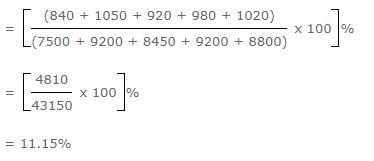
Required percentage

MCQ: Table Charts - 2 - Question 15

Study the following table and answer the questions.
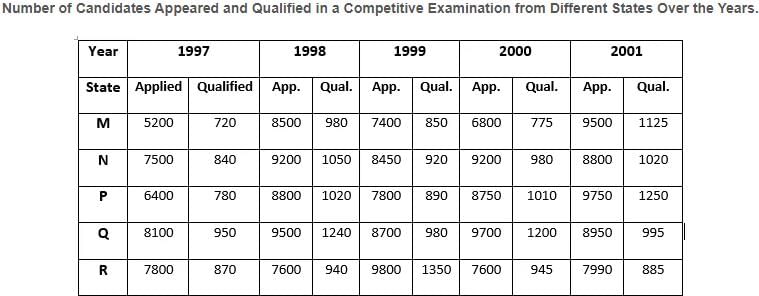
Q. Combining the states P and Q together in 1998, what is the percentage of the candidates qualified to that of the candidate appeared?

Detailed Solution: Question 15
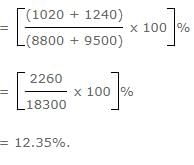
Required percentage

319 videos|366 docs|157 tests
Information about MCQ: Table Charts - 2 Page
In this test you can find the Exam questions for MCQ: Table Charts - 2 solved & explained in the simplest way possible. Besides giving Questions and answers for MCQ: Table Charts - 2, EduRev gives you an ample number of Online tests for practice
Download as PDF