NEET Exam  >  NEET Test  >  Chemistry Class 12  >  Multiple Choice Questions (MCQs): Chemical Kinetics - 1 - NEET MCQ

Chemical Kinetics - 1 - NEET Chemistry Class 12 Free MCQ Test with solutions


MCQ Practice Test & Solutions: Multiple Choice Questions (MCQs): Chemical Kinetics - 1 (18 Questions)

You can prepare effectively for NEET Chemistry Class 12 with this dedicated MCQ Practice Test (available with solutions) on the important topic of "Multiple Choice Questions (MCQs): Chemical Kinetics - 1". These 18 questions have been designed by the experts with the latest curriculum of NEET 2026, to help you master the concept.

Test Highlights:

  • - Format: Multiple Choice Questions (MCQ)
  • - Duration: 18 minutes
  • - Number of Questions: 18

Sign up on EduRev for free to attempt this test and track your preparation progress.

Multiple Choice Questions (MCQs): Chemical Kinetics - 1 - Question 1

Which of the following statement is true for order of a reaction?

Detailed Solution: Question 1

Order of a reaction is experimentally determined quantity so it can be negative fractional or zero.

Multiple Choice Questions (MCQs): Chemical Kinetics - 1 - Question 2

For the first order reaction, half life is equal to

Detailed Solution: Question 2

For 1st order reaction half life is independent of initial concentration of reactant.

Multiple Choice Questions (MCQs): Chemical Kinetics - 1 - Question 3

Straight line graph for first order reaction is obtained between

Detailed Solution: Question 3

Multiple Choice Questions (MCQs): Chemical Kinetics - 1 - Question 4

The effect of temperature on reaction rate is given by

Detailed Solution: Question 4

k = A exp(-kt)

Multiple Choice Questions (MCQs): Chemical Kinetics - 1 - Question 5

The radioactive isotope used in determining the age of organic substances is

Detailed Solution: Question 5

Carbon – 14 is used in determining the age of organic substances

Multiple Choice Questions (MCQs): Chemical Kinetics - 1 - Question 6

Which among the following statement is not true for catalyst?

Detailed Solution: Question 6

Catalyst doesnot change the equilibrium constant it only helps in reaching the equilibrium at a faster rate.

Multiple Choice Questions (MCQs): Chemical Kinetics - 1 - Question 7

A first order reaction is 50% completed in 1.26 × 10¹⁴ s. How much time would it take for 100% completion?

Detailed Solution: Question 7

The time taken for half the reaction to complete, i.e., the time in which the concentration of a reactant is reduced to half of its original value is called half-life period of the reaction. But it is impossible to perform 100% of the reaction. Whole of the substance never reacts because in every half-life, 50% of the substance reacts. Hence, time taken for 100% completion of a reaction is infinite. 

Multiple Choice Questions (MCQs): Chemical Kinetics - 1 - Question 8

Collision theory is applicable to

Detailed Solution: Question 8

Collision theory is only applicable to bimolecular reaction.

Multiple Choice Questions (MCQs): Chemical Kinetics - 1 - Question 9

Rate of reaction does not remain constant throughout because

Detailed Solution: Question 9

Rate of reaction is dependent on concentration of reactant

Multiple Choice Questions (MCQs): Chemical Kinetics - 1 - Question 10

The unit of rate constant for a first order reaction is

Detailed Solution: Question 10

The correct answer is Option C.

Let R be the rate of reaction.
For first order reaction,
R=K[A]1
⇒K=R[A]-1
Whereas, K and [A] are rate constant and initial concentration of reactant respectively.
Therefore,
Unit of rate constant =(mol L-1)1-nsec-1
For first order reaction, n=1
Unit of rate constant = sec-1
Hence the unit of rate constant for first order reaction is sec-1.

Multiple Choice Questions (MCQs): Chemical Kinetics - 1 - Question 11

Which among the following statement is not true for rate constant of a reaction?

Detailed Solution: Question 11

Rate constant is independent of concentration of reactant.

Multiple Choice Questions (MCQs): Chemical Kinetics - 1 - Question 12

Which among the following is an example of pseudo first order reaction?

Detailed Solution: Question 12

In acid catalysed hydrolysis of ethylacetate the water is in excess so it is pseudo 1st order reaction.

Multiple Choice Questions (MCQs): Chemical Kinetics - 1 - Question 13

Which among the following is an example of first order reaction?

Detailed Solution: Question 13

Decomposition of N2O5 is 1st order reaction.

Multiple Choice Questions (MCQs): Chemical Kinetics - 1 - Question 14

The rate law for the reaction   is given by rate = k[RCl]. The rate for this reaction

Detailed Solution: Question 14

As rate k = [RCl] , on decreasing the concentration of RCl to half , the rate will also be halved . Rate will also increase with temperature.

Multiple Choice Questions (MCQs): Chemical Kinetics - 1 - Question 15

For an endothermic reaction, the minimum value for the energy of activation in terms of will be

Detailed Solution: Question 15

Multiple Choice Questions (MCQs): Chemical Kinetics - 1 - Question 16

The temperature coefficient of most of the reactions lies between

Detailed Solution: Question 16

Temperature coefficient is the factor by which the rate constant of a reaction increase with increase in temperature by 10°C. It lies between 2 and 3.

Multiple Choice Questions (MCQs): Chemical Kinetics - 1 - Question 17

Following mechanism has been proposed for a reaction
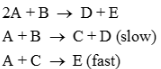
The rate law expression for the reaction is

Detailed Solution: Question 17

Rate of reaction is determined by slowest step.

Multiple Choice Questions (MCQs): Chemical Kinetics - 1 - Question 18

The expression which gives 3/4th life of first order reaction is

Detailed Solution: Question 18

54 videos|280 docs|74 tests
Information about Multiple Choice Questions (MCQs): Chemical Kinetics - 1 Page
In this test you can find the Exam questions for Multiple Choice Questions (MCQs): Chemical Kinetics - 1 solved & explained in the simplest way possible. Besides giving Questions and answers for Multiple Choice Questions (MCQs): Chemical Kinetics - 1, EduRev gives you an ample number of Online tests for practice
54 videos|280 docs|74 tests
Download as PDF
