
The Flower - Free MCQ Practice Test with solutions, NEET Biology
MCQ Practice Test & Solutions: Multiple Choice Questions (MCQs): The Flower (15 Questions)
You can prepare effectively for NEET Biology Class 11 with this dedicated MCQ Practice Test (available with solutions) on the important topic of "Multiple Choice Questions (MCQs): The Flower". These 15 questions have been designed by the experts with the latest curriculum of NEET 2026, to help you master the concept.
Test Highlights:
- - Format: Multiple Choice Questions (MCQ)
- - Duration: 15 minutes
- - Number of Questions: 15
Sign up on EduRev for free to attempt this test and track your preparation progress.

On the basis of relative position of different floral parts on the thalamus, a flower can be hypogynous, Perigynous or epigynous. With respect to the given figures (A, B, C and D), select the correct option:
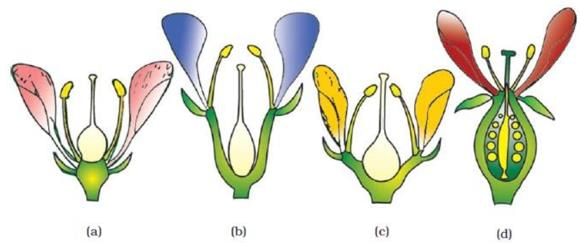
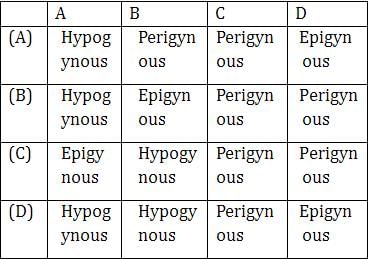
Detailed Solution: Question 1
Detailed Solution: Question 2
Topic in NCERT: Androecium
Line in NCERT: "When stamens are attached to the petals, they are epipetalous as in brinjal, or epiphyllous when attached to the perianth as in the flowers of lily."

If the gynoecium is present in the top most position of the thalamus, the flower is referred to as
Detailed Solution: Question 3
Topic in NCERT: Position of floral parts on thalamus
Line in NCERT: "In the hypogynous flower the gynoecium occupies the highest position while the other parts are situated below it."
Identify the different types of placentations shown in figure and select the correct option.
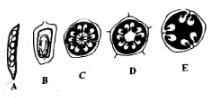
Detailed Solution: Question 4
Topic in NCERT: Placentation
Line in NCERT: "Placentation: The arrangement of ovules within the ovary is known as placentation. The placentation are of different types namely, marginal, axile, parietal, basal, central and free central (Figure 5.12)."
Based on the position of floral parts on thalamus, the flowers, are described as hypogynous, perigynous and perigynous and epigynous. Which of the following floral forms (A-D) represent the flowers of Rose and Plum respectively?
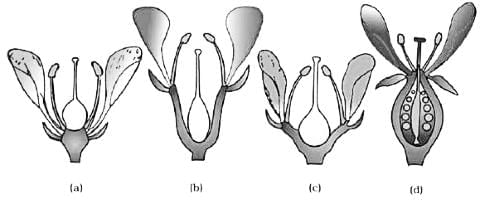
Detailed Solution: Question 5
Which of the following figures represent a typical placentation as seen in Hibiscus rosa sinensis (China rose)?
Detailed Solution: Question 6
Topic in NCERT: placentation
Line in NCERT: "When the placenta is axial and the ovules are attached to it in a multilocular ovary, the placentation is said to be axile, as in china rose, tomato and lemon."
Select the correct option for A, B and C in the given diagram of papilionaceous corolla.
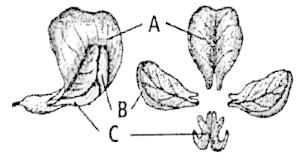
Detailed Solution: Question 7
In _____ aestivation, sepals or petals in a whorl just touch one another at the margins, without overlapping, as is found in _____ .
Detailed Solution: Question 8
The given figure represents vexillary aestivation. Select the suitable labels for P, Q and R .
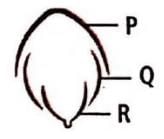
Detailed Solution: Question 9
Identify the types of aestivation shown in the folowing diagram:
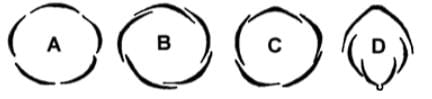
Detailed Solution: Question 10
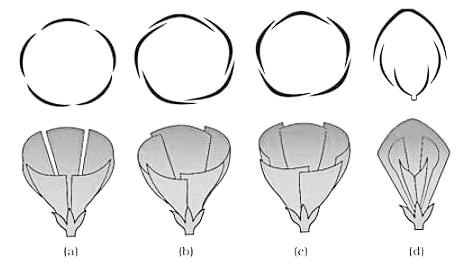
Which of the following statements is true regarding the stamens of a flower with a diadelphous condition?
Detailed Solution: Question 11
Which of the following is a feature of the ovary in a carpel?
Detailed Solution: Question 12
What is the primary difference between an apocarpous and syncarpous gynoecium?
Detailed Solution: Question 13
Which of the following terms describes the arrangement of stamens when they are united into a single bundle?
Detailed Solution: Question 14
In the context of the corolla, which of the following shapes is NOT typically associated with the structure of the petals?
Detailed Solution: Question 15
142 videos|410 docs|135 tests |
