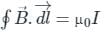
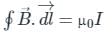
NEET Exam  >  NEET Test  >  Topic-wise MCQ Tests  >  NCERT Based Test: Ampere's Circuital Law - NEET MCQ

NCERT Based Test: Ampere's Circuital Law - Free MCQ with solutions NEET


MCQ Practice Test & Solutions: NCERT Based Test: Ampere's Circuital Law (10 Questions)

You can prepare effectively for NEET Topic-wise MCQ Tests for NEET with this dedicated MCQ Practice Test (available with solutions) on the important topic of "NCERT Based Test: Ampere's Circuital Law". These 10 questions have been designed by the experts with the latest curriculum of NEET 2026, to help you master the concept.

Test Highlights:

  • - Format: Multiple Choice Questions (MCQ)
  • - Duration: 5 minutes
  • - Number of Questions: 10

Sign up on EduRev for free to attempt this test and track your preparation progress.

NCERT Based Test: Ampere's Circuital Law - Question 1

Ampere's circuital law is given by

Detailed Solution: Question 1

The line integral of the magnetic field of induction  around any closed path in free space is equal to absolute permeability of free space μ0 times the total current flowing through area bounded by the path.
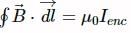
Ampere's circuital law is given by: 

NCERT Based Test: Ampere's Circuital Law - Question 2

A long straight wire in the horizontal plane carries a current of 75 A in north to south direction, magnitude and direction of field B at a point 3 m east of the wire is

Detailed Solution: Question 2
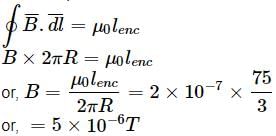
From Ampere circuital law

The direction of field at the given point will be vertical up determined by the screw rule or right hand rule.

NCERT Based Test: Ampere's Circuital Law - Question 3

If a long straight wire carries a current of 40 A, then the magnitude ol the field B at a point 15 cm away from the wire is 

Detailed Solution: Question 3

I = 40A
r = 15 cm = 15 x 10-2 m
∴  = 5.34 x 10⁻⁵ T

NCERT Based Test: Ampere's Circuital Law - Question 4

The correct plot of the magnitude of magnetic field   vs distance r from centre of the wire is, if the radius of wire is R

Detailed Solution: Question 4

The magnetic field from the centre of wire of radius R is given by
B = ((μ0I)/(2R2))r (r < R) ⇒ B ∝ r
and B = μ0I/2πr (r > R) ⇒ B ∝ 1/r
From this descriptions, we can say that the graph (b) is a correct representation.

NCERT Based Test: Ampere's Circuital Law - Question 5

Ampere's circuital law states that _______.

Detailed Solution: Question 5

The correct answer is the line integral of h along any closed path is exactly equal to the direct current enclosed by the path.

  • Ampere's Circuital Law: This fundamental law in electromagnetism states that the line integral of the magnetic field intensity (H) around a closed path is equal to the total current enclosed by that path.
  • The law can be mathematically expressed as: ∮H · dl = Ienc, where ∮H · dl is the line integral of the magnetic field around the closed path, and Ienc is the enclosed current.
  • This law is integral in understanding the relationship between the magnetic field and the electric current that produces it.
  • It is particularly useful in the design and analysis of electrical circuits, transformers, inductors, and other electromagnetic devices.

NCERT Based Test: Ampere's Circuital Law - Question 6

Two parallel conductors carrying current in opposite directions will exert on each other

Detailed Solution: Question 6

This phenomenon is known as Ampere's force law or the parallel currents interaction. According to the right-hand rule, the magnetic fields produced by the currents in the two conductors will be in the same direction between the conductors and in the opposite direction outside the conductors.

Therefore, when two parallel conductors carry current in opposite directions, they will exert a repulsive force on each other.

NCERT Based Test: Ampere's Circuital Law - Question 7

Which of the following statement is correct regarding Ampere's circuital law?
I. The law can be applied inside a conductor or outside it but total current enclosed by the path should be known
II. The law is applicable for line currents, sheet currents or volume currents

Detailed Solution: Question 7

The correct answer is Both I and II.

  • Ampere's Circuital Law states that the line integral of the magnetic field around any closed path is equal to the permeability of free space times the total current enclosed by the path.
  • The law is mathematically expressed as ∮B·dl = μ₀Ienc, where ∮B·dl is the line integral of the magnetic field B around a closed loop, μ₀ is the permeability of free space, and Ienc is the total current enclosed by the loop.
  • The law can be applied in various scenarios including inside a conductor or outside it, provided the total current enclosed by the path is known.
    • This is crucial for determining the magnetic field in different regions around current-carrying conductors.
    • Hence, statement I is correct.
  • The law is applicable for different types of currents such as line currents, sheet currents, or volume currents.
    • Line currents refer to currents flowing through thin wires or conductors.
    • Sheet currents are currents distributed over a surface.
    • Volume currents are currents distributed throughout a volume.
    • The versatility of Ampere's Circuital Law in handling these different types of current distributions makes it a powerful tool in electromagnetism.
    • Hence, statement II is correct.

NCERT Based Test: Ampere's Circuital Law - Question 8

A long wire carrying a certain current produces a magnetic field of 0.8 Tesla at a distance 0.5 cm. Then magnetic field at a distance of 1 cm is:

Detailed Solution: Question 8
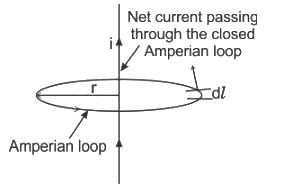
Ampere's Circuital Law: 

  • It gives the relationship between the current and the magnetic field created by it.
  • This law says that the integral of magnetic field density (B) along an imaginary closed path is equal to the product of current enclosed by the path and permeability of the medium.


Where B = magnetic field, μ0 = permeability of free space and I = current passing through the coil
Given:
B1 = 0.8 T,  d1 = 0.5 cm
The intensity of the magnetic field due to wire of infinite length at a distance d from it is given by


Where μ= permeability of free space, I = current in a wire, d = distance
As current is constant in the wire, then the magnetic field varies with the distance 'd' as

B∝1 / d

⇒ B1d= B2d2


0.4 T

NCERT Based Test: Ampere's Circuital Law - Question 9

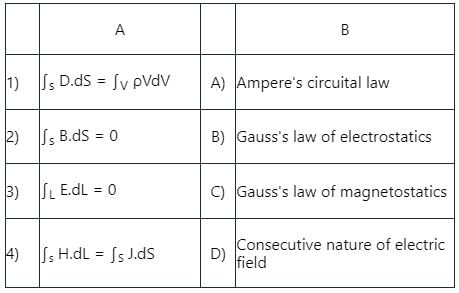
Match the following mathematical representations with their corresponding law:
Detailed Solution: Question 9
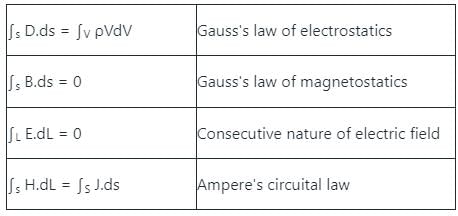
Mathematical representations with their corresponding law

Ampere's Circuital Law:

  • Ampere’s circuital law can be written as the line integral of the magnetic field (H) surrounding the closed loop equals the number of times the algebraic sum of currents passing through the loop. It can be expressed as
    ∫ Hdl = Ienc
  • Suppose a conductor carries a current I, then this current flow generates a magnetic field that surrounds the wire.
  • The equation’s left side describes that if an imaginary path encircles the wire and the magnetic field is added at every point, then it is numerically equal to the current encircled by this route, indicated by Ienc.
  • Equation of Ampere's circuital law further described as
  • ∫s H.dL = ∫s J.ds       (∵ Ienc ∫s J.ds)
  • Where J represents the current density

Gauss's law of Electrostatics:

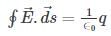
  • Gauss Law of electrostatics states that the total electric flux out of a closed surface is equal to the charge enclosed divided by the permittivity.
  • In other words, according to the Gauss law, the total flux linked with a closed surface is 1/ε0 times the charge enclosed by the closed surface. It can be expressed as
  • The electric flux in an area is defined as the electric field multiplied by the area of the surface projected in a plane and perpendicular to the field.
  • Further equation of Gauss Law of electrostatics can be expressed as
  • s D.dS = ∫V ρVdV 
  • Where 'ρV' represents volume charge density and 'D' represents electric flux density vector.

Gauss's law of Magnetostatics:

  • Gauss law on magnetostatics states that “closed surface integral of magnetic flux density (B) is always equal to total scalar magnetic flux enclosed (ϕenc) within that surface of any shape or size lying in any medium.”
  • Mathematically it is expressed as
  • ∫s B.ds = ϕenc
  • But magnetic flux cannot be enclosed within a closed surface of any shape, therefore  ϕenc = 0
  • Hence, the equation of Gauss law on magnetostatics can be expressed as  ∫s B.ds = 0

Conservative nature of the electric field:

  • The electric field is defined as the electric force per unit charge.
  • If we observe the electric field pattern, it is radially directed outward from a positive charge and is directed inwards a negative point charge.
  • The electric field is a vector quantity, and the SI unit of the electric field is volts per meter.
  • The electric field (E) is a conservative field and it is expressed as
  • ∫ L E.dL = 0
  • A force is said to be conservative if the work done by the force in moving a particle from one point to another point depends only on the initial and final points and not on the path followed.
  • The field where the conservative force is observed is known as a conservative field.
  • For Example, consider an electric field created due to a charge Q.
  • The work done to carry a test charge (q) from point A to another point B in the field due to Q does not depend upon the path followed.
  • Electric field depends upon the initial and final positions A and B. Electric fields are independent of the path followed.
  • So we say that the electric field is conservative in nature.
  • Consecutive nature of electric field

NCERT Based Test: Ampere's Circuital Law - Question 10

Ampere's circuital law involves finding the _________.

Detailed Solution: Question 10
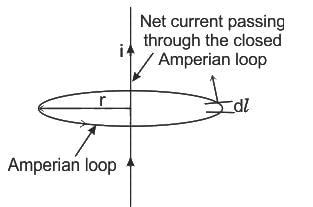
The correct answer is option b (total current enclosed by a closed path)

Ampere's Circuital Law:

  • It gives the relationship between the current and the magnetic field created by it.
  • This law says that the integral of magnetic field density (B) along an imaginary closed path is equal to the product of current enclosed by the path and permeability of the medium.

Where dl is a small element,

μ0 is the permeability of free space and

I is the electric current.

6 docs|803 tests
Information about NCERT Based Test: Ampere's Circuital Law Page
In this test you can find the Exam questions for NCERT Based Test: Ampere's Circuital Law solved & explained in the simplest way possible. Besides giving Questions and answers for NCERT Based Test: Ampere's Circuital Law, EduRev gives you an ample number of Online tests for practice
Download as PDF