NCERT Based Test: The Moving Coil Galvanometer - Free MCQ with solutions
MCQ Practice Test & Solutions: NCERT Based Test: The Moving Coil Galvanometer (15 Questions)
You can prepare effectively for NEET NCERT Based Tests for NEET with this dedicated MCQ Practice Test (available with solutions) on the important topic of "NCERT Based Test: The Moving Coil Galvanometer". These 15 questions have been designed by the experts with the latest curriculum of NEET 2026, to help you master the concept.
Test Highlights:
- - Format: Multiple Choice Questions (MCQ)
- - Duration: 15 minutes
- - Number of Questions: 15
Sign up on EduRev for free to attempt this test and track your preparation progress.

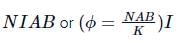
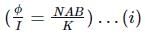
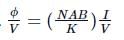
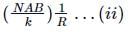
In a moving coil galvanometer the deflection (ϕ) on the scale by a pointer attached to the spring is
Detailed Solution: Question 1
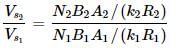
Two moving coil meters, M1 and M2 ave thhe following particulars:
R1 = 10 Ω, N1 = 30, A1 = 3.6 × 10⁻³ m2, B1 = 0.25 T
R2 = 14 Ω, N2 = 42, A2 = 1.8 × 10⁻³ m2, B2 = 0.50 T
The spring constants are identical for the two meters. What is the ratio of current sensitivity and voltage sensitivity of M2 and M1.
R1 = 10 Ω, N1 = 30, A1 = 3.6 × 10⁻³ m2, B1 = 0.25 T
R2 = 14 Ω, N2 = 42, A2 = 1.8 × 10⁻³ m2, B2 = 0.50 T
The spring constants are identical for the two meters. What is the ratio of current sensitivity and voltage sensitivity of M2 and M1.
Detailed Solution: Question 2





If the current sensitivity of a galvanometer is doubled, then its voltage sensitivity will be
Detailed Solution: Question 3

A moving coil galvanometer can be converted into an ammeter by:
Detailed Solution: Question 4
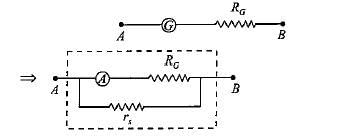
A galvanometer of resistance 70Ω, is converted to an ammeter by a shunt resistance rs = 0.03Ω. The value of its resistance will become
Detailed Solution: Question 5


If the galvanometer current is 10mA, resistance of the galvanometer is 40Ω and shunt of 2Ω is connected to the galvanometer, the maximum current which can be measured by this ammeter is
Detailed Solution: Question 6

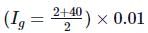
A galvanometer of resistance 40Ω gives a deflection of 5 divisions per mA. There are 50 divisions on the scale. The maximum current that can pass through it when a shunt resistance of 2Ω is connected is
Detailed Solution: Question 7


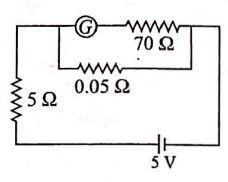
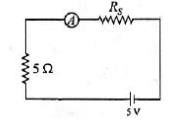
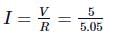
In the given circuit, a galvanometer with a resistance of 70Ω is converted to an ammeter by a shunt resistance of 0.05Ω total current measured by this device is
Detailed Solution: Question 8


A galvanometer having a resistance of 50Ω, gives a full scale deflection for a current of 0.05A. The length (in metres) of a resistance wire of area of cross section 3 × 10⁻²cm2 that can be used to convert the galvanometer into an ammeter which can read a maximum of 5A current is
(Specific resistance of the wire ρ = 5 × 10⁻⁷Ωm)
(Specific resistance of the wire ρ = 5 × 10⁻⁷Ωm)
Detailed Solution: Question 9


The conversion of a moving coil galvanometer into a voltmeter is done by
Detailed Solution: Question 10
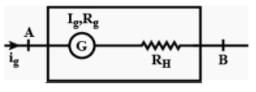
A galvanometer of resistance 10Ω gives full-scale deflection when 1mA current passes through it. The resistance required to convert it into a voltmeter reading upto 2.5V is
Detailed Solution: Question 11
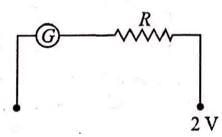
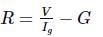
A voltmeter which can measure 2V is constructed by using a galvanometer of resistance 12Ω and that produces maximum deflection for the current of 2mA, then the resistance R is
Detailed Solution: Question 12
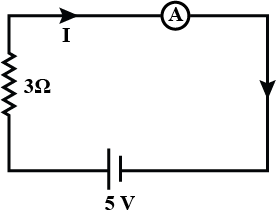
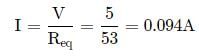
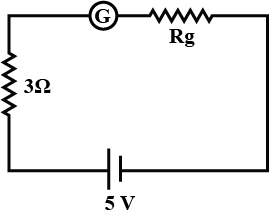
The value of current in the given circuit if the ammeter is a galvanometer with a resistance RG = 50Ω is
Detailed Solution: Question 13

A galvanometer coil has a resistance of 15Ω and the metre shows full scale deflection for a current of 4mA. To convert the meter into a voltmeter of range 0 to 18V, the required resistance is
Detailed Solution: Question 14


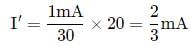
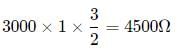
A galvanometer of resistance 50Ω is connected to a battery of 3V along with a resistance of 2950Ω in series. A full-scale deflection of 30 divisions is obtained in the galvanometer. In order to reduce this deflection to 20 divisions, the resistance in series should be:
Detailed Solution: Question 15