CBSE Class 4  >  Class 4 Test  >  Science Olympiad   >  Olympiad Test: Work, Force And Energy -2 - Class 4 MCQ

Olympiad Test: Work, Force And Energy -2 - Free MCQ with solutions


MCQ Practice Test & Solutions: Olympiad Test: Work, Force And Energy -2 (10 Questions)

You can prepare effectively for Class 4 Science Olympiad Class 4 with this dedicated MCQ Practice Test (available with solutions) on the important topic of "Olympiad Test: Work, Force And Energy -2". These 10 questions have been designed by the experts with the latest curriculum of Class 4 2026, to help you master the concept.

Test Highlights:

  • - Format: Multiple Choice Questions (MCQ)
  • - Duration: 20 minutes
  • - Number of Questions: 10

Sign up on EduRev for free to attempt this test and track your preparation progress.

Olympiad Test: Work, Force And Energy -2 - Question 1

Which of the following gadget is used to measure temperature?

Detailed Solution: Question 1

A thermometer is used to measure temperature. It can measure both hot and cold temperatures, typically in degrees Celsius or Fahrenheit.

  • Option A (Stopwatch) is used to measure time.
  • Option B (Scale) is used to measure weight or mass.
  • Option C (Measuring jar) is used to measure the volume of liquids.

Thus, the correct answer is Option D: Thermometer.

Olympiad Test: Work, Force And Energy -2 - Question 2

A calorimeter is used to:

Detailed Solution: Question 2

A calorimeter is an instrument used to measure the amount of heat absorbed or released during a chemical reaction, physical change, or phase transition. It helps determine how much heat is involved in the process.

  • Option A is incorrect because a calorimeter doesn't directly "determine the heat of a reaction" in an abstract sense, but measures the heat transferred.
  • Option C is incorrect because a calorimeter doesn't store heat; it measures it.
  • Option D is incorrect because Option B is the correct answer.

Thus, the correct answer is Option B: Determine the heat given off/absorbed during some process.

Olympiad Test: Work, Force And Energy -2 - Question 3

What is Nuclear Energy?

Detailed Solution: Question 3

Nuclear energy is the energy stored in the nucleus (core) of an atom. It can be released through processes like fission (splitting atoms) or fusion (combining atoms), which release a large amount of energy. This energy can be harnessed for electricity generation, medicine, and other applications.

  • Option A refers to solar energy, which is derived from the sun.
  • Option C refers to electrical energy or kinetic energy from moving electrons.
  • Option D refers to radiant energy like light, which travels in waves.

Thus, the correct answer is Option B: Energy that is locked in the nucleus of an atom.

Olympiad Test: Work, Force And Energy -2 - Question 4

As you go up a mountain top, your weight:

Detailed Solution: Question 4

As you go up a mountain, your weight decreases slightly because the force of gravity is weaker at higher altitudes. This happens because you are farther away from the Earth's center, where gravity is slightly weaker. However, the change in weight is very small and not noticeable without precise measurement.

Thus, the correct answer is Option B: Decreases slightly.

Olympiad Test: Work, Force And Energy -2 - Question 5

Which of the following is NOT an SI unit of measure?

Detailed Solution: Question 5

All the options listed are SI units:

  • Watt (Option A) is the SI unit of power.
  • Newton (Option B) is the SI unit of force.
  • Joule (Option C) is the SI unit of energy.

Since all the listed units are part of the International System of Units (SI), the correct answer is Option D: none.

Olympiad Test: Work, Force And Energy -2 - Question 6

Which of these contain(s) an electromagnet?

Detailed Solution: Question 6

Headphones contain an electromagnet as part of the speaker mechanism that converts electrical signals into sound.

  • Option A (Lamp) generally does not contain an electromagnet.
  • Option B (Electric stove) uses electrical heating elements but not an electromagnet.
  • Option C (Compass) uses a magnetic needle, but it does not rely on an electromagnet.

Thus, the correct answer is Option D: Headphones.

Olympiad Test: Work, Force And Energy -2 - Question 7

The mechanical energy of a freely falling object is

Detailed Solution: Question 7

The mechanical energy of a freely falling object is the sum of its kinetic energy and potential energy. As the object falls, its potential energy decreases, and its kinetic energy increases, but the total mechanical energy remains constant (assuming no air resistance).

  • Option A is incorrect because the total mechanical energy is not the difference between potential and kinetic energy; it is the sum.
  • Option B is incorrect because there is no such difference between potential energy and gravitational energy.
  • Option C is incorrect because friction energy doesn't directly apply in this context.

Thus, the correct answer is Option D: None of these.

Olympiad Test: Work, Force And Energy -2 - Question 8

In which of the following activities is force used for pulling?

Detailed Solution: Question 8
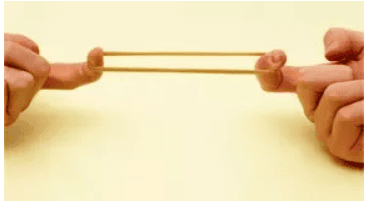
  • Option A (Blowing air into a balloon) involves pushing air into the balloon, not pulling.
  • Option B (Cycling) involves applying force to the pedals, typically in a pushing motion, not pulling.
  • Option C (Stretching a rubber band) involves pulling the rubber band to stretch it.

Therefore, the correct answer is Option C: Stretching a rubber band.

Olympiad Test: Work, Force And Energy -2 - Question 9

The part of a nuclear power plant that prevents thermal pollution of lakes or rivers is the:

Detailed Solution: Question 9

In a nuclear power plant, the cooling tower is the part that helps to dissipate excess heat and prevent thermal pollution of nearby lakes or rivers. It cools the water that has been used in the plant to absorb heat from the reactor. This cooled water is then returned to the environment at a safer temperature.

  • Option A (Reactor) generates heat through nuclear fission but does not control thermal pollution.
  • Option B (Coolant/moderator) helps control the temperature and reactions within the reactor but is not responsible for preventing thermal pollution.
  • Option D (Control rod) helps control the rate of the nuclear reaction, but it doesn't deal with thermal pollution.

Thus, the correct answer is Option C: Cooling tower.

Olympiad Test: Work, Force And Energy -2 - Question 10

The capacity to do work is called

Detailed Solution: Question 10

The capacity to do work is called energy. Energy is required to perform any work, and it can exist in different forms, such as kinetic energy, potential energy, thermal energy, etc.

  • Option A (Force) is an influence that can cause an object to move or change its motion, but it is not the capacity to do work.
  • Option C (Machine) is a device used to perform work, but it is not the capacity to do work.
  • Option D (Movement) refers to motion, which results from the application of energy but is not the capacity itself.

Thus, the correct answer is Option B: Energy.

47 videos|76 docs|66 tests
Information about Olympiad Test: Work, Force And Energy -2 Page
In this test you can find the Exam questions for Olympiad Test: Work, Force And Energy -2 solved & explained in the simplest way possible. Besides giving Questions and answers for Olympiad Test: Work, Force And Energy -2, EduRev gives you an ample number of Online tests for practice
47 videos|76 docs|66 tests
Download as PDF