CUET Exam  >  CUET Test  >   UG Mock Test Series 2026  >  Physics: CUET Mock Test - 2 - CUET MCQ

CUET UG Physics: Mock Test - 2 Free Online Test 2026


Full Mock Test & Solutions: Physics: CUET Mock Test - 2 (50 Questions)

You can boost your CUET 2026 exam preparation with this Physics: CUET Mock Test - 2 (available with detailed solutions).. This mock test has been designed with the analysis of important topics, recent trends of the exam, and previous year questions of the last 3-years. All the questions have been designed to mirror the official pattern of CUET 2026 exam, helping you build speed, accuracy as per the actual exam.

Mock Test Highlights:

  • - Format: Multiple Choice Questions (MCQ)
  • - Duration: 60 minutes
  • - Total Questions: 50
  • - Analysis: Detailed Solutions & Performance Insights

Sign up on EduRev for free and get access to these mock tests, get your All India Rank, and identify your weak areas to improve your marks & rank in the actual exam.

Physics: CUET Mock Test - 2 - Question 1

The expression for torque  experienced by an electric dipole of dipole moment  in an external uniform electric field  is given by :

Detailed Solution: Question 1

Concept:

The expression for torque (τ) experienced by an electric dipole of dipole moment (P) in an external uniform electric field (E) is given by:
τ = P x E
where
τ is the torque vector,
P is the electric dipole moment vector, and
E is the external electric field vector.
The symbol "x" represents the cross-product between the two vectors.

  • The direction of the torque is perpendicular to both the dipole moment vector and the external electric field vector and follows the right-hand rule.
  • The magnitude of the torque is given by:
  • |τ| = P E sinθ
  • where θ is the angle between the dipole moment vector and the external electric field vector.

The correct answer is option (4)

Physics: CUET Mock Test - 2 - Question 2

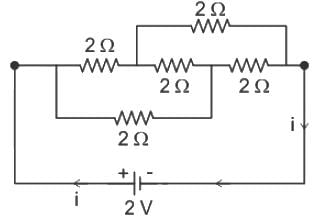
Find the value of current in the circuit.

Detailed Solution: Question 2

Calculation:

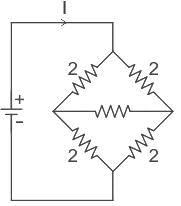
The given circuit can be rearranged as


Where the resistance of each resistors are 2 ohms and voltage applied is 2 V.
We can see that arm resistances R1 ,R2,R3,R4

R1R3 = R2R4

the above circuit is a wheatstone bridge.

The current flowing through the middle branch would be zero.

Net resistance "R" will be = (2 + 2) II (2 + 2)

R = 2 ohm.

The current from the battery would be

I = V/R

V = 2 Volts.

So, I = 2/2 = 1 A

I = 1 A.

The correct answer is option (4).

Physics: CUET Mock Test - 2 - Question 3

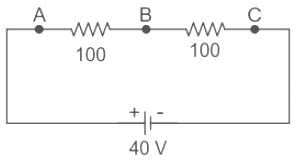
A voltmeter of resistance 150 Ω is connected across A and B in the given circuit. The reading of voltmeter will be :
Detailed Solution: Question 3

Calculation:
We know that the voltmeter is always connected in parallel.
The voltmeter resistance is given as 150 Ω and is connected across AB.
This means 150 Ω is connected in parallel with 100 Ω .
The resistance across AB will be a parallel combination of 150 and 100 Ω resistors.
The resistance across AB = (150) II (100)
= 150*100/(150 + 100)
= 60 Ω.

The net resistance of the circuit would be series combination of 60 and 100 Ω .
R = 60 + 100
= 160 Ω.
Current I = V/R
I = 40/160
= 0.25.
The voltage across AB will be the voltmeter reading which is equal to I*R.
Voltmeter reading = 0.25*60

= 15 Volts.
The correct answer is option (3)

Physics: CUET Mock Test - 2 - Question 4

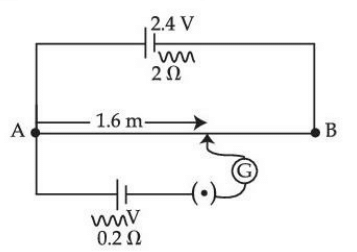
A potentiometer with a cell of 2.4 volt and internal resistance of 2 Ω maintains a potential drop across the resistance wire AB of length 2 meters and resistance 10 Ω. A standard cell which maintains a constant emf of 'V' volt with internal resistance 0.2 Ω gives a balance point at 1.6 m length of the wire. The value of emf of second (standard) cell (V) is:
Detailed Solution: Question 4

Calculation:

In the given potentiometer experiment, the balancing length l is 1.6 m, and the total length of the wire AB is 2 m. The resistance per unit length of the wire AB is R = 10/2 = 5 Ω/m.

Let V be the emf of the standard cell to be determined. At the balancing point, the potential difference across the wire AB is equal to the emf of the standard cell, i.e., V = IR, where I is the current flowing through the wire AB.

The total resistance in the circuit is the sum of the resistance of the standard cell (0.2 Ω), the internal resistance of the cell in the potentiometer (2 Ω), and the resistance of the wire AB up to the balancing point (5 Ω/m x 1.6 m = 8 Ω).

The current I in the circuit can be calculated using the potential difference across the circuit, which is the sum of the emf of the cell in the potentiometer and the potential drop across the wire AB up to the balancing point. Thus, I = (2.4 V)/(2 Ω + 5 Ω/m x 1.6 m) = 0.24 A.

Substituting the value of I and R into the equation V = IR gives V = 0.24 A x (5 x 1.6 + 0.2) = 1.968 V.

The correct answer is option (2) i.e., nearly equal to 1.9 V.

Physics: CUET Mock Test - 2 - Question 5

Drift velocity of electrons is directly proportional to the :

Detailed Solution: Question 5

Concept:

  • The drift velocity of electrons refers to the average velocity at which free electrons drift in a conductor under the influence of an electric field.
  • When a voltage is applied to a conductor, the electric field generated accelerates free electrons and they start to move in the direction of the electric field.
  • However, due to the collisions with atoms and other electrons present in the conductor, the free electrons do not move with a constant velocity, but rather move with a small, average velocity in the direction of the electric field. This average velocity is called the drift velocity.
  • The drift velocity of electrons in a conductor depends on various factors such as the applied voltage, the type of material of the conductor, the density of free electrons, and the temperature.
  • However, in a typical metallic conductor at room temperature, the drift velocity of electrons is typically on the order of a few millimeters per second, which is quite slow compared to the speed of light or even the speed of sound.

The drift velocity of electrons is directly proportional to the voltage applied across a conductor.

The other factors mentioned in the options, such as temperature, length of the conductor, and area of cross section of conductor, can affect the resistance of the conductor, but they do not directly affect the drift velocity of electrons.

So, the correct answer to the question is (2)

Additional Information

Drift velocity of electrons is directly proportional to the electric field applied to the conductor.

This means that as the strength of the electric field increases, the drift velocity of the electrons in the conductor also increases. Mathematically, the relationship between the drift velocity and the electric field is described by the following equation:

vd = μE

where vd is the drift velocity,

E is the electric field strength, and

μ is the electron mobility, which is a material property that describes how easily electrons can move through a material.

The higher the electron mobility, the higher the drift velocity for a given electric field strength.

Physics: CUET Mock Test - 2 - Question 6

Three charges –q, Q and –q are placed in a straight line maintaining equal distance from each other. What should be the ratio q/Q so that the net electric potential of the system is zero?

Detailed Solution: Question 6

Let the distance between any two charges is d. Therefore the net potential energy of the system is  But the total energy of the system is zero. So, -qQ - qQ + q2/2 = 0 hat means q = 4Q, i.e. q/Q = 4.

Physics: CUET Mock Test - 2 - Question 7

Damping in galvanometers is based on

Detailed Solution: Question 7

The coil of a galvanometer is wound on a light metallic frame (such as aluminium). When the coil rotates in the magnetic field of the permanent magnet, eddy currents are induced in the metallic frame. These eddy currents create magnetic fields that oppose the motion of the coil (according to Lenz's Law), thus providing electromagnetic damping. This damping helps the coil to return to zero quickly and prevents oscillations.

Physics: CUET Mock Test - 2 - Question 8

In a capacitance dominated RLC circuit

Detailed Solution: Question 8

In a series RLC circuit there becomes a frequency point were the inductive reactance of the inductor becomes equal in value to the capacitive reactance of the capacitor. In other words, XL = XC.
Series Resonance circuits are one of the most important circuits used electrical and electronic circuits.
 

Physics: CUET Mock Test - 2 - Question 9

The speed of electromagnetic waves in free space is given by  .
Here μ0 is ___________and ε0 is ________________ of free space.

Detailed Solution: Question 9

The speed of electromagnetic waves in free space depends on two important properties: permeability and permittivity. In this context:

  • μ0 represents the permeability of free space, which indicates how well magnetic fields can pass through a vacuum.
  • ε0 signifies the permittivity of free space, reflecting how electric fields interact with the vacuum.

These properties are fundamental to understanding how electromagnetic waves propagate in free space.

Physics: CUET Mock Test - 2 - Question 10

Electromagnetic waves constitute of

Detailed Solution: Question 10

Maxwell predicted that an accelerated charge produces a sinusoidal time varying magnetic field, which in turn produces a sinusoidal time varying electric field. These two fields are mutually perpendicular to each other and sources of each other. They (fields) form an electromagnetic wave i.e. the wave that is propagated by simultaneous periodic variations of electric field and magnetic field intensity.

Physics: CUET Mock Test - 2 - Question 11

A ray of light going from denser to rarer medium suffers refraction at a concave surface. Which of the following relations is correct?

Detailed Solution: Question 11

Solution : 

The correct option is Option A.

Laws of refraction;-

The incident ray,the refracted ray and the normal to the refracting surface at the point of incidence lie in the same plane.

For a given pair of media and for a given colour of light the ration between the sine of angle of incidence to the sine of refraction is a constant.This constant is known as refractive index of the second medium with respect to the first medium.

When a ray of light passes through a glass slab, ∠i,∠r and the normal all lie in the same plane.

When a ray of light passes from one medium to another, here from air to glass or glass to air, the ratio sini / sinr = constant.

Physics: CUET Mock Test - 2 - Question 12

Consider a curved surface between two different media with refractive indices n1 = 1 and n2 = 2. The relation between radius of curvature, image distance and object distance is given by

Detailed Solution: Question 12

The correct answer is Option D -

For refraction at a spherical surface the relation between object distance u, image distance v, radius of curvature R, and refractive indices n₁ and n₂ is n₁/u + n₂/v = (n₂ - n₁)/R.

Substituting n₁ = 1 and n₂ = 2 into the formula gives 1/u + 2/v = 1/R.

Therefore the required relation between R, v and u is 1/u + 2/v = 1/R, which confirms Option D.

Physics: CUET Mock Test - 2 - Question 13

Diffraction pattern cannot be observed with:

Detailed Solution: Question 13

For diffraction, the width of the slit must be less than the wavelength of the incident ray.

Physics: CUET Mock Test - 2 - Question 14

Work function of a metal is the

Detailed Solution: Question 14

In the photoelectric effect, the work function is the minimum amount of energy (per photon) needed to eject an electron from the surface of a metal.Electrons ejected from a sodium metal surface were measured as an electric current.The minimum energy required to eject an electron from the surface is called the photoelectric work function.
This energy (work function) is a measure of how firmly a particular metal holds its electrons. The work function is important in applications involving electron emission from metals, as in photoelectric devices and cathode-ray tubes.

Physics: CUET Mock Test - 2 - Question 15

Photon has a charge of

Detailed Solution: Question 15

A photon is massless, has no electric charge, and is a stable particle. In vacuum, a photon has two possible polarization states. The photon is the gauge boson for electromagnetism, and therefore all other quantum numbers of the photon (such as lepton number, baryon number, and flavour quantum numbers) are zero.
 

Physics: CUET Mock Test - 2 - Question 16

The work function of a photoelectric material is 3.32 eV. The threshold frequency will be equal to

Detailed Solution: Question 16

Threshold frequency: - frequency of minimum energy required to remove electron
 
work function=3.3ev
f=3.3×1.6×10−19J​ /6.626×10−34J−s
=0.8×10¹⁵Hz
=8×10¹⁴Hz

Physics: CUET Mock Test - 2 - Question 17

The average angle of deflection of α-particles by a thin gold foil as predicted by Thomson’s model is

Detailed Solution: Question 17

In Thomson’s plum pudding model, the positive charge is spread out uniformly across the atom, so α-particles passing through would experience only very small, gentle deflections, leading to a small average angle of deflection.

In contrast, Rutherford’s nuclear model postulates a dense, positively charged nucleus. While most α-particles pass through undeflected, a small number undergo large-angle scattering, which increases the overall average deflection angle.

Therefore, the average angle of deflection predicted by Thomson’s model is less than that predicted by Rutherford’s model.

Physics: CUET Mock Test - 2 - Question 18

Binding energy per nucleon is the ratio of

Detailed Solution: Question 18

Binding energy per nucleon is the ratio of the binding energy of a nucleus to the number of the nucleons.

Binding energy per nucleon = (Total binding energy) / (Number of nucleon)

Measure of stability of the nucleus: Larger the binding energy per nucleon, the greater the work that must be done to remove the nucleon from the nucleus, the more stable the nucleus.

Physics: CUET Mock Test - 2 - Question 19

Zener diodes are used as

Detailed Solution: Question 19

Zener Diodes can be used to produce a stabilised voltage output with low ripple under varying load current conditions. By passing a small current through the diode from a voltage source, via a suitable current limiting resistor (RS), the zener diode will conduct sufficient current to maintain a voltage drop of Vout.

Physics: CUET Mock Test - 2 - Question 20

The current that exists in the circuit of a photodiode even when no visible light is made incident on it is called

Detailed Solution: Question 20

In physics and in electronic engineering, dark current is the relatively small electric current that flows through photosensitive devices such as a photomultiplier tube, photodiode, or charge-coupled device even when no photons are entering the device; it consists of the charges generated in the detector when no outside radiation is entering the detector.

It is referred to as reverse bias leakage current in non-optical devices and is present in all diodes. Physically, dark current is due to the random generation of electrons and holes within the depletion region of the device.

Physics: CUET Mock Test - 2 - Question 21

The efficiency of a full wave rectifier is

Detailed Solution: Question 21

Efficiency of half-wave and full wave rectifier is given by
ηh​=40.6% and ηf​=81.2%
So,  ηhf​​​=40.6/81.2 ​=1/2​
∴f/n ​=2ηh​
Hence, the efficiency of a full wave rectifier is double of half wave-rectifier.

Physics: CUET Mock Test - 2 - Question 22

The energy of radiation emitted by LED is

Detailed Solution: Question 22

This energy is emitted in the form of heat and light. The electrons dissipate energy in the form of heat for silicon and germanium diodes but in gallium arsenide phosphide (GaAsP) and gallium phosphide (GaP) semiconductors, the electrons dissipate energy by emitting photons.

Physics: CUET Mock Test - 2 - Question 23

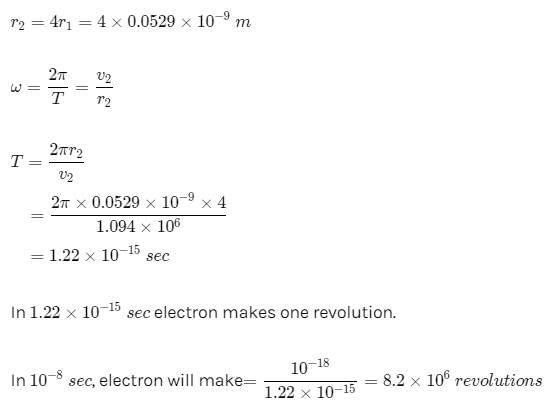
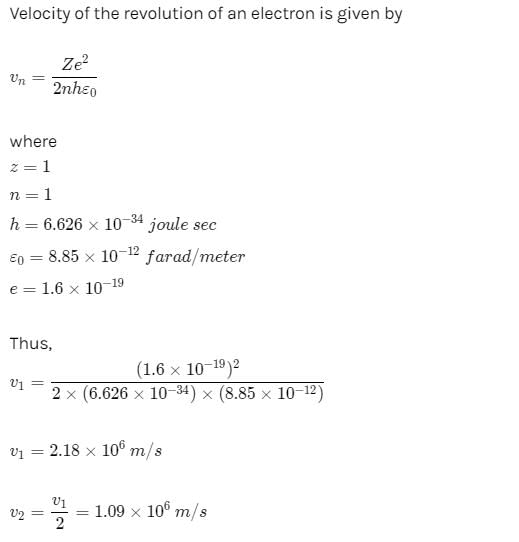
The average lifetime of the first excited level of a hydrogen atom is 1.0 ×10⁻⁸ s. In the Bohr model, how many orbits does an electron in the n = 2 level complete before returning to the ground level?

Detailed Solution: Question 23
Physics: CUET Mock Test - 2 - Question 24

Uniform electric and magnetic fields are produced pointing in the same direction. An electron is projected pointing in the same direction, then

Detailed Solution: Question 24

The forces acting on an electron in uniform electric and magnetic fields pointing in the same direction are explained below:

  • Magnetic Force: Since the electron is moving parallel to the fields, the magnetic force (v × B) is zero.
  • Electric Force: The electric field exerts a force (Fe = -E) on the electron, acting opposite to its direction of motion.

As a result:

  • The electron experiences a backward force due to the electric field.
  • This force causes the electron to decelerate, reducing its velocity.

Physics: CUET Mock Test - 2 - Question 25

Electric field due to infinitely long straight wire:
(A) Is radial and proportional to 1/r.
(B) Depends on linear charge density.
(C) Is uniform along the wire length.
(D) Is zero inside the wire.

Detailed Solution: Question 25

For an infinite straight line charge, the electric field is radial (perpendicular to the wire) and magnitude E = λ / (2πε₀r) → varies as 1/r. It depends directly on the linear charge density λ. Due to infinite length and translational symmetry, the field is uniform in magnitude and direction along the length (parallel planes). Statement (D) is not generally true (especially for non-conducting wire).

Physics: CUET Mock Test - 2 - Question 26

Gauss's theorem:
(A) Electric flux through a closed surface equals enclosed charge over ε₀.
(B) Applies to any closed surface.
(C) Used to find field for symmetric charge distributions.
(D) Flux is a vector quantity.

Detailed Solution: Question 26

Gauss’s law states that the total electric flux through any closed surface is Φ_E = Q_enclosed / ε₀. It holds for any arbitrary closed surface. It is most useful when symmetry (spherical, cylindrical, planar) allows simple calculation of E. Electric flux is a scalar quantity (not a vector).

Physics: CUET Mock Test - 2 - Question 27

Electric field lines:
(A) Start from positive charges and end on negative charges.
(B) Do not form closed loops.
(C) Are denser where field is stronger.
(D) Can cross each other.

Detailed Solution: Question 27

Electric field lines begin on positive charges and terminate on negative charges. In electrostatics they form open curves and never make closed loops. The density (number per unit area) of field lines is proportional to the magnitude of the electric field. Field lines never cross because that would mean two different directions at the same point.

Physics: CUET Mock Test - 2 - Question 28

What is current I in the circuit as shown in figure?​

Detailed Solution: Question 28

Three 2Ω resistors are in series. Their total resistance =6Ω. Now it is in parallel with 2Ω resistor, so total resistance,
1/R​=1/2+1/6​=3+1/6​=4/6=2/3
R=3/2​
∴I=RV​=3/(3/2)​=3×2​/3=2A

Physics: CUET Mock Test - 2 - Question 29

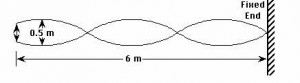
In an experiment to find the speed of waves in a rope, a standing wave pattern is established as shown in diagram below. The vibrating end of rope makes 90 vibrations per minute. The speed of the waves is
14964_image003

Detailed Solution: Question 29

If there are exactly 90 vibrations in 60.0 seconds, then there is a frequency of 1.5 Hz. The diagram shows 1.5 waves in 6.0-meters of rope; thus, the wavelength is 4.0 meters. Now use the equation v=f*w to calculate the speed of the wave. Proper substitution yields 6.0 m/s.

Physics: CUET Mock Test - 2 - Question 30

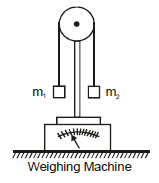
Two masses m1 and m2 which are connected with a light string, are placed over a frictionless pulley. This set up is placed over a weighing machine, as shown. Three combination of masses m1 and m2 are used, in first  case m1 = 6 kg and m2 = 2 kg, in second case m1 = 5 kg and m2 = 3kg and in third case m1 = 4 kg and m2 = 4 kg.  Masses are held stationary initially and then released. If the readings of the weighing machine after the release in three cases are W1, W2 and W3 respectively then :
Detailed Solution: Question 30

Net weight showing in the weighing machine will be equal to the tension in string on both sides i.e. on the side of m1​ and m2​.
Therefore, W= 2T
Now, from the block diagram,
m1​g−T=m1​a
T−m2​g=m2​a
Therefore,
2T = (m1​+m2​)g/m1​m2​​
Now,
W1​=6+ 22 x 6 ​x 2​​g=3g
W2​=5+ 32 x 5​ x 3​​g=3.75g
W3​=4+ 42 x4​ x 4​​g=4g
Therefore,
W1​<W2​<W3​ 

View more questions
41 docs|160 tests
Information about Physics: CUET Mock Test - 2 Page
In this test you can find the Exam questions for Physics: CUET Mock Test - 2 solved & explained in the simplest way possible. Besides giving Questions and answers for Physics: CUET Mock Test - 2, EduRev gives you an ample number of Online tests for practice
Download as PDF