Electronics and Communication Engineering (ECE) Exam  >  Electronics and Communication Engineering (ECE) Test  >  Electronic Devices  >  Practice Questions: Bipolar Junction Transistor (BJT) - 2 - Electronics and Communication Engineering (ECE) MCQ

Practice Questions: Bipolar Junction Transistor (BJT) - 2 - Free MCQ Test


MCQ Practice Test & Solutions: Practice Questions: Bipolar Junction Transistor (BJT) - 2 (10 Questions)

You can prepare effectively for Electronics and Communication Engineering (ECE) Electronic Devices with this dedicated MCQ Practice Test (available with solutions) on the important topic of "Practice Questions: Bipolar Junction Transistor (BJT) - 2". These 10 questions have been designed by the experts with the latest curriculum of Electronics and Communication Engineering (ECE) 2026, to help you master the concept.

Test Highlights:

  • - Format: Multiple Choice Questions (MCQ)
  • - Duration: 30 minutes
  • - Number of Questions: 10

Sign up on EduRev for free to attempt this test and track your preparation progress.

Practice Questions: Bipolar Junction Transistor (BJT) - 2 - Question 1

The early effect in a bipolar junction transistor is caused by

Detailed Solution: Question 1
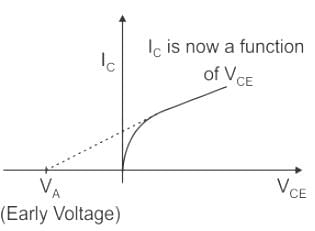
  • A large collector base reverse bias is the reason behind early effect manifested by BJTs
  • The depletion layer penetrates more into the base as the base is lightly doped increasing the concentration gradient in the base
  • As reverse biasing of the collector to base junction increases, depletion region penetrates more into the base, this reduces the effective base width
  • This reduction in base width causes less recombination of carriers in the base region
  • This is known as an early effect

Practice Questions: Bipolar Junction Transistor (BJT) - 2 - Question 2

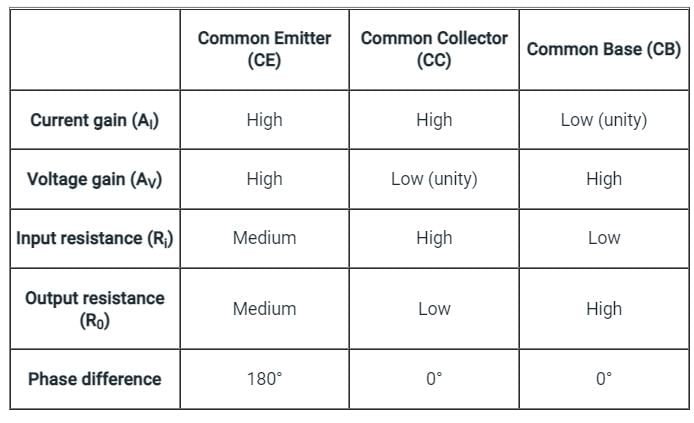
A transistor when connected in CE mode has:

Detailed Solution: Question 2
Practice Questions: Bipolar Junction Transistor (BJT) - 2 - Question 3

What is the region of operation of the bipolar junction transistor (BJT) where both the junctions are forward biased?

Detailed Solution: Question 3
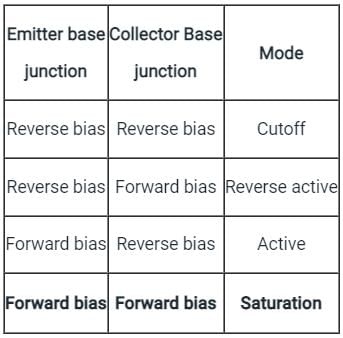
The modes of operation of an npn BJT are as follow:

Practice Questions: Bipolar Junction Transistor (BJT) - 2 - Question 4

The effect of reduction in effective base width due to an increase in reverse voltage of BJT is

Detailed Solution: Question 4
Concept:

  • A large collector base reverse bias is the reason behind the early effect manifested by BJTs.
  • As reverse biasing of the collector to base junction increases, the depletion region penetrates more into the base, as the base is lightly doped.
  • This reduces the effective base width and hence the concentration gradient in the base increases.
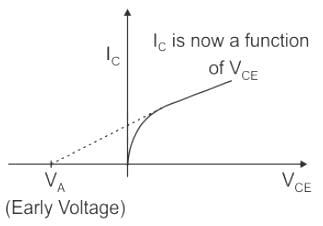
  • This reduction in the effective base width causes less recombination of carriers in the base region which results in an increase in collector current. This is known as the Early effect.
  • The decrease in base width causes ß to increase and hence collector current increases with collector voltage rather than staying constant.
  • The slope introduced by the Early effect is almost linear with IC and the common-emitter characteristics extrapolate to an intersection with the voltage axis VA, called the Early voltage.

This is explained with the help of the following VCE (Reverse voltage) vs IC (Collector current) curve:

Practice Questions: Bipolar Junction Transistor (BJT) - 2 - Question 5

The ___________ region has the highest area in the transistor.

Detailed Solution: Question 5

Transistor has three regions:

Emitter:

  • Highly doped
  • medium area

Collector:

  • moderate doping
  • largest area

Base:

  • lightest doping
  • lightest area

Practice Questions: Bipolar Junction Transistor (BJT) - 2 - Question 6

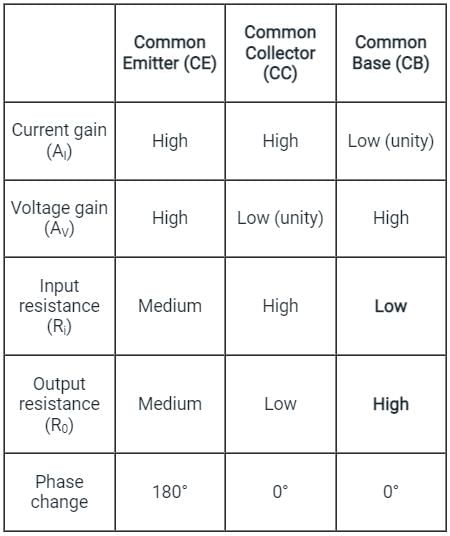
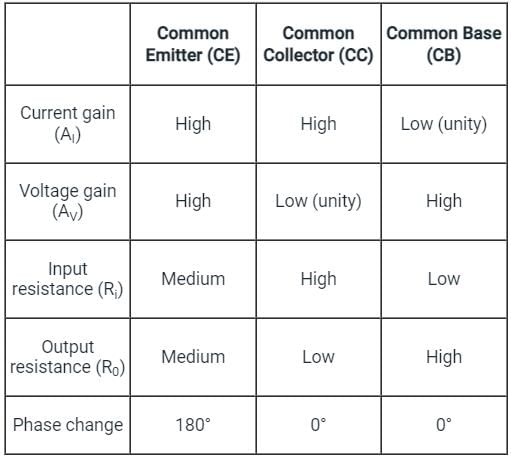
Which among the following configuration has High current and High voltage gain?

Detailed Solution: Question 6
Practice Questions: Bipolar Junction Transistor (BJT) - 2 - Question 7

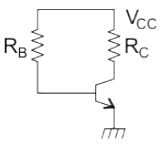
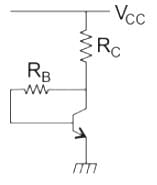
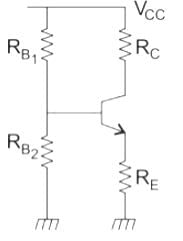
In which of the following bias circuit, the stability factor is dependent upon RC?

Detailed Solution: Question 7

Bias stabilization is a process of making Q-point independent of changes in temperature and changes in the transistor parameter.

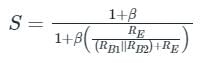
Current stability factor

Fixed bias circuit:

Base current IB is fixed. Hence it is called a fixed biased circuit.
S = 1 + β
Since S is very large, IC will be unstable
Collector to base bias circuit:


It gives a more stable IC­ than a fixed bias circuit. The stability factor is dependent upon RC. If RC­ becomes smaller or zero, the stability factor becomes very large and IC does not remain stable.

Self-bias circuit:


The Self-bias circuit has the least stability factor. The stability factor is independent of RC. it can b used to bias BJT for any configuration.

Practice Questions: Bipolar Junction Transistor (BJT) - 2 - Question 8

Which one is disadvantage of impedance matching?

Detailed Solution: Question 8

  • The term impedance matching is simply defined as the process of making one impedance look like another
  • Impedance matching is a process in which the impedance of an electrical load is made equal to the source impedance to maximize the power transfer or minimize signal reflection from the load
  • The Power amplifiers generally use transformer coupling because the transformer permits impedance matching
  • The disadvantage of impedance matching is that it gives distorted output

Practice Questions: Bipolar Junction Transistor (BJT) - 2 - Question 9

A BJT with β = 50 has a base to collector leakage current ICBO of 2.5 μA. If the transistor is connected in CE configuration, the collector current for IB = 0 is 

Detailed Solution: Question 9

Concept:
ICEO is the reverse leakage current in the common-emitter configuration of BJT when the base is open.
ICBO is the reverse leakage current in the common-base configuration of BJT when the emitter is open.
Also, ICEO > ICBO
And they are related by the relation:
ICEO = (1 + β) ICBO
Total collector current is given by:
IC = βIB + ICBO(β + 1)

Application:
The total collector current for the given configuration will be:
IC = βIB + ICBO(β + 1)   ---(1)
Given: IB = 0 A, β = 50, and ICBO = 2.5 μA.
Substituting these values in Equation (1), we get:
IC = (50)(0) + (2.5 μ) (50 + 1)
IC = 2.5 x 10-6 x 51 A
IC = 0.1275 mA

Practice Questions: Bipolar Junction Transistor (BJT) - 2 - Question 10

What is the input voltage and output current in the common base configuration of a transistor?

Detailed Solution: Question 10
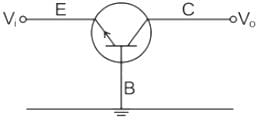
Input Terminal Emitter–Base (EB)
Output Terminal Collector–Base (CB)
Input voltage: VEB
Output current: IC
Since for Amplification Application in BJT
EB Junction → Forward Biased (Low Impedance)
CB Junction → Reversed Biased (High Impedance)

Comparison:

49 docs|29 tests
Information about Practice Questions: Bipolar Junction Transistor (BJT) - 2 Page
In this test you can find the Exam questions for Practice Questions: Bipolar Junction Transistor (BJT) - 2 solved & explained in the simplest way possible. Besides giving Questions and answers for Practice Questions: Bipolar Junction Transistor (BJT) - 2, EduRev gives you an ample number of Online tests for practice
Download as PDF